
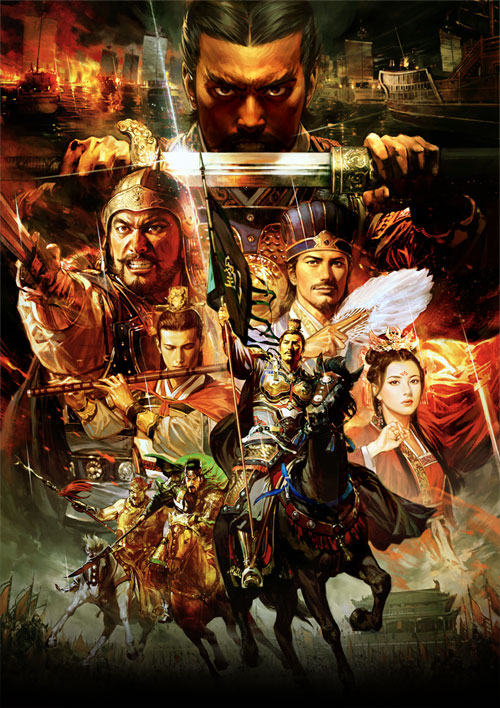
Sanguozhi is a historical simulation game based on the historical book "Sanguozhi" and the long historical novel "Sanguozhi Yanyi" and set in the period from the Later Han Dynasty to the Three Kingdoms in China. The game was released by Koei Tecmo Games and has been made into a series. The game's producer is Ko Shibusawa. Players take on the role of a monarch, increasing their national power through domestic and military affairs, and expanding their territory through battles with other monarchs. The goal of the game is to eventually unify China.
showing special confidence and courtesy (to someone, often to convince them to take a post, etc.)
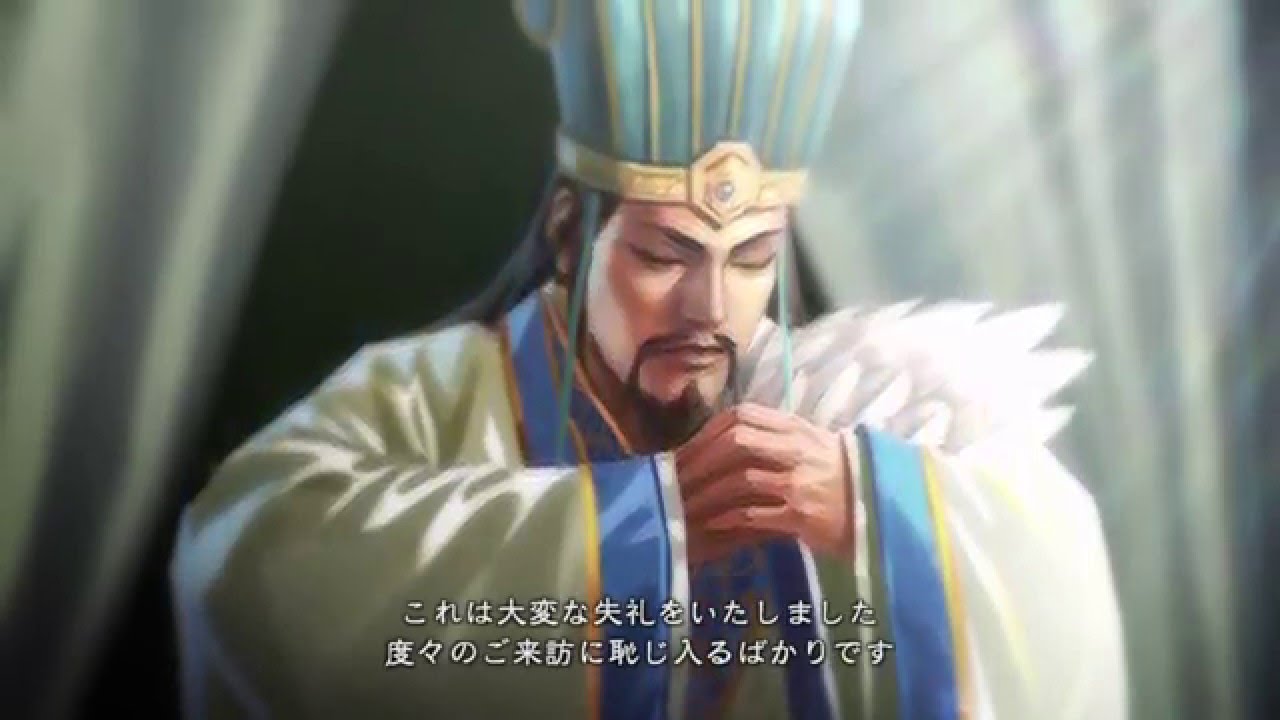
The movie of the "Sangokushi 13" event.
The event in which Liu Bei visited Zhuge Liang three times to welcome him. This was the origin of the legendary phrase "three visits".
In most cases, the condition is that Liu Bei is the monarch and rules the city of Jingzhou "Xinye" after 207, and that Guan Yu and Zhang Fei are generals under Liu Bei's command.
When the event occurs, Zhuge Liang becomes a general under Liu Bei.
Power-up kit for "Three Kingdoms
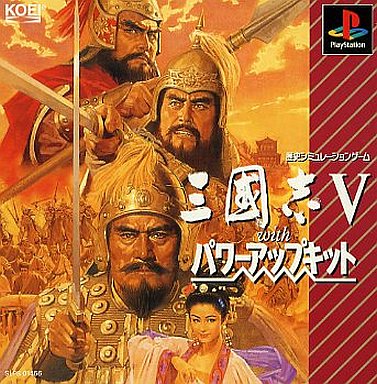
The software package of "Mikuni V with Power Up Kit".
The "with Power Up Kit" means that the standard version already contains the elements of the Power Up Kit version.
In addition to the standard version, a Power-Up Kit version of the "Sangokushi" series is released around one year after the standard version.
The Power-Up Kit version adds new scenarios, the ability to edit data such as generals and cities, a short play mode that allows players to play in a short period of time, and various other elements.
Some games also have new elements added to the game system.
Terms of "Mikokushi
Annals of the Three Kingdoms
The book on which the "Three Kingdoms" series is based. It was compiled by a man named Chen Shou during the Jin Dynasty after the Three Kingdoms Period, and is one of the Twenty-Four Histories of Chinese history.
To avoid confusion, "Sanguozhi" is often referred to as the "authentic history" as opposed to "Yanyi" in "Sanguozhi Yanyi".
It is a historical book describing the history of the Three Kingdoms period and consists of 65 volumes: 30 volumes of Wei Zhi, 15 volumes of Shu Zhi, and 20 volumes of Wu Zhi.
The history books are written in the Chronicle style, and Wei Zhi contains the life histories of emperors, kings, and other rulers in the Hongqi. The Wei Zhi, therefore, seems to consider the Wei Dynasty to be the legitimate one.
The "Three Kingdoms" was not originally intended to be an official history book, as Chen Shou intended to compile it himself. After his death, it became an official history during the Tang dynasty.
In compiling the book, Chen Shou referred to a variety of sources and summarized the contents in a concise manner. Later, a person named Bae Songzhi of the Southern Song Dynasty added explanations to the contents.
It is one of the most highly regarded history books among the Twenty-Four Histories.
set of three books of Buddhist stories, written in the late 8th and early 9th century, usually referred to as the Three Kingdoms period
This is the book on which the "Three Kingdoms" series is based. The novel is said to have been written by a man named Luo Guanzhong during the Ming Dynasty, and is one of the four most unusual books.
It is a long historical novel that depicts the period from the end of the Later Han Dynasty to the unification of the Jin Dynasty, and is extremely popular.
It is based on the historical book "The History of the Three Kingdoms" compiled by Chen Shou, but also contains elements of fiction.
The work features Liu Bei as the central character and his vassals such as Guan Yu, who are portrayed as good men. On the other hand, Cao Cao, who laid the foundation of the Wei dynasty and is considered legitimate in "The Annals of the Three Kingdoms," is portrayed as a bad guy.
The Legend of the Three Kingdoms" has been translated not only into Chinese, but also into Japanese, French, Russian, and many other languages.
It is believed to have been introduced to Japan in the early Edo period (1603-1867), and became the subject of plays and other forms of entertainment. Today, it has penetrated a very wide range of fields, including manga, novels, puppet shows, movies, and video games.
state
The administrative divisions of ancient China in the "Three Kingdoms" series, to which cities in the games belong.
In most games, there are 13 provinces: Yushu, Qingzhou, Jizhou, Merger, Huzhou, Yuzhou, Xuzhou, Xuzhou, Shihlai, Liangzhou, Jingzhou, Yangzhou, Yizhou, and Xiaozhou.
Depending on the work, ruling all the cities in one state confers official titles such as state chancellor.
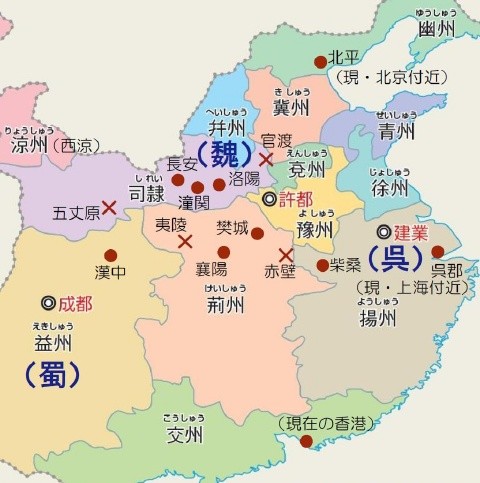
The map shows the location of each state.
vacant lot or land
In the "Sangokushi" series, a city is a city that is not ruled by any monarch.
The city icons on the strategy screen are not marked with the banner of the ruling power, and the map of power also shows them in white.
When a city is occupied by moving a general or sending out troops, it becomes a city controlled by the monarch's power.
In some works, a city becomes a vacant city when there is no warlord left in the city due to death or movement of warlords.
In some works, such as the scenario of the Yellow Turban Rebellion, there are more blank areas than cities controlled by the monarch.
In subsequent scenarios, there are also blank spaces in southern Jingzhou and southern Yizhou, but the number of blank spaces is gradually decreasing.
In some cases, a local warlord may take over a city and establish himself as a new monarch in a vacant area.
If an original warlord is selected as a monarch, he or she will start the game by selecting his or her home base from the blank areas.
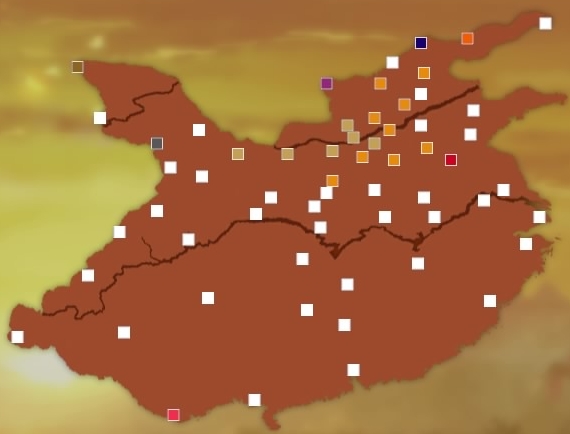
Power map of the 184th year "Yellow Turban Rebellion" scenario in "Three Kingdoms 13. There are many blank areas (white square cells), mainly in the southern part of Jingzhou.
different peoples
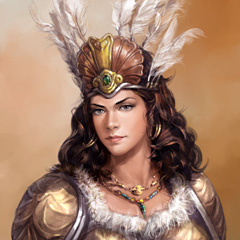
Shu-Yu, wife of Meng-Hui, King of the Southern Barbarians. She appears only in "Sanguozhi Yanyi" and is said to be a descendant of the legendary fire god "Shuyu.
The various peoples that existed in ancient China. In games, they are often referred to as "different peoples.
They first appeared in "Sangokushi IV," and depending on the game, some of them can be selected as monarchs, while others cannot.
In games in which they do not appear as monarchs, the different ethnic groups may attack at the request of other forces as an event. The same is possible for player forces.
The attacking ethnic group can be repulsed by sending out troops, in which case it will not suffer any damage. However, if the player does not send out troops, the player's internal administration value will be reduced.
Depending on the work, a city may be destroyed by an attack of a different ethnic group, and the city will become a vacant land.
Major foreign tribes appearing in the "Sanguozhi" series
Ugan: A tribe from northern China.
The Qiang: A people from the western part of China.
San'etsu: A people from southeastern China.
Namban: A people from southwestern China. However, there were no actual peoples named Nanban. In "Sanguozhi Yanyi" and other works, the name refers to the Yi people, an ethnic minority living in Yunnan Province and other areas of China.
Scenarios in which different ethnic groups appear as monarchs include those around the time of Zhu-ge Liang's conquest of the Southern barbarians. The monarch in this scenario is the Nanban king "Meng Hui".
Later Han Emperor
Emperor of the Han Dynasty (Later Han). He appears in games only in events and cannot be selected as a monarch.
In some games, the emperor can be established by ruling over a city that has an emperor of the Later Han Dynasty.
When an emperor is established, the loyalty of the generals under his control increases. Conversely, when the emperor is abolished, the loyalty level decreases. In some cases, an emperor may be forcibly abolished by the ruling power.
If there is an Emperor of the Later Han Dynasty, the accession to the throne of a new emperor takes the form of a Zen transfer from the Emperor of the Later Han Dynasty.
The following is a list of the emperors of the Later Han Dynasty who appear in the game.
Emperor Ling (156~189), reign (168~189): He was the 12th Emperor of the Later Han Dynasty and his name was Liu Hong. During the reign of Emperor Ling, there were repeated attacks by foreign tribes and local rebellions. However, he had no interest in politics, and his power was taken over by eunuchs, leading to the decline of the Han dynasty.
Emperor Shao (173 or 176~190), reign (May~September 189): He was the 13th emperor of the Later Han Dynasty, and his name was Liu Ben. He was the eldest son of Emperor Ling and ascended the throne after his death. However, he was deposed by Dong Zhuo, who entered the capital, and was later poisoned to death by a general under Dong Zhuo.
Emperor Xiong (181~234), reign (189~220): He was the 14th emperor of the Later Han Dynasty and the last emperor of the Later Han Dynasty. He was the second son of Emperor Ling. The second son of Emperor Ling, he replaced his brother Emperor Shao, who was deposed, but lost political power to Dong Zhuo and Cao Cao. He eventually gave up the throne to Cao Cao's Cao Pi, and the Later Han Dynasty was destroyed. After the Wei dynasty, he was given the title of Duke Sanyang.
In the game, Ling Emperor only appears as Emperor of the Later Han Dynasty in the Yellow Turban Rebellion scenario in 184, and the rest of the time, he is mostly the consecrated emperor until the scenario in 220, when the Han Dynasty is destroyed.
Representative generals from the "Sangokushi" series
The "Three Kingdoms" series has featured numerous generals with various characteristics, such as high and low ability values, and the latest title, "Sanguozhi 13," has more than 700 generals.
Some of the generals are fictional generals that appear only in "Sanguozhi Yanyi", while others are described only in "Sanguozhi".
The following is a list of representative generals.

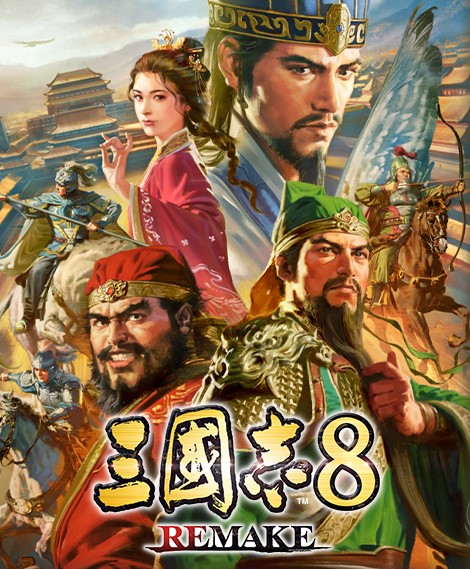
Contents
- Outline of "Three Kingdoms
- Game System of "Sangokushi
- strategic command
- domestic affairs
- military affairs
- talented person
- diplomacy
- stratagem
- battle
- departure for the front
- Main unit types
- war
- Types of battles
- personal combat
- stratagem
- deciding the outcome (e.g. game)
- postwar treatment
- military commander
- How to increase the number of generals
- attribute value
- (degree of) loyalty
- military commander related by blood
- monarch
- peerage
- territorial unit
- Scenario of "Three Kingdoms
- Items from "Three Kingdoms
- arms
- scimitar with a blue dragon scimitar (Porzana fusca)
- serpentine spear (snake)
- weapons of mass destruction
- a pair of swords for one man and a pair of swords for another
- Yi Guang's bow
- fine or famous horse
- red rabbit
- calabash (Lagenaria siceraria var. gourda)
- uninterrupted view
- extremely high-grade Japanese amberjack (species of yellowtail, Seriola quinqueradiata)
- automobile
- books
- The Art of War (military text by Sun Tzu, 512 BCE)
- Mentoku Shinsho
- the Analects of Confucius
- The Historical Records (ancient Chinese historical record)
- The Book of the Taiheiyo kyôjô
- treasure
- tree sparrow (Passer montanus)
- nine-tined kettle stand
- the wisdom of the ancients
- fan with feathers
- sovereign's seal
- Events in "Three Kingdoms
- Regular Events
- locust (of family Catantopidae)
- typhoon
- good crop and bad crop
- Historical Events
- Federation of Beautiful Women's Unions scheme (1948-1953)
- Battle of Kandu (ancient Japanese battlefield)
- showing special confidence and courtesy (to someone, often to convince them to take a post, etc.)
- Power-up kit for "Three Kingdoms
- Terms of "Mikokushi
- Annals of the Three Kingdoms
- set of three books of Buddhist stories, written in the late 8th and early 9th century, usually referred to as the Three Kingdoms period
- state
- vacant lot or land
- different peoples
- Later Han Emperor
- Representative generals from the "Sangokushi" series
- State of Wei (China)
- Cao Cao
- Cao Dai
- honest and homely
- Marco Polo Bridge (China)
- Kakujia
- Yu Yu.
- Shima Xi
- Shu Han
- Liu Bei
- Sekifu (lowest of the eight hereditary titles)
- Zhang Fei (Chinese deity said to be able to cure all ills)
- scarlet kadsura (Kadsura japonica)
- Zhao Yun
- loyalty to one's master
- Choenomeles lagenaria
- Wu (dynasty of China; 918-1392 CE)
- Sun Quan (dynasty of China; 386-534 CE)
- Sun Yat-sen
- Sun Yat-sen
- Shu Yu
- Luxemburg
- Lu or Meng (dynasty of China)
- Rikou era (1429.9.5-1441.2.17)
- Groups and Figures from the Late Later Han to the Three Kingdoms Period
- Yuan Shao
- T'ang table
- Lu Bu
- how much (long, far)
- Yuan dynasty (China)
- penis-shaped device, traditionally made of horn, shell or papier mache
- Mencius' mother
- female
- glutton
- Da Qiao and Xiao Qiao
- List of "Mikuni" series
- PC and home video game console versions
- The Three Kingdoms.
- Super Mikuni
- The Three Kingdoms Returns.
- The Three Kingdoms II
- Super Mikuni II
- Sangokushi Tshukuru" (The Legend of the Three Kingdoms)
- The Three Kingdoms III
- The Three Kingdoms IV
- Mikuni V" (The Three Kingdoms V)
- The Three Kingdoms VI
- The Three Kingdoms VII
- Three Kingdoms VIII
- Mikuni IX" (Japanese title: "Mikuni IX")
- Mikuni X" (Japanese only)
- Mikuni 11
- Mikuni 12
- Mikuni 13
- Game Boy version, Game Boy Color version, Game Boy Advance version
- Mikuni: Game Boy Version" (Japanese only)
- Mikuni: Game Boy Version 2
- The Three Kingdoms.
- Wonder Swan version
- Sangokushi for WonderSwan" (Japanese only)
- Sangokushi II for WonderSwan" (Japanese only)
- Nintendo DS version
- Mikokushi DS
- Mikuni DS2" (Japanese only)
- Mikuni DS3" (Japanese only)
- Nintendo 3DS version
- The Three Kingdoms.
- The Three Kingdoms 2
- iPhone/iPod touch and iPad versions
- Mikuni: TOUCH
- The main staff of "Mikuni
- Koh Shibusawa
- Yoko Kanno
- Jun Chousei
- Kazuki Kuriyama
- Masako Otsuka
- Noriyoshi Ikuse
- Tsuyoshi Nagano
- Kazumasa Nagai
- Xu Boqing
- Backstories, trivia, and small stories/episodes/anecdotes of "Sanguozhi" (The Three Kingdoms)
- The Birth of "Mikokushi
- Power Up Kit Edition and "The Mikuni III Incident"
- Ability value of the word
- A small story found in the one-horse race
- Title title of "Three Kingdoms
- Himiko appears in Sanguozhi