
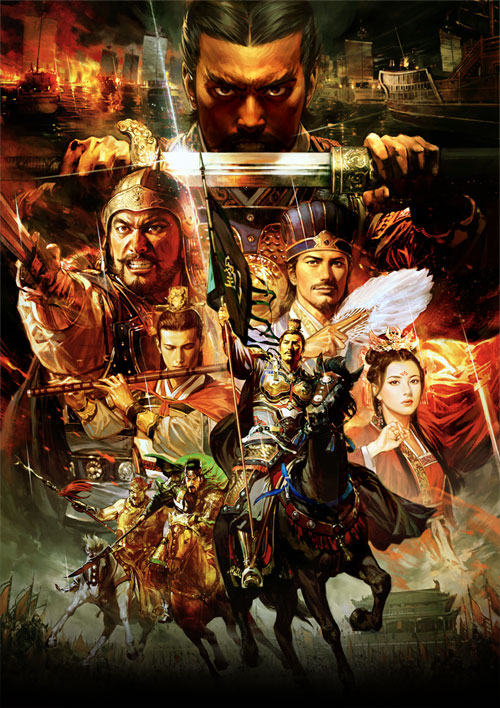
Sanguozhi is a historical simulation game based on the historical book "Sanguozhi" and the long historical novel "Sanguozhi Yanyi" and set in the period from the Later Han Dynasty to the Three Kingdoms in China. The game was released by Koei Tecmo Games and has been made into a series. The game's producer is Ko Shibusawa. Players take on the role of a monarch, increasing their national power through domestic and military affairs, and expanding their territory through battles with other monarchs. The goal of the game is to eventually unify China.
uninterrupted view
Reading: zeitgeist
Cao Cao often owns it in its initial state. However, it appears only in early scenarios and does not appear in subsequent scenarios.
It was a horse that Cao Cao rode, and is said to have originated from the fact that it was so fast that it left no shadow behind.
In "Romance of the Three Kingdoms," when Cao Cao was attacked at night by a warlord named Zhang Shu, he was hit by an arrow in the forehead and leg area during his escape.
In "Sanguozhi Yanyi," Cao Cao was shot in the eye and died after escaping from an arrow, just as in "Sanguozhi. However, he does not appear under the name Zekage.
extremely high-grade Japanese amberjack (species of yellowtail, Seriola quinqueradiata)
reading: "Hidenobu Soukou Hiden
Often initially owned by Cao Cao. After Cao Cao's death, it was passed down to his son Cao Pi and others.
In "Sanguozhi Yanyi", it is Cao Cao's favorite horse.
automobile
Reading: four-ring car
Zhuge Liang often owns them in their initial state. After Zhu-ge Liang's death, it can be obtained through search and other means.
In "Sanguozhi Yanyi", it is the wheelbarrow that Zhuge Liang used to ride. It appears in paintings depicting Zhuge Liang.
Zhuge Liang invented a tool called the "wooden ox cart. This is believed to have been a kind of wheelbarrow.
It was used to transport troops during the Northern Expedition to Wei.
books
A well-known book of military and historical texts. It has the effect of increasing the leadership, intelligence, and politics of the warlord who owns it.
The Art of War (military text by Sun Tzu, 512 BCE)
Reading: The Book of the Exonerated Person's Laws
Often owned by generations such as Sun Jian, Sun Tsuaku, and Sun Quan, who are descendants of Sun Wu, who is considered the author.
Also referred to simply as "Sun Tzu. A book on the Art of War written by Sun Wu, who served Wu during the Spring and Autumn period. It is one of the "Seven Books of the Martial Laws," which are the most representative Chinese books on military strategy.
It consists of 13 chapters and describes military strategies and tactics.
The proverb, "If you know him and know yourself, you will never be defeated in a hundred battles," is derived from the military tactics described in the "Plot and Offensive Arc.
It was introduced to Japan around the 8th century, and was used by the nobility for education and by the samurai for military purposes. Shingen Takeda's banner, "Fu-Rin-Kazan," taken from one of the "Military Conflict Papers," is very well known.
Today, it is applied to business and other fields, and books on the subject are on sale.
Mentoku Shinsho
Reading: Motto Degree Document
Often owned initially by Cao Cao and may not appear after his death.
Also called "Hyōshō tangyō" (兵書接要), it is a book on the Art of War written by Cao Cao (written by Meng De).
Cao Cao excelled in the art of war and compiled the "Sun Tzu's Art of War," which has been handed down to the present day. This book is called the "Wei Wu Zhong Sun Tzu" (魏武註孫子).
the Analects of Confucius
Reading: Theory
Available through search and other means.
One of the "Four Books," a set of sutras particularly important in Confucianism. It consists of a total of 20 verses, in which Confucius' disciples compiled the sayings and deeds of Confucius, the founder of Confucianism, and his disciples after his death.
It consists of 20 essays, including "Jin," or compassion for others, and "Rei," or propriety, a code of conduct for maintaining social order.
The "子" in the sentence "子言うく~" refers to Confucius.
The "子" in the sentence "子曰く~" refers to Confucius, from whom words such as "shi-gaku," "而立," and "不惑惑" are derived.
It was introduced to Japan during the reign of Emperor Nintoku, and was studied by later generations.
The Historical Records (ancient Chinese historical record)
Reading: Shiki
Available through search and other means.
This is one of the Twenty-four Histories of China, written from the legendary Emperor Huangdi to the Emperor Wu of the previous Han Dynasty. The author is Sima Qian, who was active during the reign of Emperor Wu.
It is a history in the form of a chronicle, and consists of 12 volumes of the main chronicle (a chronicle of emperors and kings), 10 volumes of chronology, 8 volumes of books (cultural history), 30 volumes of Chengjia (history of kings and other families), and 70 volumes of biographies (biographies of individuals).
Its historical and literary value is quite high, giving rise to such phrases as "If you are first, you will conquer others," "Four-faced siege," and "By and by".
The period when Shiji was introduced to Japan does not seem to be clear. However, in the Nara period (710-794), descriptions quoting passages from the Shiki can be found.
During the Edo period, Tokugawa Mitsukuni was so moved by reading the "Hakui Biographies" in the Shiki that he decided to study it. Mitsukuni was the initiator of the chronicle-style history book "Dai Nihon Shi" (History of Japan).
The Book of the Taiheiyo kyôjô
Reading: The Book of the Pacific Arms
Often owned initially by Zhang Jiao, and after his death, it can be obtained through search and other means.
This is a book consisting of three volumes that appears in "Sanguozhi Yanyi" (The History of the Three Kingdoms). It is said to have belonged to a man named Nanhua Laoxian.
In "Sanguozhi Yanyi," it was given to a man named Zhang Jiao Jiao by Nan Hua Lao Xian. Zhang Jiao learned from this book, and obtained the magical skills to manipulate wind and rain.
Later, Zhang Jiao, who became the founder of the Taiping Dao, revolted against the Han (Yellow Turban Rebellion).
treasure
It is thought to be so-called "treasure" such as gold, copper, and pebbles.
tree sparrow (Passer montanus)
Reading: Doujaku
Available in search, etc.
A sparrow made of copper excavated from a place called Yong in Jizhou.
It was discovered after Cao Cao destroyed Yuan Shao, after which Cao Cao built a palace at the site of Yong.
The palace was called the Copper Sparrow Palace and consisted of three palaces.
The palace was then built and expanded, but the palace was destroyed by floods during the Yuan and Ming dynasties. It is now an archaeological site.
nine-tined kettle stand
Reading: old shaku
Available in search and other places.
The nine types of bounties bestowed by the emperor during the Han Dynasty and other periods in China.
Originally, these gifts could only be used by the emperor, and the recipients of these gifts were almost equal in status to the emperor.
Most of the recipients of the nine tin were themselves or their family members on the imperial throne.
Cao Cao was given the title by the Han Emperor, and his son Cao Pi founded the Wei Dynasty. Sun Quan also received the tin from Cao Pi, who later became the emperor of Wu.

Contents
- Outline of "Three Kingdoms
- Game System of "Sangokushi
- strategic command
- domestic affairs
- military affairs
- talented person
- diplomacy
- stratagem
- battle
- departure for the front
- Main unit types
- war
- Types of battles
- personal combat
- stratagem
- deciding the outcome (e.g. game)
- postwar treatment
- military commander
- How to increase the number of generals
- attribute value
- (degree of) loyalty
- military commander related by blood
- monarch
- peerage
- territorial unit
- Scenario of "Three Kingdoms
- Items from "Three Kingdoms
- arms
- scimitar with a blue dragon scimitar (Porzana fusca)
- serpentine spear (snake)
- weapons of mass destruction
- a pair of swords for one man and a pair of swords for another
- Yi Guang's bow
- fine or famous horse
- red rabbit
- calabash (Lagenaria siceraria var. gourda)
- uninterrupted view
- extremely high-grade Japanese amberjack (species of yellowtail, Seriola quinqueradiata)
- automobile
- books
- The Art of War (military text by Sun Tzu, 512 BCE)
- Mentoku Shinsho
- the Analects of Confucius
- The Historical Records (ancient Chinese historical record)
- The Book of the Taiheiyo kyôjô
- treasure
- tree sparrow (Passer montanus)
- nine-tined kettle stand
- the wisdom of the ancients
- fan with feathers
- sovereign's seal
- Events in "Three Kingdoms
- Regular Events
- locust (of family Catantopidae)
- typhoon
- good crop and bad crop
- Historical Events
- Federation of Beautiful Women's Unions scheme (1948-1953)
- Battle of Kandu (ancient Japanese battlefield)
- showing special confidence and courtesy (to someone, often to convince them to take a post, etc.)
- Power-up kit for "Three Kingdoms
- Terms of "Mikokushi
- Annals of the Three Kingdoms
- set of three books of Buddhist stories, written in the late 8th and early 9th century, usually referred to as the Three Kingdoms period
- state
- vacant lot or land
- different peoples
- Later Han Emperor
- Representative generals from the "Sangokushi" series
- State of Wei (China)
- Cao Cao
- Cao Dai
- honest and homely
- Marco Polo Bridge (China)
- Kakujia
- Yu Yu.
- Shima Xi
- Shu Han
- Liu Bei
- Sekifu (lowest of the eight hereditary titles)
- Zhang Fei (Chinese deity said to be able to cure all ills)
- scarlet kadsura (Kadsura japonica)
- Zhao Yun
- loyalty to one's master
- Choenomeles lagenaria
- Wu (dynasty of China; 918-1392 CE)
- Sun Quan (dynasty of China; 386-534 CE)
- Sun Yat-sen
- Sun Yat-sen
- Shu Yu
- Luxemburg
- Lu or Meng (dynasty of China)
- Rikou era (1429.9.5-1441.2.17)
- Groups and Figures from the Late Later Han to the Three Kingdoms Period
- Yuan Shao
- T'ang table
- Lu Bu
- how much (long, far)
- Yuan dynasty (China)
- penis-shaped device, traditionally made of horn, shell or papier mache
- Mencius' mother
- female
- glutton
- Da Qiao and Xiao Qiao
- List of "Mikuni" series
- PC and home video game console versions
- The Three Kingdoms.
- Super Mikuni
- The Three Kingdoms Returns.
- The Three Kingdoms II
- Super Mikuni II
- Sangokushi Tshukuru" (The Legend of the Three Kingdoms)
- The Three Kingdoms III
- The Three Kingdoms IV
- Mikuni V" (The Three Kingdoms V)
- The Three Kingdoms VI
- The Three Kingdoms VII
- Three Kingdoms VIII
- Mikuni IX" (Japanese title: "Mikuni IX")
- Mikuni X" (Japanese only)
- Mikuni 11
- Mikuni 12
- Mikuni 13
- Game Boy version, Game Boy Color version, Game Boy Advance version
- Mikuni: Game Boy Version" (Japanese only)
- Mikuni: Game Boy Version 2
- The Three Kingdoms.
- Wonder Swan version
- Sangokushi for WonderSwan" (Japanese only)
- Sangokushi II for WonderSwan" (Japanese only)
- Nintendo DS version
- Mikokushi DS
- Mikuni DS2" (Japanese only)
- Mikuni DS3" (Japanese only)
- Nintendo 3DS version
- The Three Kingdoms.
- The Three Kingdoms 2
- iPhone/iPod touch and iPad versions
- Mikuni: TOUCH
- The main staff of "Mikuni
- Koh Shibusawa
- Yoko Kanno
- Jun Chousei
- Kazuki Kuriyama
- Masako Otsuka
- Noriyoshi Ikuse
- Tsuyoshi Nagano
- Kazumasa Nagai
- Xu Boqing
- Backstories, trivia, and small stories/episodes/anecdotes of "Sanguozhi" (The Three Kingdoms)
- The Birth of "Mikokushi
- Power Up Kit Edition and "The Mikuni III Incident"
- Ability value of the word
- A small story found in the one-horse race
- Title title of "Three Kingdoms
- Himiko appears in Sanguozhi