
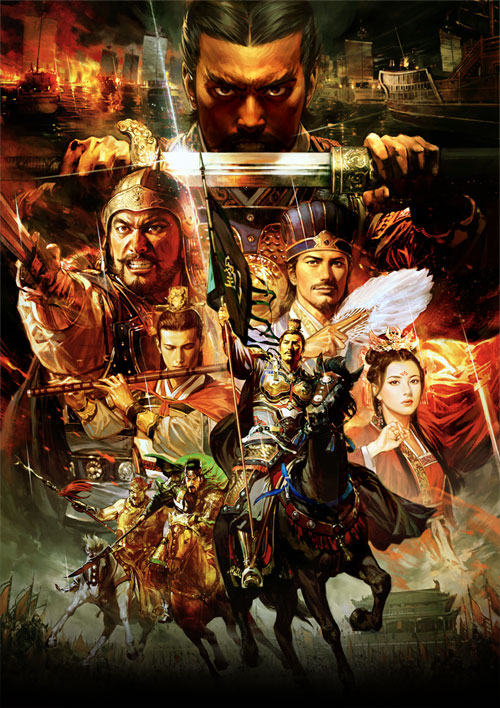
Sanguozhi is a historical simulation game based on the historical book "Sanguozhi" and the long historical novel "Sanguozhi Yanyi" and set in the period from the Later Han Dynasty to the Three Kingdoms in China. The game was released by Koei Tecmo Games and has been made into a series. The game's producer is Ko Shibusawa. Players take on the role of a monarch, increasing their national power through domestic and military affairs, and expanding their territory through battles with other monarchs. The goal of the game is to eventually unify China.
This is the basic command for fighting other monarchs and increasing the number of territories, such as controlled cities.
In addition to rations, which are the food for soldiers, some battles may require spears, war horses, crossbows, siege weapons, etc., depending on the military unit that is sent out to battle.
Basically, battles are fought on a different screen from the strategy screen, but in some works, battles are fought on the same map as the strategy screen.
departure for the front
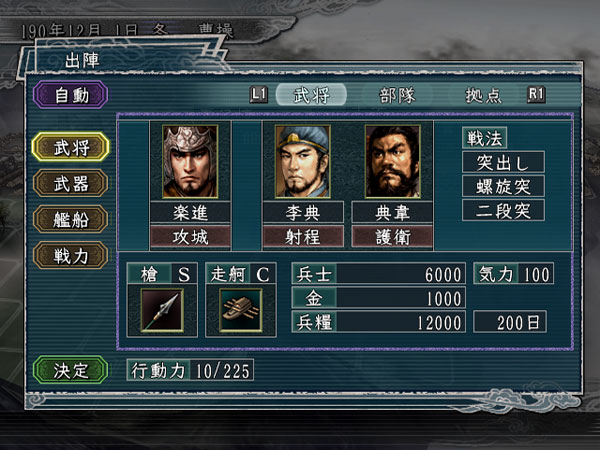
The "Mikuni 11" departure screen. The number of generals, soldiers, weapons, ships, etc. are being selected.
Organize units to go out to battle. Some works have a fixed number of troops that can go into battle, so basically, the troops are sent out from the city.
Decide on the generals who will go into battle and the number of soldiers who will go into battle.
When sending out troops such as cavalry or crossbowmen, weapons are required according to the number of soldiers, but basically no weapons are needed for infantry.
For example, castle siege weapons such as "impulse cars" and "stone throwers," and ships such as "towing ships" and "fighting ships" used in naval battles, require one per unit. In some works, troops can be organized with only money and warlord characteristics, without the need for equipment.
In some works, the number of rations to be brought and the formation may be set.
If your force is attacked by another force, you can request reinforcements from the allied forces.
When all preparations for battle are complete, the battle begins.
Main unit types
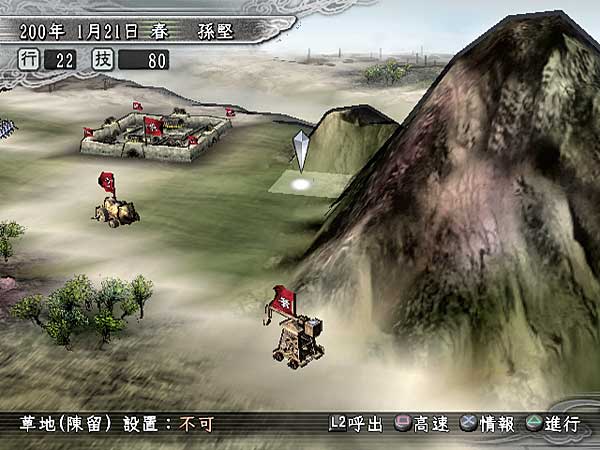
The strategy screen of "Sangokushi 11. In the foreground is the "Toushi," a siege weapon that can indirectly attack cities and other facilities.
The main types of units are as follows
Infantry: Unarmed troops.
Cavalry: A troop composed of the same number of horses as soldiers, and excels in mobility.
IJN: A unit consisting of the same number of crossbows as the number of soldiers, capable of indirect attack.
A unit equipped with an impulse chariot, which can greatly reduce the durability of a city during a siege.
Igaraki: A unit equipped with Igaraki, capable of greatly reducing a city's endurance through indirect attacks during a siege, etc.
Tougeki: A troop equipped with a stone thrower, which can greatly reduce the endurance of a city by indirect attacks during a siege, etc.
war
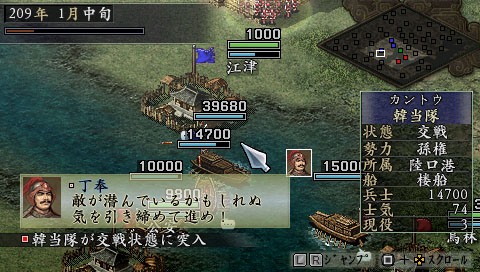
The progression screen of "Sangokushi IX. Battles are fought in real time, and when enemy units are detected, they begin attacking.
When a battle begins, instructions are given to each unit on a turn-based or real-time basis, and the own and enemy units move and act, respectively.
In the turn-based system, if one's own unit attacks an enemy unit or an enemy unit attacks one's own unit, the battle is engaged. Each unit selects its own attack method and attacks the enemy unit.
In the case of the real-time system, the battle state occurs when your unit and the enemy unit are in contact with each other. Although the attack is carried out without any particular instructions, it is advisable to create a situation in which you can attack with an advantage by moving your troops according to the situation. In the case of the real-time system, the player can also attack using a "military strategy" that he or she has organized in advance.
In addition to attacking enemy units, some "tactics" strengthen allies or hinder enemy units.
The following is an explanation of the main attack methods in the turn-based system.
Normal: A normal attack that directly attacks an enemy unit.
Simultaneous: Surround enemy units and attack them all at once.
Assault: Assaulting enemy units.
Shooting: It is an attack method that can be used when "crossbowmen" etc. are organized, and it attacks enemy units indirectly with a crossbow.
Types of battles
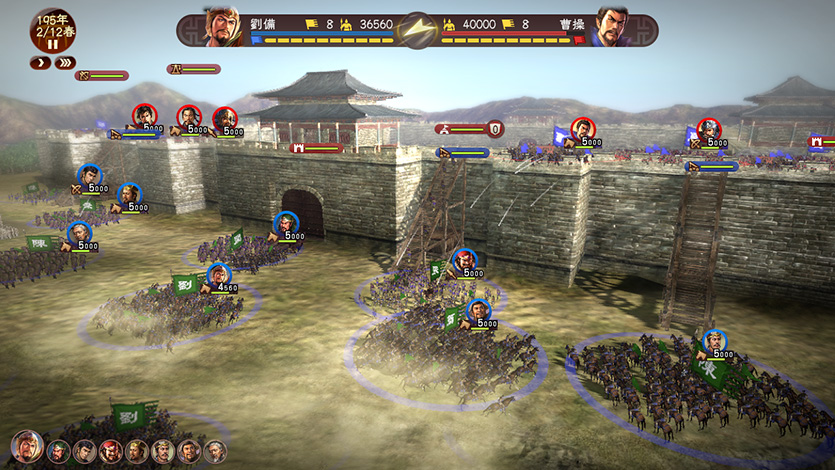
A screen shot of the siege battle in "Three Kingdoms 13. Liu Bei's army and Cao Cao's army are fighting.
There are three main types of battles in "Sangokushi.
Field battles: Battles fought on plains or mountains.
Siege battles: Battles fought in or near cities.
Naval battles: Battles fought on wide rivers such as the Yangtze River. Unlike field battles and sieges, battles are fought between ships.
Generally, when an enemy is defeated in a field battle or a naval battle, the battle moves directly to a siege battle, and if the enemy wins the siege battle, the enemy's city is acquired.
In some cases, depending on the difference in strength, the battle may start with a siege from the beginning.
personal combat
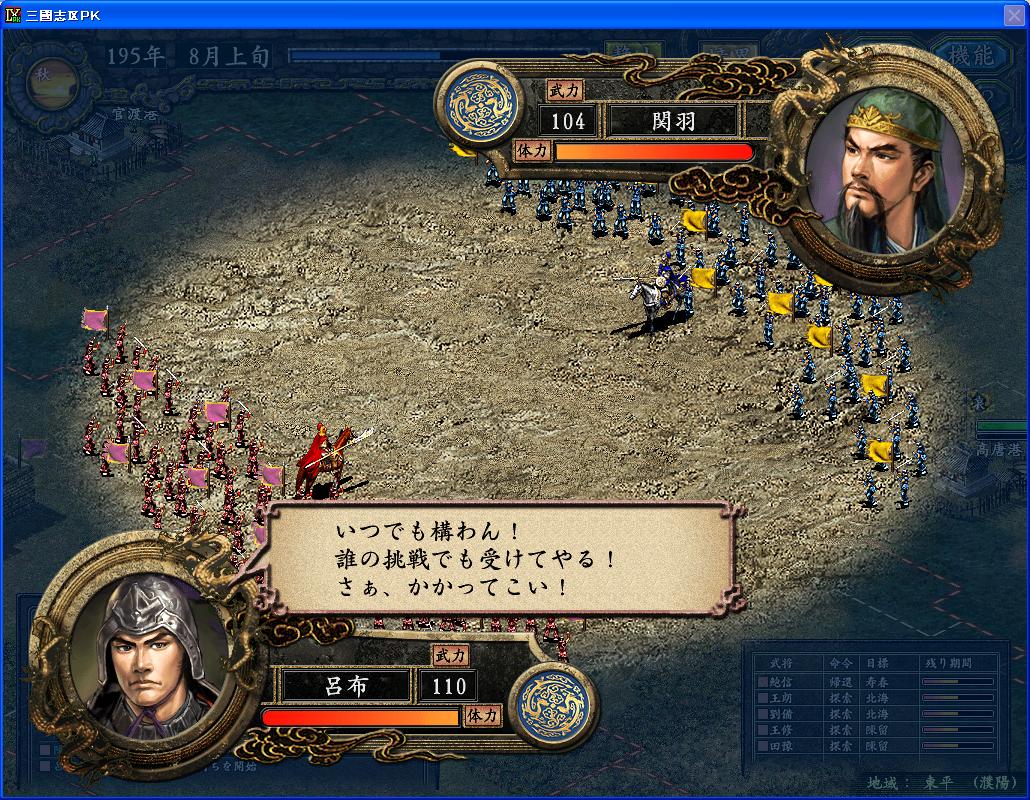
In "Sangokushi IX," one-on-one battles occur automatically.
During a battle, a general of one's own unit and a general of an enemy unit may fight directly one-on-one.
This often occurs when a general commands his troops to fight one-on-one and the enemy general responds to the command. In some works, it may occur automatically.
Basically, "the general who initiated the one-on-one fight" and "the general who responded to the one-on-one fight" fight, but in some works, other generals from their own unit or the enemy unit may fight as helpers.
In most works, each side has its own bar cage, which represents the physical strength of its generals, and the bar cage decreases each time the two sides exchange spears.
Some single combat is performed by command, while others are performed automatically.
When the bar cage is depleted, the leader of the losing side loses the battle and the leader of the remaining side wins the battle.
The general who loses a duel is often captured by the enemy as a prisoner of war or even killed.
stratagem
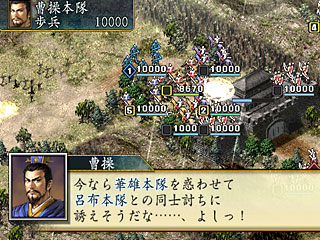
A battle screen from "Mikuni X." Cao Cao is trying to force enemy troops to fight each other. Cao Cao is trying to make the enemy troops fight each other.
During battles, as on the strategy screen in field battles, sieges, and naval battles, you can use strategies to sabotage enemy units.
The following is an introduction to the main strategies.
Turnover: Turn over a general who has been infiltrated by an enemy force or a general who has promised to turn over to the enemy.
Fire strategy: Fire is set in an adjacent area. The fire may spread, and the number of troops involved will be reduced regardless of whether they are friend or foe.
Confusion: Makes an enemy unit inactive.
Avenge: Causes two enemy units to fight each other, reducing the number of soldiers.
Natural change: Changes the weather conditions of a battle.
Wind change: Changes the direction of the wind in battle.
Inspiration: Raises the morale of troops.
Healing: Restores the number of soldiers in a unit.
deciding the outcome (e.g. game)
The following conditions are typical for determining winners and losers.
If either of the monarch's forces are wiped out, the side that wipes out the monarch wins the game.
If either monarch's forces are destroyed, the side that destroys the monarch wins and the side that destroys the monarch loses.
If a city or other city is lost, the side that loses the city wins the game and the side that loses the city loses the game.
In turn-based battles, the winner may not be decided by the expiration of the number of days. In some works, the battle may be re-fought after the next turn on the strategy screen.
Destroying an enemy force may result in the capture of the general who led it, and its disposition is decided after the battle is over.
postwar treatment
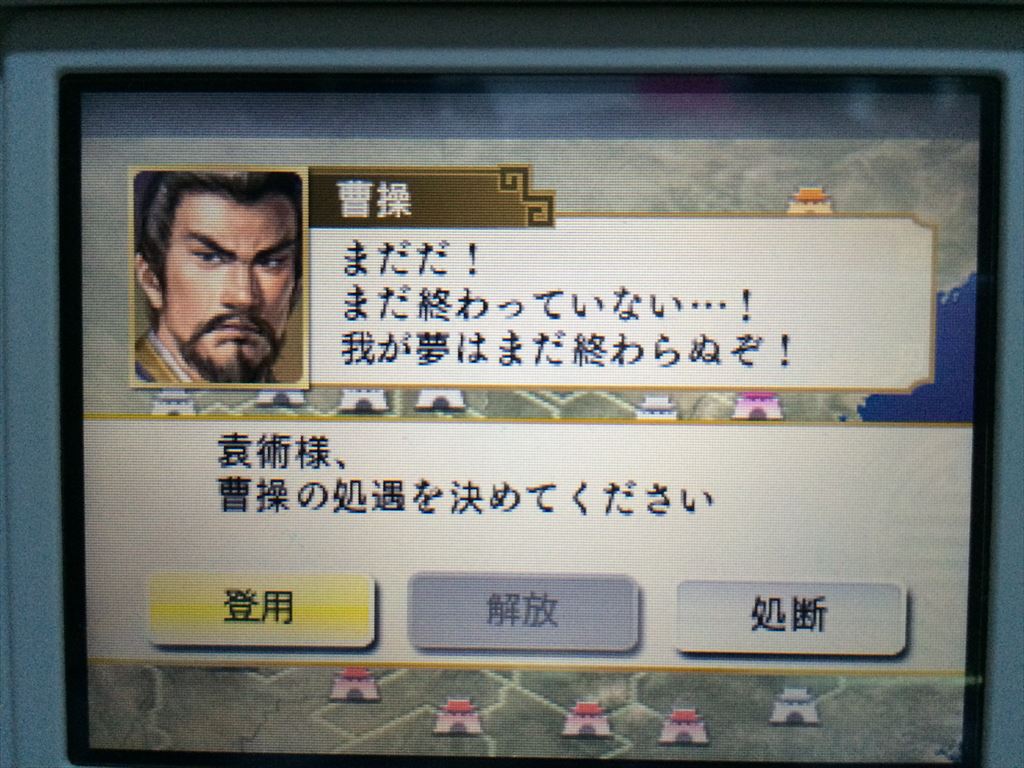
Postwar treatment screen for the Nintendo 3DS version of "Three Kingdoms.
Decides the treatment of generals captured in battle. The treatment varies from work to work, but the main treatments are as follows.
Appointment: The warlord is persuaded by the enemy to serve in his own forces. If successful, the general becomes a subordinate general of your force.
Liberation: The enemy general is liberated. If the enemy force exists, the general returns to the enemy force, but if the enemy force is destroyed, the general becomes a local general.
POW: The enemy general is made a prisoner of war. The enemy force can also accept the return of prisoners of war.
Beheading: Beheading an enemy general. The beheaded warlord will never appear in the game again.

Contents
- Outline of "Three Kingdoms
- Game System of "Sangokushi
- strategic command
- domestic affairs
- military affairs
- talented person
- diplomacy
- stratagem
- battle
- departure for the front
- Main unit types
- war
- Types of battles
- personal combat
- stratagem
- deciding the outcome (e.g. game)
- postwar treatment
- military commander
- How to increase the number of generals
- attribute value
- (degree of) loyalty
- military commander related by blood
- monarch
- peerage
- territorial unit
- Scenario of "Three Kingdoms
- Items from "Three Kingdoms
- arms
- scimitar with a blue dragon scimitar (Porzana fusca)
- serpentine spear (snake)
- weapons of mass destruction
- a pair of swords for one man and a pair of swords for another
- Yi Guang's bow
- fine or famous horse
- red rabbit
- calabash (Lagenaria siceraria var. gourda)
- uninterrupted view
- extremely high-grade Japanese amberjack (species of yellowtail, Seriola quinqueradiata)
- automobile
- books
- The Art of War (military text by Sun Tzu, 512 BCE)
- Mentoku Shinsho
- the Analects of Confucius
- The Historical Records (ancient Chinese historical record)
- The Book of the Taiheiyo kyôjô
- treasure
- tree sparrow (Passer montanus)
- nine-tined kettle stand
- the wisdom of the ancients
- fan with feathers
- sovereign's seal
- Events in "Three Kingdoms
- Regular Events
- locust (of family Catantopidae)
- typhoon
- good crop and bad crop
- Historical Events
- Federation of Beautiful Women's Unions scheme (1948-1953)
- Battle of Kandu (ancient Japanese battlefield)
- showing special confidence and courtesy (to someone, often to convince them to take a post, etc.)
- Power-up kit for "Three Kingdoms
- Terms of "Mikokushi
- Annals of the Three Kingdoms
- set of three books of Buddhist stories, written in the late 8th and early 9th century, usually referred to as the Three Kingdoms period
- state
- vacant lot or land
- different peoples
- Later Han Emperor
- Representative generals from the "Sangokushi" series
- State of Wei (China)
- Cao Cao
- Cao Dai
- honest and homely
- Marco Polo Bridge (China)
- Kakujia
- Yu Yu.
- Shima Xi
- Shu Han
- Liu Bei
- Sekifu (lowest of the eight hereditary titles)
- Zhang Fei (Chinese deity said to be able to cure all ills)
- scarlet kadsura (Kadsura japonica)
- Zhao Yun
- loyalty to one's master
- Choenomeles lagenaria
- Wu (dynasty of China; 918-1392 CE)
- Sun Quan (dynasty of China; 386-534 CE)
- Sun Yat-sen
- Sun Yat-sen
- Shu Yu
- Luxemburg
- Lu or Meng (dynasty of China)
- Rikou era (1429.9.5-1441.2.17)
- Groups and Figures from the Late Later Han to the Three Kingdoms Period
- Yuan Shao
- T'ang table
- Lu Bu
- how much (long, far)
- Yuan dynasty (China)
- penis-shaped device, traditionally made of horn, shell or papier mache
- Mencius' mother
- female
- glutton
- Da Qiao and Xiao Qiao
- List of "Mikuni" series
- PC and home video game console versions
- The Three Kingdoms.
- Super Mikuni
- The Three Kingdoms Returns.
- The Three Kingdoms II
- Super Mikuni II
- Sangokushi Tshukuru" (The Legend of the Three Kingdoms)
- The Three Kingdoms III
- The Three Kingdoms IV
- Mikuni V" (The Three Kingdoms V)
- The Three Kingdoms VI
- The Three Kingdoms VII
- Three Kingdoms VIII
- Mikuni IX" (Japanese title: "Mikuni IX")
- Mikuni X" (Japanese only)
- Mikuni 11
- Mikuni 12
- Mikuni 13
- Game Boy version, Game Boy Color version, Game Boy Advance version
- Mikuni: Game Boy Version" (Japanese only)
- Mikuni: Game Boy Version 2
- The Three Kingdoms.
- Wonder Swan version
- Sangokushi for WonderSwan" (Japanese only)
- Sangokushi II for WonderSwan" (Japanese only)
- Nintendo DS version
- Mikokushi DS
- Mikuni DS2" (Japanese only)
- Mikuni DS3" (Japanese only)
- Nintendo 3DS version
- The Three Kingdoms.
- The Three Kingdoms 2
- iPhone/iPod touch and iPad versions
- Mikuni: TOUCH
- The main staff of "Mikuni
- Koh Shibusawa
- Yoko Kanno
- Jun Chousei
- Kazuki Kuriyama
- Masako Otsuka
- Noriyoshi Ikuse
- Tsuyoshi Nagano
- Kazumasa Nagai
- Xu Boqing
- Backstories, trivia, and small stories/episodes/anecdotes of "Sanguozhi" (The Three Kingdoms)
- The Birth of "Mikokushi
- Power Up Kit Edition and "The Mikuni III Incident"
- Ability value of the word
- A small story found in the one-horse race
- Title title of "Three Kingdoms
- Himiko appears in Sanguozhi