
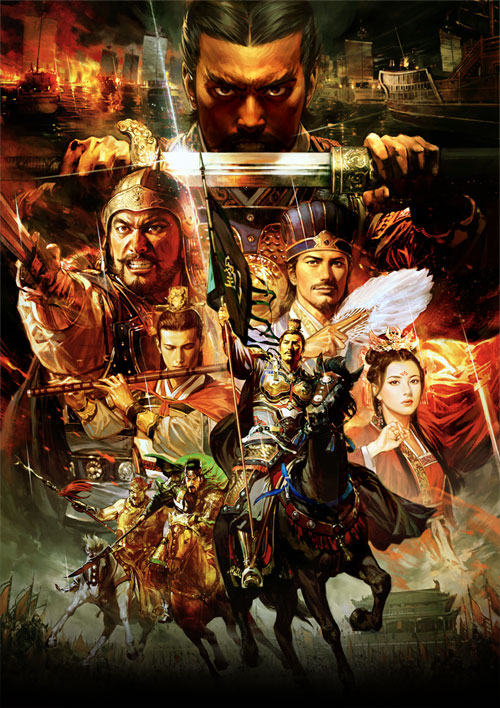
Sanguozhi is a historical simulation game based on the historical book "Sanguozhi" and the long historical novel "Sanguozhi Yanyi" and set in the period from the Later Han Dynasty to the Three Kingdoms in China. The game was released by Koei Tecmo Games and has been made into a series. The game's producer is Ko Shibusawa. Players take on the role of a monarch, increasing their national power through domestic and military affairs, and expanding their territory through battles with other monarchs. The goal of the game is to eventually unify China.
military commander
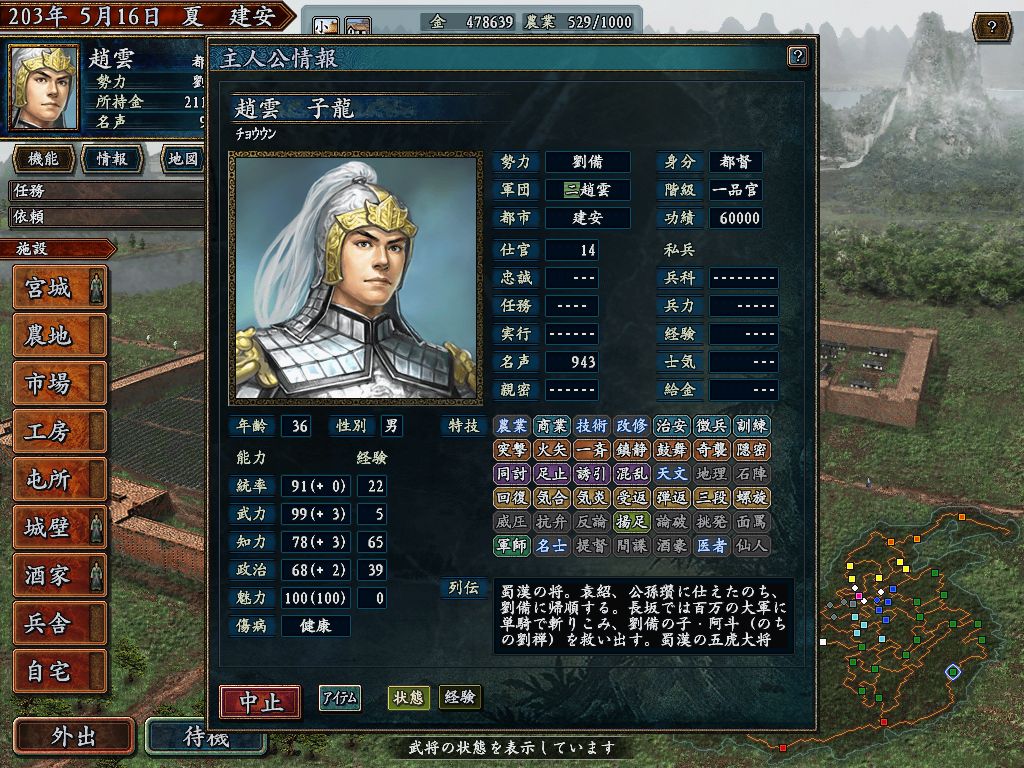
Warlord information screen of "Three Kingdoms X". The general shown is "Zhao Yun", one of the Five Tiger Generals of Shu.
In the "Three Kingdoms" series, generals are characters that are necessary for command instructions and troop formation.
Warlords from a wide range of ages, from the end of the Later Han Dynasty to the Three Kingdoms and beyond, appear in the series, and their personalities are expressed by their ability values and other characteristics.
For example, a general with high military power is a fierce general type, while a general with high political power is a civil official type.
The ranks of the generals vary from work to work, but they are generally categorized as monarch, daimyo, military commander, general, or general in the field.
Monarch: The overall ruler of a territory, such as a city.
A master: A person who has been entrusted by a sovereign with a city or other territory.
Strategist: A person who advises the sovereign in the execution of commands.
General: A general who is not a monarch, a governor, or a military commander.
A general who does not serve any force.
Many works have biographies of generals that describe their lives and achievements. Most of them are based on the historical novel "Sanguozhi Yanyi," but some are based on the historical book "Sanguozhi.
In the works after "Sanguozhi 11," the "Sanguozhi Yanyi" and the "Sanguozhi (authentic history)" are divided into "Sanguozhi Yanyi" and "Sanguozhi (authentic history).
How to increase the number of generals
The message that appears when a local general is discovered in a search in "Sangokushi IX.
Since manpower is required to advance the game, such as commanding and organizing troops, it is basically better to have a large number of generals.
However, generals need a stipend, which is deducted from their monetary and food income. If you have too many generals while your income is low, it will put pressure on your financial situation, so you should be careful.
In general, the following methods are used to increase the number of generals.
Appointment: Appoint a local general in your own territory, a captured general captured in a battle, or a general from another force. The same time a native general is discovered in a search, he can be promoted.
Coming of Age: In the game, the player comes of age at about age 15 and appears as a warlord. At this time, he appears in the city of the warlord to whom he is related by blood, such as his father.
Turnover: A warlord of another force promises to turn over to the other force in advance and does so during a battle.
Battle: Capture an enemy general in a battle and promote him after the war. The general can also be made a prisoner of war and promoted later.
Selection: A system used in "Sangokushi IX". After destroying an enemy unit, the general of that unit will report to you that he has a soldier who is worth watching as a general.
After that, a general acting as a teacher is assigned to the soldier and the soldier is given several months of training. When the training is completed, the soldier appears as a general. The name of the general is fixed by default.
attribute value
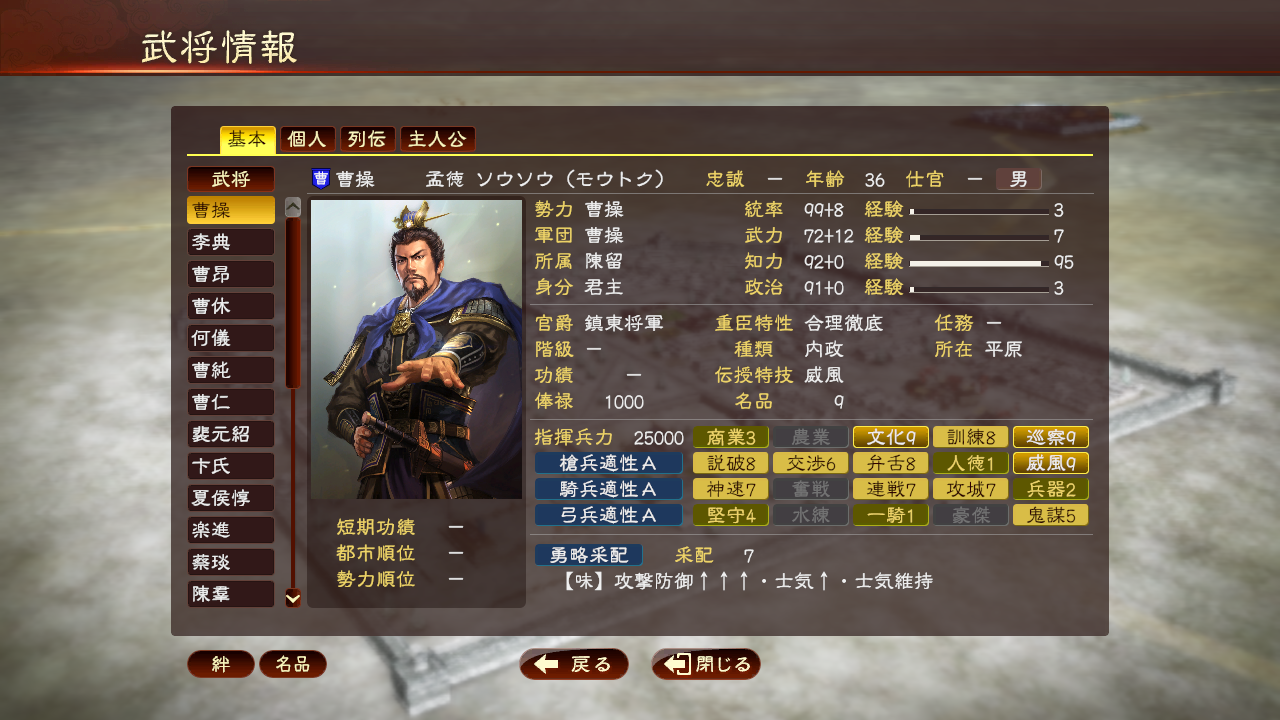
Warlord information screen of "Three Kingdoms 13. The general shown is Cao Cao, who laid the foundation of Wei. In general, all ability values are high.
Warlords have a set of ability values that represent their personal abilities. Ability values are expressed as numbers, with higher numbers indicating greater skill and lower numbers indicating less skill.
Ability values affect the effectiveness and success or failure of strategic commands, the attack power of troops in battle commands, the strength of one-on-one battles, and other factors.
The following is an introduction to the main ability values.
Politics: This is a numerical expression of political skill and ability. The higher this value is, the more effective the domestic affairs command is, and the easier it is to succeed in diplomacy and appointment.
Armed Forces: The strength of a person's personal power. A high value increases the effectiveness of military command training and makes it easier to win a single combat.
Intelligence: This is a numerical value that expresses the skillfulness of a strategy. A high number makes it easier to succeed in strategy and strategy commands during battles.
Leadership: A numerical expression of the skill in commanding troops. A high number increases the offensive and defensive power of troops in battle.
(degree of) loyalty
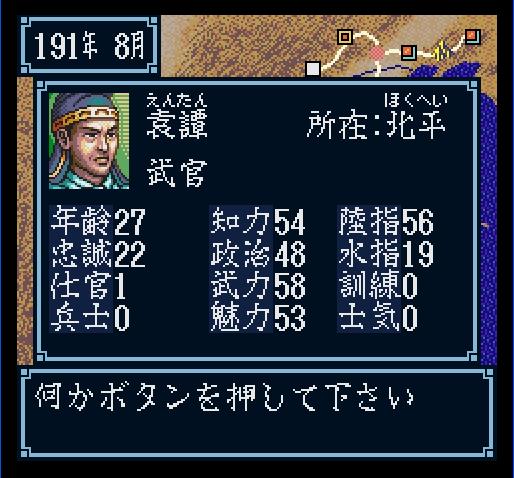
Low loyalty may cause a player to switch sides, so it is important to give him rewards and other benefits to bring his loyalty level to 100 as much as possible. The screen shot is from "Sangokushi III.
In many of the "Three Kingdoms" series, there is a "loyalty level" that quantifies the loyalty of the warlord to the sovereign. The highest loyalty level is often 100.
A high loyalty level makes it more difficult for a warlord to betray the sovereign, but a low loyalty level can lead to a warlord easily turning to other forces.
In many cases, loyalty is determined by the affinity set for the general.
For example, if a number from 0 to 100 is assigned, a general with a compatibility of 0 is most compatible with a general with the same compatibility of 0, followed by a general with a compatibility of 1 and a compatibility of 100.
In other words, when the numbers are arranged in a circle, the compatibility becomes worse each time the numbers are farther apart. The compatibility is worst with generals whose numbers are the exact opposite (for generals with compatibility 0, the compatibility is worst with generals with compatibility 50 or 51).
Good affinity tends to increase loyalty, while bad affinity tends to decrease loyalty.
Loyalty increases when money or items are given, and decreases when items are confiscated or when the warlord falls prey to the schemes of other forces.
Also, depending on the work, the loyalty of generals whose compatibility with their lord exceeds a certain level may decrease each season.
The compatibility is also related to the success or failure of the appointment of generals in the field, and generals with good compatibility with the monarch are easy to appoint, while those with poor compatibility are difficult to appoint.
military commander related by blood
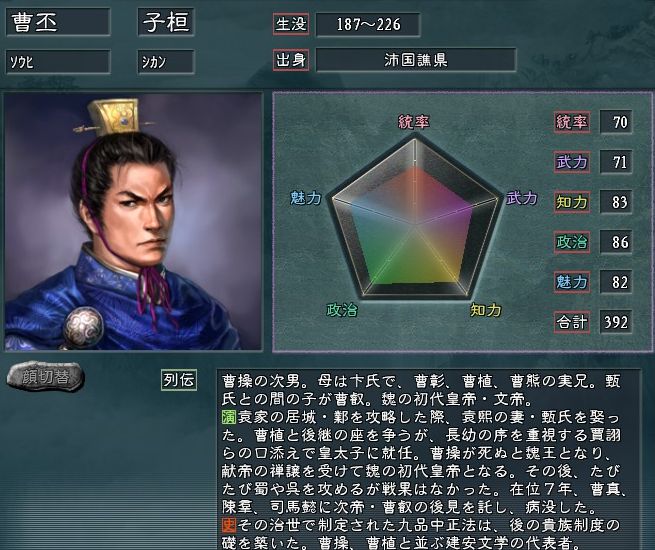
Cao Cao's second son and the first emperor of Wei, "Cao Pi". As an adult, he appears in the same city as his father, Cao Cao.
Warlords who are related to each other as parents, siblings, etc. are called blood warlords.
When they come of age, they appear in the city to which their father or other family members belong.
In "Three Kingdoms IX," when attacking an enemy force, a certain number of military strategies may occur. If two or more generals have the same strategy and the strategy is activated, a "chain" will be formed and the enemy troops will receive a large amount of damage.
The closer the generals are to each other, the more likely it is to occur, and if they are related by blood, the probability increases even more.
monarch
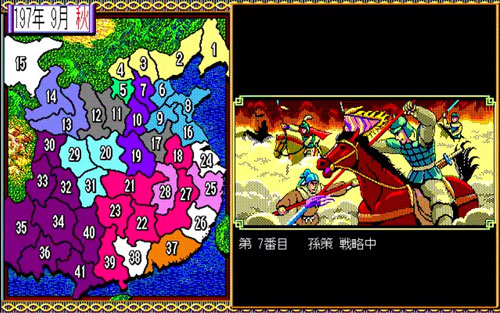
The "Mikuni II" screen during the strategy of other forces. The territory (cities) with numbers are color-coded so that you can tell which force is in control.
A monarch is the overall ruler of a territory and can be chosen as a player in most of the "Three Kingdoms" series.
Although various monarchs appear in the scenarios, only certain monarchs could be selected in the early works.
In the "Three Kingdoms" series, the monarchs are strongly associated with the warlord forces that occupy each region. In some works, they are referred to as "(name of monarch)'s army.
However, some of them, such as Zhang Jiao in the scenario of the Yellow Turban Rebellion, united rebel forces, and some of them, such as Meng Hui in the scenario of the Three Kingdoms Tripartite, were ethnic forces in ancient China.
The identification of the forces is done by marks in the early works and by color coding such as red, blue, and green in many of the later works.
For example, Cao Cao's (Wei) forces are colored blue, Liu Bei's (Shu) forces are colored green, and Sun Quan's (Wu) forces are colored red.
In some works, the surname of the ruling power is displayed on the banner of the city. In the case of Cao Cao, the character "Cao" is used as the banner.
In many cases, the scope of each monarch's power is based on historical facts. Cao Cao, for example, was initially a weak force that ruled only the city of Chenliu in central China, but he gradually increased his power by welcoming the Han emperor, and his power expanded to include the capital city of Luoyang, where he ruled Sihlai, Huzhou, and Yuzhou.
After defeating Yuan Shao in the Battle of Guandu, he expanded into northern China, taking control of Jizhou, Meridian, Yushu, Qingzhou, and Xuzhou, and claiming almost all of the northern half of the Chinese continent.
Cao Cao then set his sights on Jingzhou in the south, but he was unable to fully control Jingzhou due to his defeat at the Battle of Red Cliff and other factors.
In the scenario in which Cao Cao was still alive, he was the most powerful and had many generals under his control in the scenario around the year 220, when he died of illness.
peerage
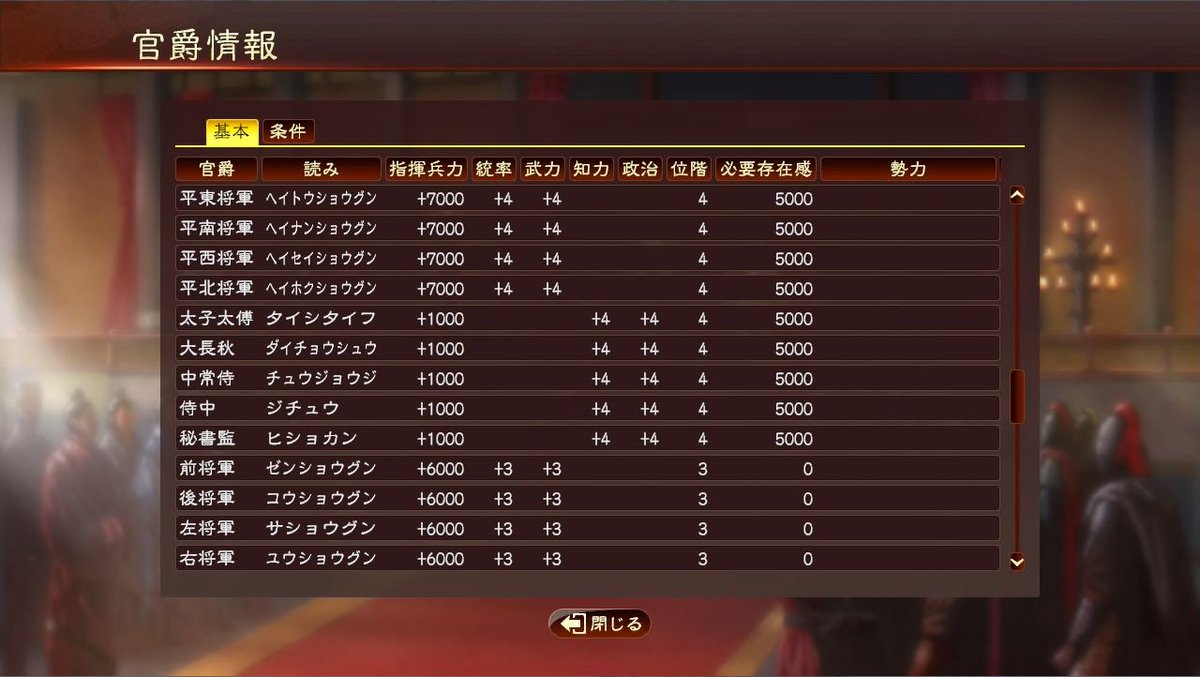
The dukes in "Three Kingdoms 13". There are both military and civilian dukes.
A "duke" is a position in the court (Han Dynasty) that can be conferred on a monarch or his subordinate generals in the game.
If the monarch is weak, the rank of the "duke" is low, but as the monarch expands his power, the rank of the "duke" becomes higher.
Generally, a knighthood is conferred on a monarch by the court and can be conferred on his subordinate generals in proportion to the rank conferred. The granting of a knighthood increases the value of abilities such as politics and wits.
In scenarios in which the Han dynasty does not appear, the monarch is given the title of "official.
In some works, there are forces (e.g., Zhang Jiao) that cannot be conferred with a duke.
The following is a list of the official titles of major monarchs. The lower the rank, the higher the rank.
The lower the rank, the higher the rank.
Zhonglang-general: A general who was in charge of the palace guard and played the role of commander in chief.
General: The highest military commander in an emergency situation, such as the suppression of a rebellion.
Grand Marshal: The highest military commander.
Duke: The highest of the five titles given to monarchs during the Zhou dynasty.
King: The title of a monarch one rank below the emperor.
Emperor: The title of the ruler established by Qin Shi Huangdi (Bei Zheng) when he unified the country.
To be crowned emperor, a monarch must have the title of "king" and be powerful enough to rule more than half of the cities in the game.
If there is a Han dynasty, the emperor is succeeded by the Han dynasty emperor; if there is no Han dynasty, the emperor is proclaimed himself emperor.
When an emperor ascends to the throne, the name of the country is newly determined.
territorial unit
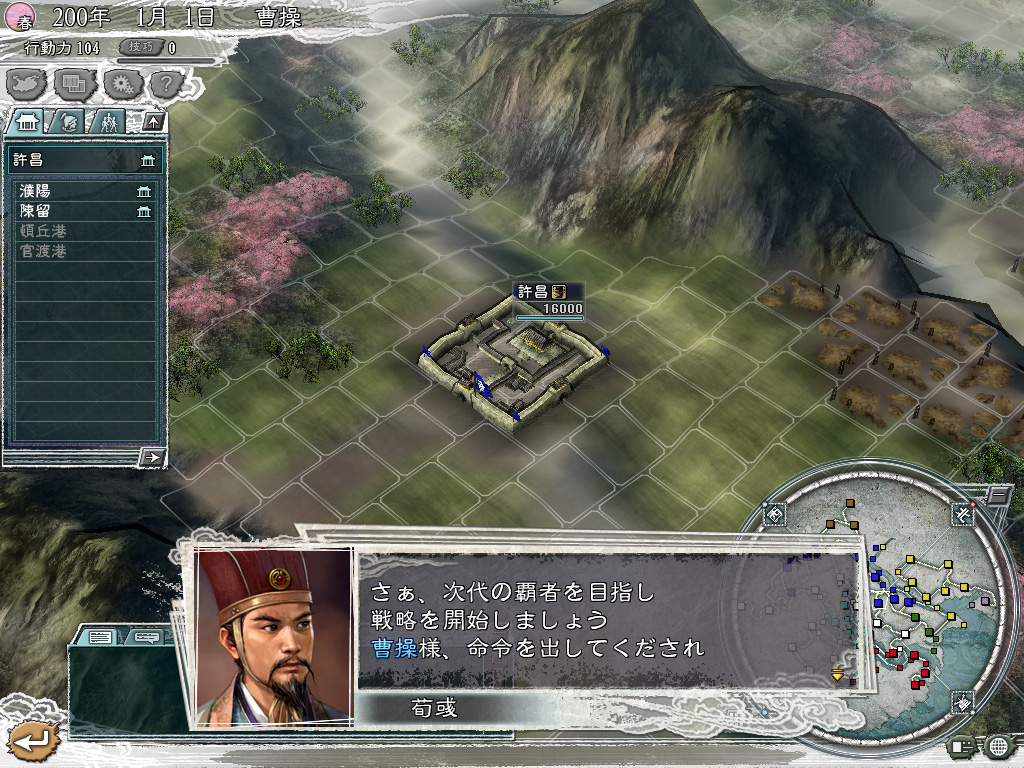
The strategy screen of "Three Kingdoms 11. The city on the screen is Xuchang, which became one of the capitals of Wei.
Monarchs appear in most works as rulers over cities such as "Luoyang" or "Chang'an".
In some works, they may also rule facilities such as ports.
In most works, strategic commands are given on a city-by-city basis, and battles and sieges are fought on a city-by-city basis.
Cities in most works belong to the ancient Chinese administrative divisions called "provinces. For example, Cao Cao's initial base of operations in the game "Chenliu" belongs to the province of Hushu.

Contents
- Outline of "Three Kingdoms
- Game System of "Sangokushi
- strategic command
- domestic affairs
- military affairs
- talented person
- diplomacy
- stratagem
- battle
- departure for the front
- Main unit types
- war
- Types of battles
- personal combat
- stratagem
- deciding the outcome (e.g. game)
- postwar treatment
- military commander
- How to increase the number of generals
- attribute value
- (degree of) loyalty
- military commander related by blood
- monarch
- peerage
- territorial unit
- Scenario of "Three Kingdoms
- Items from "Three Kingdoms
- arms
- scimitar with a blue dragon scimitar (Porzana fusca)
- serpentine spear (snake)
- weapons of mass destruction
- a pair of swords for one man and a pair of swords for another
- Yi Guang's bow
- fine or famous horse
- red rabbit
- calabash (Lagenaria siceraria var. gourda)
- uninterrupted view
- extremely high-grade Japanese amberjack (species of yellowtail, Seriola quinqueradiata)
- automobile
- books
- The Art of War (military text by Sun Tzu, 512 BCE)
- Mentoku Shinsho
- the Analects of Confucius
- The Historical Records (ancient Chinese historical record)
- The Book of the Taiheiyo kyôjô
- treasure
- tree sparrow (Passer montanus)
- nine-tined kettle stand
- the wisdom of the ancients
- fan with feathers
- sovereign's seal
- Events in "Three Kingdoms
- Regular Events
- locust (of family Catantopidae)
- typhoon
- good crop and bad crop
- Historical Events
- Federation of Beautiful Women's Unions scheme (1948-1953)
- Battle of Kandu (ancient Japanese battlefield)
- showing special confidence and courtesy (to someone, often to convince them to take a post, etc.)
- Power-up kit for "Three Kingdoms
- Terms of "Mikokushi
- Annals of the Three Kingdoms
- set of three books of Buddhist stories, written in the late 8th and early 9th century, usually referred to as the Three Kingdoms period
- state
- vacant lot or land
- different peoples
- Later Han Emperor
- Representative generals from the "Sangokushi" series
- State of Wei (China)
- Cao Cao
- Cao Dai
- honest and homely
- Marco Polo Bridge (China)
- Kakujia
- Yu Yu.
- Shima Xi
- Shu Han
- Liu Bei
- Sekifu (lowest of the eight hereditary titles)
- Zhang Fei (Chinese deity said to be able to cure all ills)
- scarlet kadsura (Kadsura japonica)
- Zhao Yun
- loyalty to one's master
- Choenomeles lagenaria
- Wu (dynasty of China; 918-1392 CE)
- Sun Quan (dynasty of China; 386-534 CE)
- Sun Yat-sen
- Sun Yat-sen
- Shu Yu
- Luxemburg
- Lu or Meng (dynasty of China)
- Rikou era (1429.9.5-1441.2.17)
- Groups and Figures from the Late Later Han to the Three Kingdoms Period
- Yuan Shao
- T'ang table
- Lu Bu
- how much (long, far)
- Yuan dynasty (China)
- penis-shaped device, traditionally made of horn, shell or papier mache
- Mencius' mother
- female
- glutton
- Da Qiao and Xiao Qiao
- List of "Mikuni" series
- PC and home video game console versions
- The Three Kingdoms.
- Super Mikuni
- The Three Kingdoms Returns.
- The Three Kingdoms II
- Super Mikuni II
- Sangokushi Tshukuru" (The Legend of the Three Kingdoms)
- The Three Kingdoms III
- The Three Kingdoms IV
- Mikuni V" (The Three Kingdoms V)
- The Three Kingdoms VI
- The Three Kingdoms VII
- Three Kingdoms VIII
- Mikuni IX" (Japanese title: "Mikuni IX")
- Mikuni X" (Japanese only)
- Mikuni 11
- Mikuni 12
- Mikuni 13
- Game Boy version, Game Boy Color version, Game Boy Advance version
- Mikuni: Game Boy Version" (Japanese only)
- Mikuni: Game Boy Version 2
- The Three Kingdoms.
- Wonder Swan version
- Sangokushi for WonderSwan" (Japanese only)
- Sangokushi II for WonderSwan" (Japanese only)
- Nintendo DS version
- Mikokushi DS
- Mikuni DS2" (Japanese only)
- Mikuni DS3" (Japanese only)
- Nintendo 3DS version
- The Three Kingdoms.
- The Three Kingdoms 2
- iPhone/iPod touch and iPad versions
- Mikuni: TOUCH
- The main staff of "Mikuni
- Koh Shibusawa
- Yoko Kanno
- Jun Chousei
- Kazuki Kuriyama
- Masako Otsuka
- Noriyoshi Ikuse
- Tsuyoshi Nagano
- Kazumasa Nagai
- Xu Boqing
- Backstories, trivia, and small stories/episodes/anecdotes of "Sanguozhi" (The Three Kingdoms)
- The Birth of "Mikokushi
- Power Up Kit Edition and "The Mikuni III Incident"
- Ability value of the word
- A small story found in the one-horse race
- Title title of "Three Kingdoms
- Himiko appears in Sanguozhi