
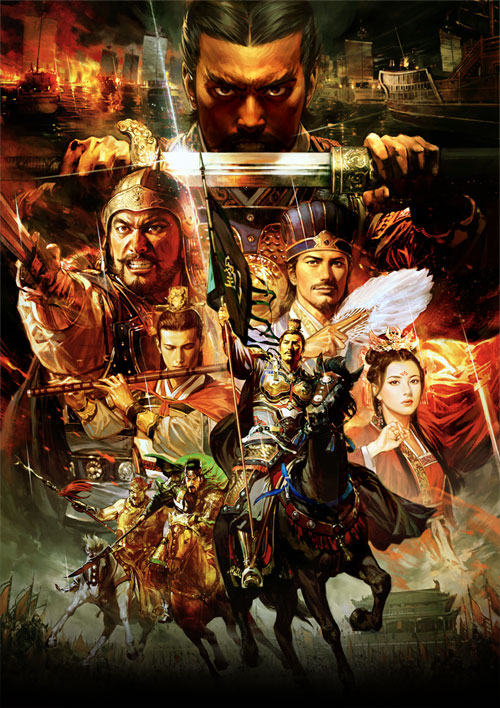
Sanguozhi is a historical simulation game based on the historical book "Sanguozhi" and the long historical novel "Sanguozhi Yanyi" and set in the period from the Later Han Dynasty to the Three Kingdoms in China. The game was released by Koei Tecmo Games and has been made into a series. The game's producer is Ko Shibusawa. Players take on the role of a monarch, increasing their national power through domestic and military affairs, and expanding their territory through battles with other monarchs. The goal of the game is to eventually unify China.
Scenario of "Three Kingdoms
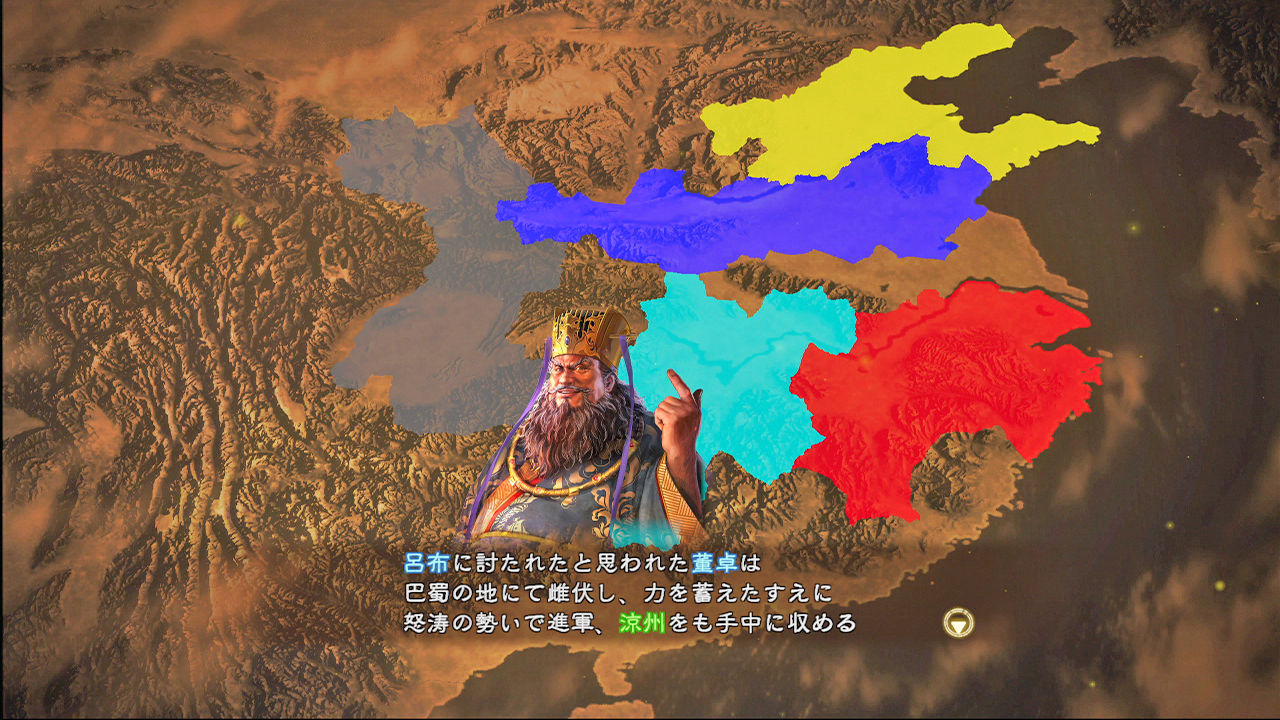
The virtual scenario "Return of the Demon King (downloadable content)" in "Three Kingdoms 13" in which Toutaku, who survived without being defeated by Lu Bu, makes another breakthrough.
The screen is the opening movie at the start of the game.
Although the title of the game is "Sanguozhi," it can be played from the period before the three kingdoms of Wei, Shu, and Wu were established.
Although the age of the game varies from work to work, it ranges from the Yellow Turban Rebellion at the end of the Later Han Dynasty to the period just before the fall of Shu in the Three Kingdoms Era.
There are two types of scenarios: regular scenarios based on historical facts and virtual scenarios that recreate hypothetical situations. Some works do not allow you to play virtual scenarios.
In some works, the Han Dynasty court forces appear in the normal scenario. This power is not playable, but it has a great deal to do with the official titles given to monarchs from the court and the inauguration of emperors.
They do not appear in scenarios after 220, when the Han Dynasty was destroyed in history.
In general, the number of generals in a scenario increases until the middle of the game, but gradually decreases toward the end.
Examples of normal scenarios
184: A scenario in which the Yellow Turban Rebellion occurs and the Han Dynasty is in severe decline.
190: A scenario in which the lords of various regions form an anti-tabletaku coalition against T'ao T'ao, the ruler of the Imperial Court.
194: Scenario in 194, when the lords of the various regions began to expand their power after the death of Dong Tak.
200: Scenario before the Battle of Guandu, when Cao Cao and Yuan Shao fought in northern China.
207: Scenario before the Battle of Red Cliff, when Cao Cao begins his southward march and fights Sun Quan and Liu Bei.
221: Scenario when the Han Dynasty is destroyed and the three kingdoms of Wei, Shu, and Wu are formed.
Year 234: Scenario before Zhuge Liang dies during the battle against Wei.
Year 261: Scenario before Wei attacks Shu and Shu is destroyed.
In virtual scenarios, regardless of age or lifespan, there are scenarios in which all the generals in the story appear and fight for supremacy, as well as scenarios based on situations that differ from those in the historical record.
Items from "Three Kingdoms
Items in the "Three Kingdoms" series have the effect of strengthening the warlord, such as increasing the warlord's ability value. The types of items include weapons, famous horses, books, and treasures.
Items can be obtained by searching for warriors in the field on their behalf or by purchasing them from merchants.
Some items are necessary for certain events to occur.
Depending on the scenario, certain generals may initially possess the items, which can be obtained by capturing and beheading them in war.
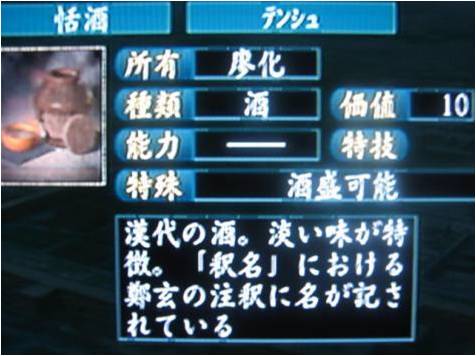
Items include famous sake.
arms
Weapon items such as swords, knives, and bows. They have the effect of increasing the military power of the general who possesses them.
scimitar with a blue dragon scimitar (Porzana fusca)
read: a refreshing moon moonlight
Often initially owned by Guan Yu. After the death of Guan Yu, it is inherited by his son Guan Xing and others.
The Seiryu Bastion is a large sword shaped like a naginata. The name "Seiryu" refers to the decoration of a blue dragon on the blade.
Because it is extremely heavy, it was mainly used for training and was not used much in actual battles.
Although it is known as the weapon used by Guan Yu in "Sanguozhi Yanyi," it did not actually appear until the Song dynasty (960-1279). It is also not mentioned in the authentic history of "Records of the Three Kingdoms.
According to "Sanguozhi Yanyi," when Guan Yu raised an army with Liu Bei and others, he had a blacksmith make a sword. Guan Yu named the sword "Reiyan-kyo" (艷鋸).
When Guan Yu and his son Guan Ping were beheaded in Jingzhou, it was temporarily taken by Sun Quan's side, but Guan Xing, another son of Guan Yu, later recovered it. He also appears in "Water Margin".
serpentine spear (snake)
Reading: Dabo, Jabo
Often initially owned by Zhang Fei. After the death of Zhang Fei, it is passed on to his son Zhang Bract and others.
It is said to have appeared in the Ming Dynasty.
In "Sanguozhi Yanyi," this weapon was used by Zhang Fei and a general under Sun Quan named Cheng Pu. The snake spear used by Zhang Fei was made by a blacksmith when Liu Bei and his men raised an army.
It also appears in "Water Margin" as a weapon used by a character.
weapons of mass destruction
Reading: "lawmaker's month
Often initially owned by Lu Bu. After Lu Bu's death, it can be obtained through search and other means.
It is one of the "geukyoku," a weapon combining a spear and a pike, with a crescent-shaped blade called a "moon fang" on one side of the blade.
Such a geiken is called a "seiryu-geki," "tangeki," or "geikkoto.
They appeared after the Song dynasty and do not appear in the "Records of the Three Kingdoms.
The one used by Lu Bu in "Sanguozhi Yanyi" is called "Fangtian Gageki (双戟)". It also appears in "Water Margin".
a pair of swords for one man and a pair of swords for another
reading: the right of a single pair of eyes
Often initially owned by Liu Bei. After Liu Bei's death, it was inherited by his son Liu Zen.
A pair of swords (male and female swords) with different sword lengths and blade tips. However, there is no such terminology as "male/female sword" or "female/female pair" in terms of swords.
In "Sanguozhi Yanyi", Liu Bei is known to be carrying a female sword, which was made to resemble the swords of his ancestors when he raised his army.
It was made at the same time as Guan Yu's "Bastion of the Blue Dragon" and Zhang Fei's "Snake Pike".
Yi Guang's bow
Reading: Yumi Kou no Yumi
Can be obtained through exploration and other means.
Li Guang was a military commander who served three generations of the Wen to Wu emperors of the Former Han Dynasty. Li Ling was his grandson.
A master archer, he was feared as the "Flying General" for his achievements in conquering the Xiongnu in northern China and suppressing rebellions.
During the reign of Emperor Wu, he was temporarily taken prisoner by the Xiongnu and later reduced to a commoner. However, he was later reinstated.
In 119 B.C., he served in a battle against the Xiongnu. However, he lost his way and fell into a late battle, and the indignant Li Guang beheaded himself.
This item is thought to be named after Li Guang, a master archer.
fine or famous horse
A famous horse that appears in "Sanguozhi" and "Sanguozhi Yanyi". The horse is a horse that can always retreat even if it is destroyed or defeated in a single battle, and it is not captured by the enemy.
red rabbit
reading: "a stone's throw away
Often owned by Toutaku, Lu Bu, and Guan Yu. Depending on the work, it may not appear in scenarios after Guan Yu's death.
In "Records of the Three Kingdoms," it appears as a horse ridden by Lu Bu, and it is said that "there is a Lu Bu among men and a red rabbit among horses.
In "Sanguozhi Yanyi," it was known as a surging horse that could run a long distance in a day.
Originally owned by Dong Zhuo, it was considered a gift to invite Lu Bu. After Lu Bu's death, it passed through Cao Cao and became the property of Guan Yu.
It then became Guan Yu's favorite horse, but after he was killed in Jingzhou, it was given to a general named Ma Chu under Sun Quan. However, the red rabbit horse stopped eating and died.
The horse also appears in "Water Margin" as a character's horse.
calabash (Lagenaria siceraria var. gourda)
Read: "Tegoro
Often owned by Liu Bei, from a scenario around 207. After Liu Bei's death, it was taken over by Liu Zen.
The term "的盧" refers to a horse with a white pattern on its forehead that extends all the way to its mouth, and is said to kill the rider.
According to "The Annals of the Three Kingdoms," Liu Bei was almost killed at a feast by one of Liu Meng's men when he was under Liu Meng in Jingzhou.
Liu Bei rode away on his Dalu, but on the way, he got stuck in the current of a river called Danxi. However, when Liu Bei called out to him, Dalu jumped out of the stream and saved Liu Bei's life.
A similar story is told in "Sanguozhi Yanyi" (The History of the Three Kingdoms), in which he was ultimately killed by an enemy arrow during the Iizhou invasion.

Contents
- Outline of "Three Kingdoms
- Game System of "Sangokushi
- strategic command
- domestic affairs
- military affairs
- talented person
- diplomacy
- stratagem
- battle
- departure for the front
- Main unit types
- war
- Types of battles
- personal combat
- stratagem
- deciding the outcome (e.g. game)
- postwar treatment
- military commander
- How to increase the number of generals
- attribute value
- (degree of) loyalty
- military commander related by blood
- monarch
- peerage
- territorial unit
- Scenario of "Three Kingdoms
- Items from "Three Kingdoms
- arms
- scimitar with a blue dragon scimitar (Porzana fusca)
- serpentine spear (snake)
- weapons of mass destruction
- a pair of swords for one man and a pair of swords for another
- Yi Guang's bow
- fine or famous horse
- red rabbit
- calabash (Lagenaria siceraria var. gourda)
- uninterrupted view
- extremely high-grade Japanese amberjack (species of yellowtail, Seriola quinqueradiata)
- automobile
- books
- The Art of War (military text by Sun Tzu, 512 BCE)
- Mentoku Shinsho
- the Analects of Confucius
- The Historical Records (ancient Chinese historical record)
- The Book of the Taiheiyo kyôjô
- treasure
- tree sparrow (Passer montanus)
- nine-tined kettle stand
- the wisdom of the ancients
- fan with feathers
- sovereign's seal
- Events in "Three Kingdoms
- Regular Events
- locust (of family Catantopidae)
- typhoon
- good crop and bad crop
- Historical Events
- Federation of Beautiful Women's Unions scheme (1948-1953)
- Battle of Kandu (ancient Japanese battlefield)
- showing special confidence and courtesy (to someone, often to convince them to take a post, etc.)
- Power-up kit for "Three Kingdoms
- Terms of "Mikokushi
- Annals of the Three Kingdoms
- set of three books of Buddhist stories, written in the late 8th and early 9th century, usually referred to as the Three Kingdoms period
- state
- vacant lot or land
- different peoples
- Later Han Emperor
- Representative generals from the "Sangokushi" series
- State of Wei (China)
- Cao Cao
- Cao Dai
- honest and homely
- Marco Polo Bridge (China)
- Kakujia
- Yu Yu.
- Shima Xi
- Shu Han
- Liu Bei
- Sekifu (lowest of the eight hereditary titles)
- Zhang Fei (Chinese deity said to be able to cure all ills)
- scarlet kadsura (Kadsura japonica)
- Zhao Yun
- loyalty to one's master
- Choenomeles lagenaria
- Wu (dynasty of China; 918-1392 CE)
- Sun Quan (dynasty of China; 386-534 CE)
- Sun Yat-sen
- Sun Yat-sen
- Shu Yu
- Luxemburg
- Lu or Meng (dynasty of China)
- Rikou era (1429.9.5-1441.2.17)
- Groups and Figures from the Late Later Han to the Three Kingdoms Period
- Yuan Shao
- T'ang table
- Lu Bu
- how much (long, far)
- Yuan dynasty (China)
- penis-shaped device, traditionally made of horn, shell or papier mache
- Mencius' mother
- female
- glutton
- Da Qiao and Xiao Qiao
- List of "Mikuni" series
- PC and home video game console versions
- The Three Kingdoms.
- Super Mikuni
- The Three Kingdoms Returns.
- The Three Kingdoms II
- Super Mikuni II
- Sangokushi Tshukuru" (The Legend of the Three Kingdoms)
- The Three Kingdoms III
- The Three Kingdoms IV
- Mikuni V" (The Three Kingdoms V)
- The Three Kingdoms VI
- The Three Kingdoms VII
- Three Kingdoms VIII
- Mikuni IX" (Japanese title: "Mikuni IX")
- Mikuni X" (Japanese only)
- Mikuni 11
- Mikuni 12
- Mikuni 13
- Game Boy version, Game Boy Color version, Game Boy Advance version
- Mikuni: Game Boy Version" (Japanese only)
- Mikuni: Game Boy Version 2
- The Three Kingdoms.
- Wonder Swan version
- Sangokushi for WonderSwan" (Japanese only)
- Sangokushi II for WonderSwan" (Japanese only)
- Nintendo DS version
- Mikokushi DS
- Mikuni DS2" (Japanese only)
- Mikuni DS3" (Japanese only)
- Nintendo 3DS version
- The Three Kingdoms.
- The Three Kingdoms 2
- iPhone/iPod touch and iPad versions
- Mikuni: TOUCH
- The main staff of "Mikuni
- Koh Shibusawa
- Yoko Kanno
- Jun Chousei
- Kazuki Kuriyama
- Masako Otsuka
- Noriyoshi Ikuse
- Tsuyoshi Nagano
- Kazumasa Nagai
- Xu Boqing
- Backstories, trivia, and small stories/episodes/anecdotes of "Sanguozhi" (The Three Kingdoms)
- The Birth of "Mikokushi
- Power Up Kit Edition and "The Mikuni III Incident"
- Ability value of the word
- A small story found in the one-horse race
- Title title of "Three Kingdoms
- Himiko appears in Sanguozhi