
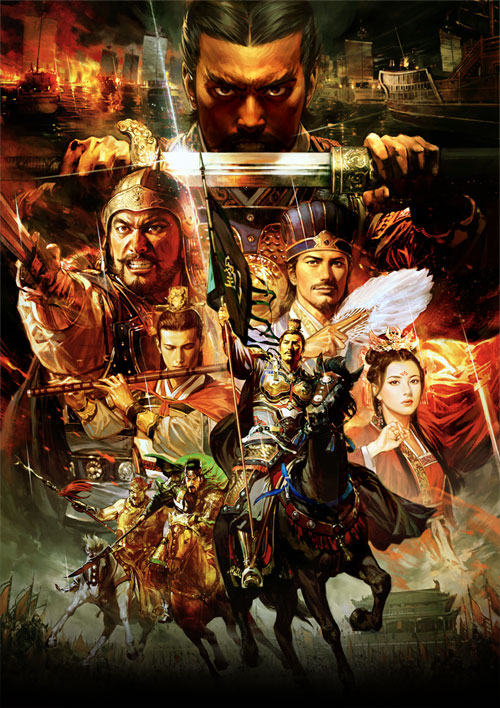
Sanguozhi is a historical simulation game based on the historical book "Sanguozhi" and the long historical novel "Sanguozhi Yanyi" and set in the period from the Later Han Dynasty to the Three Kingdoms in China. The game was released by Koei Tecmo Games and has been made into a series. The game's producer is Ko Shibusawa. Players take on the role of a monarch, increasing their national power through domestic and military affairs, and expanding their territory through battles with other monarchs. The goal of the game is to eventually unify China.
List of "Mikuni" series
This section introduces all the titles in the "Mikuni: XX" series.
Unlike the "Nobunaga's Ambition" series released by Koei Tecmo Games, the titles in this series are not subtitled "Mikuni: XX," but have a number after the title indicating the series' title.
The numbers from "Mikuni II" to "Mikuni X" are Roman numerals, but from "Mikuni 11" onward, they are Arabic numerals.
PC and home video game console versions
The Three Kingdoms.
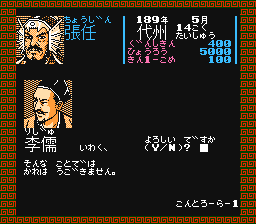
The strategy screen of "Sanguozhi.
The memorable first game in the series was released on December 10, 1985 in a PC version. A Family Computer (NES) version was later released.
The game's goal is for the player to become a monarch and rule all countries in order to unify China. However, there are some monarchs that cannot be selected.
The game is played by executing strategic commands and battle commands. Only one strategic command can be executed per country.
Unlike the first "Ambition of Nobunaga," a historical simulation game also by Koei Tecmo Games, generals appear in the game from the beginning.
Warlords are assigned ability values such as military prowess and intellectual power, and a high intellectual power makes the warlord a military strategist who gives advice when executing commands.
Even if the monarch of the player's choice dies, the game can be continued by appointing a subordinate warlord as his successor.
The game system differs depending on the hardware on which the game was released.
Super Mikuni
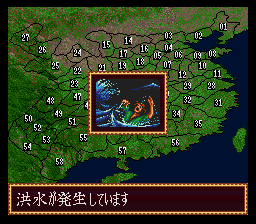
Message of the flood event in "Super Mikuni".
It was a remake of the Super Nintendo port of "Sangokushi" and was released on August 12, 1994.
The Three Kingdoms Returns.
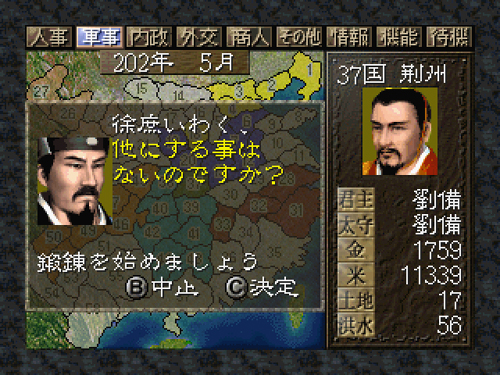
The strategy screen of "Mikuni Returns.
Like "Super Mikuni", it is a remake of "Mikuni" and was released in February 1996 for the PC version. Later, Sega Saturn and PlayStation versions were released.
The face graphics are polygonal, as in "Nobunaga's Ambition Returns".
The Three Kingdoms II
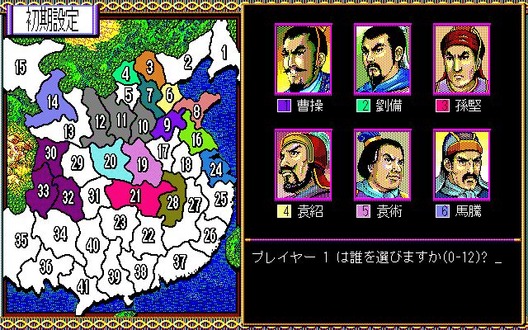
The monarch selection screen in "Mikuni II.
The second title in the "Sangokushi" series, it was released in December 1989 for the PC. Later versions were released for the NES, Super NES, and PlayStation.
The game goals are the same as the previous title. Also, as in the previous title, some monarchs cannot be selected as players, but it is now possible to select original generals created by oneself as monarchs.
Mask data, which could not be confirmed in the game, was set for generals for the first time and has been set for generals appearing in subsequent games in the series.
A parameter called "credibility" was introduced, which affects diplomacy with other forces and the loyalty of the generals under his command.
Strategic command instructions can now be given according to the number of generals under one's command.
In battles with other forces, elements such as single combat, reinforcements, and strategies are introduced.
Historical events appear for the first time and are related to Diao Chan. However, the events do not exist in the home console versions, such as the NES version.
Super Mikuni II
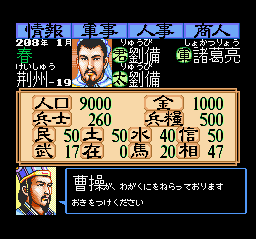
The strategy screen of "Super Mikuni II.
A remake of "Mikuni II" ported to the Super Nintendo Entertainment System, it was released on September 15, 1991.
Titles such as "Super Mikuni" and "Super Mikuni 2" are thought to be the "Super" of Super Famicom added to the remake.
Sangokushi Tshukuru" (The Legend of the Three Kingdoms)
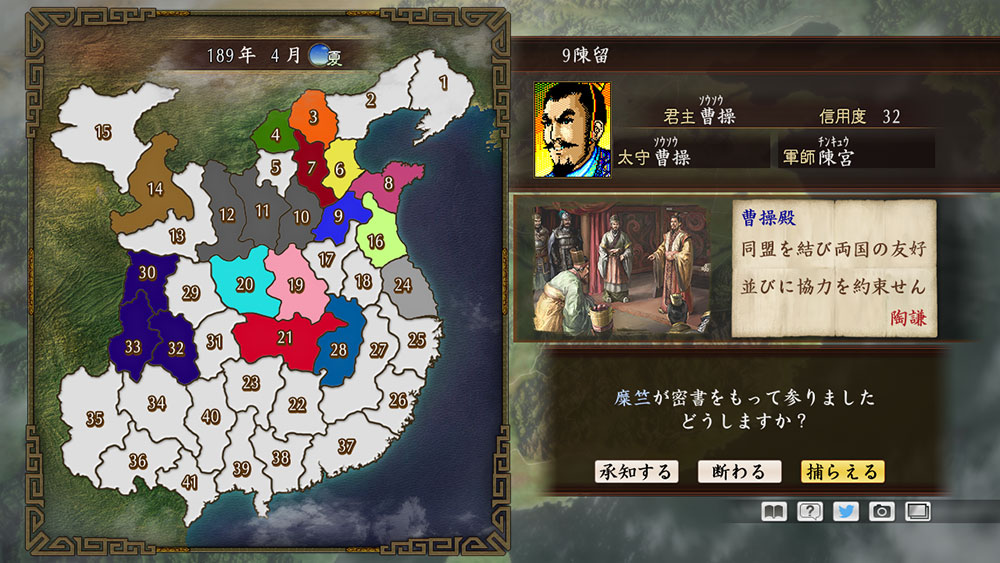
The strategy screen of "Sangokushi Tukur.
Based on the game system of "Mikuni II," this work allows players to freely edit generals, forces, battle maps, and more.
It is classified in the genre of "Tskool Simulation" and was released on December 10, 2015 for the PC version.
The face materials for "Mikuni 13" and the 184-year "Yellow Turban Rebellion" scenario can be downloaded for free, but other face materials and additional scenarios are available as paid downloads.
The Three Kingdoms III
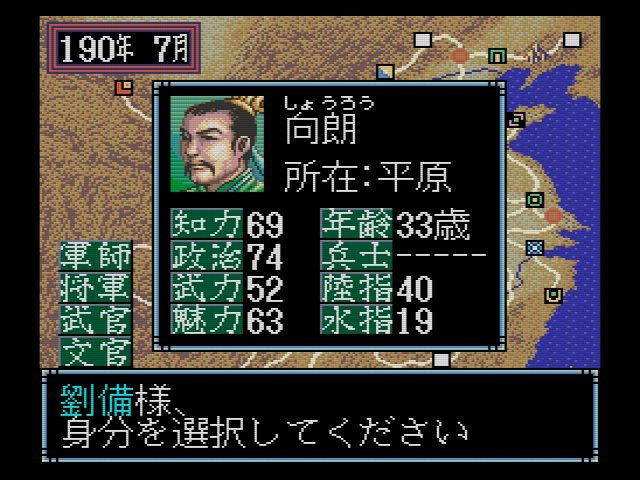
The strategy screen of "Mikuni III.
The third title in the "Sangokushi" series, it was released on February 5, 1992, in a PC version. Later versions were released for the Super Nintendo Entertainment System (SNES), PlayStation, and other platforms.
In order to achieve the game's goal of unifying China, the territories to rule changed from countries to cities.
All monarchs could now be selected as players. In addition, the appearance of registered generals (monarchs and warlords) in the game can now be determined by default settings.
Warlord ability values were subdivided into smaller categories, such as "politics" for the first time.
Strategic commands each have a command execution period, and when the period ends, the command also ends automatically.
The generals under their command are assigned the status of "military commander" or "general," and the strategic commands that can be executed differ depending on their status. In addition, the corresponding ability value must be higher than the specified value depending on the status.
In addition to city battles (siege battles), field battles can now be fought in the vicinity of specific cities. In addition, the number of strategies that can be used during battles has also increased.

Contents
- Outline of "Three Kingdoms
- Game System of "Sangokushi
- strategic command
- domestic affairs
- military affairs
- talented person
- diplomacy
- stratagem
- battle
- departure for the front
- Main unit types
- war
- Types of battles
- personal combat
- stratagem
- deciding the outcome (e.g. game)
- postwar treatment
- military commander
- How to increase the number of generals
- attribute value
- (degree of) loyalty
- military commander related by blood
- monarch
- peerage
- territorial unit
- Scenario of "Three Kingdoms
- Items from "Three Kingdoms
- arms
- scimitar with a blue dragon scimitar (Porzana fusca)
- serpentine spear (snake)
- weapons of mass destruction
- a pair of swords for one man and a pair of swords for another
- Yi Guang's bow
- fine or famous horse
- red rabbit
- calabash (Lagenaria siceraria var. gourda)
- uninterrupted view
- extremely high-grade Japanese amberjack (species of yellowtail, Seriola quinqueradiata)
- automobile
- books
- The Art of War (military text by Sun Tzu, 512 BCE)
- Mentoku Shinsho
- the Analects of Confucius
- The Historical Records (ancient Chinese historical record)
- The Book of the Taiheiyo kyôjô
- treasure
- tree sparrow (Passer montanus)
- nine-tined kettle stand
- the wisdom of the ancients
- fan with feathers
- sovereign's seal
- Events in "Three Kingdoms
- Regular Events
- locust (of family Catantopidae)
- typhoon
- good crop and bad crop
- Historical Events
- Federation of Beautiful Women's Unions scheme (1948-1953)
- Battle of Kandu (ancient Japanese battlefield)
- showing special confidence and courtesy (to someone, often to convince them to take a post, etc.)
- Power-up kit for "Three Kingdoms
- Terms of "Mikokushi
- Annals of the Three Kingdoms
- set of three books of Buddhist stories, written in the late 8th and early 9th century, usually referred to as the Three Kingdoms period
- state
- vacant lot or land
- different peoples
- Later Han Emperor
- Representative generals from the "Sangokushi" series
- State of Wei (China)
- Cao Cao
- Cao Dai
- honest and homely
- Marco Polo Bridge (China)
- Kakujia
- Yu Yu.
- Shima Xi
- Shu Han
- Liu Bei
- Sekifu (lowest of the eight hereditary titles)
- Zhang Fei (Chinese deity said to be able to cure all ills)
- scarlet kadsura (Kadsura japonica)
- Zhao Yun
- loyalty to one's master
- Choenomeles lagenaria
- Wu (dynasty of China; 918-1392 CE)
- Sun Quan (dynasty of China; 386-534 CE)
- Sun Yat-sen
- Sun Yat-sen
- Shu Yu
- Luxemburg
- Lu or Meng (dynasty of China)
- Rikou era (1429.9.5-1441.2.17)
- Groups and Figures from the Late Later Han to the Three Kingdoms Period
- Yuan Shao
- T'ang table
- Lu Bu
- how much (long, far)
- Yuan dynasty (China)
- penis-shaped device, traditionally made of horn, shell or papier mache
- Mencius' mother
- female
- glutton
- Da Qiao and Xiao Qiao
- List of "Mikuni" series
- PC and home video game console versions
- The Three Kingdoms.
- Super Mikuni
- The Three Kingdoms Returns.
- The Three Kingdoms II
- Super Mikuni II
- Sangokushi Tshukuru" (The Legend of the Three Kingdoms)
- The Three Kingdoms III
- The Three Kingdoms IV
- Mikuni V" (The Three Kingdoms V)
- The Three Kingdoms VI
- The Three Kingdoms VII
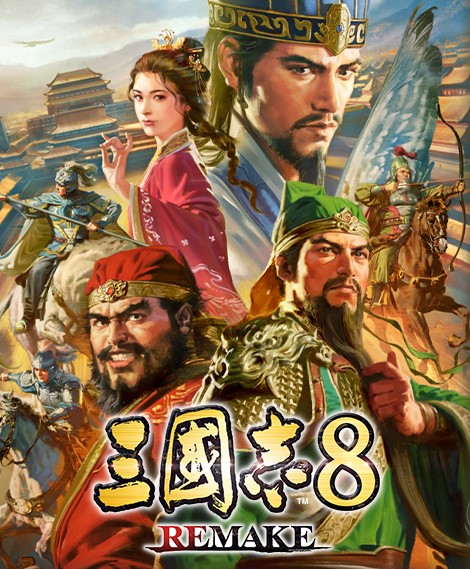
- Three Kingdoms VIII
- Mikuni IX" (Japanese title: "Mikuni IX")
- Mikuni X" (Japanese only)
- Mikuni 11
- Mikuni 12
- Mikuni 13
- Game Boy version, Game Boy Color version, Game Boy Advance version
- Mikuni: Game Boy Version" (Japanese only)
- Mikuni: Game Boy Version 2
- The Three Kingdoms.
- Wonder Swan version
- Sangokushi for WonderSwan" (Japanese only)
- Sangokushi II for WonderSwan" (Japanese only)
- Nintendo DS version
- Mikokushi DS
- Mikuni DS2" (Japanese only)
- Mikuni DS3" (Japanese only)
- Nintendo 3DS version
- The Three Kingdoms.
- The Three Kingdoms 2
- iPhone/iPod touch and iPad versions
- Mikuni: TOUCH
- The main staff of "Mikuni
- Koh Shibusawa
- Yoko Kanno
- Jun Chousei
- Kazuki Kuriyama
- Masako Otsuka
- Noriyoshi Ikuse
- Tsuyoshi Nagano
- Kazumasa Nagai
- Xu Boqing
- Backstories, trivia, and small stories/episodes/anecdotes of "Sanguozhi" (The Three Kingdoms)
- The Birth of "Mikokushi
- Power Up Kit Edition and "The Mikuni III Incident"
- Ability value of the word
- A small story found in the one-horse race
- Title title of "Three Kingdoms
- Himiko appears in Sanguozhi