
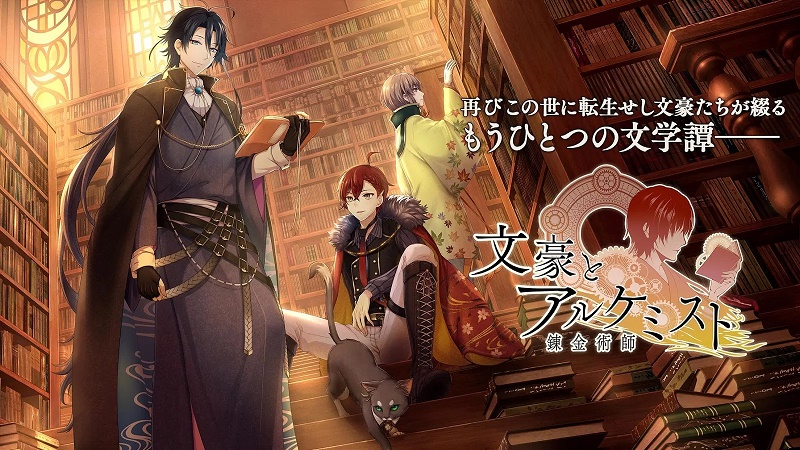
Bungo to Alchemist" (abbreviated as "Bungo and Alchemist") is a training simulation game based on the theme of "Bungo". Developed and operated by the gaming platform DMM Games, the browser version was released in November 2016, and the smartphone version was released the following year in June 2017. The story is set in Japan, which has a different history from reality, based on Taisho Romanticism and Steampunk. In order to protect literature from enemies known as "invaders," players reincarnate literary giants and fight alongside them against these invaders.
Later, Ao replaces Aka, who is unable to move, and this time Ao goes into the literary book with the players and literary giants. The three members of the literary group, Ryunosuke Akutagawa, Haruo Sato, and Shigeharu Nakano, replaced Sakunosuke Oda and Tatsuo Hori, who were taking care of Aka, and came to investigate.
After hearing from Sakunosuke Oda that "Aka told us to look for something that only exists in literature," the players decided to start by considering the meaning of that phrase. However, the meaning was not so easy to grasp, and the topic evolved into "What is literature in the first place? They then decided to talk to other great writers to get a hint about "what literature is," while defeating the invaders in the literature book.
Episode 14 Naturalism
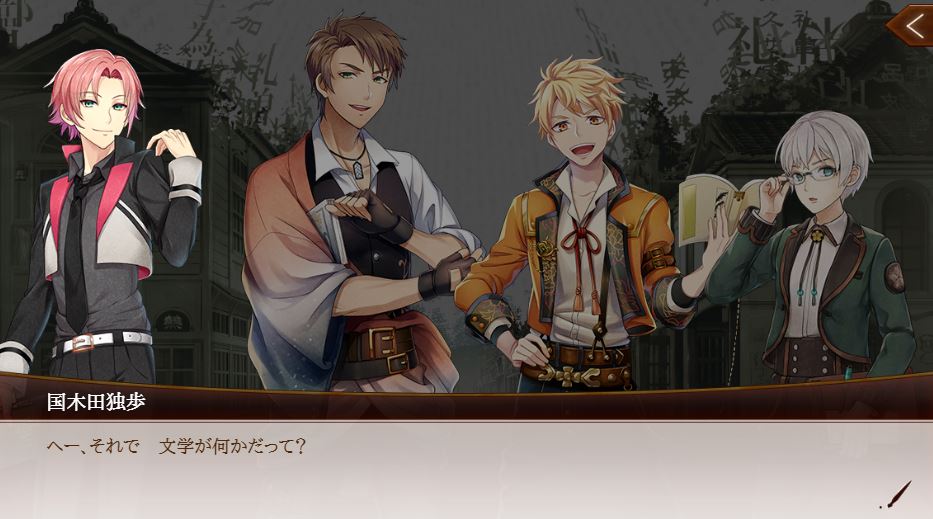
The naturalist writers Kunikida Doppo (pink-haired youth) and Tayama Hanabukuro (blond-haired youth) are gathered by Sato Haruo (brown-haired youth) and Ao (white-haired boy) to discuss literature.
First, they spoke with Tayama Hanabukuro and Kunikida Doppo, two great writers who dominated the mainstream of literature known as naturalism. Naturalism became a literature that portrayed people as they are, and it greatly changed the "typical characters" and "rigid, fixed, opportunistic development" that had existed in novels up to that time.
However, Ao was unable to understand the naturalism that honestly expressed even the "perversity" within him as he depicted people as they are, and was reluctant to accept it. Ao is taken aback by this, as he is unable to comprehend the naturalism that he describes in such a straightforward manner, even to the point of perverting himself. Ao, without understanding what he is talking about, pretends to be convinced by his story and concludes, "The pervert saved the world, didn't he?
Episode 15 Aestheticism
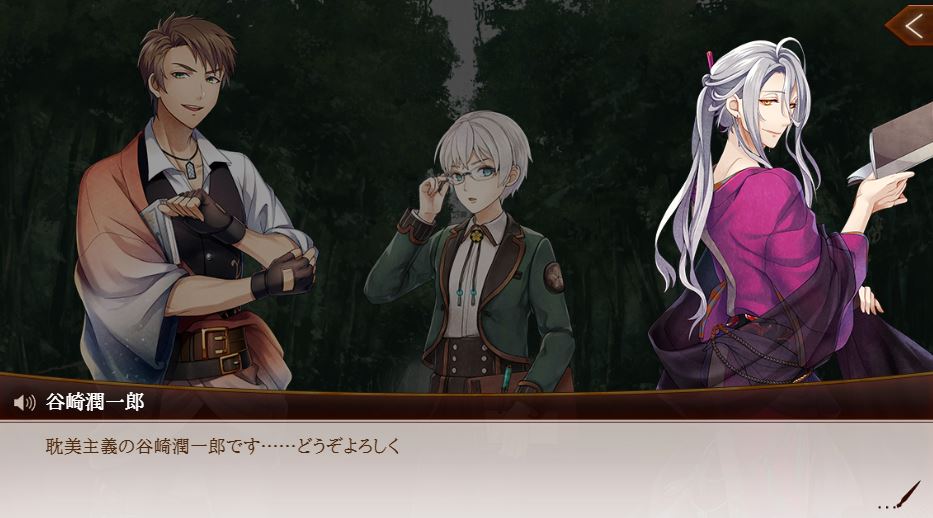
Junichiro Tanizaki (the young man on the right side of the screen), a great writer of aestheticism, comes to Haruo Sato (the young man on the left side of the screen) and Ao (the boy in the middle of the screen) when he hears they are discussing literature.
The next person to appear before Ao and his friends was the great writer Junichiro Tanizaki, a representative of the literature known as aestheticism. He kicked out Hanabukuro Tayama's idea, saying that it lacked romance. Junichiro Tanizaki was a great writer with a foot fetish who was particular about the way he depicted women, especially women's feet, and was good at writing about the world of glamorous sensuality. However, he says, "I don't just write about eros, but about the love that lies beyond it. He then excitedly tries to describe his ideal woman and man to Ao, who asks him what kind of love it is, but is stopped by Haruo Sato, who senses that it will be a long story. Finally, he told Ao that his idea of literature is "to affirm human beings and pursue beauty," and quietly left the place.
Episode 16 Art Made of Words / Out of Order
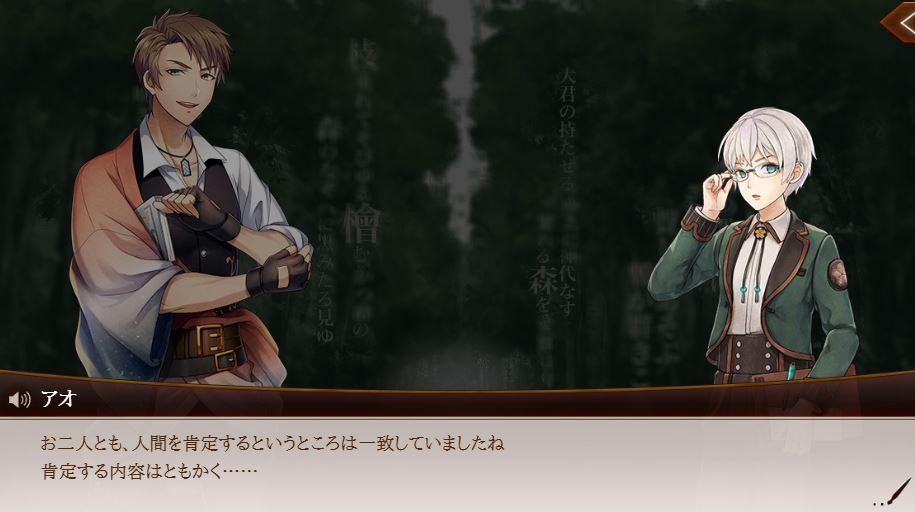
Ao (the boy on the right of the screen) talks to Haruo Sato (the young man on the left of the screen) about what he thought after listening to the naturalist and aestheticist writers.
Although he still does not have a good understanding of literature, Ao realizes from the stories of the two literary giants that "literature is something that affirms human beings" in both cases. However, because the literary giants who have appeared in his life have changed their tastes and preferences, the word "pervert" has almost become attached to the image he has of them.
In order to get rid of this, Haruo Sato, prompted by Ao, begins to talk about what literature means to him. Haruo Sato says that literature is an art made of words. He, too, was unable to find the correct answer to the question, "What is literature?" But he came up with the answer, "Humans think in words," and "Therefore, literature that shakes the emotions of others with words is an art made up of words. Then suddenly, Osamu Dazai, a literary giant with close ties to Haruo Sato, appears and begins to vehemently agree with his answer. When Dazai Osamu learns that Haruo Sato and his colleagues are investigating the interesting question of "what literature is," he can hardly stand still and comes here. Just when Haruo Sato is taken aback by his energy, the invader appears and attacks them.
The players somehow succeed in defeating the invader, but the invader affects Dazai Osamu's mental instability. Dazai Osamu says languidly, "I don't feel like doing anything right," and "I want to go home." Ao realizes that among the great writers, some are more susceptible to the influence of the Eclipser and others are not.
Episode 17 Private Novels
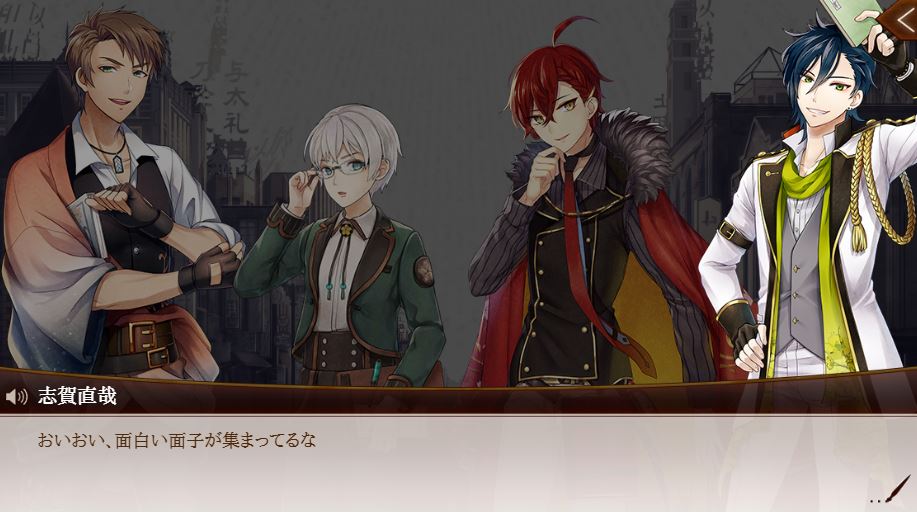
Naoya Shiga (young man with dark hair on the far right of the screen) was invited to discuss literature as "the god of novels.
After a short break, the players somehow managed to restore Dazai Osamu's tension. Then, Shigeharu Nakano, who had once gone outside the literature library, returns with the great writer Naoya Shiga. He was once a great writer who was even called the "God of Novels" for his concise, easy-to-read, and simple writing.
Naoya Shiga said, "The style of writing is the author's way of thinking and feeling. However, Osamu Dazai, who had a history with Shiga Naoya when he was active as a great writer, disagreed with his view. The two begin to argue. When Haruo Sato, who could not bear to watch, tried to stop them, the invader appeared and attacked the players, just as they had expected.
Episode 18 Differences of Opinion
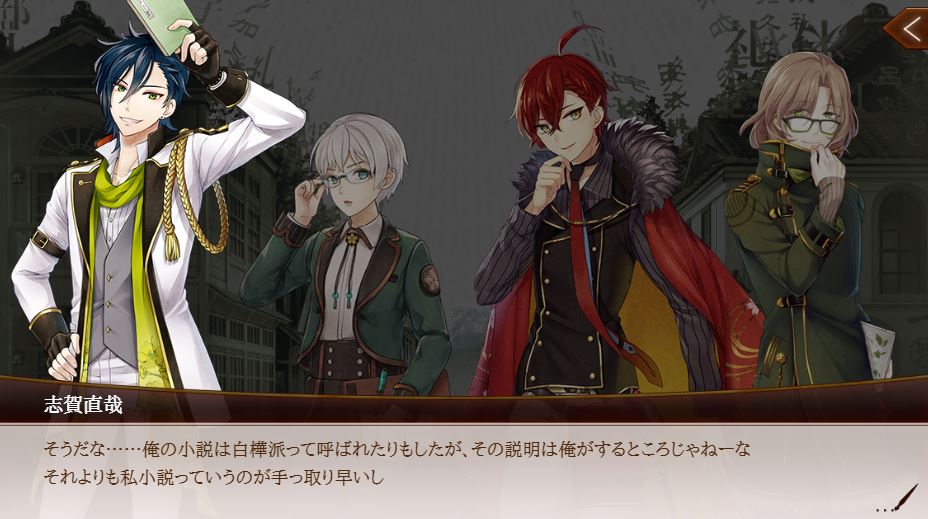
Naoya Shiga (young man with black hair, far left of screen) begins to explain to his friends about the "private novels" he was writing.
After defeating the invader, the players listen again to Naoya Shiga's story about "literature. Naoya Shiga tells them about the "private novels" he used to write. He said that his private novels, which he wrote based on experiences that happened around him and what he felt from them, sounded close to naturalism at first glance, but they were more productive than that. Naoya Shiga, who believes that what is important is that "the life of the one who reads what is created by his own experience will be changed," concludes that "literature is about 'human growth. Hearing this, however, Osamu Dazai countered that "literature is not such a lofty thing" and "it is something that accompanies even the weakest of people. The atmosphere once again becomes swarthy.
Later, after being admonished by Haruo Sato and Ao, Dazai Osamu leaves the literature book first, alone. Naoya Shiga also says, "I'm done talking," and tries to return to the library. Just before he does so, however, he suddenly remembers the existence of a great writer who cannot be left out when talking about "literature," and he tells the players about it.
Episode 19 The Beginning of Literature
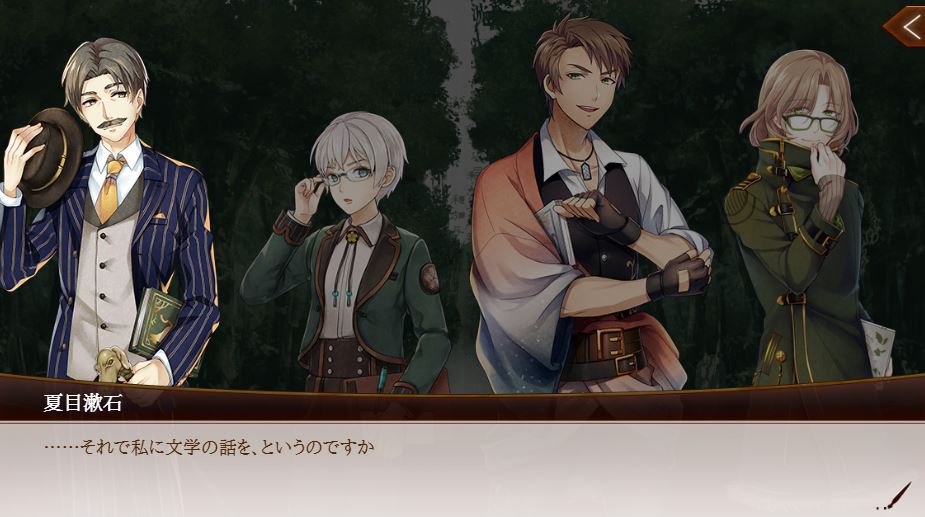
Soseki Natsume (the elderly gentleman on the far left of the screen), a great writer who was approached as a representative of the great writers of his day.
The players followed Naoya Shiga's advice and were approached by the great writer Soseki Natsume. After understanding the situation, Soseki Natsume told the players about the times in which he lived. Although it was not until the Meiji era that Natsume Soseki became active as a literary giant, he was born in the Edo period and lived across two different eras. During the Edo period, it was a rule that children were supposed to follow in their parents' footsteps, and they were not free to choose their own jobs. However, with the change of the times in the Meiji era, people gained freedom. However, many people were puzzled by the freedom that was suddenly given to them and were unable to give answers as to what they should do. Natsume Soseki explains to the players that most of the protagonists of novels are "young men who are troubled by the way of life" because the word "novel" was born when such worries and conflicts began to appear, and "that is why good literature touches the hearts of readers even if the times change.
Ao understands that literature and human beings are inseparable. At the same time, he realizes that the earlier quarrel between Naoya Shiga and Osamu Dazai developed because of their different "way of life. Soseki Natsume tells Ao that "everyone is that serious about their work," and Ao concludes that "artists are all idiots. Hearing this, Shigeharu Nakano laughs and says, "I can't argue with that.
Episode 20 Literature on How to Live / Disturbing Footsteps
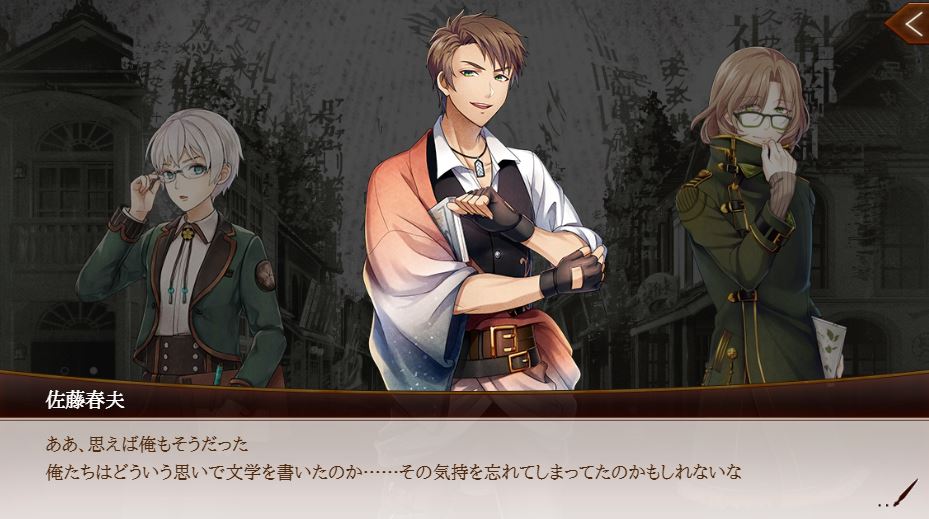
Haruo Sato (the young man in the middle of the screen) heard about Soseki Natsume and remembered how he and other great writers had written their literature.
Thanks to Soseki Natsume's story, the literary giants who were present at the event remembered what they were thinking when they wrote literature and showed a renewed attitude toward literature. Ao hypothesizes that "literary books are a concept similar to alchemy. He said that books of literature, which are filled with the spiritual energy of the great writers' strong feelings, may therefore easily influence other spiritual energies and be targeted by the invaders, who are a mass of emotions. Having obtained an answer, the players decided to take this hypothesis back to the director.
The players return to the library after defeating the invaders. Suddenly, they receive a message from Aka in the library. Surprised by Aka's impatient voice, "Something terrible has happened," the players decide to return to the library in a hurry.
new prologue
The new prologue starts the story after the player finishes purifying "Evil No Hana," the foreign literature that was subsequently implemented. After purifying "Evil Flowers," the player, a special librarian, takes a long vacation, but when he returns to the library, he meets Akio Tokuda and Kyoka Izumi, two great writers, who are holding an item he has never seen before.
The player also sees Ryunosuke Akutagawa, a great writer who has been defeated in the face of a new type of invader. In the player's absence, four new attributes of the invaders have emerged: fire, water, wind, and earth, and in order to combat them, the great writers must now wear costumes with these attributes. The items possessed by Tokuda Akio and Izumi Kyoka were items used to create costumes with these attributes.
Players will thus join with the great writers to fight against the invaders who have acquired new abilities, and investigate their true nature.

Contents
- Overview of "Bungo to Alchemist
- Synopsis and story of "The Bungo and the Alchemist"
- Old Prologue
- Literary Oddities Chapter 1
- Episode 1 Welcome to the Insulated Book
- Episode 2 Fight Against the Invaders
- Episode 3 Purge the Insulators
- Episode 4 The Curator's Command
- Episode 5 Find the Infiltrator
- Episode 6 The Ecology of the Invaders
- Episode 7 Causes of Erosion Phenomena
- Episode 8 The World of Literature / Victory
- Episode 9 Alchemy and Alchemists
- Episode 10 The Power of the Alchemist
- Episode 11 The Concept of the Infringer
- Episode 12 Chasing the Invaders/Rescue
- Literary Oddities, Chapter 2
- Episode 13 The World of Literature
- Episode 14 Naturalism
- Episode 15 Aestheticism
- Episode 16 Art Made of Words / Out of Order
- Episode 17 Private Novels
- Episode 18 Differences of Opinion
- Episode 19 The Beginning of Literature
- Episode 20 Literature on How to Live / Disturbing Footsteps
- new prologue
- Game System of "Bungo to Alchemist
- Library/Librarian's Office
- latent writing
- letter of invitation
- Sealed book
- Yuso Sho (book with a cover letter)
- The Book of the Soul (Yu-kon-sho)
- strolling
- credibility
- literary master
- formation
- blooming (esp. of cherry blossoms)
- spirit
- Calling
- picture book
- character sketch
- book of reminiscences
- research report
- interior
- Characters in "Bungo to Alchemist
- New Thought School (Shinshichouha)
- Ryunosuke Akutagawa
- Junichiro Tanizaki
- Yuzuru Matsuoka
- Yuzo Yamamoto
- Masao Kume
- Kan Kikuchi
- Burai-ha
- Osamu Dazai
- Ango Sakaguchi
- Sakunosuke Oda
- Kazuo Dan
- Kitahara Ichimon
- Kitahara Hakushu
- Sakutaro Hagiwara
- Saisei Murou
- Ichimon Ozaki
- Momiji Ozaki
- Kyoka Izumi
- Tokuda, Shusei
- Yoyuha (a group that can afford to lose money)
- Natsume Soseki
- Mori Ogai
- Shiki Masaoka
- Mita School (Mita-ha)
- Kafu Nagai
- Haruo Sato
- Rofu Miki
- Shirakaba-ha
- Naoya Shiga
- Mushanokouji Saneatsu
- Takeo Arishima
- Satomi Tonon
- proletarian
- Takiji Kobayashi
- Sunao Tokunaga
- Shigeharu Nakano
- New Sensory School
- Yasunari Kawabata
- Toshikazu Yokomitsu
- Emerging Artists (Shin Kougeijutsu-ha)
- Kajii Motojiro
- Ibuse Masuji
- Tatsuo Hori
- Myojo (bright star)
- Kotaro Takamura
- Ishikawa Takuboku
- Isamu Yoshii
- Araragi Faction (of the LDP)
- Sachio Ito
- Mokichi Saito
- Natsume Kadokoro
- Miekichi Suzuki
- Uchida Hyakken
- Masaoka Ichimon
- Kyoshi Takahama
- Hekigoto Kawahigashi
- Soun
- Taneda Santoka
- Hosai Ozaki
- Factionless writers
- Nakahara Chuya
- Kenji Miyazawa
- Toson Shimazaki
- Tayama Hanabukuro
- Kazuo Hirotsu
- Rampo Edogawa
- TSUBOUCHI Shoyo
- Futabatei Shimei
- Atsushi Nakajima
- Koizumi Yakumo
- Wakayama Makisui
- Kunikida Doppo
- Rohan Koda
- Eiji Yoshikawa
- Iwano Houmei
- Masamune Swan
- Roka Tokutomi
- Sanjuugo Naoki
- Hisasaku Yumeno
- Nakazato Kaizan
- Tatsuji Miyoshi
- Nankichi Niimi
- Mimei Ogawa
- Bi Myo Yamada
- Shinpei Kusano
- Nobuo ORIGUCHI, Shinobu
- Kunio Yanagita
- Seijiro Shimada
- Kitamura Torutani
- Russia
- Lev Tolstoy.
- Fyodor Dostoevsky.
- Germany
- Johann Wolfgang von Goethe
- France
- Charles Baudelaire
- Artur Rambo.
- America
- Ernest Hemingway.
- Francisco Scott Fitzgerald
- Edgar Allan Poe.
- Howard Phillips Lovecraft
- United Kingdom
- Conan Doyle.
- Lewis Carroll.
- Imperial Library staff
- director
- cat
- (in hanafuda) the collection of the three red poetry ribbon cards
- blue
- Faust
- enemy character
- corruptor
- Mephistopheles (book of the Bible)
- Items from "Bungo to Alchemist
- Costume
- statue
- gaily coloured statue
- Summation stone
- Western ink
- letter
- Flowering Materials
- Fumitama
- Omodama
- The soul of a word (kataridama)
- Tamashii no Haguruma (Soul Gears)
- Fuminohana
- Omoi-no-hana
- Katanohana
- Yuso Sho (book with a cover letter)
- The Book of the Soul (Yu-kon-sho)
- Kakusei no Yubi (Ring of Awakening)
- Speed regulator
- gold coin
- Interior permits
- Reishi (spiritual medicine)
- cat's paw
- Terms of "Bungo to Alchemist
- Alchemist / Special Librarian
- National Library of Japan
- Imperial Library
- literary master
- man of letters
- assistant
- government
- association
- arms
- attribute
- literary level
- Costume Level
- erosion
- spirit
- The Art of the Brush Slayer
- advent
- The Essence of the Double Brush (Souhitsu Shinsei)
- early great writers
- great writer
- Yaiba Bungo
- Yumi Bungo
- Guns, Literature, and the Arts
- whip (whip) writer
- Famous quotes, lines/scenes, and scenes from "Bungo to Alchemist
- Ryunosuke Akutagawa: "Don't forget that life is a fight to the death."
- Osamu Dazai: "Oh, Akutagawa-sensei said he wanted to read my work! No way, this is called ...... pulse!"
- Masuji Ibushi: "The main character of a novel should be half-hearted. It's more realistic and interesting that way.
- Backstories, trivia, and small stories/episodes and anecdotes from "Bungo to Alchemist".
- The manuscript depicted in the background of the work contains a passage from a real novel.
- Recollection of a once defunct cafeteria
- Wife of musician Hideki Sakamoto is a fan of DMM Games' works
- Theme and insert songs for "Bungo to Alchemist
- Theme song: "Bungo to Alchemist" by Hideki Sakamoto