
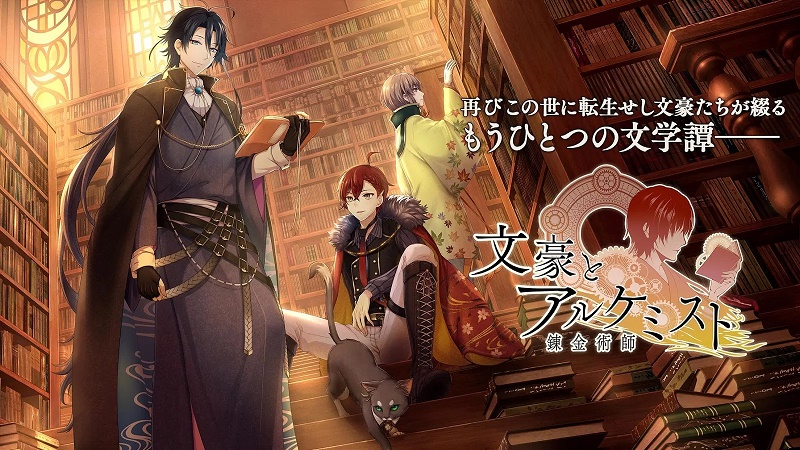
Bungo to Alchemist" (abbreviated as "Bungo and Alchemist") is a training simulation game based on the theme of "Bungo". Developed and operated by the gaming platform DMM Games, the browser version was released in November 2016, and the smartphone version was released the following year in June 2017. The story is set in Japan, which has a different history from reality, based on Taisho Romanticism and Steampunk. In order to protect literature from enemies known as "invaders," players reincarnate literary giants and fight alongside them against these invaders.
CV: Kenji Nojima
The character is modeled on Sakutaro Hagiwara, a poet active from the Taisho to Showa periods. His representative works include "Tsuki no Howl" and "Blue Cat. As a poet who created new possibilities for poetry, he is known as the "father of modern Japanese poetry. He also wrote novels and essays. His weapon of choice when writing undercover is a gun. In his normal costume, his attribute is earth. His mental state is unstable.
He is a young man with the opposite traits of a misanthrope and a lonely person. The reason for this characterization seems to be that Sakutaro Hagiwara, the original character, had a "solitude habit. However, his fans speculate that he is not a misanthrope but simply has trouble communicating with others, judging from his words and actions in his works. In fact, he shows a friendly attitude toward those whom he has once allowed himself to get to know, and he has interacted with various poets who appear in "Bun'alu. He is especially close with his teacher, the poet Kitahara Hakushu, and his ally, the poet Muroo Saisei. He is also on good terms with the poet Tatsuji Miyoshi, who was his student before his reincarnation. He also maintains a good relationship with Ryunosuke Akutagawa, a great writer who was also a friend of his before his reincarnation. He is on good terms with Edogawa Rampo, a great writer who was a great fan of detective novels and magic tricks. On the other hand, he still seems to have a dislike for the poet Rofu Miki, whom he has disliked since before his reincarnation. As evidence of this, he is described in "Bunnaru" as intentionally keeping his distance from her.
As a poet, he has more ideals about poetry than anyone else and continues to pursue them. He is known as the "father of modern Japanese poetry," and his ability as a poet is solid, but he does not think so. In fact, he often expresses his low self-esteem in his works. He is not interested in anything other than poetry, and his personal life is noticeably sloppy, as evidenced by the fact that he leaves his sleeping habits on and does not tie his kimono obi properly. He also seems to have poor motor skills and, according to the official, "often trips over something.
Saisei Murou
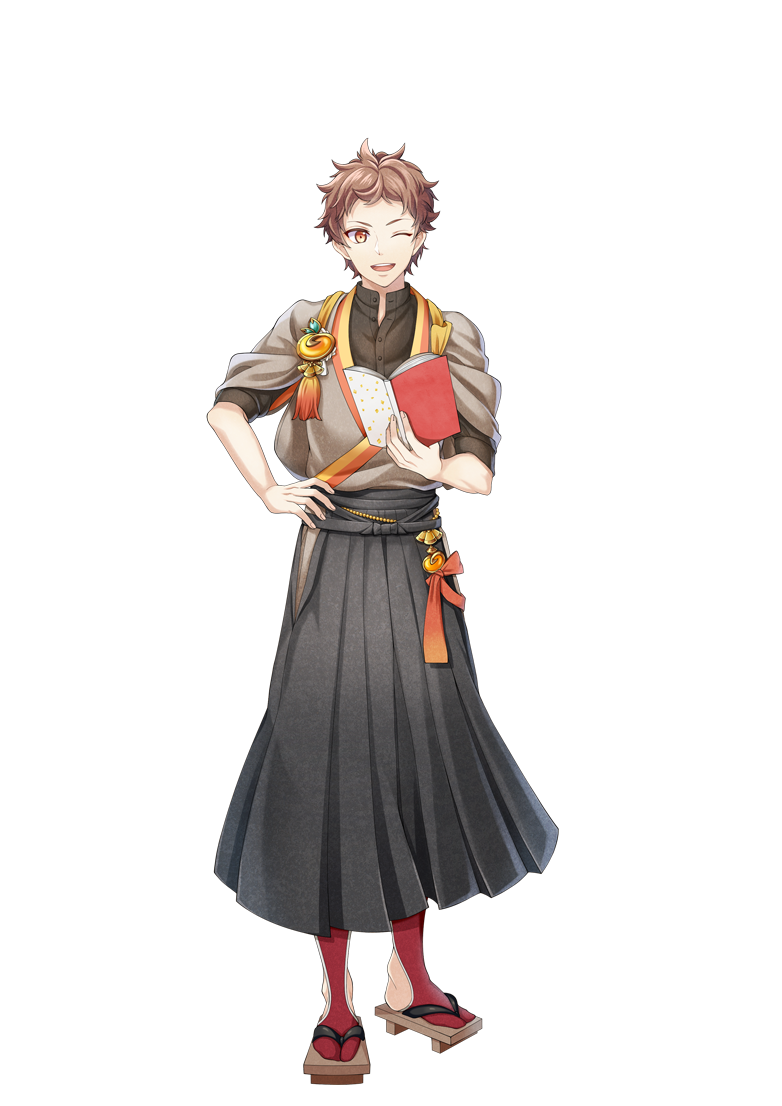
CV: Ryota Osaka
A character modeled after Saisei Muroo, a poet and writer of pure literature active from the Taisho to Showa periods. His representative works include "Ai no shishu (Love Poems)," "Lyric Pieces," and "Ani imouto. The novel "Ani imouto" is also a popular work that has been made into a movie and a TV drama. Her weapon of choice when she is in her undercover costume is a gun. In her normal costume, her attribute is earth. Her mental state is somewhat stable.
He is a young man with an honest and unaffected personality. He loves his hometown, Kanazawa, and introduces himself as "the poet of Kanazawa" in his new life. He calls himself a "wild child who grew up in nature," and his vivacious personality seems to derive from this upbringing. He is concerned about the fact that he looks like a middle-aged boy when he is reincarnated, and his short stature is officially stated as "a complex. Outside of Kanazawa, he is fond of cats. This is because the original character, Saisei Muroo, was a cat lover.
He still admires his teacher, Kitahara Hakushu, even after his reincarnation, and often asks for lessons from him and the poet Hagiwara Sakutaro, who is from the same school. He and Sakutaro Hagiwara are close allies, and they have such a deep bond that even Kitahara Hakushu calls them "two souls in one. The official explanation is that "anyone who cries for him is unforgivable. He is also a good-natured person and cannot overlook those in need. For this reason, he often takes care of Sakutaro Hagiwara, who is indifferent to his personal life and is a misanthrope and lonely person.
He is good friends with Ryunosuke Akutagawa and Tatsuo Hori, who were great writers before their reincarnation. In addition, he is admired by the great writer Sakunosuke Oda. This is because he was the person who discovered Saisei Muroo's talent when he was working as a poet and writer.
Ichimon Ozaki
A group of great writers who took Ozaki Momiji (尾崎紅葉), a great writer, as their teacher. At the time in his twenties, Momoyo Ozaki had a large number of disciples. In particular, four representative disciples are called the "Four Heavenly Kings under Mozakimon (Ozakimon). In "Bunnaru," in addition to Momiji Ozaki himself, Kyoka Izumi and Akio Tokuda, two of the Four Heavenly Kings under Momon, are included as part of the Ozaki clan.
In addition, other factions have also included writers who studied under Ozaki Momiji, although they are not included in this grouping.
Momiji Ozaki
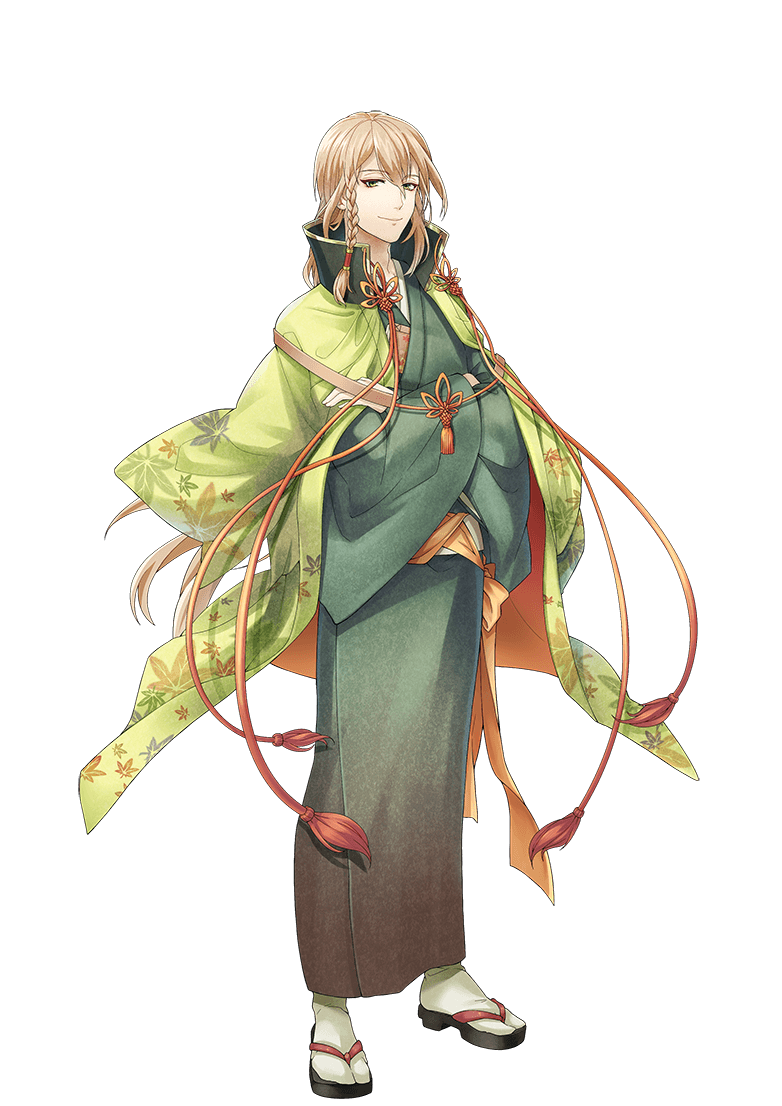
CV: Hikaru Midorikawa
This character is modeled after the great writer Ozaki Momiji, who was active in the Meiji era (1868-1912). He was a novelist who wrote popular novels, and his representative works include "Tajo Tajo", "Nijinbikuni-shiki Penance", and "Konjikinyasha". Her weapon of choice when writing undercover is a whip. In her normal costume, her attribute is earth. Her mental state is stable.
He is a great writer who had many disciples when he was in his 20s. He is a caring young man who has the dexterity to handle any situation with ease. He seems to have kept in touch with his former disciples, especially with Kyoka Izumi and Akio Tokuda, who were counted among his four most famous disciples, the Four Heavenly Kings under Ozakimon (Ozaki Mon). He also seems to be in friendly competition with his rival, the great writer Koda Rohan, with whom he continues to work hard. Thanks to his deep pockets, he is also able to interact with a wide variety of people, whether it be mischievous pranksters or difficult-to-get-together literary giants. His mischievous side, in fact, is one of the reasons why he is so easily approachable.
Even so, he seems to have a non-negotiable attitude toward food, and will not eat anything he doesn't like, no matter what it is. Some people call him "hag" because of his beautiful appearance, and some voices are angry at him saying, "Who's hag?
Kyoka Izumi
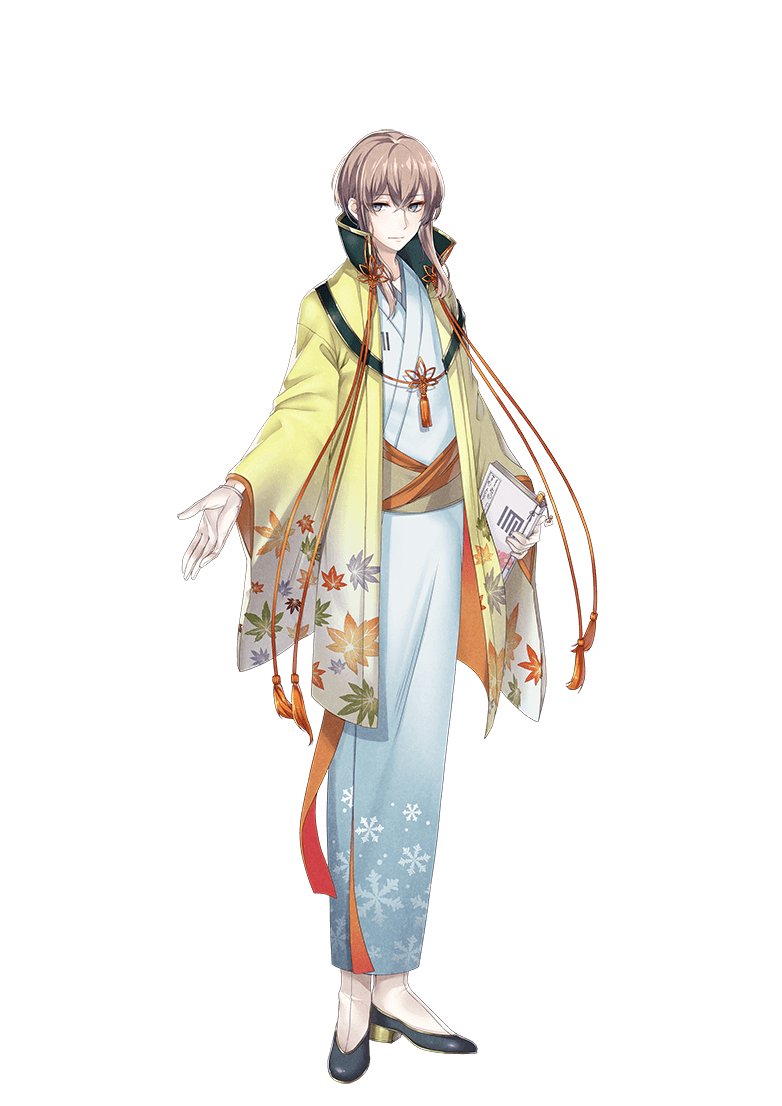
CV: Hiroshi Kamiya
The character is modeled on Kyoka Izumi, a literary giant active from the Meiji to Showa eras. A famous novelist and pioneer of fantasy literature that depicts things that cannot exist in reality, his representative works include "The Tale of the Heavenly Guard", "Koya Sei", and "Fukeizu". He also produced plays and haiku. Her weapon of choice when writing undercover is a sword. In her normal costume, her attribute is water. Her mental state is somewhat stable.
Contrary to his calm appearance, he is a strong and fastidious young man. His fastidiousness is so extreme that it is not an exaggeration to say that he "always wears clean gloves," "never touches things with his bare hands," and "is not satisfied until he has cooked his food again, even if it has already been cooked once before. It is assumed that this is based on an episode in which Kyoka Izumi, the model for the character, suffered from dysentery (sekiri), a disease that destroyed her stomach and intestines, and since then she has become an extreme germophobe. In addition, there is another setting that is closely related to the model: "Her hobby is collecting rabbit goods. The reason for this seems to be that Kyoka Izumi, the original author of the story, was obsessed with rabbit goods throughout her life. It is so famous among those who know Kyoka Izumi that even her literary monuments are made in the shape of rabbits. In "Bunnaru," she is depicted as using fantastic metaphors such as "the world of the spirit of words" and "the space between dreams and reality" to describe the inside of books she was writing undercover, as if she were a literary master who was creating "fantasy literature.
He has sworn allegiance to his master, the great writer Momiji Ozaki, and what he says is absolute. He will not tolerate anyone who is an enemy of his master, no matter how famous he may be. He has a harsh attitude toward Tokuda Akio, a literary master who is his younger apprentice and a member of the same school. This seems to be due to a quarrel she had with him before her reincarnation, and Izumi Kyoka herself seems to have no small amount of regret over it. Izumi Kyoka herself seems to have some regrets about this. She is also in contact with various great writers outside the Ozaki clan.
Tokuda, Shusei
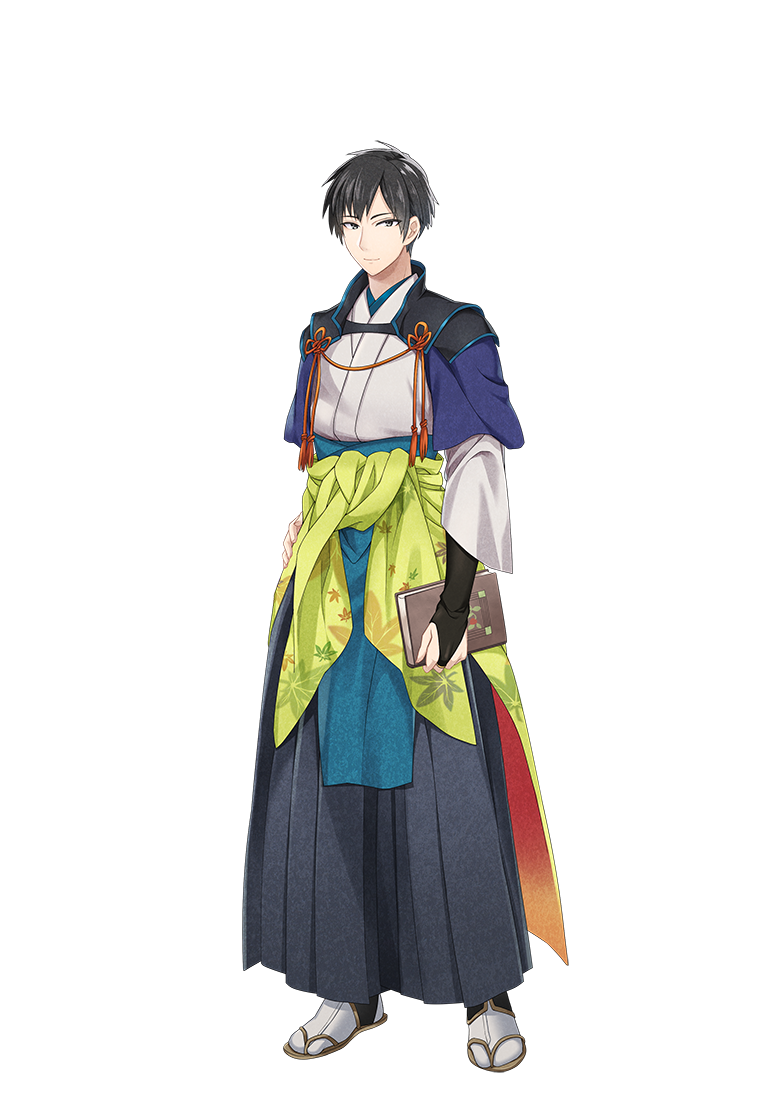
CV: Takumi Watanabe
This character is modeled after Tokuda Akiyoshi, a great writer active from the Meiji era to the Showa era. Although he was a writer of pure literature, he came to be known as a writer of naturalistic literature because of his style and the "naturalistic literature" that appeared later. His representative works include "Mold," "Arakure," and "Shikuzu. His weapon of choice when writing undercover is the bow. In her normal costume, her attribute is wind. Her mental state is somewhat unstable.
He is a hard-working young man with a tendency to be overshadowed by others and to have a hard time. He is a hard-working young man, but he is also a bit of a hard-worker. In fact, Tokuda's literary ability was such that he was counted as one of the "Four Heavenly Kings" representing the students of the Ozaki clan, but because of his realistic and unassuming style, he was overshadowed by the other three. Perhaps feeling inferior to the other three, he is concerned about his lack of presence and shadow. He also has a cynical side with low self-esteem, perhaps because he was once rejected by Momiji Ozaki and was pushed around by his brother Kyoka Izumi. According to his voice in "Bun'alu," he yearns for "talent" that he does not possess. He seems to have a good relationship with the members of Ozaki's clan, but he does not seem to have a good relationship with Momiji Ozaki and Kyoka Izumi because of the above-mentioned incident. In particular, he and Kyoka Izumi had a bitter dispute before her death, which has left a lingering stain on their relationship. However, he does not lack respect for his teacher, and although he considers Kyoka Izumi a nagging partner, he does not dislike her, as can be seen from his words and actions in the work.
In addition, he is often in the company of literary giants belonging to the naturalistic literature. Among them, she seems to have a close relationship with the poet Toson Shimazaki, with whom she has been friends since before her reincarnation. It was Shimazaki Toson who supported Akiyoshi Tokuda, who was in the doldrums as a writer before his reincarnation. Also, the great writer Kawabata Yasunari is a fan of Tokuda Akiyoshi and seems to adore him. However, Kawabata Yasunari himself is taciturn and rarely speaks to Tokuda Akiyoshi. He is more likely to stare at him silently, and Tokuda Akio himself seems to be at a loss as to how he should treat him.
Among the many great writers, Tokuda Akiyoshi is one of the tutorial writers who can always be reincarnated when starting "Bunn-Aru". He first appeared in the "Old Prologue," the main scenario released when "Bunn-Al" was first released, as the first player to be reincarnated. Many players are attached to him as a literary master who has been with them since the beginning, separate from the "initial literary masters" that can be selected during game play.
Yoyuha (a group that can afford to lose money)
A faction that existed before World War II. It is said to have originated from a sentence written by the great writer Natsume Soseki in his novel "Chicken Head" by Takahama Kyoshi: "A novel with room to spare. This was in direct contrast to the naturalistic literature of the time, which depicted the harshness of reality and the ugliness of human nature as they were. For this reason, the term "Marginalists" was used by the great writers of naturalistic literature as a somewhat derogatory term.
There are also such terms as "Teikaiha," "Haikaiha," and "Shaseibunha.
Natsume Soseki
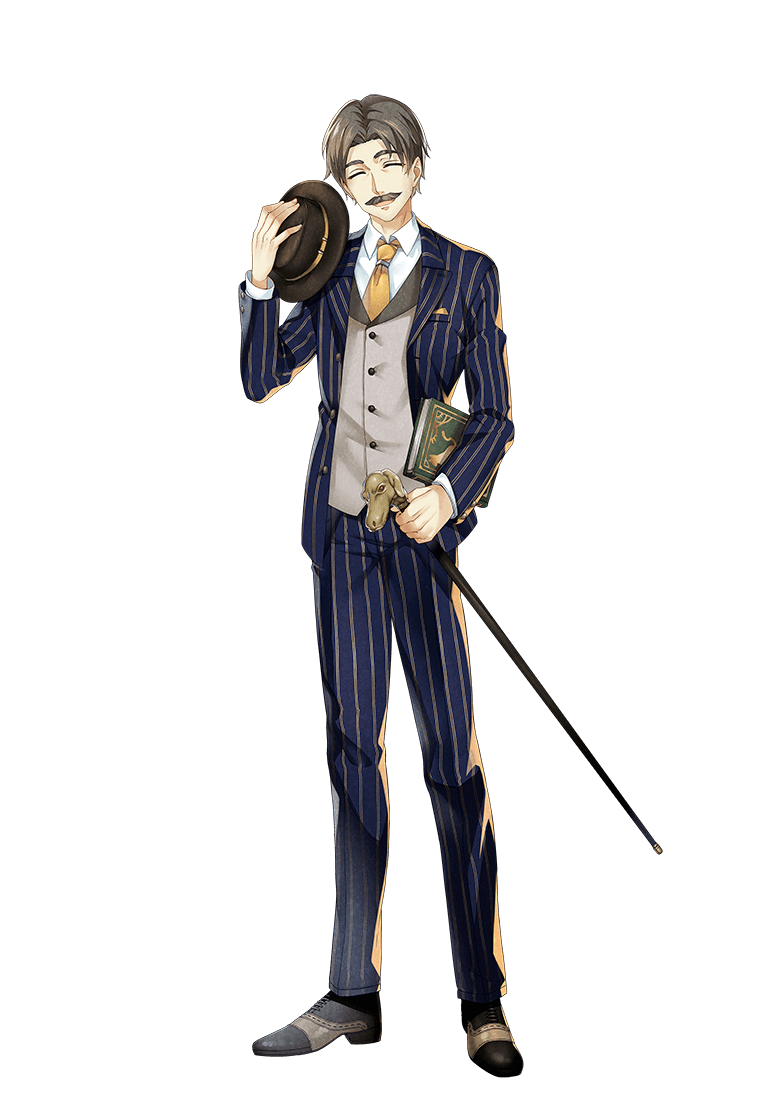
CV: Kosuke Toriumi
The character is modeled on Soseki Natsume, a great writer active during the Meiji and Taisho eras. His representative works of pure literature include "I am a Cat", "Kokoro", and "Botchan". His weapon of choice when undercover is a blade. In her normal costume, her attribute is earth. Her mental state is somewhat unstable.
While many great writers are reincarnated as young men, Soseki Natsume was unusually reincarnated as an older man. The reason for this appearance is unknown, but it is assumed to be due to the fact that the face of Soseki Natsume printed on the real bills was an older one, and that he himself made his debut as a writer late in life.
Usually a gentle gentleman, he is a mature man with a great sense of humor. Even before his reincarnation, he was admired by many great writers. After his reincarnation, he has continued to interact with various great writers and is as well-liked as he was before his reincarnation. He is still in good terms with Shiki Masaoka, a haiku master and close friend of his after his reincarnation. She also treats not only the great writers, but also the special librarians equally, and she responds to their questions about "literature" with sincerity.
On the other hand, she is also sensitive. In front of his friends who know him well, he sometimes shows his weakness. The story of Soseki Natsume, who studied abroad and suffered a nervous breakdown due to stress, is thought to have been inspired by this story.
Another deeply related story is that of the model's "unrivaled sweet tooth. Soseki Natsume, the model for the character, was a famous writer with a sweet tooth who had an insatiable appetite for both Japanese and Western sweets, and it is said that if he received a sweet treat, he would eat it all by himself without telling his family. In "Bun'ar," he is also depicted eating both Japanese and Western sweets, and some of the events that are held regularly are based on his sweet tooth.
Mori Ogai
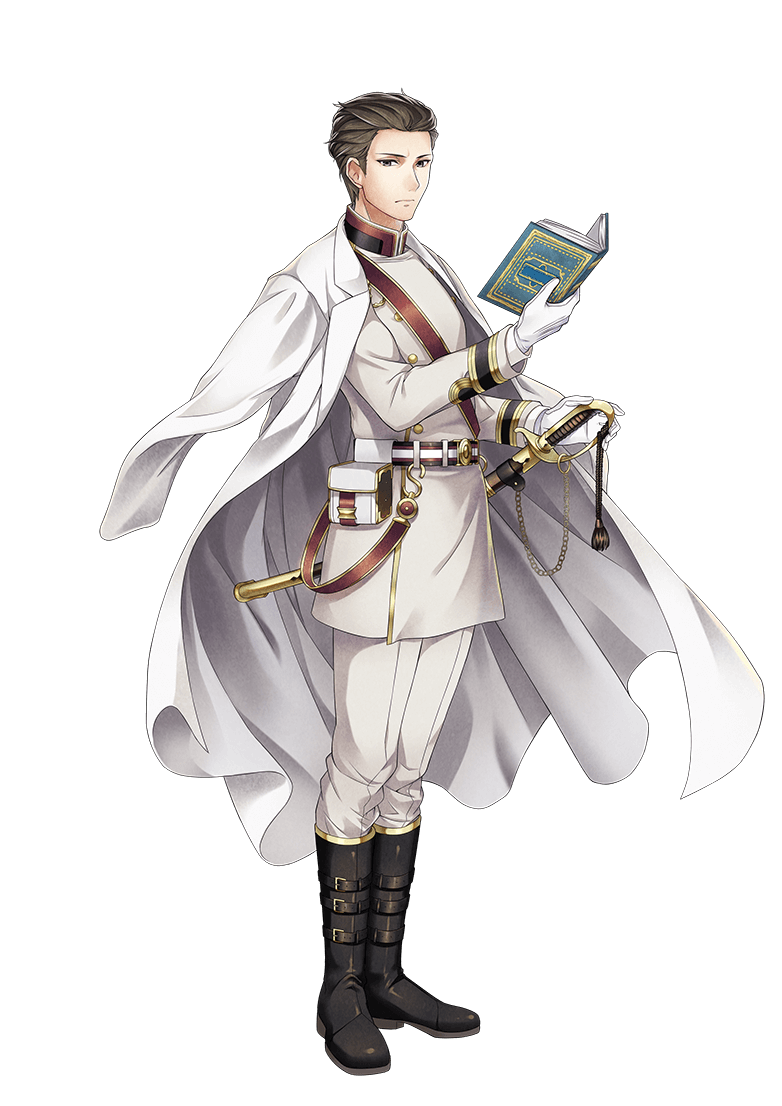
CV: Toru Okawa
The character is modeled on Mori Ogai, a great writer active during the Meiji and Taisho eras. His representative works of pure literature include "Maihime," "Wild Geese," and "Sansho-tayu. He was also active as a military doctor and published various papers as a physician. There was a time when he was appointed as a commissioner of military medicine in the army and director of the medical bureau of the Ministry of the Army. His weapon of choice when undercover writing is a blade. In his normal costume, his attribute is earth. His mental state is somewhat stable.
He is a serious male character with a strong sense of responsibility. Perhaps because he used to be a military doctor, he is concerned about the writers who tend to get sick, and sometimes takes care of them. Some of the great writers come to him for medicine and money because he is a doctor, but he somehow manages to evade their requests every time. He seems to consider his work as a doctor and his work as a writer separately, and becomes grumpy if you call him by his writer's name "Ogai" while he is working as a doctor.
He is a germophobe on a level second only to the great writer Izumi Kyoka, who was also a germophobe. This is thought to be based on the fact that his model, Mori Ogai, became a germophobe as a result of studying cutting-edge bacteriology in Germany, fearing the bacteria that can grow on food. Another setting closely related to the same model is that of a sweet tooth. He has the same sweet tooth as Soseki Natsume, a great writer and a representative of the sweet-toothed literary giants, but he also had a picky eater, so he has a different sweet tooth from Soseki Natsume. In "Bun'al", he ate manju chazuke (a mixture of manju and ochazuke), a dish that is representative of his eccentric eating episodes.
However, it is also true that he is a highly skilled writer, and many great writers admire him. He is admired by many famous people such as Ryunosuke Akutagawa, Soseki Natsume, and Rohan Koda, who are often regarded as representatives of great writers, and he is able to discuss literature with them on an equal footing.
Shiki Masaoka

Contents
- Overview of "Bungo to Alchemist
- Synopsis and story of "The Bungo and the Alchemist"
- Old Prologue
- Literary Oddities Chapter 1
- Episode 1 Welcome to the Insulated Book
- Episode 2 Fight Against the Invaders
- Episode 3 Purge the Insulators
- Episode 4 The Curator's Command
- Episode 5 Find the Infiltrator
- Episode 6 The Ecology of the Invaders
- Episode 7 Causes of Erosion Phenomena
- Episode 8 The World of Literature / Victory
- Episode 9 Alchemy and Alchemists
- Episode 10 The Power of the Alchemist
- Episode 11 The Concept of the Infringer
- Episode 12 Chasing the Invaders/Rescue
- Literary Oddities, Chapter 2
- Episode 13 The World of Literature
- Episode 14 Naturalism
- Episode 15 Aestheticism
- Episode 16 Art Made of Words / Out of Order
- Episode 17 Private Novels
- Episode 18 Differences of Opinion
- Episode 19 The Beginning of Literature
- Episode 20 Literature on How to Live / Disturbing Footsteps
- new prologue
- Game System of "Bungo to Alchemist
- Library/Librarian's Office
- latent writing
- letter of invitation
- Sealed book
- Yuso Sho (book with a cover letter)
- The Book of the Soul (Yu-kon-sho)
- strolling
- credibility
- literary master
- formation
- blooming (esp. of cherry blossoms)
- spirit
- Calling
- picture book
- character sketch
- book of reminiscences
- research report
- interior
- Characters in "Bungo to Alchemist
- New Thought School (Shinshichouha)
- Ryunosuke Akutagawa
- Junichiro Tanizaki
- Yuzuru Matsuoka
- Yuzo Yamamoto
- Masao Kume
- Kan Kikuchi
- Burai-ha
- Osamu Dazai
- Ango Sakaguchi
- Sakunosuke Oda
- Kazuo Dan
- Kitahara Ichimon
- Kitahara Hakushu
- Sakutaro Hagiwara
- Saisei Murou
- Ichimon Ozaki
- Momiji Ozaki
- Kyoka Izumi
- Tokuda, Shusei
- Yoyuha (a group that can afford to lose money)
- Natsume Soseki
- Mori Ogai
- Shiki Masaoka
- Mita School (Mita-ha)
- Kafu Nagai
- Haruo Sato
- Rofu Miki
- Shirakaba-ha
- Naoya Shiga
- Mushanokouji Saneatsu
- Takeo Arishima
- Satomi Tonon
- proletarian
- Takiji Kobayashi
- Sunao Tokunaga
- Shigeharu Nakano
- New Sensory School
- Yasunari Kawabata
- Toshikazu Yokomitsu
- Emerging Artists (Shin Kougeijutsu-ha)
- Kajii Motojiro
- Ibuse Masuji
- Tatsuo Hori
- Myojo (bright star)
- Kotaro Takamura
- Ishikawa Takuboku
- Isamu Yoshii
- Araragi Faction (of the LDP)
- Sachio Ito
- Mokichi Saito
- Natsume Kadokoro
- Miekichi Suzuki
- Uchida Hyakken
- Masaoka Ichimon
- Kyoshi Takahama
- Hekigoto Kawahigashi
- Soun
- Taneda Santoka
- Hosai Ozaki
- Factionless writers
- Nakahara Chuya
- Kenji Miyazawa
- Toson Shimazaki
- Tayama Hanabukuro
- Kazuo Hirotsu
- Rampo Edogawa
- TSUBOUCHI Shoyo
- Futabatei Shimei
- Atsushi Nakajima
- Koizumi Yakumo
- Wakayama Makisui
- Kunikida Doppo
- Rohan Koda
- Eiji Yoshikawa
- Iwano Houmei
- Masamune Swan
- Roka Tokutomi
- Sanjuugo Naoki
- Hisasaku Yumeno
- Nakazato Kaizan
- Tatsuji Miyoshi
- Nankichi Niimi
- Mimei Ogawa
- Bi Myo Yamada
- Shinpei Kusano
- Nobuo ORIGUCHI, Shinobu
- Kunio Yanagita
- Seijiro Shimada
- Kitamura Torutani
- Russia
- Lev Tolstoy.
- Fyodor Dostoevsky.
- Germany
- Johann Wolfgang von Goethe
- France
- Charles Baudelaire
- Artur Rambo.
- America
- Ernest Hemingway.
- Francisco Scott Fitzgerald
- Edgar Allan Poe.
- Howard Phillips Lovecraft
- United Kingdom
- Conan Doyle.
- Lewis Carroll.
- Imperial Library staff
- director
- cat
- (in hanafuda) the collection of the three red poetry ribbon cards
- blue
- Faust
- enemy character
- corruptor
- Mephistopheles (book of the Bible)
- Items from "Bungo to Alchemist
- Costume
- statue
- gaily coloured statue
- Summation stone
- Western ink
- letter
- Flowering Materials
- Fumitama
- Omodama
- The soul of a word (kataridama)
- Tamashii no Haguruma (Soul Gears)
- Fuminohana
- Omoi-no-hana
- Katanohana
- Yuso Sho (book with a cover letter)
- The Book of the Soul (Yu-kon-sho)
- Kakusei no Yubi (Ring of Awakening)
- Speed regulator
- gold coin
- Interior permits
- Reishi (spiritual medicine)
- cat's paw
- Terms of "Bungo to Alchemist
- Alchemist / Special Librarian
- National Library of Japan
- Imperial Library
- literary master
- man of letters
- assistant
- government
- association
- arms
- attribute
- literary level
- Costume Level
- erosion
- spirit
- The Art of the Brush Slayer
- advent
- The Essence of the Double Brush (Souhitsu Shinsei)
- early great writers
- great writer
- Yaiba Bungo
- Yumi Bungo
- Guns, Literature, and the Arts
- whip (whip) writer
- Famous quotes, lines/scenes, and scenes from "Bungo to Alchemist
- Ryunosuke Akutagawa: "Don't forget that life is a fight to the death."
- Osamu Dazai: "Oh, Akutagawa-sensei said he wanted to read my work! No way, this is called ...... pulse!"
- Masuji Ibushi: "The main character of a novel should be half-hearted. It's more realistic and interesting that way.
- Backstories, trivia, and small stories/episodes and anecdotes from "Bungo to Alchemist".
- The manuscript depicted in the background of the work contains a passage from a real novel.
- Recollection of a once defunct cafeteria
- Wife of musician Hideki Sakamoto is a fan of DMM Games' works
- Theme and insert songs for "Bungo to Alchemist
- Theme song: "Bungo to Alchemist" by Hideki Sakamoto