
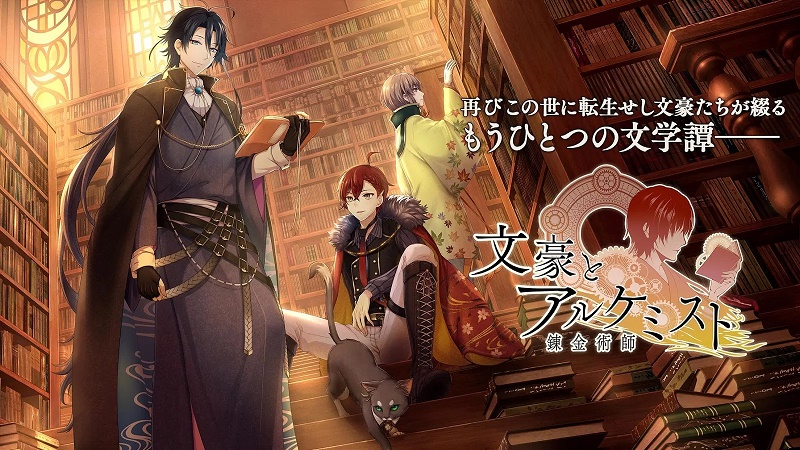
Bungo to Alchemist" (abbreviated as "Bungo and Alchemist") is a training simulation game based on the theme of "Bungo". Developed and operated by the gaming platform DMM Games, the browser version was released in November 2016, and the smartphone version was released the following year in June 2017. The story is set in Japan, which has a different history from reality, based on Taisho Romanticism and Steampunk. In order to protect literature from enemies known as "invaders," players reincarnate literary giants and fight alongside them against these invaders.
CV: Yuichi Iguchi
The character is modeled on the poet and novelist Ito Sachio, who was active during the Meiji and Taisho eras. His representative works include "Wild Chrysanthemum Blossoms," "The Wife Next Door," and "Spring Lake. He is also famous as the heir to the skills of the haiku poet Masaoka Shiki. His weapon of choice when undercover writing is a gun. In normal costume, her attribute is wind. His mental state is normal.
He is a boy who loves flowers and cows. According to the official story, as a result of his love for flowers and cows, he "knows the names of flowers and the language of flowers" and "keeps a cow outside the library.
His love of flowers and cows is presumably due to the fact that his model, Sakio Ito, created works using subjects related to flowers and cows, and that he was in the milking business before becoming a poet and novelist.
She has a calm and laid-back personality and is young for her external age. On the other hand, he seems to have a firm confidence in his own abilities, and believes that he is the one who has inherited the techniques and sketches created by his teacher, Masaoka Shiki. Although he looks very young, his model, Ito Sachio, was older than Masaoka Shiki. It is unclear why Ito Sakio was younger in appearance than Masaoka Shiki.
Masaoka Shiki called him by the nickname "Satchi," and he was adored by him as his pupil. He is also close with his disciples, Kyoshi Takahama and Hekigoto Kawahigashi, who are both literary giants and literary connoisseurs, although they belong to different factions. He is impressed by the poet Shigekichi Saito, who is also a member of the Araragi school and his own disciple, because of the way he continued to work as a poet even though he was busy with his dual job as a doctor.
Mokichi Saito
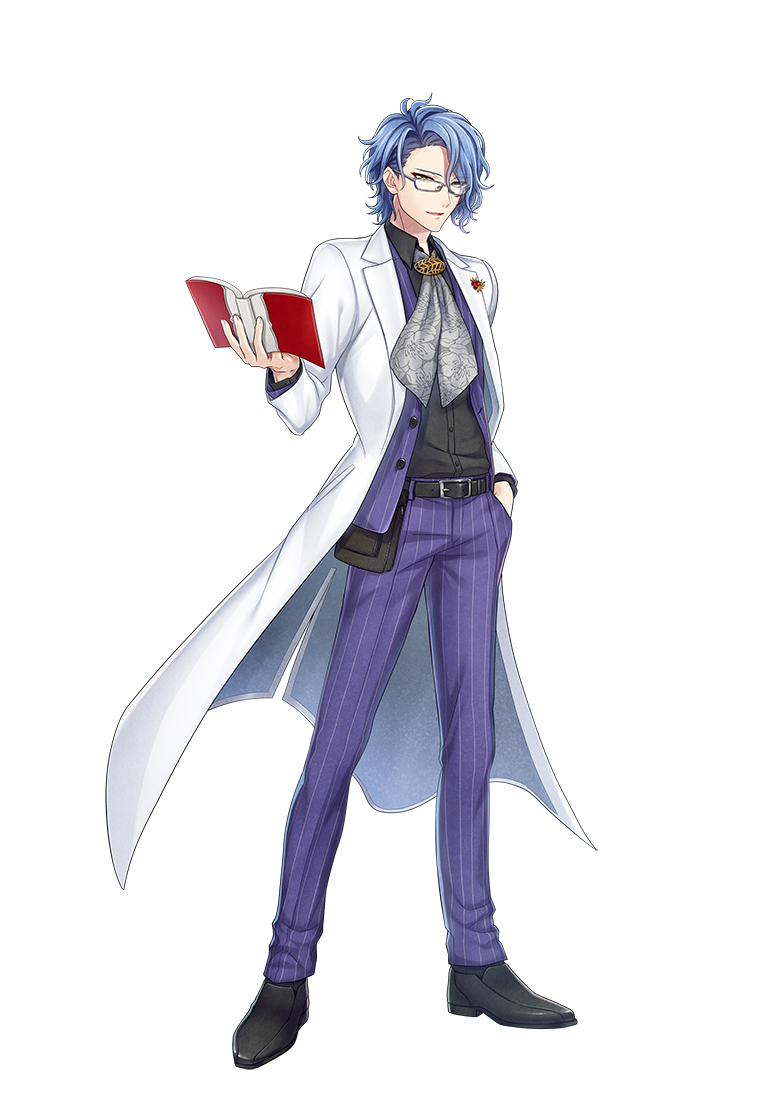
CV: Takahiro Sakurai
The character is modeled on the poet and songwriter Mokichi Saito, who was active from the Meiji era to the Showa era. His representative works include "Akamitsu", "Kakinomotojinmaro", and "Tomoshibi". He was also active as a psychiatrist. His weapon of choice when undercover is a gun. In his normal costume, his attribute is fire. Her mental state is normal.
He is a serious young man who is strict with himself and others. He is not without a sense of humor, but even when he makes jokes, he speaks in a serious manner, which confuses those around him. In fact, he has a side that loves to argue, and he shows a belligerent attitude in situations where it is possible to argue. When he was active as a writer, some writers distanced themselves from him because of this personality.
He has a bit of an angry streak, but as he was a poet and a doctor, he knew people in both capacities. Many of the great writers were mentally ill, and he took care of many of them. The great writer Mori Ogai, who was a doctor as well as a novelist, highly evaluated him as both a poet and a doctor.
He respected not only his teacher, the poet Ito Sa-chio, but also his teacher, the haiku poet Masaoka Shiki, and would not tolerate anyone who had anything bad to say about them. He has a good relationship with Shigeharu Nakano, a great writer, after his reincarnation because he admires Shigeharu Nakano's works. In addition, the historical Shigeharu Nakano, perhaps because of his love for Shigekichi Saito's works, wrote a critical book about Shigekichi Saito himself, "Saito Shigekichi noto" (or "Shigekichi Saito notebook").
Natsume Kadokoro
A faction of great writers who studied under the great writer Soseki Natsume. This terminology is only used in the "Bun'ar" work.
Natsume Soseki also had a group called the "Thursday Club," where those who sought his teachings gathered. At these gatherings, writers who wanted to learn from Soseki and his students from the time when he was a teacher met every Thursday to discuss various literary topics. In addition to the great writers under Natsume's tutelage, many of the great writers from other factions of "Bunnaru" also belonged to this group.
Miekichi Suzuki
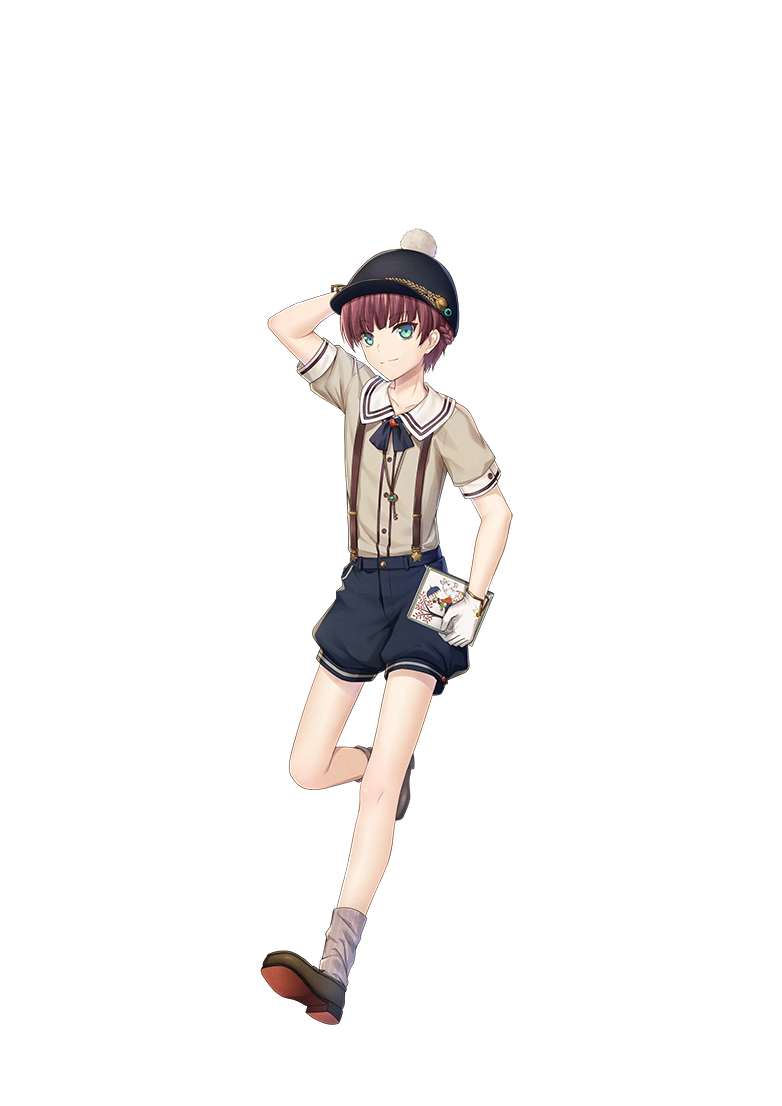
CV: Yuki Yoneuchi
The character is modeled on Miekichi Suzuki, a great writer active from the Meiji era to the Showa era. He was very active as a writer of novels and children's literature, and is also famous as the founder of the children's magazine Akai Tori. Because of his significant contributions to children's literature, he was also called the "father of the children's culture movement. His representative works include "Chidori," "Kuwa no Mi," and "Kosui no Onna. He was also active as a psychiatrist. Her weapon of choice when undercover is a gun. In her normal costume, her attribute is fire. Her mental state is normal.
He is a caring boy character with an older brotherly nature. According to the official story, when he sees a bully or a child being abused, he can't keep quiet. In "Bun'alu," he plays the role of leading the other writers of children's stories with his natural caring nature. His teacher, the great writer Soseki Natsume, praised his character, saying, "He is a little too energetic, but he is also dependable. Miekichi Suzuki himself, even after his reincarnation, adores Soseki Natsume and calls him "sensei" (teacher).
He usually hangs out with the fairy tale writers, and is especially close to Niimi Nankichi, a great writer. The main reason for this seems to be that Miekichi Suzuki discovered Nankichi's talent as a writer when he was active as a literary giant. He also seems to have a sense of camaraderie with the great writer Kitahara Hakushu, with whom he used to work on the magazine Akai Tori (Red Bird). However, Kitahara Hakushu had no intention to do so, and so he refused the invitation.
Uchida Hyakken
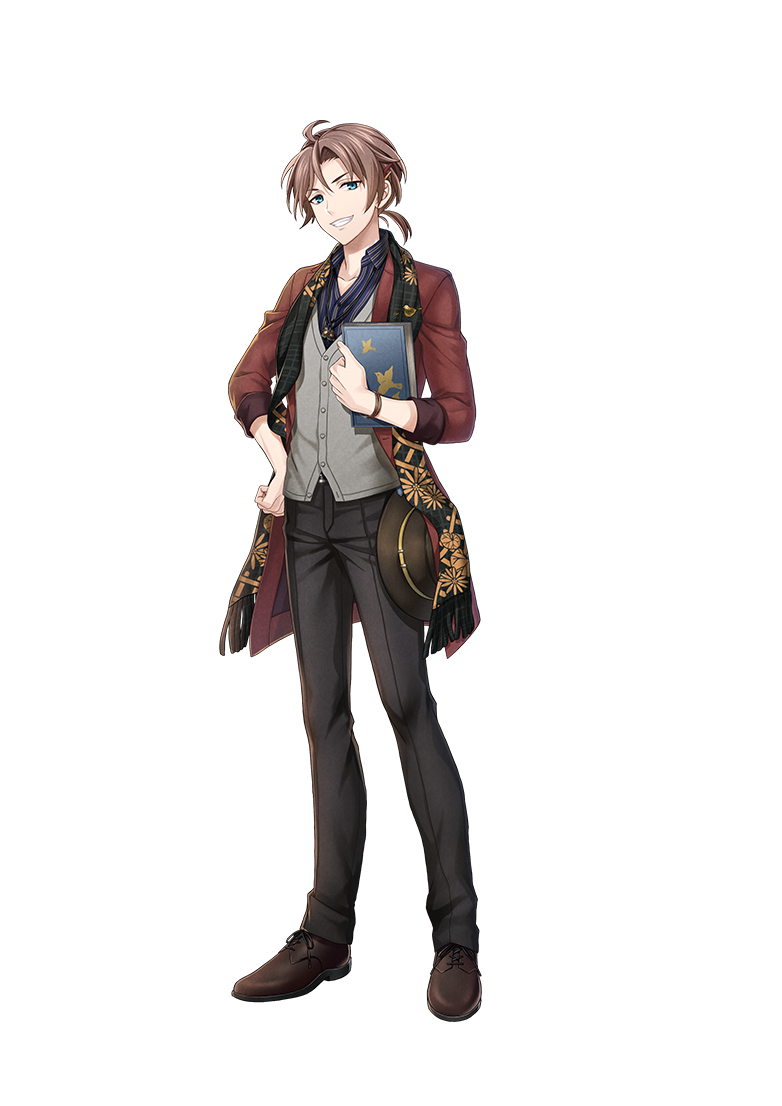
CV: Taku Yashiro
The character is modeled after the great writer Uchida Hyakken, who was active from the Taisho to Showa periods. A writer of popular novels, his representative works include "Meizu", "Santo Kyoden", and "Hanabi". In addition to being a novelist, he was also active in essay writing. His weapon of choice when writing undercover is a whip. In his normal costume, his attribute is wind. His mental state is stable.
He is an aloof and cheerful young man. He loves train travel and cherishes the scenery and culture he encounters on his journeys. Besides traveling, he likes animals, fine wine, and gastronomy. He also cares about his clothes and wears fashionable clothes in his works.
He has good communication skills and is good at enlivening the atmosphere. He seems to like events and demonstrates his communication skills without regret in such situations. On the other hand, however, he has a shortcoming: he has a habit of borrowing money. This seems to be based on the fact that his model, Uchida Hyakken, had a habit of borrowing money. According to the historical fact, he was originally poor and started borrowing money to make ends meet, but before long, borrowing itself became his hobby. In order to pay back the debt he had borrowed from one person, he would borrow money from another. In "Bun'alu," he carries around a notebook called "Renkin-chou" (alchemy book), in which he writes down the methods and secrets of borrowing money. He also has the absurd belief that he will borrow money no matter what, and continues to pursue his hobby of borrowing money.
He deeply respects his mentor, the great writer Soseki Natsume. He also seems to worship the great writers Ryunosuke Akutagawa and Masao Kume, who were also students of Soseki. Although he has a habit of borrowing money, as mentioned above, he is a good communicator and gets along well with the great writers of the other factions. He is able to communicate with even those literary giants with whom he has difficulty conversing.
Masaoka Ichimon
This faction refers to haiku poets and novelists who were students of the haiku poet Masaoka Shiki. Only two haiku poets, Kyoshi Takahama, a novelist and haiku poet, and Hekigoto Kawahigashi, an essayist and haiku poet, belong to this faction in the Bun'alu, but there are also those who studied under Shiki Masaoka in other factions.
Kyoshi Takahama
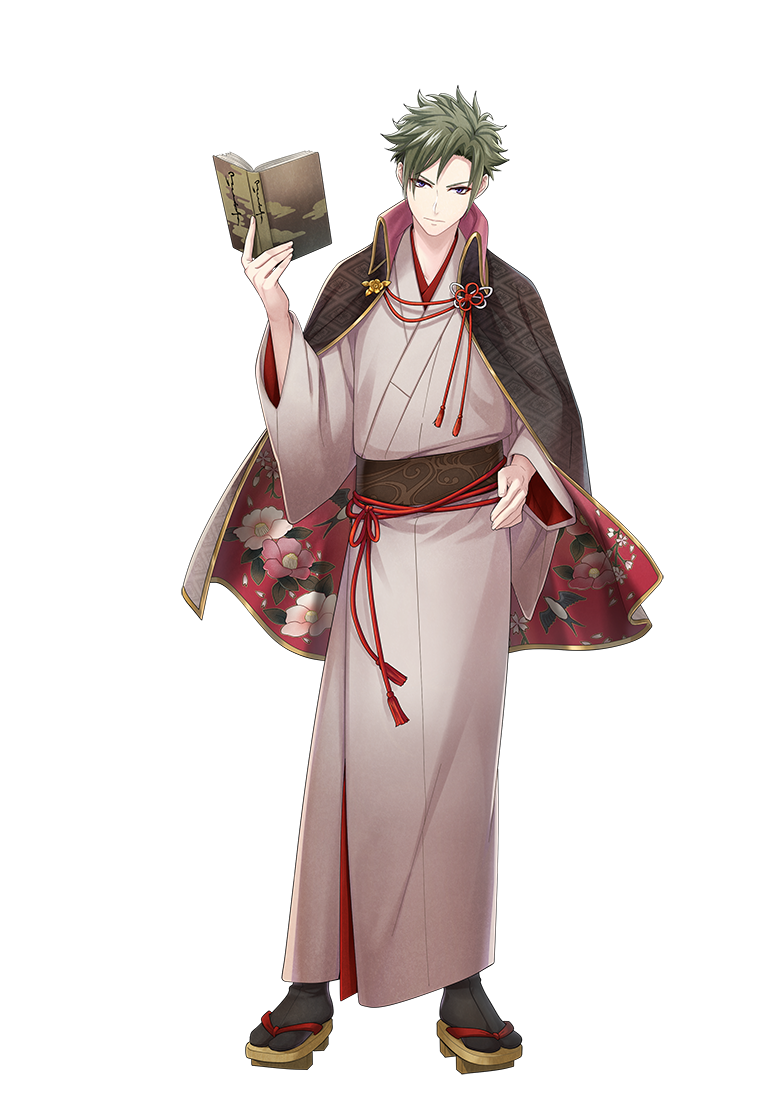
CV: Tatsuo Suzuki
The character is modeled on Kyoshi Takahama, a haiku poet active from the Meiji era to the Showa era. His representative works include "Two Persimmons," "Five Hundred Poems," and "The Haikai Poet. He is famous as the person who created the philosophy behind the magazine Hototogisu, which was founded by his teacher, the haiku poet Shiki Masaoka, and his friends. In addition to being a haiku poet, he was also active as a novelist. His weapon of choice when writing undercover is a gun. In her normal costume, her attribute is fire. His mental state is somewhat unstable.
He is a serious young man with a strong sense of responsibility. He is the type of person who can take a good look at someone who he thinks is doing something wrong, no matter what the person is doing. He often speaks harshly about his mentor Masaoka Shiki, showing concern for his health. This is a reflection of Kyoshi Takahama's concern for Masaoka Shiki, who was sickly even when he was active as a great writer. She also feels a sense of debt to Masaoka Shiki, who asked her to be his successor when he was still active as a great writer, but she turned him down. In front of him, she sometimes shows an attitude as if she is feeling somewhat inferior to him.
He is said to have been at odds with Hekigoto Kawahigashi, a haiku poet and essayist who is also a member of the Masaoka clan, because of his haiku tendencies when he was active as a great writer. Although the tendency itself does not seem to have changed after his reincarnation, at the same time, he has become the only person with whom he can vent his anxieties and weaknesses. In addition, he is trusted by the great writer Soseki Natsume, although he is a literary genius of another faction. This is because Kyoshi Takahama, who modeled for him, corrected Soseki's novel "I am a Cat.
Hekigoto Kawahigashi
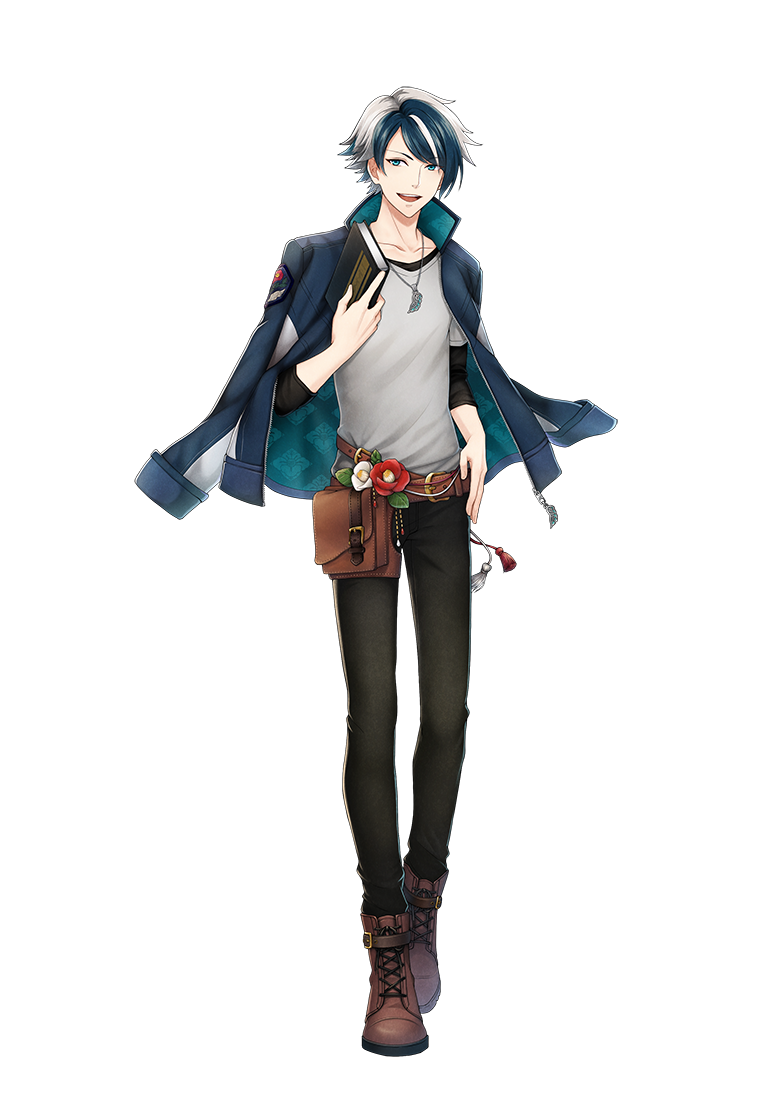
CV: Nobunaga Shimazaki
The character is modeled after Hekigoto Kawahigashi, a haiku poet active from the Meiji era to the Showa era. In addition to being a haiku poet, he was also active as an essayist. His representative works include "Eight Years" and "Sanzensen". His weapon of choice when writing undercover is a gun. When wearing her normal costume, her attribute is water. Her mental state is somewhat unstable.
He is a curious and vivacious young man. He is so slender that people are concerned about his thinness, but despite his appearance, he actually has active hobbies and "loves to travel. It is assumed that this is based on the fact that Hekigoto Kawahigashi, who served as the model for the character, traveled throughout Japan. He also seems to be good at Go in "Bun'ar," as the actual Hekigoto Kawahigashi was also good at Go. According to the official version, his skill is "one of the best in the literary world.
His friendly and cheerful personality makes it difficult for people to dislike him. On the other hand, deep in his heart, he seems to be afraid of being "unappreciated.
He still adores his teacher, the haiku poet Shiki Masaoka, even after his reincarnation. Masaoka Shiki also loves him as a disciple. He also sees his fellow disciple Takahama Kyoshi as a rival, but also as a close friend, and after his reincarnation, they have a good relationship. Since he died of two diseases, he is often worried about his health by Kyoshi Takahama, who takes good care of him.
Soun
Haiku poets associated with Soun, a haiku magazine founded by the haiku poet Ogiwarai Sensui. The magazine was founded for the purpose of research and dissemination of new trends in haiku. However, as the number of publications increased, the magazine began to include descriptions of German literature, and it became more of a literary magazine than a haiku magazine.
In "Bun'aru," Taneda Santoka and Ozaki Housai, pupils of Ogiharai Sensui, who had contributed to the magazine Soun, were included. Although not a member of this faction, the essayist and haiku poet Hekigoto Kawahigashi, a member of the Masaoka clan, was also once involved with the magazine Soun.
Taneda Santoka


Contents
- Overview of "Bungo to Alchemist
- Synopsis and story of "The Bungo and the Alchemist"
- Old Prologue
- Literary Oddities Chapter 1
- Episode 1 Welcome to the Insulated Book
- Episode 2 Fight Against the Invaders
- Episode 3 Purge the Insulators
- Episode 4 The Curator's Command
- Episode 5 Find the Infiltrator
- Episode 6 The Ecology of the Invaders
- Episode 7 Causes of Erosion Phenomena
- Episode 8 The World of Literature / Victory
- Episode 9 Alchemy and Alchemists
- Episode 10 The Power of the Alchemist
- Episode 11 The Concept of the Infringer
- Episode 12 Chasing the Invaders/Rescue
- Literary Oddities, Chapter 2
- Episode 13 The World of Literature
- Episode 14 Naturalism
- Episode 15 Aestheticism
- Episode 16 Art Made of Words / Out of Order
- Episode 17 Private Novels
- Episode 18 Differences of Opinion
- Episode 19 The Beginning of Literature
- Episode 20 Literature on How to Live / Disturbing Footsteps
- new prologue
- Game System of "Bungo to Alchemist
- Library/Librarian's Office
- latent writing
- letter of invitation
- Sealed book
- Yuso Sho (book with a cover letter)
- The Book of the Soul (Yu-kon-sho)
- strolling
- credibility
- literary master
- formation
- blooming (esp. of cherry blossoms)
- spirit
- Calling
- picture book
- character sketch
- book of reminiscences
- research report
- interior
- Characters in "Bungo to Alchemist
- New Thought School (Shinshichouha)
- Ryunosuke Akutagawa
- Junichiro Tanizaki
- Yuzuru Matsuoka
- Yuzo Yamamoto
- Masao Kume
- Kan Kikuchi
- Burai-ha
- Osamu Dazai
- Ango Sakaguchi
- Sakunosuke Oda
- Kazuo Dan
- Kitahara Ichimon
- Kitahara Hakushu
- Sakutaro Hagiwara
- Saisei Murou
- Ichimon Ozaki
- Momiji Ozaki
- Kyoka Izumi
- Tokuda, Shusei
- Yoyuha (a group that can afford to lose money)
- Natsume Soseki
- Mori Ogai
- Shiki Masaoka
- Mita School (Mita-ha)
- Kafu Nagai
- Haruo Sato
- Rofu Miki
- Shirakaba-ha
- Naoya Shiga
- Mushanokouji Saneatsu
- Takeo Arishima
- Satomi Tonon
- proletarian
- Takiji Kobayashi
- Sunao Tokunaga
- Shigeharu Nakano
- New Sensory School
- Yasunari Kawabata
- Toshikazu Yokomitsu
- Emerging Artists (Shin Kougeijutsu-ha)
- Kajii Motojiro
- Ibuse Masuji
- Tatsuo Hori
- Myojo (bright star)
- Kotaro Takamura
- Ishikawa Takuboku
- Isamu Yoshii
- Araragi Faction (of the LDP)
- Sachio Ito
- Mokichi Saito
- Natsume Kadokoro
- Miekichi Suzuki
- Uchida Hyakken
- Masaoka Ichimon
- Kyoshi Takahama
- Hekigoto Kawahigashi
- Soun
- Taneda Santoka
- Hosai Ozaki
- Factionless writers
- Nakahara Chuya
- Kenji Miyazawa
- Toson Shimazaki
- Tayama Hanabukuro
- Kazuo Hirotsu
- Rampo Edogawa
- TSUBOUCHI Shoyo
- Futabatei Shimei
- Atsushi Nakajima
- Koizumi Yakumo
- Wakayama Makisui
- Kunikida Doppo
- Rohan Koda
- Eiji Yoshikawa
- Iwano Houmei
- Masamune Swan
- Roka Tokutomi
- Sanjuugo Naoki
- Hisasaku Yumeno
- Nakazato Kaizan
- Tatsuji Miyoshi
- Nankichi Niimi
- Mimei Ogawa
- Bi Myo Yamada
- Shinpei Kusano
- Nobuo ORIGUCHI, Shinobu
- Kunio Yanagita
- Seijiro Shimada
- Kitamura Torutani
- Russia
- Lev Tolstoy.
- Fyodor Dostoevsky.
- Germany
- Johann Wolfgang von Goethe
- France
- Charles Baudelaire
- Artur Rambo.
- America
- Ernest Hemingway.
- Francisco Scott Fitzgerald
- Edgar Allan Poe.
- Howard Phillips Lovecraft
- United Kingdom
- Conan Doyle.
- Lewis Carroll.
- Imperial Library staff
- director
- cat
- (in hanafuda) the collection of the three red poetry ribbon cards
- blue
- Faust
- enemy character
- corruptor
- Mephistopheles (book of the Bible)
- Items from "Bungo to Alchemist
- Costume
- statue
- gaily coloured statue
- Summation stone
- Western ink
- letter
- Flowering Materials
- Fumitama
- Omodama
- The soul of a word (kataridama)
- Tamashii no Haguruma (Soul Gears)
- Fuminohana
- Omoi-no-hana
- Katanohana
- Yuso Sho (book with a cover letter)
- The Book of the Soul (Yu-kon-sho)
- Kakusei no Yubi (Ring of Awakening)
- Speed regulator
- gold coin
- Interior permits
- Reishi (spiritual medicine)
- cat's paw
- Terms of "Bungo to Alchemist
- Alchemist / Special Librarian
- National Library of Japan
- Imperial Library
- literary master
- man of letters
- assistant
- government
- association
- arms
- attribute
- literary level
- Costume Level
- erosion
- spirit
- The Art of the Brush Slayer
- advent
- The Essence of the Double Brush (Souhitsu Shinsei)
- early great writers
- great writer
- Yaiba Bungo
- Yumi Bungo
- Guns, Literature, and the Arts
- whip (whip) writer
- Famous quotes, lines/scenes, and scenes from "Bungo to Alchemist
- Ryunosuke Akutagawa: "Don't forget that life is a fight to the death."
- Osamu Dazai: "Oh, Akutagawa-sensei said he wanted to read my work! No way, this is called ...... pulse!"
- Masuji Ibushi: "The main character of a novel should be half-hearted. It's more realistic and interesting that way.
- Backstories, trivia, and small stories/episodes and anecdotes from "Bungo to Alchemist".
- The manuscript depicted in the background of the work contains a passage from a real novel.
- Recollection of a once defunct cafeteria
- Wife of musician Hideki Sakamoto is a fan of DMM Games' works
- Theme and insert songs for "Bungo to Alchemist
- Theme song: "Bungo to Alchemist" by Hideki Sakamoto