
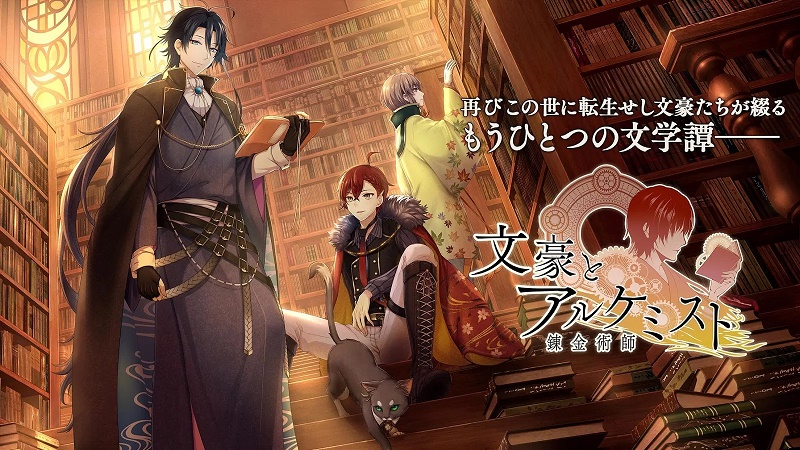
Bungo to Alchemist" (abbreviated as "Bungo and Alchemist") is a training simulation game based on the theme of "Bungo". Developed and operated by the gaming platform DMM Games, the browser version was released in November 2016, and the smartphone version was released the following year in June 2017. The story is set in Japan, which has a different history from reality, based on Taisho Romanticism and Steampunk. In order to protect literature from enemies known as "invaders," players reincarnate literary giants and fight alongside them against these invaders.
An overseas organization located outside of Japan. Its mission is to "observe the concepts of mankind, record them as books, and protect them.
After centuries of working in secret, the organization learns that the Japanese government is using the power of alchemists and great writers to protect books from invaders, and dispatches alchemist Faust, who belongs to the organization, to work with the protagonists. At first, Faust focused only on the secret of "the power to reincarnate great writers" and thought of bringing the secret back to the association, but after witnessing the heroes' abilities as protectors of literature, he changed his mind and decided to cooperate with the Japanese government side.
After becoming a cooperative organization, he continues to communicate with the special librarians of the Imperial Library through Faust.
arms
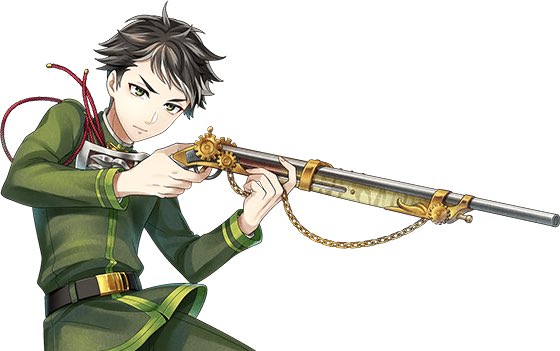
Tatsuji Miyoshi, a great writer, holds up a gun, his weapon of choice.
Tools used to fight the invaders and the writers. There are four types: blades, bows, guns, and whips. The weapons that can be used are determined for each literary master, and in principle cannot be replaced. The broad classification tends to be as follows: blades = great writers of pure literature, bows = great writers of naturalistic literature, guns = great writers of poetry, and whips = great writers of popular literature.
Only those great writers who have the "Ring of Awakening" can change their weapon type by attaching the ring. The types of weapons that can be changed are fixed.
attribute
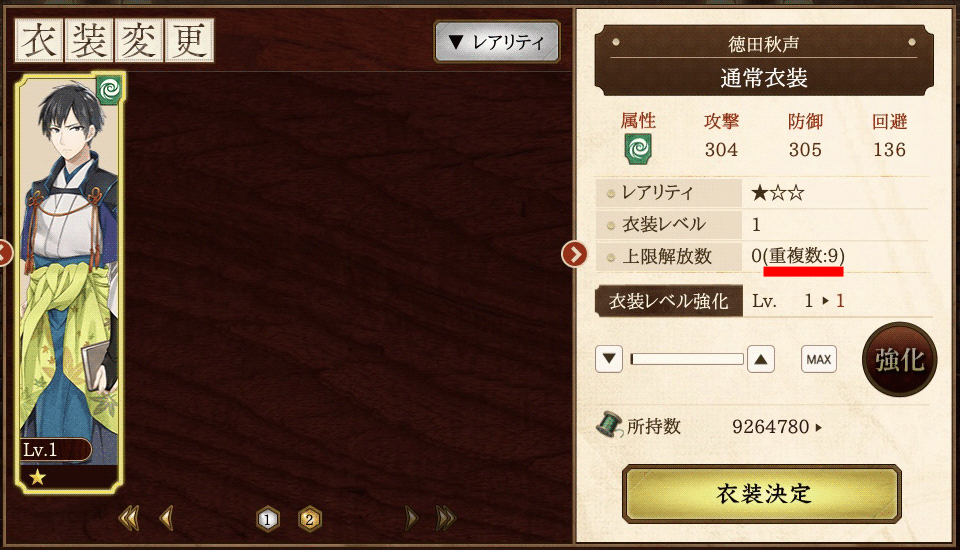
The "Attributes" item on the parameter screen of the writer on the right side of the screen is the attributes that come with the costume that the writer is wearing.
Attributes attached to each costume worn by the writer and the invader. There are four attributes: fire, wind, earth, and water. The balance is such that fire is strong against wind, wind is strong against earth, earth is strong against water, and water is strong against fire. The attributes that are effective against the invader are listed in the upper right corner of the spine of each book that is to be hidden.
literary level
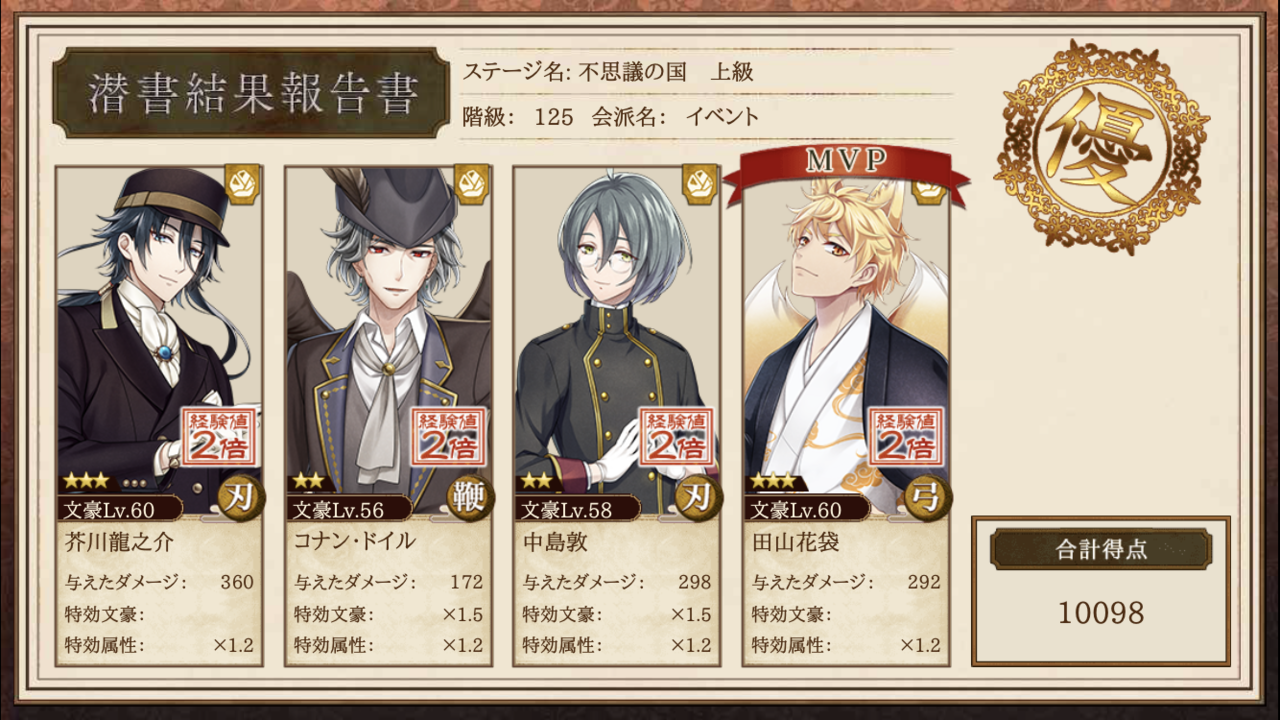
Levels in Bun'alu are the levels of the writer himself/herself. There are two levels in "BUNRAL": the "Bungo Level" and the "Costume Level," of which the "Bungo Level" is related to the status of the player himself. Depending on the level reached, there is a difference in the ability values of the literary artists that can be unlocked through the "flowering" system.
Costume Level
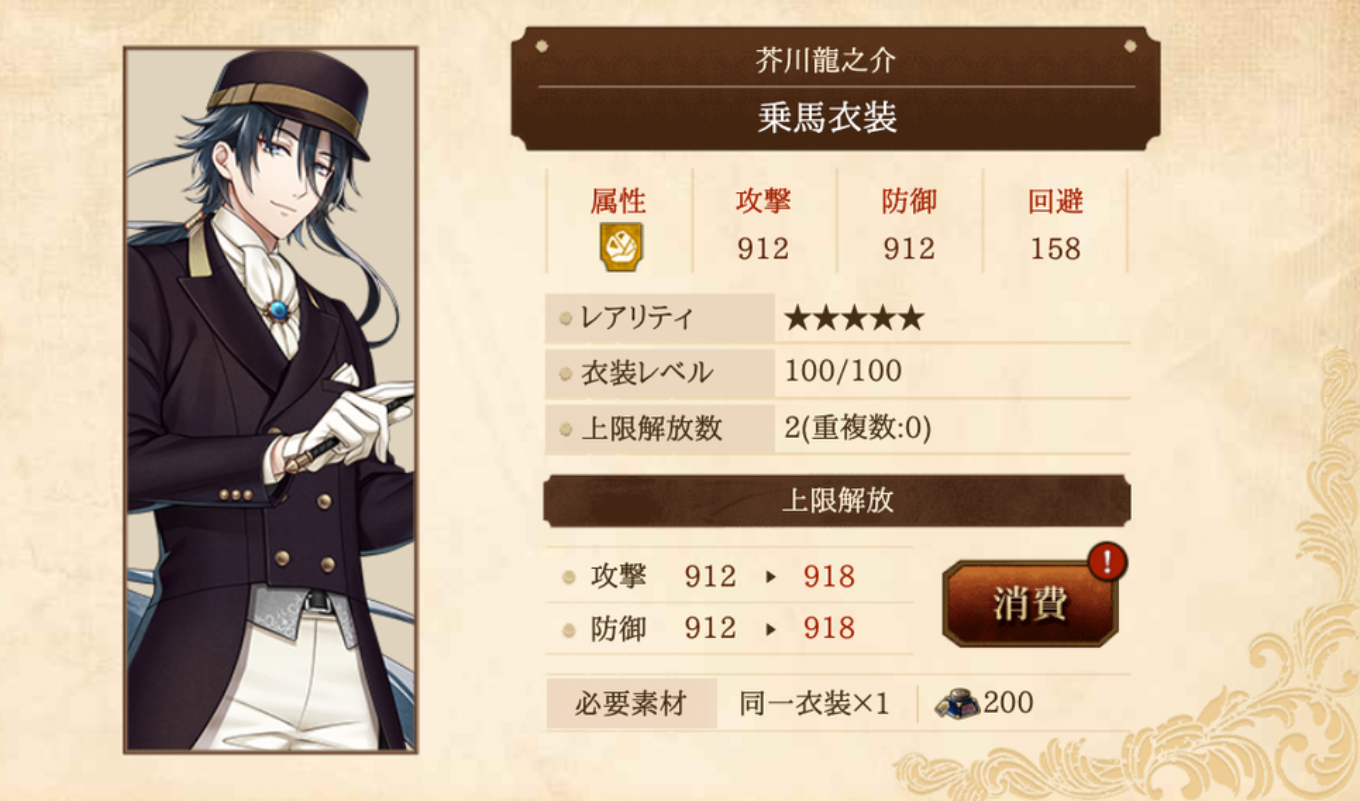
The level of the costume worn by a literary masterpiece. There are two levels in "Bun'ar": the "Bun'ar Level" and the "Costume Level." The "Costume Level" increases the attack power, defense power, and evasion of the Bun'ar. By raising the costume level, the attack, defense, and evasion values attached to each costume are increased, and the overall combat power of the person wearing the costume can be increased.
Status values vary according to rarity. The higher the rarity, the higher the value, but once a certain level is reached, the costume level cannot be increased any further. To open the upper limit of the level, a certain number of Western ink and the same costume are required.
erosion
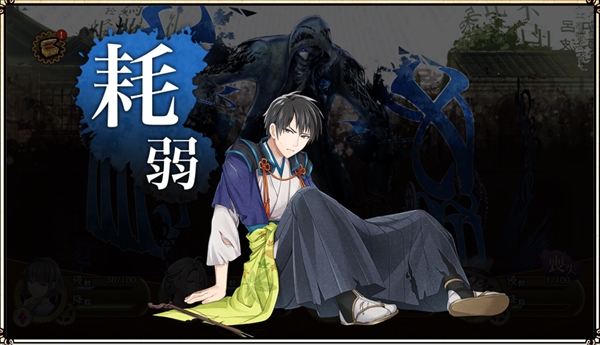
A term used to describe a literary masterpiece being attacked by an enemy. Because they are "eroding literature" of their enemies, the literary giants who have created their "literature" become "spiritually eroded" when they are attacked by them.
The more the erosion progresses, the more the spirit of the eroded writers is worn away. In addition to losing the energy to attack and being unable to fight even if they are in the organization, the main story and event scenarios depict the eroded literary artists as emotionally unstable, as their negative emotions are amplified and they become disheartened or, conversely, explode with anger at past associations.
spirit
The mental state of the great writers. The mental state differs from writer to writer and is classified into five categories: stable, slightly stable, normal, slightly unstable, and unstable. The more stable the mental state, the less susceptible to erosion from the eroder, and the harder it is for the eroder to accumulate the "descent gauge" needed to perform a special move. Conversely, the more unstable a person is, the more easily he or she is affected by the erosion, and the more easily the descent gauge accumulates.
The Art of the Brush Slayer
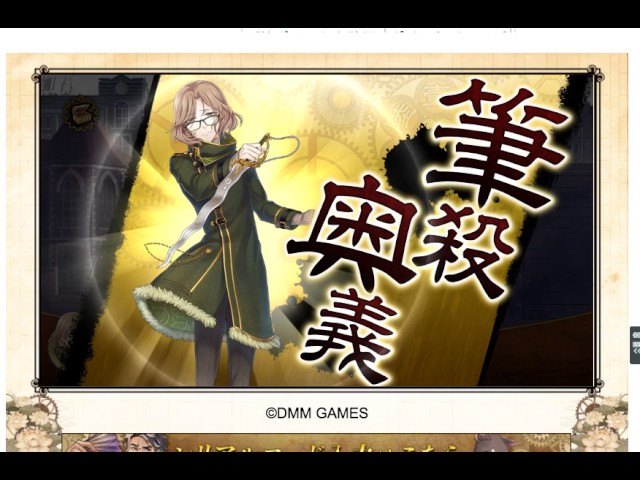
A special move that is triggered when a writer's spirit is eroded by an invader to the point of exhaustion or loss. The activation is not absolute, but has a certain probability.
Only when the technique is activated, the attack power of the writer increases and attacks the enemy's vital point.
advent
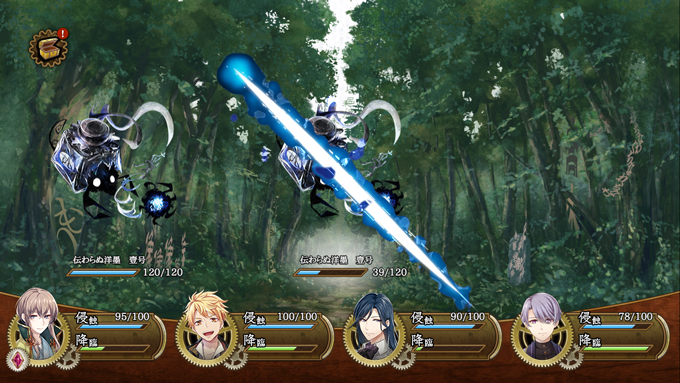
The green gauge next to the icons of the writers at the bottom of the screen is the "descent" gauge.
Abbreviated name for the "descent gauge" required to activate one of the special techniques, sohitsu shinzui (双筆神髄). It accumulates each time the invader attacks. The gauge becomes zero when the Souhitsu Shinzui is activated, but as long as it accumulates, the technique can be activated as many times as necessary.

Contents
- Overview of "Bungo to Alchemist
- Synopsis and story of "The Bungo and the Alchemist"
- Old Prologue
- Literary Oddities Chapter 1
- Episode 1 Welcome to the Insulated Book
- Episode 2 Fight Against the Invaders
- Episode 3 Purge the Insulators
- Episode 4 The Curator's Command
- Episode 5 Find the Infiltrator
- Episode 6 The Ecology of the Invaders
- Episode 7 Causes of Erosion Phenomena
- Episode 8 The World of Literature / Victory
- Episode 9 Alchemy and Alchemists
- Episode 10 The Power of the Alchemist
- Episode 11 The Concept of the Infringer
- Episode 12 Chasing the Invaders/Rescue
- Literary Oddities, Chapter 2
- Episode 13 The World of Literature
- Episode 14 Naturalism
- Episode 15 Aestheticism
- Episode 16 Art Made of Words / Out of Order
- Episode 17 Private Novels
- Episode 18 Differences of Opinion
- Episode 19 The Beginning of Literature
- Episode 20 Literature on How to Live / Disturbing Footsteps
- new prologue
- Game System of "Bungo to Alchemist
- Library/Librarian's Office
- latent writing
- letter of invitation
- Sealed book
- Yuso Sho (book with a cover letter)
- The Book of the Soul (Yu-kon-sho)
- strolling
- credibility
- literary master
- formation
- blooming (esp. of cherry blossoms)
- spirit
- Calling
- picture book
- character sketch
- book of reminiscences
- research report
- interior
- Characters in "Bungo to Alchemist
- New Thought School (Shinshichouha)
- Ryunosuke Akutagawa
- Junichiro Tanizaki
- Yuzuru Matsuoka
- Yuzo Yamamoto
- Masao Kume
- Kan Kikuchi
- Burai-ha
- Osamu Dazai
- Ango Sakaguchi
- Sakunosuke Oda
- Kazuo Dan
- Kitahara Ichimon
- Kitahara Hakushu
- Sakutaro Hagiwara
- Saisei Murou
- Ichimon Ozaki
- Momiji Ozaki
- Kyoka Izumi
- Tokuda, Shusei
- Yoyuha (a group that can afford to lose money)
- Natsume Soseki
- Mori Ogai
- Shiki Masaoka
- Mita School (Mita-ha)
- Kafu Nagai
- Haruo Sato
- Rofu Miki
- Shirakaba-ha
- Naoya Shiga
- Mushanokouji Saneatsu
- Takeo Arishima
- Satomi Tonon
- proletarian
- Takiji Kobayashi
- Sunao Tokunaga
- Shigeharu Nakano
- New Sensory School
- Yasunari Kawabata
- Toshikazu Yokomitsu
- Emerging Artists (Shin Kougeijutsu-ha)
- Kajii Motojiro
- Ibuse Masuji
- Tatsuo Hori
- Myojo (bright star)
- Kotaro Takamura
- Ishikawa Takuboku
- Isamu Yoshii
- Araragi Faction (of the LDP)
- Sachio Ito
- Mokichi Saito
- Natsume Kadokoro
- Miekichi Suzuki
- Uchida Hyakken
- Masaoka Ichimon
- Kyoshi Takahama
- Hekigoto Kawahigashi
- Soun
- Taneda Santoka
- Hosai Ozaki
- Factionless writers
- Nakahara Chuya
- Kenji Miyazawa
- Toson Shimazaki
- Tayama Hanabukuro
- Kazuo Hirotsu
- Rampo Edogawa
- TSUBOUCHI Shoyo
- Futabatei Shimei
- Atsushi Nakajima
- Koizumi Yakumo
- Wakayama Makisui
- Kunikida Doppo
- Rohan Koda
- Eiji Yoshikawa
- Iwano Houmei
- Masamune Swan
- Roka Tokutomi
- Sanjuugo Naoki
- Hisasaku Yumeno
- Nakazato Kaizan
- Tatsuji Miyoshi
- Nankichi Niimi
- Mimei Ogawa
- Bi Myo Yamada
- Shinpei Kusano
- Nobuo ORIGUCHI, Shinobu
- Kunio Yanagita
- Seijiro Shimada
- Kitamura Torutani
- Russia
- Lev Tolstoy.
- Fyodor Dostoevsky.
- Germany
- Johann Wolfgang von Goethe
- France
- Charles Baudelaire
- Artur Rambo.
- America
- Ernest Hemingway.
- Francisco Scott Fitzgerald
- Edgar Allan Poe.
- Howard Phillips Lovecraft
- United Kingdom
- Conan Doyle.
- Lewis Carroll.
- Imperial Library staff
- director
- cat
- (in hanafuda) the collection of the three red poetry ribbon cards
- blue
- Faust
- enemy character
- corruptor
- Mephistopheles (book of the Bible)
- Items from "Bungo to Alchemist
- Costume
- statue
- gaily coloured statue
- Summation stone
- Western ink
- letter
- Flowering Materials
- Fumitama
- Omodama
- The soul of a word (kataridama)
- Tamashii no Haguruma (Soul Gears)
- Fuminohana
- Omoi-no-hana
- Katanohana
- Yuso Sho (book with a cover letter)
- The Book of the Soul (Yu-kon-sho)
- Kakusei no Yubi (Ring of Awakening)
- Speed regulator
- gold coin
- Interior permits
- Reishi (spiritual medicine)
- cat's paw
- Terms of "Bungo to Alchemist
- Alchemist / Special Librarian
- National Library of Japan
- Imperial Library
- literary master
- man of letters
- assistant
- government
- association
- arms
- attribute
- literary level
- Costume Level
- erosion
- spirit
- The Art of the Brush Slayer
- advent
- The Essence of the Double Brush (Souhitsu Shinsei)
- early great writers
- great writer
- Yaiba Bungo
- Yumi Bungo
- Guns, Literature, and the Arts
- whip (whip) writer
- Famous quotes, lines/scenes, and scenes from "Bungo to Alchemist
- Ryunosuke Akutagawa: "Don't forget that life is a fight to the death."
- Osamu Dazai: "Oh, Akutagawa-sensei said he wanted to read my work! No way, this is called ...... pulse!"
- Masuji Ibushi: "The main character of a novel should be half-hearted. It's more realistic and interesting that way.
- Backstories, trivia, and small stories/episodes and anecdotes from "Bungo to Alchemist".
- The manuscript depicted in the background of the work contains a passage from a real novel.
- Recollection of a once defunct cafeteria
- Wife of musician Hideki Sakamoto is a fan of DMM Games' works
- Theme and insert songs for "Bungo to Alchemist
- Theme song: "Bungo to Alchemist" by Hideki Sakamoto