
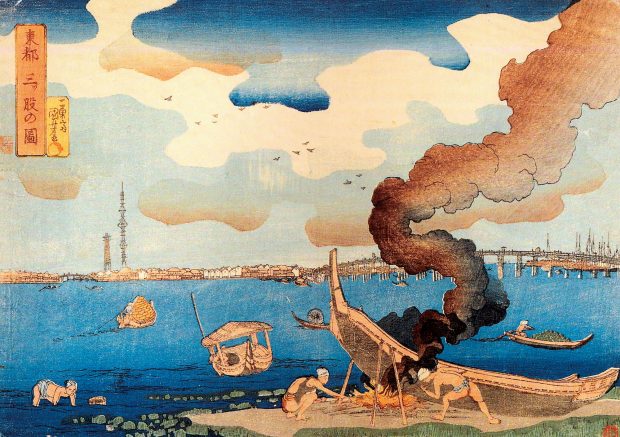
Urban legends and mysteries scattered all over Japan are collected.
However, it is said that the person who was crucified was his younger brother Isquiri who was a scapegoat, and Jesus himself escaped from Siberian to Alaskan and visited Hachinohe by ship, calling himself' Torai Taro Tenkubo' and died at the age of 106 in Herai, Shingo-mura.
First, it is said that the place name Herai is a corruption of Hebrew. Furthermore, the place used to call its father "Ada" and its mother "Aba", which is reminiscent of "Adam and Eve" famous in the Old Testament.
In the northern part of the Nanbu Domain, including Shingo-mura, there is a Bon Festival dance called' Nanyadoyara' where the meaning of the words is unknown, and according to the decipherment of theologians, the meaning of the words is' Praise the Lord for 聖前' in Hebrew.
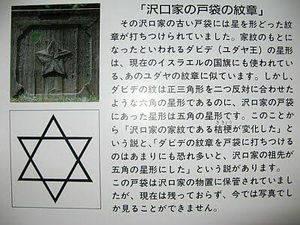
Furthermore, it has been pointed out that the tobukuro of the Sawaguchi family, where Christ's Grave is located, is related to the' Rokubusei' (hexagram).
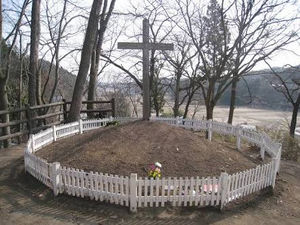
The memorial sites for Christ's Grave and his younger brother Isukiri are named "Juritsuka" and "Jurihaka" respectively, and are located on a small hill overlooking the village.
Sugisawa
Source: kuroi69.hatenablog.com
It is said that Sugisawa Village was located deep in the mountains of Aomori Prefecture, and its existence itself is said to be an urban legend because it has disappeared from the map and there is no corresponding official record in Aomori Prefecture.
The reason why its existence was erased was that an incident occurred in Sugisawa Village, which is a story from the early Showa period.
Suddenly, one day, a villager went mad and used a hand axe to kill everyone living in the area and even took his own life. The village was deserted and abandoned. It is said that the local government tried to cover up this incident and the name of Sugisawa Village was erased from maps and official records.
However, no matter how many records of the incident were erased, people's memories could not be erased, and the fact that there was an old man who knew about the incident made his existence known to other people.
It was around 2000 when these urban legends began to spread, and it seems that visitors to Sugisawa Village began to appear as if they were trying their luck, but since none of them came back, they became even more famous as urban legends. As a result, although the TV station started to cover the story, they did not know anything about the urban legend, and the village became known as a village that disappears and appears because it exists in the distortion of space-time.
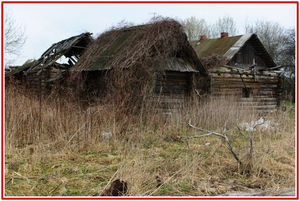
On the road leading to Sugisawa Village, there is a sign that says, "There is no guarantee of life for anyone who enters from here onward." At the entrance to the village is a decayed torii gate with a stone shaped like a skull at its base. Going further, there is a decayed house that seems to have lived there, and something like blood can be seen inside.
Although the village of Sugisawa has been erased from records, it is said to have actually existed in Aomori Prefecture, but its name is Kosugi Village, and the whole area around it is said to have been called Sugisawa Village.
In addition, it seems that the village was abandoned not because of the incident mentioned above, but because there was no one to settle down due to depopulation, so it was merged with the neighboring village. In other words, the village disappeared peacefully and there was no murder case.
But there is still a lot of mystery about this urban legend, which could have been manipulated to hide the murders.
M Fund
Source: d.hatena.ne.jp
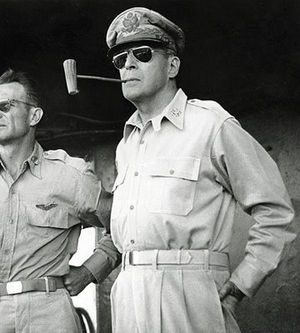
The M Fund is a secret fund based on property and other assets confiscated by the Supreme Commander of the Allied Powers (GHQ) in occupied Japan and rumored to have been secretly managed since then.
It is generally believed that M stands for Major Prince William Frederick, Duke of Gloucester and Edinburgh Frederick Murcutt (later Major General), who was the second director of the GHQ Economics and Science Department. Other theories include MacArthur, the MSA Agreement, and Freemason.
During the chaotic period at the end of World War II, there was an incident in which military supplies including large amounts of precious metals, diamonds, and other jewels were illegally diverted from the Bank of Japan's underground safe where they were stored, and an incident in which a unit led by Major Murkat of GHQ military supplies when they visited the Bank of Japan underground safe for investigation and seizure.
It is said that most of the seized assets under GHQ's control were spent on post-war reconstruction and reparations, but the flow of funds was somewhat unclear, and this became the source of rumors about "M funds."

Contents
- Table of Contents
- Location of Tokugawa Hidden Treasure
- Identity of Hanzo Hattori
- Tokugawa Ieyasu encounters unknown people
- Muramasa THE UNCANNY SWORD AVENGING THE TOKUGAWA FAMILY
- Ii Naomasa and Honda Tadakatsu's Wounds
- Japan's first mentalist
- Predictions of Prince Shōtoku
- Horyuji no Nazo
- TAIRA no Masakado's curse
- Vengeful ghost of SUGAWARA no Michizane
- Minamoto Yoshitsune = Genghis Khan
- Uesugi Kenshin was a woman.
- Uesugi Kenshin and Bishamonten
- Did Nobunaga Oda have black retainers?
- Toyotomi Hideyoshi had six fingers?
- Hihiirokane
- Legend of Daidarabotchi
- 800 Bikuni
- Kifune
- Edo Period Ukiyoe and Sky Tree
- Yonaguni Island Undersea Remains
- Mt. Tsurugidake
- Solomon's Hidden Treasure Hidden in Kenzan
- Christ's Grave
- Sugisawa
- M Fund
- Truth of the death of Rentaro Taki
- Japanese psychic
- Iron Barrier in the Capital Tokyo
- Reasons why Kyoto was not bombed during the Second World War
- Three Bridges Spanning Shikoku
- Otorii at Haneda Airport
- Curse of Roppongi Hills
- It wasn't Showa.
- Real Antarctica