
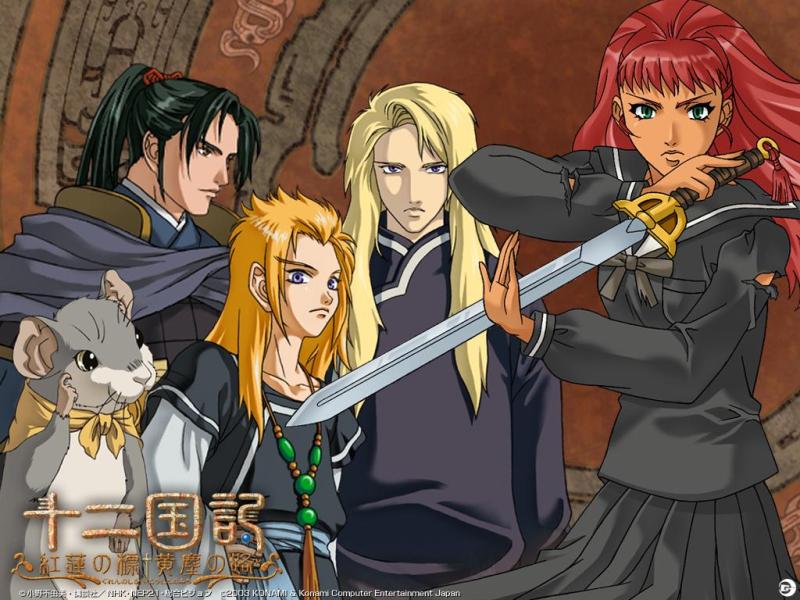
The Twelve Kingdoms" is a novel by Ono Fuyumi and an anime and other media mix works based on the novel. Yoko Nakajima, a high school girl, has lived her whole life with a concern for the color of others' faces. Then, a young man who calls himself Jingqi, the Qilin, appears in front of Yoko and calls her king. Yoko travels to her original home in the world of the Twelve Kingdoms, where she goes through various battles and decides to become king. Some of them face power and the responsibilities that come with it, while others grow up facing their complexes. This is an otherworldly fantasy set in an ancient Chinese-style world, but with a strange sense of reality.
丕緒(丕しょ)
Not yet in animation.
Beginning in the time of King Shuang, he served five kings. The Luo Clan* makes the "magpie*" used in the Twelve Kingdoms' ceremonial archery rites. When King Yeonjo was enthroned, he placed red glass in the magpie he had made to make it look as if it were splattered with blood when it broke. The magpie was one of the reasons for King Yeon's seclusion from the affairs of state.
The name "magpie" is also read as "toshaku," which means "to shaku. A target modeled after a bird used in coronation ceremonies. Real birds were used in the past, but ceramic ones have been used ever since. One reason for the use of the ceramic magpie is that the kylin do not like to kill (the kylin do not participate in this ceremony anymore). Nowadays, the same number of birds as the ceramic magpie are released into the garden.
*Rashi is read as "the magpie. The position of ordering and directing the production of the magpie. It is not involved in state affairs. There is also a sekichoji, who is in charge of the shooting ceremony, but sometimes the Luo clan is in charge of the shooting ceremony.
Soken
Has not appeared in the anime. One of the "echidori" (artisans who make ceramic magpies). He is a mild-mannered old man with a somewhat innocent air. He is a renowned bird-shooter and has many disciples, including 丕緒. He was suddenly arrested after the leopard king's leopard change.
Xiaolan
She has not appeared in the anime.
A childhood friend of 丕緒's, she is a female artisan who makes the "ceramic magpie". She was slow to react to King Yeon's decree banning women, but was eventually captured and went missing. When 丕緒 saw Xiao Lan throwing pears from Lingyun Mountain, he thought that Xiao Lan was not thinking about this country, but in fact, Xiao Lan was focused on completing their own tasks at hand. From the pears that Siew Lan threw, flowers bloomed, letting 丕緒 know that what Siew Lan had done was not in vain. Throwing pears is like the work that the people do every day, meaning that devoting oneself to the task at hand is not in vain. 丕緒 did not even try to realize Siew Lan's intention, which was contained within.
Aoe
Has not yet appeared in an animation. A disciple of Syaoran. To 丕緒, who claims that Xiaolan did not see reality, he told him that although he did not see reality head-on, he was not rejecting it. He tells 丕緒 about the ideas that Xiao Lan had about T'ao Ch'iao regarding T'ao Chiao.
Riou.
Not yet in the anime.
King Jing, four generations before Yoko. It is said that when his reign passed 60 years, he suddenly became a tyrant, harshly criticizing officials and only listening to words that would bring others down. He is said to have increasingly asked officials to do what seemed to be an impossible task, and to have demanded unusual tokens of allegiance. According to one theory, he is rumored to have changed after the assassination of the crown prince.
The King of Thin
Has not yet appeared in an animated series.
Queen of Keikoku three generations before Yoko. She is said to have had no interest in the monarchy and indulged in extravagance.
Hi-oh
Has not yet appeared in an animated series.
Queen of Gyeongguk, a generation before her predecessor (one generation before King Yeon). She was not as extravagant as King Usu, but enjoyed having officials do as she commanded and played with authority.
lotus flower
She has not appeared in an animated series.
She lost her family when her hometown was burned to the ground due to a decree by the Yeou King banning women. On the way to Mugishu, a route to Wild Goose Country, she and the survivors of the town commit suicide by her childhood friend, Meizhu. On the way to Muguju, they hear of the death of King Yeong. While everyone is trying to return to their hometowns, Renka does not want to be swept away by her surroundings any longer and stays in the town of Setsuyo. She gets a job working for the local people at an observatory called Keien.
She was bewildered by the out-of-this-world lifestyle of the people of Keien, but she was getting used to it when she was attacked by the forces of Seorong, who was rumored to be a fake king. Renka cursed Jiaqing and the other people of Keien for doing nothing when the city was burned down, but Jiaqing told her that all they could do was to make a calendar and that they had to do it. The city was burned, but they did not put up much resistance, so they suffered less damage than elsewhere. Following Setsuyo's idea of engaging in his role, he now assists Jiaqing's subordinates.
Kakei
Not yet in animation.
Hosho clan of Setsuyogun (a position that coordinates calendars, etc.). He works with farmers and menial workers to create calendars in a garden forest called Keien. He was so absorbed in his research and duties that he often caused Renka and his subordinates to be immensely impressed. Although all they can do for the world is to make calendars, they understand that it is important for the city.
Wild Goose Country
Ganzhou Province is also known as Wild Goose Country or Wild Geese. At the end of the reign of the previous king, the Owl King, politics was in disorder and the country was in disarray. Both the current king and the Qilin are the result of having grown up in Horai. The system for accepting refugees is more solid than in other countries, and even hailing people can obtain a family register if they find a job and work for a certain period of time. Because of the relatively low level of discrimination against sea travelers, and the solid acceptance system, Rakutoshi brought Yoko to Gankoku. Until she obtains a family register, she can receive assistance. The government office has Japanese-speaking staff to deal with sea visitors, and asks for telephone numbers and zip codes. The information at the reception desk for sea visitors was somewhat outdated, and when Yuka told them her zip code, they asked, "Why is your zip code seven digits? She was scolded and asked why her zip code was seven digits and if she was going to get protection by pretending to be a guest of the sea.
Kanade-kuni is called the country ruled by a great ruler, along with Kanade-kuni. According to Rakutoshi, "Kanaguni is peaceful and Ganguo is lively. In fact, the town was more bustling than in Takumi Country.
King Yan, Shoryu
Source: heart-to-heart.jp
Voice: Masateru Aizawa
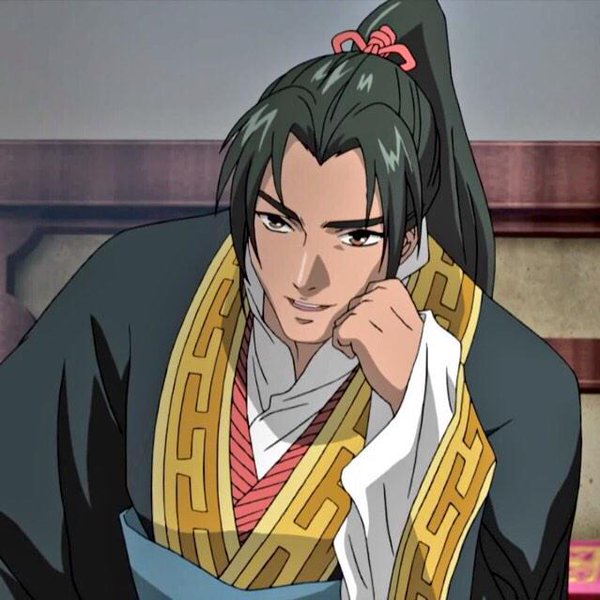
King of the Wild Goose Kingdom. His first appearance is in "Shadow of the Moon: Sea of Shadows". He was exiled to Horai in the Warring States period and returned with Enkiru. His name in Horai was Naotaka Komatsu Saburo. In the world of the Twelve Kingdoms, his name is Shoryu. He is known as a great ruler with a reign of 500 years. He has many roles to look after Yōko by protecting her and sending Rakushun to college. According to Yanqi, he would like to see more kings of Tainan. This seems to be Yanqi's concern for Yoko not to make her feel self-conscious about relying on Yanwang.
He usually wears simple clothes, but it took him 300 years to get his vassals to approve of this attire. Whenever he went down to the city to check on the city government, he was found by his vassals working in a gambling den (by losing bets, etc.) and taken back to the city. Although he often engages in such problematic behavior, he is serious about his country and sometimes gives some advice to Yoko about governing the country. Incidentally, the name he uses when he goes off on his own is Fuhankan. Since the king is not allowed to go to Horai, he entrusts his escapades to Yanqi.
They also put a lot of effort into protecting refugees and sea travelers, and have a receptionist who can speak Japanese and give them a family register if they find a job within three years. Seeing this system, Yoko was keenly aware of the difference from Takumi's country, which had drifted in first, and the difference in the king's level of authority. According to Le Shun, King Yan is a shrewd man who has accomplished various reforms. He made Wild Goose Country known as a vibrant country.
In "The Sea of the Moon, the Shore of the Labyrinth," when Taiki thought that he had chosen a king who had defied the heavens (by kneeling to someone he recognized as not the king), he and Yanqi put on a show and forced the other Kirins to get down on their knees. He did this in order to show that the Qilin could not be falsely restricted by the leader of the Qilin who had been chosen as the King of Tai, since Taeki could not get down on his knees to King Yeon-wang. He is a master swordsman, and in a match with Seungjong, who was in the military, he won with two out of three blows.
When he was in Horai, he was good friends with the people of the territory. The reason why he was close to the people was because they all supported him who would eventually rule the country. He was aware that he was carrying the wishes and expectations of the people, and he held the belief that "the people are the only reason for the country. He was in a standoff with the Murakami Suigun (actual pirates) who were after Komatsu's territory, and in the middle of the standoff, he picked up Enkiru who returned to Horai.
During the battle with the Murakami Suigun, he tried to escape his people by using his army, including himself, as bait. His vassals told him to run away, but he could not abandon his people, so he fought a decisive battle on the sea. However, the people he had let escape returned to the battlefield to help Shoryu, and they were all defeated.
Shoryu, who survived thanks to Yeon-gil's decree, was asked if he wanted a country and people, to which he replied, "Yes, I do. A lord without a country is a laughingstock," he replied. He was told that he would never be able to return to Horai, but he made a pact with Enkiru and went to Wild Goose Country. The Wild Geese Land was still in ruins, but he spoke to Yanqi, saying, "If there is nothing like this, maybe it will be easier to do things," and he ascended to the throne at Mt.
Although he is now a great king, for the first 20 years after his accession to the throne, he was questioned as a king and was almost turned against by the people he was supposed to protect. He was also regarded as a threat to the country by Yanqi, who did not trust him at all. The story of his determination and resolve as a king, and how he came to win the trust of Yanqi, is told in "The Sea God of the East: The Canghai of the West.
In the original story, the Komatsu family, like the Murakami clan, was a navy, and Shoryu was their third son. He took a wife, but while they never met, a child was born (probably the child of Naotaka's father and wife). He had two older brothers, but they died young and he himself was the heir.
Enkirokuta/ idiot

Related Articles
Spoiler commentary and discussion of Shikon (novel, manga, and anime).
Shikishi Oni" is a horror novel, manga, and anime work based on the novel by Mayumi Ono. The comic version by Ryu Fujisaki was serialized in "JUMP SQUARE". The anime aired for 22 episodes from July to December 2010. A small village with a population of 1,300, "Sotoba Village" is isolated from its surroundings, and the custom of burial still remains. One day, three bodies were found in the Yamairi area, but the villagers decided that there was nothing unusual about the deaths, and they were treated as ordinary deaths. However, villagers continue to die one after another, and the anomalies accelerate.
Read Article
鬼談百景(小説・映画)のネタバレ解説・考察まとめ
『鬼談百景』とは、2012年に発表された小野不由美による短編怪談集。読者からの投稿をもとに作り上げた99の実話怪談を収録している。 日常の違和感が静かに恐怖へと変わる“静怖”が特徴となっており、後に『残穢』と世界観が繋がる。 2016年には、短編オムニバス形式で怪談集の中の99話のうち10のエピソードが映画化された。
Read Article
![You'll have a lot of fun! NHK Anime] 7 recommendations](https://renote.net/files/blobs/proxy/eyJfcmFpbHMiOnsiZGF0YSI6MjA5OCwicHVyIjoiYmxvYl9pZCJ9fQ==--6894577131203bf259e7ae517196d07bfd140267/51R1yxTfoLL.jpg)
You'll have a lot of fun! NHK Anime] 7 recommendations
Do you have an image that "NHK is a broadcaster, so it must be stiff" or "it looks childish"? No, no, there are many highly finished animations that are satisfying for adults as well. This is why we have compiled a list of recommended NHK animations.
Read Article
Tags
Contents
- Overview of The Twelve Kingdoms
- The Twelve Kingdoms" synopsis and story
- Moon Shadow Shadow Sea
- The Moon Sea The shore of the labyrinth
- Ten Thousand Miles of Wind, Reimei no Sora
- the first lunar month
- The Sea of God in the East The Canghai in the West
- Characters from "The Twelve Kingdoms
- Gyeongdong Province
- Yoko Nakajima/Keio/Naka Yoko (中嶋陽子/景王/中陽子)
- Keiki
- white mustard (Sinapis alba)
- redundant help
- Houki (驃騎)
- group culvert
- heavy ceremony held in June
- Jakko
- green monkey (Chlorocebus sabaeus, sometimes considered to be a subspecies of Chlorocebus auratus)
- Jade leaf
- Yoo / Seowang
- Seo Ei (Seo Ei is a Japanese word meaning "to save" or "to save")
- Chairperson
- Candy-selling leaves (Ame-uri Gyokuyo)
- Bishin.
- Iron pyrites
- far-fetched (argument, opinion)
- Su Lan Yu
- Su Lan Gui
- Shoqiong
- Oki Suzu/Mokurin
- Seishu
- Gaho (呀)
- Shoko
- Small horse
- (Yasukuni Shrine)
- bulky
- Shibamochi
- Kantai (垣魋)
- Chief of the fall officialdom
- Chief summer official
- thunderclap
- Labor and Foreign Employment
- tiger's howling
- rays of the setting sun
- Tatsuo
- 丕緒(丕しょ)
- Soken
- Xiaolan
- Aoe
- Riou.
- The King of Thin
- Hi-oh
- lotus flower
- Kakei
- Wild Goose Country
- King Yan, Shoryu
- Enkirokuta/ idiot
- White fertile fly
- good (bright) angle
- Rakushun
- the chance of seeing a fish in the wild
- Yang Zhu Heng
- Seisho
- Meiken
- spider pillow (chuchin)
- Master Yutaka
- Kenro Shinkun/Baku Koya
- Ribi
- Mediation
- Yizhin (a kind of "Yizhin" in Japanese)
- In Shirasawa
- hair whirl
- GENKAI
- Shiken-nai
- Waht is the name of the Chinese character for "rough" and "rough" is the name of the Japanese character for "rough
- Kokei
- Koshu Country
- King Hanawa / King Sakuou
- Hanawa In/Hanawa Wa
- Hakuyun Kaiswa
- mother of Rakushun
- Miss Tatsuki
- Seizo Matsuyama
- Kyongju Province
- King of offerings, pearl crystals
- Qi (Qin)
- Sangyeongsang, preface (in Chinese, approx. 3.5 cm)
- Kiwa Muro
- gong carrier
- Lianqiangdai (Lianqiang table)
- Houkyoku Koku
- Mine King, Middle Poach / King Rokuo
- Kahana
- Hourin
- Moon Stream
- Gobo.
- Daijiyoku Koku (The Land of the Rising Sun)
- King Tai, leader of the Taoist movement
- Tai-Ki Kouri/Kaname Takasato
- White Shanty
- arrogance
- the true grandson (or grandchild)
- Li Saisai
- Lu Haku
- Kaiei (flower shadow)
- Langsan
- Joua Sen
- Ganzhao
- English name
- Seirai
- Frozen Gen (Sougen)
- Gashin
- Rennpokukoku
- Ren Wang Oh Seitaku
- Renrin
- Saizhou Province
- King of the Order, Huangguo (Chinese: 采王; pinyin: 采王; pinyin: 采王)
- Cradle of the Cheilin
- Suibi-kun / Riyou
- Shishou / Gowang
- Buuang (dynasty of China)
- Celebration of prosperity
- Shu Xia
- Seiki
- Zun Emperor
- Sounangukoku (South Korea)
- Sung King O-ro Seng-shin
- Sung In, Sho Sho
- Meiqi.
- Ritatsu
- Rikou
- Bunki (Princess Bunki)
- Ryuhoku Country (Ryukoku Province)
- Liu Wang Sukeroho
- Liu Qi
- Stubborn hill
- Ei Kung
- Gamagetsu
- Yuhu
- Enga
- otter (Lutra lutra)
- Sunryo
- Eshi (blessing)
- HANSEI KOKOKU
- Wu Lanjiao, King of the Flood
- Flooding, Risetsu
- Nyusen (female immortal)
- Gyokuha/Hekikagenkun
- Teiei
- Ryoke
- Shoshun
- Kaikaku / Hourai
- Ikuya Asano
- Yuka Sugimoto
- Heki Rakunin (Wall Rakunin)
- Tak Takasato, Taku
- Grandmother of the keystone
- Masashi Nakajima
- Ritsuko Nakajima (Ritsuko Nakajima)
- Terms in The Twelve Kingdoms
- Worldview and Geography of the Twelve Kingdoms World
- Sea of clouds
- The false sea
- Mt. Lingun
- Gozan (Five Mountains)
- Hourogu (Palace of the Peng Lu)
- Yellow Sea
- Mt. Ascending (Mt. Shozan)
- Shiryoumon (four-order gate)
- (food) erosion
- Egg Fruit
- Heaven, King, and Kirin in the Twelve Kingdoms World
- Heavenly King
- Seiohbo
- King.
- Kao/Kiou (False King)
- Kirin
- lost road
- woman-kai (i.e. a monster, monster-like creature, etc.)
- Status and creatures other than kings of the Twelve Kingdoms World
- Immortals
- Nyusen (female immortal)
- Womb Fruit
- Sea guest / Mountain guest
- demon
- commander
- half-human and half-beast
- Cavalry
- Hakuchi (Hakuchi)
- luan (mythical Chinese bird)
- Phoenix
- Other
- Winter Ware (Touki)
- Water Punishing Sword
- Kaitatsu
- Rike
- Famous quotes, lines, scenes, and scenes from "The Twelve Kingdoms
- 'I don't care about the world or strangers. I am kind because I want to be kind. I believe because I want to believe.
- I was so far away from Le Shun's heart. He didn't discriminate against me when I was a fetus, but now he discriminates against me when I am a king? There are only two steps between us. No, it is three steps for me.
- It's the tears of a child to say he feels sorry for himself.
- The important thing is to make an effort to understand the intentions of the other party.
- The world is made up of half happy things and half painful things, and a person is happy not because he or she is blessed but because he or she strives to be happy.
- If they give you things without effort, it means they demand that you work that much harder."
- Backstories, trivia, subplots/episodes, and anecdotes from "The Twelve Kingdoms
- The Twelve Kingdoms" is a sequel to the same author's novel "The Devil's Child" and the main story
- Differences between the original novel and the anime
- Hanawa In's cause of death changed from death from illness to murder by Hanawa King.
- Yuka Sugimoto is another form of Yoko
- Why Rakutoshi went to Yanagikuni
- Theme and insert songs for "The Twelve Kingdoms
- OP (Opening): "Twelve Phantom Songs
- ED (Ending): Mika Arisaka "Moon Lost in the Wind Shadow