
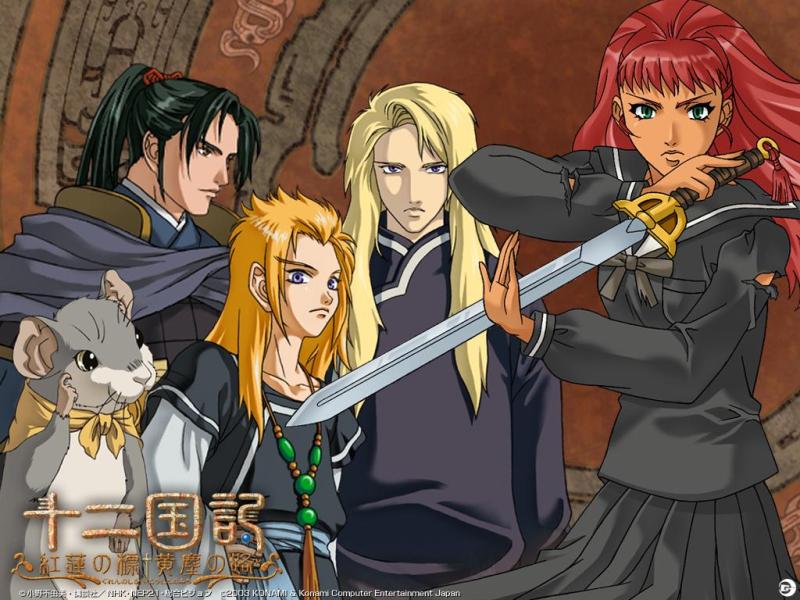
The Twelve Kingdoms" is a novel by Ono Fuyumi and an anime and other media mix works based on the novel. Yoko Nakajima, a high school girl, has lived her whole life with a concern for the color of others' faces. Then, a young man who calls himself Jingqi, the Qilin, appears in front of Yoko and calls her king. Yoko travels to her original home in the world of the Twelve Kingdoms, where she goes through various battles and decides to become king. Some of them face power and the responsibilities that come with it, while others grow up facing their complexes. This is an otherworldly fantasy set in an ancient Chinese-style world, but with a strange sense of reality.
The Yellow Sea is a region located around the Five Mountains and is considered to be outside the laws of the Celestial Empire. Although written as "sea," it is actually an island, and beings outside the laws of this world, such as demons and beasts, basically live in the Yellow Sea. The five mountains cannot be reached without passing through this area, and those who ascend the mountains often hire guards to escort them. It is also known as the land abandoned by God. It is said that the only god who protects those who go through the Yellow Sea is Inuwolf Makun.
Mt. Ascending (Mt. Shozan)
A person who wishes to be chosen as king must ascend Mount Yongsan on his own and meet with the Kirin. The condition is that the person must be registered in the country, and once he or she ascends the mountain, he or she cannot ascend again. If there is a king among those who have ascended the mountain, a pledge is made on the spot. Since it is not always the person who is to be king who ascends the mountain, the kirin sometimes leave Mount Yongsan to look for the king, relying on the king's chi. Yangzi and Shanglong were caught in an erosion and were swept away to Horai (Japan) in the state of eggshells. The供王 is in the process of ascending the mountain and the供麒 comes to pick him up.
Shiryoumon (four-order gate)
Four gates located at the foot of Mt. Once a year, the gates are opened on a day called Anjeongil until noon of the following day. Those who wish to ascend to the throne go to Mount Bongsan during this period. This is called "ascending the mountain. Anhwang-do day refers to the spring equinox, the autumnal equinox, the winter solstice, and the summer solstice. When the gate opens, it is said that demons come out from inside the Yellow Sea, which is one of the reasons why ascending the mountain is considered dangerous.
The gate is located on the opposite shore of the Wild Geese Country.
This gate is located on the opposite shore from Ganguo. The Winter Solstice is the opening day.
The gate of Tatsumi is on the other side of Takumi Province.
The geese are on the other side of Takumi Province. The autumnal equinox is the opening day.
The autumnal equinox is the day of the opening of the gate.
The summer solstice is a safe opening day. The summer solstice is the opening day.
The summer solstice is the day of the opening of the gate.
The Chinese kingship of Kyo-kuo is on the other side of the river. The spring equinox is the opening day.
(food) erosion
A phenomenon in which the worlds of the Twelve Kingdoms are connected to the worlds of Horai and Kunlun. Basically, it happens naturally, but it can also be caused intentionally by Kirin or witchcraft. Jingqi caused the erosion of the king in Horai and crossed over to Horai.
Originally, the worlds of Horai and Kunlun and the world of the Twelve Kingdoms have different dimensions and are not supposed to intersect. Therefore, if an erosion were to occur, a tremendous storm would be generated and the surrounding area would be damaged. The eggfruit can only be picked up by the parent's hand, but the force of the erosion can cause it to leave the tree and be swept away to Horai or Kunlun. This ripped-off egg-fruit becomes what is known as an embryonic fruit. The kylin's ovipositor is no exception. Basically, they spend their lives in Horai and Kunlun without knowing their true origins, but important ones such as kings and qilins are brought back.
Both sea travelers and mountain travelers are brought back to Horai (Japan, also known as Japan in the Twelve Kingdoms world) due to an erosion. The sea guests and mountain guests are both eroded, and are then transferred to Horai (Japan, also called Japan in the Twelve Kingdoms) or Kunlun (China, also called Han in the Twelve Kingdoms). The Umikaishi and Shankaku were exiled from Horai (Japan, also called Wa in the Twelve Kingdoms) and Kunlun (China, called Han in the Twelve Kingdoms). They are called "Umikaishi (sea guest)" and "Yamaishi (mountain guest)" because they arrive at the foot of Mount Kongo. For some reason, they cannot cross over to Horai or Kunlun from the Twelve Kingdoms World, and can only maintain their physical existence as a Sacred Being or a Tainkan.
Jingqi and Yanqi were the ones who caused the eclipse in the work. Yanqi once crossed over to Horai by causing an erosion half-unconsciously and met Shaorong.
Egg Fruit
Source: w.atwiki.jp
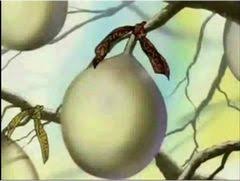
Egg fruit on a village tree.
In the Twelve Kingdoms, the fruit that gives birth to living things, including humans. Gender exists in the Twelve Kingdoms, and there is a marriage system and a brothel, but children are born only from the ovipositor, and eggs laid by birds do not hatch. Since there is no heredity, children do not resemble their parents, and half-breeds may be born even if their parents are not half-breeds. Human eggs grow on trees called "ri-boku," while biological eggs grow on "yaboku," or wild trees. In the film, there is a scene in which Yoko is shown a ri-moku tree in Gankoku.
The day of the year depends on which organisms' eggs and fruits are wished for. For humans, it is either the 7th or the 9th or later. It is said that if you pray on the 7th, you will be blessed with a better child.
For humans, couples pray to the Satoki and tie a sash to the branch. When the Emperor of Heaven deems the couple worthy of having a child, an egg will be born. It is customary for the parents to pluck the ovum in the tenth month after the prayer, as Rakutoshi explains to Yoko: "Father and mother plucked me. No one but the parents could pluck the eggs.
Yoko was absolutely mortified by this, but to the inhabitants of the Twelve Kingdoms, the way of birth in Horai and Kunlun, where children are born from the mother's belly and families are supposed to be similar, is more mysterious and eerie. In fact, Le Shun asked Yoko how they were born from their bellies and whether it was not weird to have someone who looked like him in the same house. Rakutoshi asked out of curiosity, but Hanawa-Oh spoke out in a discriminatory manner, saying, "A womb-grown fruit or a sea-guest born from a woman's belly is no rokku.
In the case of humans, only one band can be tied to a branch at a time, and only one child can be born from one ovum, so there are no twins in the world of the Twelve Kingdoms. It seems that one can pray any number of times if the time is staggered, and fraternal relations do exist. The minimum requirement for a married couple is that they be registered in the same country and be officially married.
There is no pregnancy or childbirth, and women can hold the same jobs as men. If they are capable, they can hold military positions and serve as generals, as in the case of Li Sai of Dai Guo.
The kylin eggfruit grows at the same time as the female monster eggfruit on the discarded trees on Mount Pengshan. Since there are no other gods and goddesses, including nymphs, in Mt. When the previous kirin dies, the next kirin's egg bears fruit immediately, and the female monster watches over the kirin from the egg stage. When Yoko visits Mt. Pengshan in the film, the egg of a Hanawa Kirin from Takumi Province has already borne fruit since the death of the previous Kirin. The female monster hatches overnight and watches over the kylin eggs for about ten months until the kylin are born.
Under the wild tree is an absolutely safe place, as even demons do not attack them. Creatures that eat and are eaten are born on different days. It is the king's role to pray for grain seeds to be born.
Heaven, King, and Kirin in the Twelve Kingdoms World
Heavenly King
He is the god who created the world of the Twelve Kingdoms. According to the creation myth of the Twelve Kingdoms, he is said to have reset the corrupt world. This myth is recreated in the form of a play by a troupe of traveling entertainers. There is a description of a candy seller Tamahaha calling the Emperor of Heaven "God" and talking to Yuka about the myth.
The kings of the twelve kingdoms are said to be chosen by the qilin, but strictly speaking, the emperor decides in advance who is suitable and lets the qilin find him. When a qilin feels the royal spirit and kneels before a person he recognizes as the king, he is said to have received a heavenly command, and when he receives a revelation at Mount Yongsan, he is said to have received an imperial decree.
Although the heavenly decree is considered absolute, it is also true that the person designated as king does not necessarily possess the capacity to be a great ruler (e.g., Yeowang and Kikakuwang), and Yoko also questions the will of the emperor of heaven.
He never appears at the time of the king's accession to the throne, and he says he has never met King Yeon, who has been on the throne for 500 years. When the king is appointed to the throne, a voice can be heard explaining the king's mindset, but it is not believed to be the voice of the Celestial Emperor (it is unclear who exactly this voice is).
Seiohbo
Lord of the Five Mountains and chief goddess. It is said that she rarely appears in public and only appears when something is beyond Jade Leaf's control. In the original story, she exorcised Taiki's illness upon his return to the Twelve Kingdoms.
King.
Source: www.happyon.jp
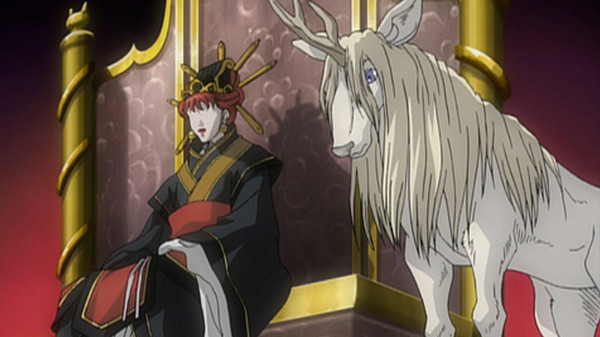
King Jing (left) in Bell's dream.
One exists in each country to rule the country. He is not hereditary, but is chosen by the kirin to sit on the throne and conduct politics. The conditions are that the person must be born in the country and must not have the same family name as the previous king. The latter condition is based on the ancient Chinese Confucian idea of the Yi Surname Revolution (see below).
A "king" in the world of the Twelve Kingdoms is designated as a king by the Celestial Emperor and is said to possess royalty. There are kings who became kings at the age of 12 (ku-king) and kings who were born in the womb (yan-king and jing-king). The only one who can sense the kingly spirit is chosen by the qilin and makes a pact with them. At this stage, he is only considered to have "received a heavenly mandate" and is not immediately placed on the throne, but he is automatically placed on the Immortal Registry. The reason why Yangzi did not have trouble with the language when she came to the Twelve Kingdoms is because she entered the Immortal Realm when she was kneeled down by Jingqi (if she entered the Immortal Realm, even if she was born in Horai, she would not have trouble with the language of the Twelve Kingdoms). ) If you are a member of the Immortal Realm, you will not die of hunger or other causes.
The king is officially enthroned by receiving an imperial decree at Mount Penglai, and a bird called "Hakuchi" in each country cries "Enthronement. When a king is crowned, a dragon banner is flown over the country as a sign of his or her kingship. The dragon banner is also the king's seal, and the forbidden army (or royal army), the army under the king's direct control, also flies this banner. Qilin can go to Horai or Kunlun on their own, but they cannot take the king with them. This is because the king's leaving the country would cause the country to fall into disrepair.
When he becomes king, he is automatically placed in the Immortal Registry and becomes a hermit and gains immortality. This is described as dying as a man and living as a king. The only way to kill a king is to behead or cut off his body with a winter weapon. If a kirin dies of a disease of the roadside or other causes due to misguided politics, the king dies together with the kirin. In some cases, such as the case of Yeowang, the king may give up his throne and die.
The king is not a mere ruler, but the foundation of the nation, and his very existence determines the direction of the nation. There are duties that only the king can perform, such as performing ceremonies to prevent disasters from occurring.
Political direction is left to the skill of each individual, that is, the king's will and talent. A country in which the king chooses good officials and exercises good government becomes prosperous. When the king dies, the country begins to lean. The country becomes infested with demons, and the harvest is not good, and the people's hearts and minds gradually become desolate. For this reason, many of the people of a country whose king dies flee to other countries until the next king is elected. These people are called refugees or floating people, and some countries protect refugees from other countries. The degree of protection for refugees varies from country to country, but again, this depends on the king's capacity. Some countries give family registers to refugees who meet certain criteria, while others simply accept them.
In many cases, a misguided political policy has led to the downfall of the king and the country's collapse. In the film, two countries (Takumi and Fang) were destroyed because of their kings' misgovernment. The country of Fang, however, has a provisional king, so it is still functioning. Takumi has no kirin, no king, and no provisional king.
The king will continue to rule the country as long as he does not die under the conditions mentioned above, and the country will prosper. King Ganguo Yan's reign spans 500 years. In reality, not only the king, but also the bureaucrats, who govern together, and the relationship with the provincial governors and other officials must be taken into account. Even if a king tries to conduct politics in a respectable manner, the bureaucrats may demand bribes from the criminals, or they may abuse the people.
According to King Yan, a king has three turning points. The first was when he had been king for more than ten years. The first difficulty is whether or not he can assemble a group of excellent bureaucrats within the first ten or so years after his accession to the throne. It is said that not a few kings fail in this formation and lose interest and spirit in politics. King Yeong also lost interest in politics due to pressure. The second time was when he exceeded the life span of an average human being. It is said that they lose the desire to live. It is said that many of the officials also leave the Seonrei at the end of their human life span.
The third turning point is about 300 years after accession to the throne. It is said that they feel pressure to continue ruling the country forever. In the past, there have been many kings who were great monarchs for several hundred years but fell due to tyranny at the end of their reign (King Owl, King Tatsu, etc.). It is also possible for a king to go to Pengshan and give up his throne himself (Yeowang).
If a king is not married at the time of his accession to the throne, he cannot have a spouse. If a king has a family at the time of his accession to the throne, they are both enshrined in the royal family, and their children are designated as gongs (children) and gongs (lords). The queen consort, prince, and lord are expected to assist the king along with the bureaucrats.
The king and his family are basically allowed to live in luxury, a privilege that is granted to them because of their heavy responsibilities, according to the king's advisor. Rakushun says, "The king should be a great man. A king is a man of dignity, and he must fulfill his responsibilities.
Although he is called "Shujo" by the Kirin and his vassals, this is an honorific title used to address him face to face, and is basically the name of each country followed by the word "king.
The name of the country is basically followed by "king." The name of the country is given the same pronunciation as the name of the country (e.g., Gyeongguk → Jingwang, Jingkir, etc., when read as "Kei"). Le Shun explains that this kokuji was given to each country by the heavens.
The first imperial edict is a measure of a king's character and capacity as a king. This was the first public order issued by the king, and Yangzi was concerned about what to do with the first imperial edict. Some kings, such as King Yeon and King Yeon-gil, said that there was no need to think too hard about it, and that the people should live in good health, while others did not issue the first imperial edict. After giving it some thought, Yangzi forbade the bureaucrats from leveling with him. This was because he wanted the people of Gyeongguk to each become their own king.
The Yi Surname Revolution
A real-life Confucian idea about politics. In ancient China, the term "yi surname revolution" was used to refer to the transition of dynasties. In ancient China, it was believed that the position of king or emperor was ordained by heaven. A king or an emperor who had gone astray in politics would have his position taken away and a new dynasty would be established, ruled by a person with a different family name.
In reality, the Yi Surname Revolution represents a transition from one era to the next, in which an old dynasty with a hereditary succession (the same surname in the Twelve Kingdoms) is abolished and a new dynasty (a king with a different surname from the previous one) takes its place. One historical example is the transition of dynasties from Shang to Zhou. The last Shang king, Shuang, became infatuated with his wife, Qi Ji, and imposed an oppressive and tyrannical regime. He is said to have lost the hearts of his people and was replaced by King Wu of the Zhou Dynasty.
The selection of kings in the Twelve Kingdoms is based on this idea, and a king is not chosen if his family name is the same as that of his predecessor. In the story, it is said that Rakushun of Takumi Province is not chosen as king because he has the same surname as the previous king. When Yoko mentions her true parentage, Rakutoshi points out that her surname should be different from that of the previous king.
Kao/Kiou (False King)
A provisional king is a person who temporarily serves as king in a country where there is no king or qilin, according to the rules of tenkoku and custom. In the film, Gekkei of Fang Province is a provisional king. Gekkei is technically a false king because he defeated the king of his own country, but he is called a provisional king because of the trust of the people around him. Seo-rong, the younger sister of Seo-kaku, is also a provisional king, but because she was forced to follow a qilin, she is considered a false king.
Kirin
Source: www.videomarket.jp
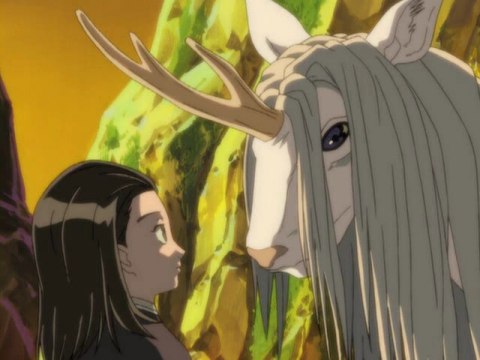
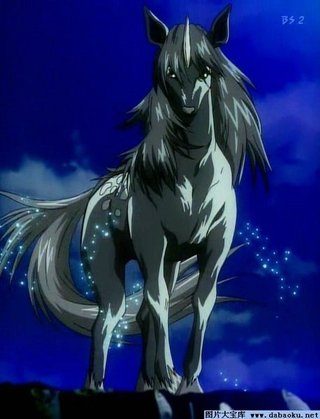
Taiki (humanoid) and Jingqi (animaloid)
Source: shinyaanimewalker.blog.fc2.com
Taiki takes the form of a black qilin.
A being that chooses the kings of the Twelve Kingdoms. There is one head (one person) in each country. Only the person who will be the king of his country bends his knees and bows his head. The title is "Saiho," but because it is considered too formal for someone other than the king to refer to a kylin, a being similar to a divinity, as a title, it is called "Taiho" (Jingqi is followed by "Taiho," for example, "Jingdai" for Jingqi). ) "Taiho" is considered to be a kind of honorific title, similar to calling a king "Shujo. Although there are individual differences in the character of the Qilin, their nature and character are generally made up of benevolence, mercy, and compassion, and King Yan and Shanglong said, "The Qilin advises us to be compassionate to our people.
They are susceptible to blood stains, and are described as suffering from sickness and fever at the mere sight of or exposure to blood. The kylin is described as "blood-drunk" when it is weakened by the sight of blood. The nature of blood, such as that of a grudge, can be understood to some extent (there is a scene in which Taiki becomes intoxicated when he recognizes that the blood is that of a person who has hurt each other out of hatred). Since there are signs that can be recognized only between qilin, it is possible to find a qilin that is in the womb. In "The Sea of Wind, the Shore of Labyrinth," Yanqi finds Taqi's embryonic Qilin. When Taqi is unsure whether he is really a qilin or not, Jingqi says that he does indeed have the presence of a qilin.
The selection of kings is done by sensing and finding the king qi according to heaven's instructions. It is said that only a qilin can distinguish the king's qi, but the king's qi itself does not have a specific shape, and even the qilin who selects the king may have some unexplainable characteristics. Some people, such as Enqi, can tell by intuition, while others, such as Taqi, may feel a sense of fear. If you feel a kind of attachment to that person, even if it resembles fear, you are a king, according to Jingqi.
He never bows to anyone other than his own king. This is instinctive, and it is impossible to force a kirin to get down on his knees, even if he is the king of another country. On the other hand, if it is the king of one's own country, one will get down on one's knees or even kneel down, even if one thinks in one's head, "This person is not a king. This characteristic of royalty was embodied by Tai Ki of Dai. He felt that he was not a king, but he bowed his head, and he sank to his knees and disobeyed his heavenly command. When Jingqi confided this to him, he asked King Yan of the Wild Goose Kingdom, a neighbor of Dai, and Yanqi, a Qilin, to put on a show of forcing King Yan to get down on his knees. Taigirin could not help but bow to King Yan, and he learned that Taigirin was able to break his knees because he was the man who should have been king. Even if a person is not a king in his mind, he can still be a king. When Jingqi chose Seojaku (later Yeonwang), he also sensed that she lacked something that would make her a great king.
The Yellow Sea, the center of the world, bears as a golden egg-fruit on a discarded tree in the Houro Palace in the middle of Mount Houzan, and is born in the form of a beast that is halfway between a horse and a deer. The source of its power is its horns. These horns grow out of the forehead and are slightly raised when in human form.
The mane becomes hair when in human form, and in general, qilin have long hair. The basic color of their hair is white with a golden mane, which becomes blonde when they are in humanoid form. Residents of the Twelve Kingdoms have a variety of hair colors, but only kylins have blonde hair, and Yanqi wrap a cloth around their heads to hide their conspicuous blonde hair when they go out on the town. Taqilin are black qilin with steel-colored fur all over their bodies, and they kept their black hair even when they were in human form.
As soon as the previous qilin died, the eggfruit of the next qilin would be borne on the discarded tree. The fruit of a qilin egg is called "tai-ga" or "hanawa-ga. When a qilin goes missing, it is possible to tell if it is alive or dead by whether or not it bears a new egg.
Immediately after birth, they grow up on the milk of the female monster and are protected by her. As a young beast, it takes on the form of a kylin and subdues demons to become its servant. After about five years, it grows horns, assumes human form, and speaks human language. Until then, he is like a baby who does not even understand human language. Until he becomes an adult animal and chooses a king, he is called the Lord of Pengshan (Mt. Pengshan). In addition to subduing demons, he can also go to the sea of emptiness by himself and cross over to Horai and Kunlun.
When the Yellow Banner is raised and it is known that the Qilin can select the king, those who wish to sit on the throne go to Mount Bongsan on their own. This is called ascending the mountain. Sometimes the person who ascends the mountain becomes king, and sometimes a qilin who feels the royal spirit outside the mountain leaves the mountain. Those who became kings without ascending the mountain include Jingwang and Yoko, Yeonwang and Shangrong (both of whom were embryonic), Yeowang, and Gugwang (technically, Gugwang ascended the mountain, but Gugi came to pick him up while he was in the process).
Even if they are in child form when in human form, they are considered "adults" once they have chosen a king, and are no longer accompanied by a female monster. They are the king's assistants and sometimes give him advice. Taeki was considered an adult when he chose Seungjong as king, but as a qilin, he was like a baby, and even after his return from Horai, he was only about 15 years old physically.
Male (male) qilin and female (female) qilin are called "ki" and "lin," respectively, and the name of each country is followed by "ki" or "lin" (e.g., Jingqi, Enqi, Taqi, Bonglin, Hanawa Lin, etc.). These are called country names, and they are sometimes referred to as "characters" (ji). The character for Enkiru is Rokutai or Baka, and the character for Taiki is Chaoheri.

Related Articles
Spoiler commentary and discussion of Shikon (novel, manga, and anime).
Shikishi Oni" is a horror novel, manga, and anime work based on the novel by Mayumi Ono. The comic version by Ryu Fujisaki was serialized in "JUMP SQUARE". The anime aired for 22 episodes from July to December 2010. A small village with a population of 1,300, "Sotoba Village" is isolated from its surroundings, and the custom of burial still remains. One day, three bodies were found in the Yamairi area, but the villagers decided that there was nothing unusual about the deaths, and they were treated as ordinary deaths. However, villagers continue to die one after another, and the anomalies accelerate.
Read Article
鬼談百景(小説・映画)のネタバレ解説・考察まとめ
『鬼談百景』とは、2012年に発表された小野不由美による短編怪談集。読者からの投稿をもとに作り上げた99の実話怪談を収録している。 日常の違和感が静かに恐怖へと変わる“静怖”が特徴となっており、後に『残穢』と世界観が繋がる。 2016年には、短編オムニバス形式で怪談集の中の99話のうち10のエピソードが映画化された。
Read Article
![You'll have a lot of fun! NHK Anime] 7 recommendations](https://renote.net/files/blobs/proxy/eyJfcmFpbHMiOnsiZGF0YSI6MjA5OCwicHVyIjoiYmxvYl9pZCJ9fQ==--6894577131203bf259e7ae517196d07bfd140267/51R1yxTfoLL.jpg)
You'll have a lot of fun! NHK Anime] 7 recommendations
Do you have an image that "NHK is a broadcaster, so it must be stiff" or "it looks childish"? No, no, there are many highly finished animations that are satisfying for adults as well. This is why we have compiled a list of recommended NHK animations.
Read Article
Tags
Contents
- Overview of The Twelve Kingdoms
- The Twelve Kingdoms" synopsis and story
- Moon Shadow Shadow Sea
- The Moon Sea The shore of the labyrinth
- Ten Thousand Miles of Wind, Reimei no Sora
- the first lunar month
- The Sea of God in the East The Canghai in the West
- Characters from "The Twelve Kingdoms
- Gyeongdong Province
- Yoko Nakajima/Keio/Naka Yoko (中嶋陽子/景王/中陽子)
- Keiki
- white mustard (Sinapis alba)
- redundant help
- Houki (驃騎)
- group culvert
- heavy ceremony held in June
- Jakko
- green monkey (Chlorocebus sabaeus, sometimes considered to be a subspecies of Chlorocebus auratus)
- Jade leaf
- Yoo / Seowang
- Seo Ei (Seo Ei is a Japanese word meaning "to save" or "to save")
- Chairperson
- Candy-selling leaves (Ame-uri Gyokuyo)
- Bishin.
- Iron pyrites
- far-fetched (argument, opinion)
- Su Lan Yu
- Su Lan Gui
- Shoqiong
- Oki Suzu/Mokurin
- Seishu
- Gaho (呀)
- Shoko
- Small horse
- (Yasukuni Shrine)
- bulky
- Shibamochi
- Kantai (垣魋)
- Chief of the fall officialdom
- Chief summer official
- thunderclap
- Labor and Foreign Employment
- tiger's howling
- rays of the setting sun
- Tatsuo
- 丕緒(丕しょ)
- Soken
- Xiaolan
- Aoe
- Riou.
- The King of Thin
- Hi-oh
- lotus flower
- Kakei
- Wild Goose Country
- King Yan, Shoryu
- Enkirokuta/ idiot
- White fertile fly
- good (bright) angle
- Rakushun
- the chance of seeing a fish in the wild
- Yang Zhu Heng
- Seisho
- Meiken
- spider pillow (chuchin)
- Master Yutaka
- Kenro Shinkun/Baku Koya
- Ribi
- Mediation
- Yizhin (a kind of "Yizhin" in Japanese)
- In Shirasawa
- hair whirl
- GENKAI
- Shiken-nai
- Waht is the name of the Chinese character for "rough" and "rough" is the name of the Japanese character for "rough
- Kokei
- Koshu Country
- King Hanawa / King Sakuou
- Hanawa In/Hanawa Wa
- Hakuyun Kaiswa
- mother of Rakushun
- Miss Tatsuki
- Seizo Matsuyama
- Kyongju Province
- King of offerings, pearl crystals
- Qi (Qin)
- Sangyeongsang, preface (in Chinese, approx. 3.5 cm)
- Kiwa Muro
- gong carrier
- Lianqiangdai (Lianqiang table)
- Houkyoku Koku
- Mine King, Middle Poach / King Rokuo
- Kahana
- Hourin
- Moon Stream
- Gobo.
- Daijiyoku Koku (The Land of the Rising Sun)
- King Tai, leader of the Taoist movement
- Tai-Ki Kouri/Kaname Takasato
- White Shanty
- arrogance
- the true grandson (or grandchild)
- Li Saisai
- Lu Haku
- Kaiei (flower shadow)
- Langsan
- Joua Sen
- Ganzhao
- English name
- Seirai
- Frozen Gen (Sougen)
- Gashin
- Rennpokukoku
- Ren Wang Oh Seitaku
- Renrin
- Saizhou Province
- King of the Order, Huangguo (Chinese: 采王; pinyin: 采王; pinyin: 采王)
- Cradle of the Cheilin
- Suibi-kun / Riyou
- Shishou / Gowang
- Buuang (dynasty of China)
- Celebration of prosperity
- Shu Xia
- Seiki
- Zun Emperor
- Sounangukoku (South Korea)
- Sung King O-ro Seng-shin
- Sung In, Sho Sho
- Meiqi.
- Ritatsu
- Rikou
- Bunki (Princess Bunki)
- Ryuhoku Country (Ryukoku Province)
- Liu Wang Sukeroho
- Liu Qi
- Stubborn hill
- Ei Kung
- Gamagetsu
- Yuhu
- Enga
- otter (Lutra lutra)
- Sunryo
- Eshi (blessing)
- HANSEI KOKOKU
- Wu Lanjiao, King of the Flood
- Flooding, Risetsu
- Nyusen (female immortal)
- Gyokuha/Hekikagenkun
- Teiei
- Ryoke
- Shoshun
- Kaikaku / Hourai
- Ikuya Asano
- Yuka Sugimoto
- Heki Rakunin (Wall Rakunin)
- Tak Takasato, Taku
- Grandmother of the keystone
- Masashi Nakajima
- Ritsuko Nakajima (Ritsuko Nakajima)
- Terms in The Twelve Kingdoms
- Worldview and Geography of the Twelve Kingdoms World
- Sea of clouds
- The false sea
- Mt. Lingun
- Gozan (Five Mountains)
- Hourogu (Palace of the Peng Lu)
- Yellow Sea
- Mt. Ascending (Mt. Shozan)
- Shiryoumon (four-order gate)
- (food) erosion
- Egg Fruit
- Heaven, King, and Kirin in the Twelve Kingdoms World
- Heavenly King
- Seiohbo
- King.
- Kao/Kiou (False King)
- Kirin
- lost road
- woman-kai (i.e. a monster, monster-like creature, etc.)
- Status and creatures other than kings of the Twelve Kingdoms World
- Immortals
- Nyusen (female immortal)
- Womb Fruit
- Sea guest / Mountain guest
- demon
- commander
- half-human and half-beast
- Cavalry
- Hakuchi (Hakuchi)
- luan (mythical Chinese bird)
- Phoenix
- Other
- Winter Ware (Touki)
- Water Punishing Sword
- Kaitatsu
- Rike
- Famous quotes, lines, scenes, and scenes from "The Twelve Kingdoms
- 'I don't care about the world or strangers. I am kind because I want to be kind. I believe because I want to believe.
- I was so far away from Le Shun's heart. He didn't discriminate against me when I was a fetus, but now he discriminates against me when I am a king? There are only two steps between us. No, it is three steps for me.
- It's the tears of a child to say he feels sorry for himself.
- The important thing is to make an effort to understand the intentions of the other party.
- The world is made up of half happy things and half painful things, and a person is happy not because he or she is blessed but because he or she strives to be happy.
- If they give you things without effort, it means they demand that you work that much harder."
- Backstories, trivia, subplots/episodes, and anecdotes from "The Twelve Kingdoms
- The Twelve Kingdoms" is a sequel to the same author's novel "The Devil's Child" and the main story
- Differences between the original novel and the anime
- Hanawa In's cause of death changed from death from illness to murder by Hanawa King.
- Yuka Sugimoto is another form of Yoko
- Why Rakutoshi went to Yanagikuni
- Theme and insert songs for "The Twelve Kingdoms
- OP (Opening): "Twelve Phantom Songs
- ED (Ending): Mika Arisaka "Moon Lost in the Wind Shadow