
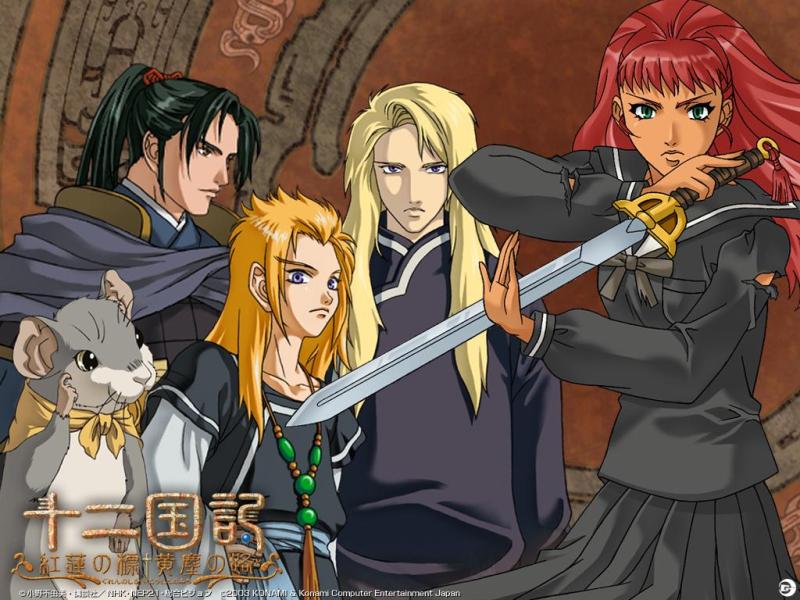
The Twelve Kingdoms" is a novel by Ono Fuyumi and an anime and other media mix works based on the novel. Yoko Nakajima, a high school girl, has lived her whole life with a concern for the color of others' faces. Then, a young man who calls himself Jingqi, the Qilin, appears in front of Yoko and calls her king. Yoko travels to her original home in the world of the Twelve Kingdoms, where she goes through various battles and decides to become king. Some of them face power and the responsibilities that come with it, while others grow up facing their complexes. This is an otherworldly fantasy set in an ancient Chinese-style world, but with a strange sense of reality.
Has not yet appeared in an animated series. He is a Qilin of the present Liugu Province.
In "The Letter," both the king and the qilin appear only in silhouette and not in the main story. It is said that it took 20 years to select the current king. Since the king has not ascended the mountain, it is believed that he sought his royalty outside of Pengshan.
Stubborn hill
Has not yet appeared in animation.
Born in Liuguo. Formerly, he was a Chu clan (Chu-min without an employer; a Chu-min is a floating people who travel around the country without a permanent home) who hunted cavalry in the Yellow Sea. He was a Chu-min (a Chu-min is a floating people who travel around the country without a permanent residence). When Zhu-min ascended the mountain, he was hired as a stiff clan, a guard of the Yellow Sea.
He is an optimistic person who does not care if others do not understand him. He promised Zhuchang that if Zhuchang was not king, he would be his apprentice, and if he became king, he would take Zhuchang as his vassal or escort in the Yellow Sea, and he would come to deliver the cavalry from time to time.
Ei Kung
Not yet in animation.
Autumn official judicial punishment (like a judge). He rarely shows his emotions. He is troubled by the treatment of the treatment of heinous criminals. The king, who is not interested in politics, has told him to "leave it to the judiciary," and he wonders whether to reinstate the death penalty, which is forbidden by imperial order. This was because he feared that if mortal sins were reinstated, those in the fall service would abuse their authority.
Before the age of 50, he became a state official from the local government, and entered the Seonreki. He was married twice and resigned from his position to take responsibility for the scandalous fraud committed by his first wife, Keishi. During his descent, he met and married a woman named Seika. Three years after his descent, he was recalled by the government.
He had two sons and a daughter with Huishi, but the eldest son and daughter remained on earth because they had a family when Ei Gung entered the Seonreki, and he died before his father. The second son who joined the Immortal Registry with him later became a state official in the land of Chiazhou. He and Seika have one daughter.
Gamagetsu
Not yet in animation.
Assistant to the Heavenly Officer of the Palace. He is the grandson of Eigeng.) He is the grandson of Ei Geng.
Yuhu
Not yet in animation.
Akikan Chouji Sashi (declares if there are extenuating circumstances for the guilty and petitions for a reduction of the penalty). In response to Ei Gung's fear that reinstating the death penalty would lead to abuse of authority, he states that the death penalty is necessary only for the innocent, and that the people would be relieved if they thought that the guilty would be punished.
Enga
Has not yet appeared in animation.
The Crown Prince of the Liugu Kingdom. Formerly the head of the Jikan, he is now the head of the Akikan. He is stubborn and will never change his mind once he has made a decision, and will not accept any criticism or retraction. Because of this personality, he is not able to respond to politics that should be governed flexibly, and he often annoys his subordinates with his righteous arguments that seem to ignore reality. He is not incompetent by any means, but according to those around him, he is a man without an opinion of his own, and often acts as if the decisions made by his father, the king, were his own. Sometimes the king reverses his decisions, but even if he is admonished for it, he has neither the talent nor his own opinion, and it is said that there have been no successful cases. He is so arrogant that some call him more Liu King than Liu King, but his rivalry with his father is at the root of his arrogance.
otter (Lutra lutra)
Not yet in animation.
He has been tried for robbery and murder in several states. Six months after he was released to the streets after serving his sentence in the Equatorial States, he committed another heinous crime. In two years, he committed 16 crimes, resulting in 23 victims. Although he admits his wrongdoings, he shows no remorse for them and wishes to be put to death himself. For a long time, Ryukoku did not use the death penalty, but the atrocities committed by the hunter-otter were so severe that there was a strong desire among the people for the death penalty, which troubled the judicial officers. The conclusion of whether or not to condemn him to death was difficult to reach, and the focus became whether or not the kariotar could be rehabilitated. Eigeng's view was that refusing to rehabilitate the kariotar was the kariotar's revenge against the judiciary, which discriminated against the guilty by tattooing them.
Sunryo
He has not yet appeared in an animated series.
An eight-year-old boy living in Shibakusa, the capital of Yanagi Province. He was a bright and cheerful boy, but was killed by a hunting otter for a mere 12 sen (money to buy peaches). At that time, the hunting otter had more than enough money and did not need to rob him of the 12 sen. Suryo's case is told as a symbolic condemnation of the kari otter and his evil deeds.
Eshi (blessing)
She has not appeared in the anime.
Ei Geng's first wife. She lived in the royal palace for 60 years and left him, saying, "I am not as stupid as you think. She refused Ei Gung's support and lived on her own, but eventually, out of desperation, she committed fraud by using Ei Gung's name to cheat him out of money and goods. She repeated the same crime even though she was arrested several times, probably as an attack on her husband who called her a fool.
HANSEI KOKOKU
Wu Lanjiao, King of the Flood
Not yet in the anime. In "Letters," he and the Kirin appear only in silhouette.
The current Flood King. He reigned for 300 years. He is a beautiful man, as beautiful as a woman, who hates bad taste and things. Since the country was not blessed with a favorable climate or material resources, it exported its crafts and arts to other countries, thereby enriching itself. Since it prospered through trade, it is always aware of what is going on in other countries.
Flooding, Risetsu
Not in the anime. In "Letters," he and the king appear only in silhouette.
She is the current Qilin of Fan Province. She has a tomboyish personality. Her current name is Risetsu, but it is said that her name is often changed at the whim of the king.
Nyusen (female immortal)
Gyokuha/Hekikagenkun

Related Articles
Spoiler commentary and discussion of Shikon (novel, manga, and anime).
Shikishi Oni" is a horror novel, manga, and anime work based on the novel by Mayumi Ono. The comic version by Ryu Fujisaki was serialized in "JUMP SQUARE". The anime aired for 22 episodes from July to December 2010. A small village with a population of 1,300, "Sotoba Village" is isolated from its surroundings, and the custom of burial still remains. One day, three bodies were found in the Yamairi area, but the villagers decided that there was nothing unusual about the deaths, and they were treated as ordinary deaths. However, villagers continue to die one after another, and the anomalies accelerate.
Read Article
鬼談百景(小説・映画)のネタバレ解説・考察まとめ
『鬼談百景』とは、2012年に発表された小野不由美による短編怪談集。読者からの投稿をもとに作り上げた99の実話怪談を収録している。 日常の違和感が静かに恐怖へと変わる“静怖”が特徴となっており、後に『残穢』と世界観が繋がる。 2016年には、短編オムニバス形式で怪談集の中の99話のうち10のエピソードが映画化された。
Read Article
![You'll have a lot of fun! NHK Anime] 7 recommendations](https://renote.net/files/blobs/proxy/eyJfcmFpbHMiOnsiZGF0YSI6MjA5OCwicHVyIjoiYmxvYl9pZCJ9fQ==--6894577131203bf259e7ae517196d07bfd140267/51R1yxTfoLL.jpg)
You'll have a lot of fun! NHK Anime] 7 recommendations
Do you have an image that "NHK is a broadcaster, so it must be stiff" or "it looks childish"? No, no, there are many highly finished animations that are satisfying for adults as well. This is why we have compiled a list of recommended NHK animations.
Read Article
Tags
Contents
- Overview of The Twelve Kingdoms
- The Twelve Kingdoms" synopsis and story
- Moon Shadow Shadow Sea
- The Moon Sea The shore of the labyrinth
- Ten Thousand Miles of Wind, Reimei no Sora
- the first lunar month
- The Sea of God in the East The Canghai in the West
- Characters from "The Twelve Kingdoms
- Gyeongdong Province
- Yoko Nakajima/Keio/Naka Yoko (中嶋陽子/景王/中陽子)
- Keiki
- white mustard (Sinapis alba)
- redundant help
- Houki (驃騎)
- group culvert
- heavy ceremony held in June
- Jakko
- green monkey (Chlorocebus sabaeus, sometimes considered to be a subspecies of Chlorocebus auratus)
- Jade leaf
- Yoo / Seowang
- Seo Ei (Seo Ei is a Japanese word meaning "to save" or "to save")
- Chairperson
- Candy-selling leaves (Ame-uri Gyokuyo)
- Bishin.
- Iron pyrites
- far-fetched (argument, opinion)
- Su Lan Yu
- Su Lan Gui
- Shoqiong
- Oki Suzu/Mokurin
- Seishu
- Gaho (呀)
- Shoko
- Small horse
- (Yasukuni Shrine)
- bulky
- Shibamochi
- Kantai (垣魋)
- Chief of the fall officialdom
- Chief summer official
- thunderclap
- Labor and Foreign Employment
- tiger's howling
- rays of the setting sun
- Tatsuo
- 丕緒(丕しょ)
- Soken
- Xiaolan
- Aoe
- Riou.
- The King of Thin
- Hi-oh
- lotus flower
- Kakei
- Wild Goose Country
- King Yan, Shoryu
- Enkirokuta/ idiot
- White fertile fly
- good (bright) angle
- Rakushun
- the chance of seeing a fish in the wild
- Yang Zhu Heng
- Seisho
- Meiken
- spider pillow (chuchin)
- Master Yutaka
- Kenro Shinkun/Baku Koya
- Ribi
- Mediation
- Yizhin (a kind of "Yizhin" in Japanese)
- In Shirasawa
- hair whirl
- GENKAI
- Shiken-nai
- Waht is the name of the Chinese character for "rough" and "rough" is the name of the Japanese character for "rough
- Kokei
- Koshu Country
- King Hanawa / King Sakuou
- Hanawa In/Hanawa Wa
- Hakuyun Kaiswa
- mother of Rakushun
- Miss Tatsuki
- Seizo Matsuyama
- Kyongju Province
- King of offerings, pearl crystals
- Qi (Qin)
- Sangyeongsang, preface (in Chinese, approx. 3.5 cm)
- Kiwa Muro
- gong carrier
- Lianqiangdai (Lianqiang table)
- Houkyoku Koku
- Mine King, Middle Poach / King Rokuo
- Kahana
- Hourin
- Moon Stream
- Gobo.
- Daijiyoku Koku (The Land of the Rising Sun)
- King Tai, leader of the Taoist movement
- Tai-Ki Kouri/Kaname Takasato
- White Shanty
- arrogance
- the true grandson (or grandchild)
- Li Saisai
- Lu Haku
- Kaiei (flower shadow)
- Langsan
- Joua Sen
- Ganzhao
- English name
- Seirai
- Frozen Gen (Sougen)
- Gashin
- Rennpokukoku
- Ren Wang Oh Seitaku
- Renrin
- Saizhou Province
- King of the Order, Huangguo (Chinese: 采王; pinyin: 采王; pinyin: 采王)
- Cradle of the Cheilin
- Suibi-kun / Riyou
- Shishou / Gowang
- Buuang (dynasty of China)
- Celebration of prosperity
- Shu Xia
- Seiki
- Zun Emperor
- Sounangukoku (South Korea)
- Sung King O-ro Seng-shin
- Sung In, Sho Sho
- Meiqi.
- Ritatsu
- Rikou
- Bunki (Princess Bunki)
- Ryuhoku Country (Ryukoku Province)
- Liu Wang Sukeroho
- Liu Qi
- Stubborn hill
- Ei Kung
- Gamagetsu
- Yuhu
- Enga
- otter (Lutra lutra)
- Sunryo
- Eshi (blessing)
- HANSEI KOKOKU
- Wu Lanjiao, King of the Flood
- Flooding, Risetsu
- Nyusen (female immortal)
- Gyokuha/Hekikagenkun
- Teiei
- Ryoke
- Shoshun
- Kaikaku / Hourai
- Ikuya Asano
- Yuka Sugimoto
- Heki Rakunin (Wall Rakunin)
- Tak Takasato, Taku
- Grandmother of the keystone
- Masashi Nakajima
- Ritsuko Nakajima (Ritsuko Nakajima)
- Terms in The Twelve Kingdoms
- Worldview and Geography of the Twelve Kingdoms World
- Sea of clouds
- The false sea
- Mt. Lingun
- Gozan (Five Mountains)
- Hourogu (Palace of the Peng Lu)
- Yellow Sea
- Mt. Ascending (Mt. Shozan)
- Shiryoumon (four-order gate)
- (food) erosion
- Egg Fruit
- Heaven, King, and Kirin in the Twelve Kingdoms World
- Heavenly King
- Seiohbo
- King.
- Kao/Kiou (False King)
- Kirin
- lost road
- woman-kai (i.e. a monster, monster-like creature, etc.)
- Status and creatures other than kings of the Twelve Kingdoms World
- Immortals
- Nyusen (female immortal)
- Womb Fruit
- Sea guest / Mountain guest
- demon
- commander
- half-human and half-beast
- Cavalry
- Hakuchi (Hakuchi)
- luan (mythical Chinese bird)
- Phoenix
- Other
- Winter Ware (Touki)
- Water Punishing Sword
- Kaitatsu
- Rike
- Famous quotes, lines, scenes, and scenes from "The Twelve Kingdoms
- 'I don't care about the world or strangers. I am kind because I want to be kind. I believe because I want to believe.
- I was so far away from Le Shun's heart. He didn't discriminate against me when I was a fetus, but now he discriminates against me when I am a king? There are only two steps between us. No, it is three steps for me.
- It's the tears of a child to say he feels sorry for himself.
- The important thing is to make an effort to understand the intentions of the other party.
- The world is made up of half happy things and half painful things, and a person is happy not because he or she is blessed but because he or she strives to be happy.
- If they give you things without effort, it means they demand that you work that much harder."
- Backstories, trivia, subplots/episodes, and anecdotes from "The Twelve Kingdoms
- The Twelve Kingdoms" is a sequel to the same author's novel "The Devil's Child" and the main story
- Differences between the original novel and the anime
- Hanawa In's cause of death changed from death from illness to murder by Hanawa King.
- Yuka Sugimoto is another form of Yoko
- Why Rakutoshi went to Yanagikuni
- Theme and insert songs for "The Twelve Kingdoms
- OP (Opening): "Twelve Phantom Songs
- ED (Ending): Mika Arisaka "Moon Lost in the Wind Shadow