
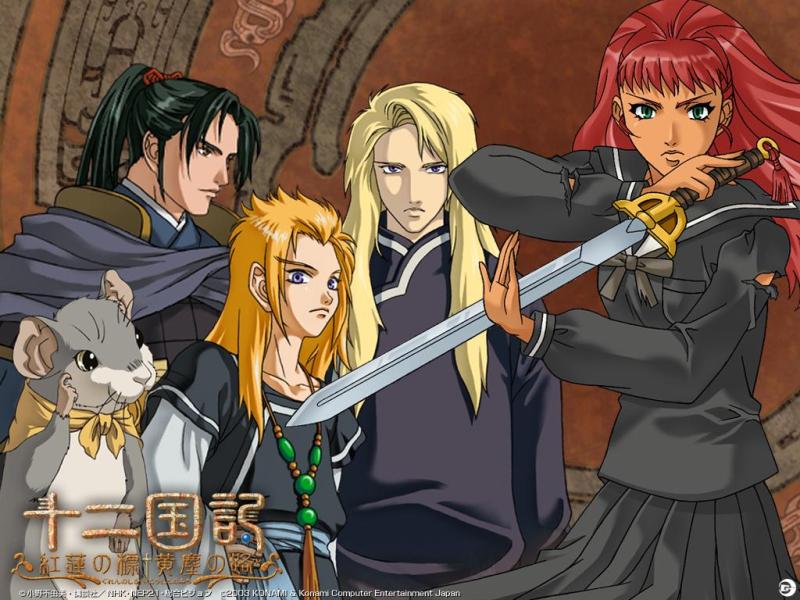
The Twelve Kingdoms" is a novel by Ono Fuyumi and an anime and other media mix works based on the novel. Yoko Nakajima, a high school girl, has lived her whole life with a concern for the color of others' faces. Then, a young man who calls himself Jingqi, the Qilin, appears in front of Yoko and calls her king. Yoko travels to her original home in the world of the Twelve Kingdoms, where she goes through various battles and decides to become king. Some of them face power and the responsibilities that come with it, while others grow up facing their complexes. This is an otherworldly fantasy set in an ancient Chinese-style world, but with a strange sense of reality.
Voice: Daisuke Sakaguchi/Junko Noda (Childhood)
Kaname's younger brother. He is a delinquent and attends the lowest-ranked high school. He hates his brother, who is rumored to be "haunted," but he also hates himself for having such feelings. He develops a faint crush on Yuka, who is investigating Kaname's mysterious disappearance. When he realizes that Yuka has approached him for his brother, he is frustrated by his hatred for his brother again.
He is the one who "dropped the cup" that caused Kaname to be taken out on a snowy night, but he is afraid of his grandmother and puts the blame on his brother. The reason why he dropped the cup was because he saw a white hand inviting his brother to come to him, and he has a slight exposure to the world of the Twelve Kingdoms.
In the novel "The Demon Child," which served as a prototype for her novel, she was taught by her grandmother to be sensitive to others. As if to release his stress, he was often arrested as a juvenile delinquent. He has a history of being bullied because of an incident in which Kaname was hidden by a god. In the anime, he survived, but in the original story, he and his parents were killed by Arrogance and Toriko.
Grandmother of the keystone
Voice: Naoko Kyoda
Appears in "The Sea of Wind: The Shore of the Labyrinth. Deceased. Grandmother of Kaname Takasato and Taku. She was harsh with Kaname because he patted her head and brushed her hand away, and because he did not bow to her. On the night Kaname dropped a cup (actually it was his younger brother Taku who dropped the cup), she let 10-year-old Kaname out in the snow. He never saw Kaname again and died a year later. Kaname returned on the day of his grandmother's funeral.
In the original story, "The Devil's Child," he was named Miki Takasato.
*The unwillingness to be patted on the head and the inability (or inability) to bow are both characteristics of the Kirin.
Masashi Nakajima
Source: 12kingdoms.fandom.com
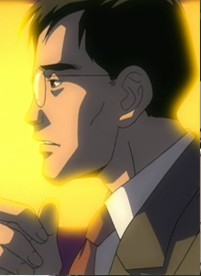
Voice: Takeru Watanabe
Yoko's father in Hourai. He has an outdated, male-dominated philosophy and forces his daughter to be "feminine." When Yoko wanted to wear pants, he told her to "dress like a girl. He is one of the people who contributed to the formation of Yoko's personality, as she was always looking at other people's faces and unable to express her own opinions.
In the original story, he thought Yoko was dead and clashed with his wife, who was worried about their daughter who did not return home. He assumes that his daughter has become a delinquent because he saw Yoko with a blond man (Keikiru).
Ritsuko Nakajima (Ritsuko Nakajima)
Source: 12kingdoms.fandom.com
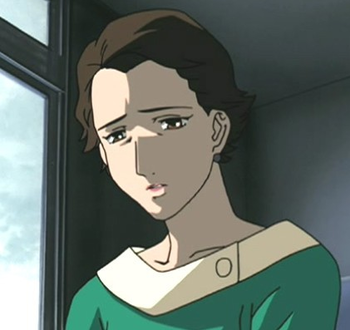
Voice: Sayuri
Yoko's mother in Hourai. She is one of the people who contributed to the formation of Yoko's personality, which makes her look at other people's faces. Although she had shown some understanding to Yoko, she was unable to resist her husband. When Yoko disappeared, she asked her homeroom teacher for advice, but the teacher confronts her about whether Yoko was overworking herself at the time.
When she hears from Yuka that Yoko is not coming back, she mutters to herself, "Maybe she is finally free. When Yuka tells him, "I think Mr. Nakajima wanted to go home," he seems to be saved from the feeling that the reason Yoko did not return was because they had trapped her.
Terms in The Twelve Kingdoms
Worldview and Geography of the Twelve Kingdoms World
Source: ja.wikipedia.org
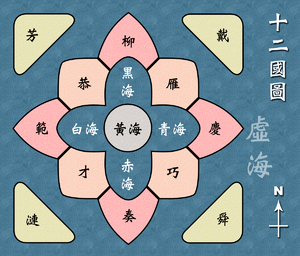
Map of the Twelve Kingdoms World.
The Twelve Kingdoms World exists in another dimension and consists of twelve countries and several oceans. Its official name is unknown. It is said that the world once consisted of thirteen states and was a world very different from the one we know today. Because people continued to behave out of line, the Celestial Emperor once destroyed the world and returned all but five gods and twelve people to the egg. This is the creation myth of the Twelve Kingdoms world.
Today, the world of the Twelve Kingdoms is home to near-gods such as the Shinzen and monsters such as the Yōma, which are harmful to both humans and animals. The general worldview is similar to that of ancient China. The characters used are similar to Chinese characters, but the shapes are slightly different. The writing is similar to Chinese writing, but again, even a student of the University of Tokyo with knowledge of ancient Chinese would have a hard time mastering it. Names such as Le Shun and Yuha are called characters (azana), and the original name consists of the family name and first name as originally recorded in the family register. Some names were given only in childhood, and it is common for a person to have more than one given name, even among commoners.
Each of the twelve kingdoms has a king and a qilin who chooses the king. If the king's politics are correct, the country flourishes, but if the politics are wrong or the king dies, the country falls into ruin. This is not only because of the loss of the leader, but also because of the effects on the climate, such as the loss of a good harvest (if there is a king, rituals are performed and natural disasters decrease). (If there is a king, rituals are performed and natural disasters are reduced.) Since monsters called "demons" appear in a country without a king, the qilin who choose the king are cherished. Sometimes, some people directly ask the king to choose a king as soon as possible. The king is the same as a god, and from the moment he makes a contract with a qilin, he never grows old or becomes ill.
Although there are no wars between nations in the world of the Twelve Kingdoms, there are conflicts in the form of rebellions and civil wars. Not only war, but also aid to other countries is considered an extraordinary crime. In the past, the king of Saigoku, who sent an army to Fan for assistance, was killed along with his kirin for the crime of extraordinary justice. As a result, the characters of the king of Saigoku, as well as those of the kirin, were changed. Basically, the king and qilin do not meet even in neighboring countries unless there are special circumstances, and they do not show up at the coronation ceremony of the new king unless they are invited. Trade does take place, and some countries have been enriched by the former's own production.
What is noteworthy is the way creatures are born. In the Twelve Kingdoms, man and beast are all born as fruit from trees, which are called ovipositories.
The Twelve Worlds are connected to Japan and China by a phenomenon with tremendous power called the Eclipse, from which people are sometimes swept into the Twelve Worlds. The inhabitants of the Twelve Worlds recognize Japan as Horai and China as Kunlun, but they do not welcome those who are swept away by the Eclipse. Rather, they often discriminate against those from Horai and Kunlun, calling them "Kaikaku" (sea guests) and "San-kaku" (mountain guests), respectively, as they come from worlds that are not originally connected to each other. The birth method of being born from the mother's womb is another reason why they are regarded with suspicion. It is said that Horai is at the end of the world and Kunlun is in the shadow of the world.
The Twelve Kingdoms use their own language, which is similar to ancient Chinese. There is a registry called the Immortal Registry, which is used to become a non-human immortal, and those who are admitted to this registry become immortal (not completely immortal), and even haikaku do not have to struggle with language. Yangzi was registered as an immortal because she entered the world of the Twelve Kingdoms after making a pact with Jingqi, so she has no language difficulties (she can only converse, but has difficulty reading Chinese-like sentences).
He is not swept away from the Twelve Kingdoms to Horai or Kunlun (it is said that he cannot keep his form), but sometimes he is caught in an eclipse and swept away to Horai or Kunlun in the form of an egg. The egg is then placed in the belly of a suitable married woman, and is born through the stages of pregnancy and childbirth. The person thus born is called a tai ka. Although taika are residents of the Twelve Kingdoms, they are discriminated against like the sea-guests and mountain-guests because of the unusual and eerie way they are born, "born from the belly of a woman," as residents of the Twelve Kingdoms say.
All countries are governed by a king, but even in the absence of a king, a competent official may take the place of the king. Even when a new king is appointed, the people take pride in the fact that they have protected the country, and in the case of an unborn king, they sometimes assume that the king does not know anything about this world.
Sea of clouds
In the world of the Twelve Kingdoms, the sea separates the heavenly world where kings live and the lower world where ordinary people live. It looks like water floating in the sky. As it is called the sea, it smells like the tide and has waves. It is transparent and slightly bluish when seen from the heavens, and appears gloomy and gray from the lower world. Usually, a sea of clouds looks more like clouds than a sea from below.
The false sea
The ocean outside the eight countries. It is said to be endless, and it is said that not a single person has ever sailed out to see the end of the sea of emptiness and returned. It is also recognized as the borderline between other worlds, and is connected to Horai and Kunlun. It is said that high ranking Immortals, Kirins, and Kings can go to Horai and Kunlun at their discretion. Yanqi of the Wild Goose Kingdom often crosses over to Horai and other places as "the privilege of a qilin," and plays a role in the discovery of the taiqi.
Mt. Lingun
This mountain penetrates the sea of clouds like a pillar. From above the sea of clouds, the peak of this mountain is said to look like an islet.
Gozan (Five Mountains)
It consists of Pengshan, Huoshan, Huooshan, and Hengshan, with Chongshan in the center of the Yellow Sea. It is said to belong to the heavenly realm ruled by Xiwangmu (the chief goddess). There are demons in the Yellow Sea, but they cannot enter the Five Mountains (for reasons unknown). Mt. Pengshan, where the Qilin spend their childhood, is located on the east side of the mountain when viewed from Chongshan. No one can jump over the Five Mountains. This is because they are afraid of Xiwangmu and Shenxian.
Hourogu (Palace of the Peng Lu)
An area on Mt. Qilin who have not chosen a king spend their time here. The terrain is gentle and there is a sacred tree where qilin are born. Bixia Xuanguon, who organizes the female immortals, lives here, and the area can be said to be a bridge between the heavenly world and the earthly world, as it is also where the qilin reside. There are many buildings, and qilin live in the building of their choice. In "Shadow of the Moon: The Shore of the Labyrinth," the Qilin are told by the female Immortal Rong Kae that they can move into any building they like. The terrain, with a sheer cliff to the east and a precipitous cliff to the north, was designed to prevent intruders and to protect the safety of the qilin and the female immortal.
Immediately after the king was chosen, he would wait for an auspicious day at Tangyeonggung, the largest building in the area, and receive an imperial decree. Only after receiving the imperial decree is the king officially enthroned.
Yellow Sea

Related Articles
Spoiler commentary and discussion of Shikon (novel, manga, and anime).
Shikishi Oni" is a horror novel, manga, and anime work based on the novel by Mayumi Ono. The comic version by Ryu Fujisaki was serialized in "JUMP SQUARE". The anime aired for 22 episodes from July to December 2010. A small village with a population of 1,300, "Sotoba Village" is isolated from its surroundings, and the custom of burial still remains. One day, three bodies were found in the Yamairi area, but the villagers decided that there was nothing unusual about the deaths, and they were treated as ordinary deaths. However, villagers continue to die one after another, and the anomalies accelerate.
Read Article
鬼談百景(小説・映画)のネタバレ解説・考察まとめ
『鬼談百景』とは、2012年に発表された小野不由美による短編怪談集。読者からの投稿をもとに作り上げた99の実話怪談を収録している。 日常の違和感が静かに恐怖へと変わる“静怖”が特徴となっており、後に『残穢』と世界観が繋がる。 2016年には、短編オムニバス形式で怪談集の中の99話のうち10のエピソードが映画化された。
Read Article
![You'll have a lot of fun! NHK Anime] 7 recommendations](https://renote.net/files/blobs/proxy/eyJfcmFpbHMiOnsiZGF0YSI6MjA5OCwicHVyIjoiYmxvYl9pZCJ9fQ==--6894577131203bf259e7ae517196d07bfd140267/51R1yxTfoLL.jpg)
You'll have a lot of fun! NHK Anime] 7 recommendations
Do you have an image that "NHK is a broadcaster, so it must be stiff" or "it looks childish"? No, no, there are many highly finished animations that are satisfying for adults as well. This is why we have compiled a list of recommended NHK animations.
Read Article
Tags
Contents
- Overview of The Twelve Kingdoms
- The Twelve Kingdoms" synopsis and story
- Moon Shadow Shadow Sea
- The Moon Sea The shore of the labyrinth
- Ten Thousand Miles of Wind, Reimei no Sora
- the first lunar month
- The Sea of God in the East The Canghai in the West
- Characters from "The Twelve Kingdoms
- Gyeongdong Province
- Yoko Nakajima/Keio/Naka Yoko (中嶋陽子/景王/中陽子)
- Keiki
- white mustard (Sinapis alba)
- redundant help
- Houki (驃騎)
- group culvert
- heavy ceremony held in June
- Jakko
- green monkey (Chlorocebus sabaeus, sometimes considered to be a subspecies of Chlorocebus auratus)
- Jade leaf
- Yoo / Seowang
- Seo Ei (Seo Ei is a Japanese word meaning "to save" or "to save")
- Chairperson
- Candy-selling leaves (Ame-uri Gyokuyo)
- Bishin.
- Iron pyrites
- far-fetched (argument, opinion)
- Su Lan Yu
- Su Lan Gui
- Shoqiong
- Oki Suzu/Mokurin
- Seishu
- Gaho (呀)
- Shoko
- Small horse
- (Yasukuni Shrine)
- bulky
- Shibamochi
- Kantai (垣魋)
- Chief of the fall officialdom
- Chief summer official
- thunderclap
- Labor and Foreign Employment
- tiger's howling
- rays of the setting sun
- Tatsuo
- 丕緒(丕しょ)
- Soken
- Xiaolan
- Aoe
- Riou.
- The King of Thin
- Hi-oh
- lotus flower
- Kakei
- Wild Goose Country
- King Yan, Shoryu
- Enkirokuta/ idiot
- White fertile fly
- good (bright) angle
- Rakushun
- the chance of seeing a fish in the wild
- Yang Zhu Heng
- Seisho
- Meiken
- spider pillow (chuchin)
- Master Yutaka
- Kenro Shinkun/Baku Koya
- Ribi
- Mediation
- Yizhin (a kind of "Yizhin" in Japanese)
- In Shirasawa
- hair whirl
- GENKAI
- Shiken-nai
- Waht is the name of the Chinese character for "rough" and "rough" is the name of the Japanese character for "rough
- Kokei
- Koshu Country
- King Hanawa / King Sakuou
- Hanawa In/Hanawa Wa
- Hakuyun Kaiswa
- mother of Rakushun
- Miss Tatsuki
- Seizo Matsuyama
- Kyongju Province
- King of offerings, pearl crystals
- Qi (Qin)
- Sangyeongsang, preface (in Chinese, approx. 3.5 cm)
- Kiwa Muro
- gong carrier
- Lianqiangdai (Lianqiang table)
- Houkyoku Koku
- Mine King, Middle Poach / King Rokuo
- Kahana
- Hourin
- Moon Stream
- Gobo.
- Daijiyoku Koku (The Land of the Rising Sun)
- King Tai, leader of the Taoist movement
- Tai-Ki Kouri/Kaname Takasato
- White Shanty
- arrogance
- the true grandson (or grandchild)
- Li Saisai
- Lu Haku
- Kaiei (flower shadow)
- Langsan
- Joua Sen
- Ganzhao
- English name
- Seirai
- Frozen Gen (Sougen)
- Gashin
- Rennpokukoku
- Ren Wang Oh Seitaku
- Renrin
- Saizhou Province
- King of the Order, Huangguo (Chinese: 采王; pinyin: 采王; pinyin: 采王)
- Cradle of the Cheilin
- Suibi-kun / Riyou
- Shishou / Gowang
- Buuang (dynasty of China)
- Celebration of prosperity
- Shu Xia
- Seiki
- Zun Emperor
- Sounangukoku (South Korea)
- Sung King O-ro Seng-shin
- Sung In, Sho Sho
- Meiqi.
- Ritatsu
- Rikou
- Bunki (Princess Bunki)
- Ryuhoku Country (Ryukoku Province)
- Liu Wang Sukeroho
- Liu Qi
- Stubborn hill
- Ei Kung
- Gamagetsu
- Yuhu
- Enga
- otter (Lutra lutra)
- Sunryo
- Eshi (blessing)
- HANSEI KOKOKU
- Wu Lanjiao, King of the Flood
- Flooding, Risetsu
- Nyusen (female immortal)
- Gyokuha/Hekikagenkun
- Teiei
- Ryoke
- Shoshun
- Kaikaku / Hourai
- Ikuya Asano
- Yuka Sugimoto
- Heki Rakunin (Wall Rakunin)
- Tak Takasato, Taku
- Grandmother of the keystone
- Masashi Nakajima
- Ritsuko Nakajima (Ritsuko Nakajima)
- Terms in The Twelve Kingdoms
- Worldview and Geography of the Twelve Kingdoms World
- Sea of clouds
- The false sea
- Mt. Lingun
- Gozan (Five Mountains)
- Hourogu (Palace of the Peng Lu)
- Yellow Sea
- Mt. Ascending (Mt. Shozan)
- Shiryoumon (four-order gate)
- (food) erosion
- Egg Fruit
- Heaven, King, and Kirin in the Twelve Kingdoms World
- Heavenly King
- Seiohbo
- King.
- Kao/Kiou (False King)
- Kirin
- lost road
- woman-kai (i.e. a monster, monster-like creature, etc.)
- Status and creatures other than kings of the Twelve Kingdoms World
- Immortals
- Nyusen (female immortal)
- Womb Fruit
- Sea guest / Mountain guest
- demon
- commander
- half-human and half-beast
- Cavalry
- Hakuchi (Hakuchi)
- luan (mythical Chinese bird)
- Phoenix
- Other
- Winter Ware (Touki)
- Water Punishing Sword
- Kaitatsu
- Rike
- Famous quotes, lines, scenes, and scenes from "The Twelve Kingdoms
- 'I don't care about the world or strangers. I am kind because I want to be kind. I believe because I want to believe.
- I was so far away from Le Shun's heart. He didn't discriminate against me when I was a fetus, but now he discriminates against me when I am a king? There are only two steps between us. No, it is three steps for me.
- It's the tears of a child to say he feels sorry for himself.
- The important thing is to make an effort to understand the intentions of the other party.
- The world is made up of half happy things and half painful things, and a person is happy not because he or she is blessed but because he or she strives to be happy.
- If they give you things without effort, it means they demand that you work that much harder."
- Backstories, trivia, subplots/episodes, and anecdotes from "The Twelve Kingdoms
- The Twelve Kingdoms" is a sequel to the same author's novel "The Devil's Child" and the main story
- Differences between the original novel and the anime
- Hanawa In's cause of death changed from death from illness to murder by Hanawa King.
- Yuka Sugimoto is another form of Yoko
- Why Rakutoshi went to Yanagikuni
- Theme and insert songs for "The Twelve Kingdoms
- OP (Opening): "Twelve Phantom Songs
- ED (Ending): Mika Arisaka "Moon Lost in the Wind Shadow