
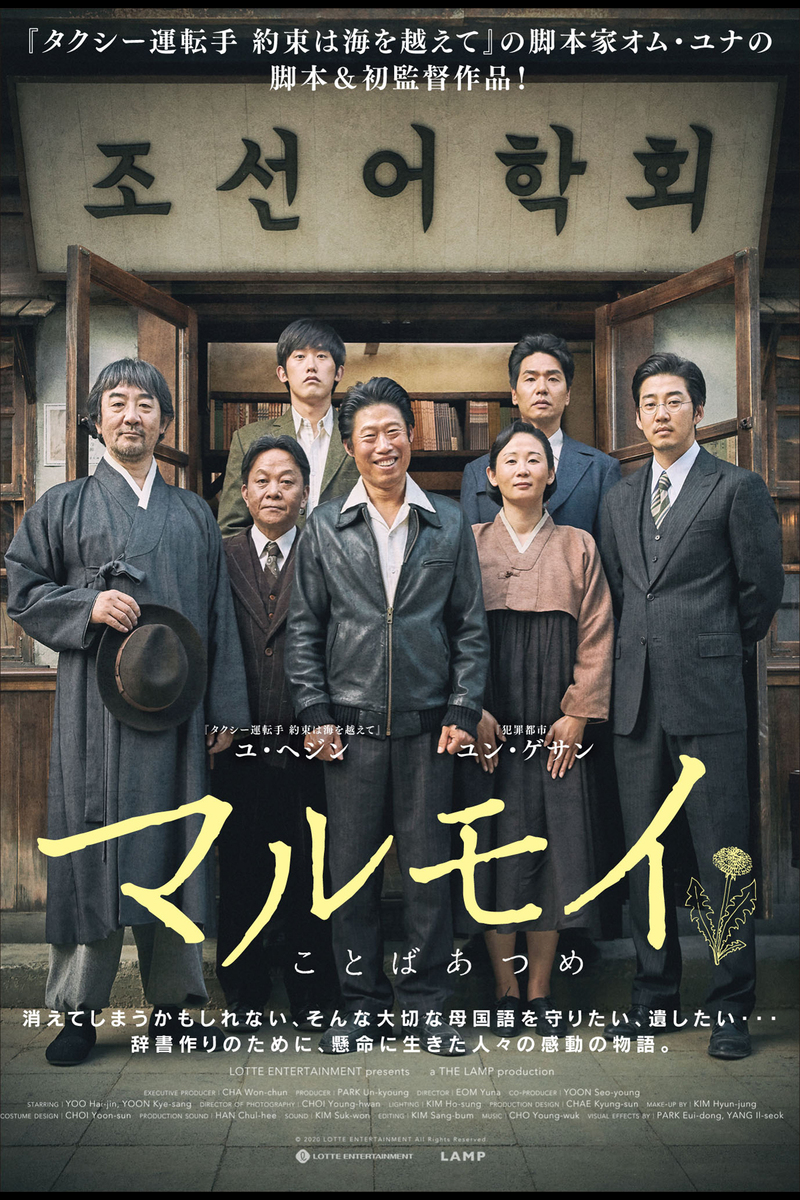
Marmoi Kotoba Atsume" is a Korean film released in Japan in 2020. Directed and written by Om Yoon-ah, the film is based on the "Korean Language Society Incident" that actually occurred in Korea during World War II. Kim Pang-soo, a poor man living in Gyeongseong on the Korean Peninsula under Japanese rule, happens to meet Ryu Jung-hwan, a representative of the Korean Language Society, which compiles a dictionary of the Korean language. The two are at odds with each other, but as they collect various Korean words, they form a strong bond as comrades. This film is a story about people who live wisely with national pride.
The reality of the script that brings tears to the audience's eyes.
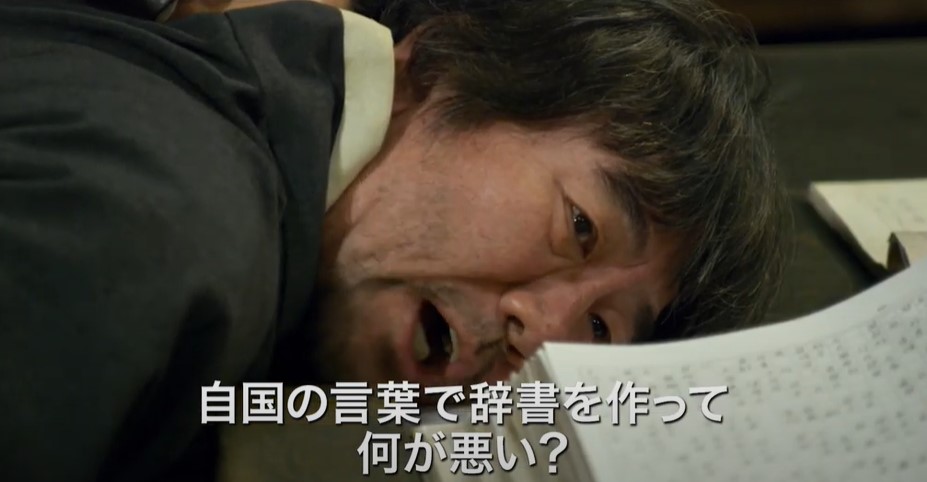
Gapuin taken to the Korean Governor-General's Office
Marmoi Kotoba Atsume" is based on the "Korean Language Society Incident" in which the Japanese oppressed Koreans in Korea under Japanese rule. As mentioned above, for Koreans, "urimaru" represents the spirit of the nation. However, during World War II, Japan suppressed the Korean Language Society in order to suppress the rebellion of Koreans, arresting 33 members of the society within about a year. Some of them were tortured and others died of cold and hunger in prison. As a result, the manuscript of the dictionary was temporarily lost, and the dictionary was not completed until after World War II. In this film, too, there are links to historical facts, such as the murder by torture of Cho Gap-in, who was working hard to compile the dictionary, and the temporary disappearance of the manuscript that Pang-soo risked his life to protect. In addition to the skillful portrayal by Om Yoon-ah, the realism of the film, based on such real-life incidents, is a factor that brings tears to the audience's eyes.
Theme and insert songs for "Marmoi Kotoba Atsume
Insert song: "반달 (Half Moon)" written by Yoon Kuk-young
It is said that "Half Moon," which is an inserted song in "Marmoi Kotoba Atsume," was the first children's song in Korea, written by Yoon Kuk-yong in 1924. The song appears twice in the film, once when Pang-su reaffirms his commitment to cooperate with the Korean Language Society, and again after the hearing when Pang-su says, "I'll never go to jail again. The second scene is when Duk-jin sings the song for Pang-su, who has not returned home after saying, "I promise I will never go back to jail again. Half Moon" was written 14 years after the Japanese took over Korea, and the lyrics include a metaphor for Korea: "A white wooden boat with no sails and no poles, but we're going forward. Also, "Hanzuki" appears in "Marmoi Kotoba Atsume" (Marmoi: Kotoba Atsume), both of which are scenes in which the singers are anxious about not being able to see the path they should take in Korea and themselves. The Pangs were searching for where they were going and where they should go under the unforeseen circumstances of Japanese rule. This is what "Half Moon" expresses.

Tags
Contents
- Outline of "Marmoi Kotoba Atsume
- The story of "Marmoi Kotoba Atsume
- encounter
- comrade
- public hearing
- 1945
- Characters in "Marmoi Kotoba Atsume
- key people
- Kim Pang-soo (played by Yoo Hye-jin)
- Ryu Jung-hwan (played by Yoon Gesang)
- Figures from the Korean Language Society
- Cho Gap-in (played by Kim Hong-pa)
- Im Dong-ik (played by Woo Hyun)
- Park Hoon (played by Kim Tae-hoon)
- Koo Ja-young (played by Kim So-young)
- Min Woo-chul (played by Min Jin-woong)
- Persons hostile to the Korean Language Society
- Ryu Wan-taek (played by Song Young-chang)
- Ueda (played by Ho Seong-dae)
- People around Pance
- Kim Duk-jin (played by Cho Hyun-do)
- Adult Duk-jin (played by Kim Dong-young)
- Kim Sun-hee (played by Park Ye-na)
- Seung Hee (played by Yoo Eun Mi) in junior high school
- Jang Choon-sam (played by Lee Sung-wook)
- PARK Pondoo (played by CHO Hyun-cheol)
- Optician's president (played by Yoon Kyung-ho)
- Collaborators of the Korean Language Society
- Jeju Teacher (played by Lee Jung-eun)
- Postman (Actor: Choi Gui Hwa)
- Cho Gap-Yoon (played by Ye Su-Jeong)
- Kim Doo-bong (played by Yoo Jae-myung)
- Terms for "Marmoi Kotoba Atsume
- era of Japanese colonial rule
- Korean Language Institute
- Urimaru/Urinara
- Gyeongseong (Prefecture)
- Governor-General of Korea
- the order forced on Koreans to change their names to Japanese ones
- General Federation of Korean Industries
- Gyeongseong First Middle School
- illiterate person
- public hearing
- Famous quotes, lines, scenes and scenes from "Marmoi Kotoba Atsume
- Koo, Ja-young: "Language is a vessel that contains the spirit of a people.
- Ryu Jung-hwan: "I'm an important comrade... please forgive me."
- Letter from Pance.
- Behind the Scenes, Trivia, Episodes, and Anecdotes of "Marmoi Kotoba Atsume" (Marmoi Kotoba Atsume)
- Director Yuna Ohm sublimates somber & dark themes into entertainment
- Korean People's Thoughts on "Urimaru
- The reality of the script that brings tears to the audience's eyes.
- Theme and insert songs for "Marmoi Kotoba Atsume
- Insert song: "반달 (Half Moon)" written by Yoon Kuk-young