
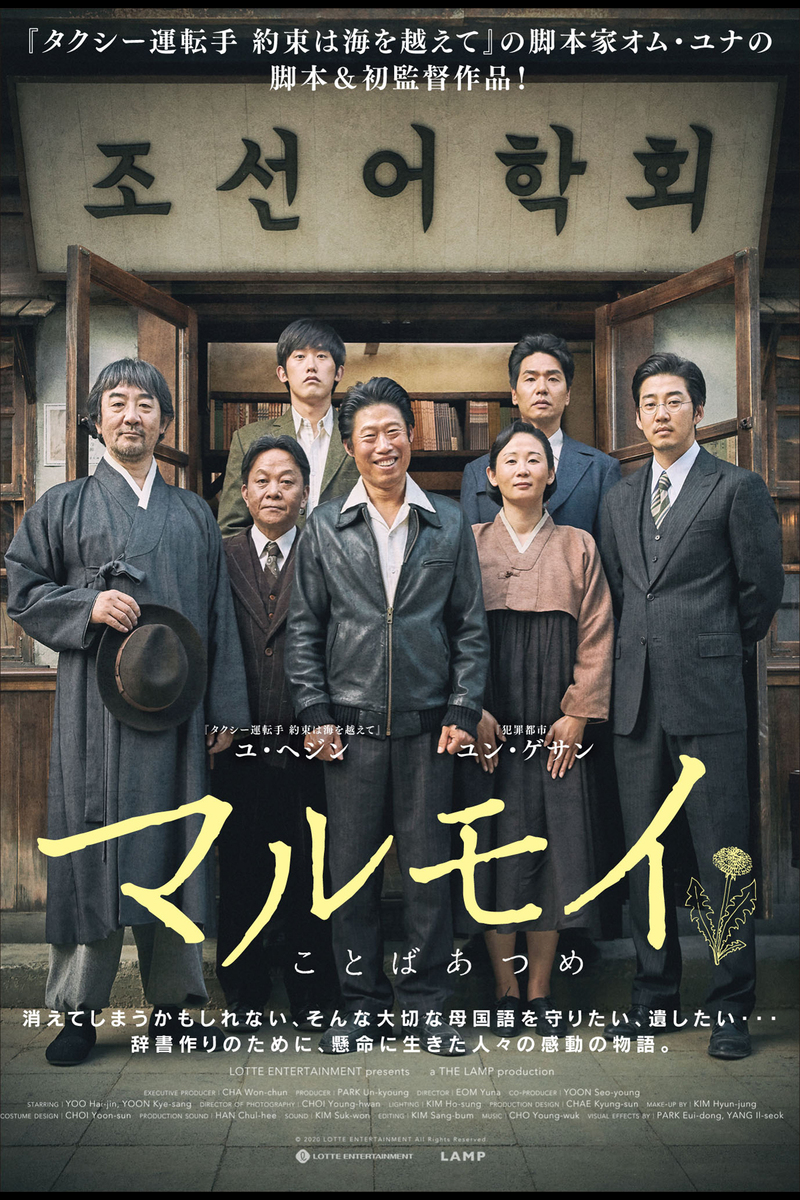
Marmoi Kotoba Atsume" is a Korean film released in Japan in 2020. Directed and written by Om Yoon-ah, the film is based on the "Korean Language Society Incident" that actually occurred in Korea during World War II. Kim Pang-soo, a poor man living in Gyeongseong on the Korean Peninsula under Japanese rule, happens to meet Ryu Jung-hwan, a representative of the Korean Language Society, which compiles a dictionary of the Korean language. The two are at odds with each other, but as they collect various Korean words, they form a strong bond as comrades. This film is a story about people who live wisely with national pride.
Outline of "Marmoi Kotoba Atsume
Marmoi Kotoba Atsume" is a South Korean film that was released in South Korea on January 9, 2019 and in Japan on July 20, 2020. The film was directed and written by Om Yoon-ah, who wrote the screenplay for "Taxi Driver: Promise Across the Sea" and this is her first film as a director. The film stars Yoo Hye Jin of "Luck-Key" and "Taxi Driver: Promise Across the Sea" and Yoon Gae Sang of "Crime City" and "Golden Slumber. He is further flanked by Kim Hong Pa, Woo Hyun, and other splendid actors. The film was originally scheduled to be released in Japan on May 22, 2020, but was postponed to July 20 of the same year due to the outbreak of the new coronavirus.
The film "Marmoi Kotoba Atsume" was based on the "Korean Language Society Incident" that actually occurred on the Korean Peninsula in 1942. The Korean language society was under Japanese rule in Korea, where the use of the Korean language was restricted, and members of the society were arrested and imprisoned for crimes. Two Koreans died in prison from cold and hunger as a result of this incident. The story in this film takes place against the background that Koreans were forced to use the Japanese language under Japanese colonial rule and that the Korean Language Society sacrificed much to compile the dictionary.
Kim Pang-soo, who lived a poor life in "Gyeongseong" under Japanese rule, which later became Seoul, one day tries to steal Ryu Jung-hwan's bag, the representative of the Korean Language Society, in order to pay for his son's tuition. The Korean Language Society, of which Jung-hwan is the president, is an organization that tries to compile a dictionary of the Korean language while withstanding Japanese oppression. However, Pang-soo ends up working for the society by chance, and he and Jung-hwan are at loggerheads because of his illiteracy. The two gradually develop a bond as comrades in arms in the process of collecting Korean words, but they are eventually cornered by the Japanese governor-general of Korea, who is promoting the assimilation of Korea into Japan.
The story is a human drama of people who, with the belief that "language is the vessel that contains the spirit of a people," strive for the independence of Korea and the establishment of the Korean language.
The story of "Marmoi Kotoba Atsume
encounter
During the Japanese colonial period, the use of the Korean language was forbidden by the Empire of Japan within the Korean Peninsula. Some people, fearing the loss of their own language and spirit in the process, established the Korean Language Society to study and maintain the Korean language. The members of the Korean Language Society began compiling a dictionary of "Urimaru (our language)" while enduring oppression from Japan.
In 1941, many people gathered at a movie theater called the Chosun Theater in Gyeongseong (Kyongseong), which later became Seoul. Movies were one of the few forms of entertainment for the people of Gyeongseong. Kim Pang-su, who works at the theater, and his lackey, Park Pong-doo, are shouting to attract customers. However, Pang-soo, who is in need of money for his son Deok-jin's school fees, conspires with Jang Chun-sam, another minion posing as a customer, and ends up picking pockets in the theater. Pang-su is eventually caught by his boss for pickpocketing and is fired from his job at the theater.
At the train station in Gyeongseong, Pangsu, along with Chungsam and Bongdu, is looking for a duck to use as a prey for the pickpocket. A well-dressed Ryu Jung-hwan with glasses walks by. Pang-soo and his friends see an opportunity and grab Jung-hwan's bag, but Jung-hwan is not to be outdone, and the police rush to the scene. Since the bag contained a valuable collection of dialects he had collected in the provinces, neither Jung-hwan nor the police could afford to be caught. So, for their own reasons, the two men desperately tried to escape from the police.
comrade
One night, there was a meeting of the directors of the National Federation of Korea. The meeting is hosted by a military officer from the Korean Governor-General's Office, who has changed his name from his Korean name to his Japanese name, Ueda. Ryu Wang-taek, Jung-hwan's father and president of Gyeongseong First Middle School, is also in attendance. At the meeting, Wang-taek is criticized for his son Jung-hwan's position as a representative of the Korean Language Society, which is hostile to the Governor-General of Korea.
Jung-hwan runs a small bookstore called Mundang Bookstore, and in the basement of the bookstore, he is secretly compiling a dictionary with his friends from the society. However, he lacked the funds and manpower to compile a dictionary in Korean, as it was subject to suppression under Japanese colonial rule in Korea. Then Cho Gap-in, a scholar and a member of the society, brought a man he had known for a long time who was looking for work. Since the man was Pang-su, Jung-hwan was vehemently opposed to hiring Pang-su. However, Pang-su needs money for Deok-jin's tuition at Gyeongseong First Middle School, so he insists on getting her hired. The other members of the society who were present are also charmed by Pang-su's pleasant personality, and Jung-hwan reluctantly agrees to hire Pang-su.
However, Pang-su is illiterate, so Jung-hwan gives him a literacy test in a month's time, and if he does not pass the test, he will be fired immediately. Pang-su rebels against Jung-hwan's harsh words. However, Koo Ja-young, one of the members of the society and the reddest member, follows Jung-hwan behind his back, saying, "The representative used to be a joking person and used to laugh a lot. He says that since the Korean language was abused and many of his comrades were taken away, he has changed his personality like a different person.
One day, Pang-su overslept after drinking with Chung-sam and Pondoo the day before, and went to work with his daughter Seung-hee to ease the workplace. However, Mundang Bookstore was in no condition to worry about such things. The day before, Ueda and his subordinates had visited the bookstore, and they were about to find the materials of the dictionary they had collected. The entire academic staff was busy moving the materials to a hidden room in the basement. What's all this stuff? Jayeon replies, "It's a mal (language), and I've been collecting it for 10 years. Pang-su, however, does not care if the Korean language is lost and does not understand the meaning of collecting "maru" over a long period of time. Jayeon tells Pangsu that "language is a vessel that contains the spirit of a people. He then gives an example of how overseas people refer to the country in which they live as "my country," but in Korea, where "community" is more important, they refer to it as "our country. This was to admonish how language is unique and important to each ethnic group.
Meanwhile, upstairs, Jung-hwan is reading a book to Seung-hee. He was reading a book to Seung Hee, and Seung Hee was very much taken with his gentle face and voice, which was very different from the way he read to Pang Soo. As Pang-su watched, he naturally called Seung-hee "our Seung-hee. Pang-su then remembers Jayoung's words earlier, "Words are an expression of one's ethnicity. The Mundang Bookstore seemed to be safe now that the materials had been moved to the basement. On the other hand, however, Jung-hwan's father and Ueda demand that he dismantle the Korean Language Society and change his name to Soseon. Pang-su's son, Duk-jin, also has a bad impression of his father, who works for the Korean Language Society, and has developed an awkward attitude toward Pang-su.
One day, a statement by a Korean writer affirming the Japanese rule of Korea created a dark atmosphere at the Mundang Bookstore. Reporter Park Hoon, a member of the Korean Language Society of Japan, taunted Im Dong-taek, a poet and also a member of the society, saying, "As a fellow Korean writer, what do you think about that? Even in such a situation, however, the Korean Language Society has to send the manuscripts of its monthly magazine, "Hangul," to the printer. Pang-soo volunteers to deliver the finished manuscript to the printer, saying, "I can do it if you just hand it over to me.
As Pang-su is on his way to the printing plant, he sees Im about to throw dirt on the National Federation of Korea. Meanwhile, Jung-hwan expresses his disappointment when Pang-su does not return that night, saying, "We were fools to believe in him. Jung-hwan returns to the bookstore, finds Pang-su there, and chastises him for stealing the printing money. Pang-su, however, was just taking care of Im and couldn't go to the printing house. Pang-su is furious at Jung-hwan's accusation and says, "Don't make fun of me just because I'm poor! and threw the printing fee he was holding so dearly at Jung-hwan, and left the bookstore.
The next day, Jung-hwan comes to Pang-su's house to apologize for not coming to work. When Pang-su asks him to leave, Jung-hwan insists, "I misunderstood. He continues, "Where people gather, there are words. Where words gather, there are aspirations...Where aspirations gather, the road to independence will eventually open up. I was foolish. Please forgive me..." Jung-hwan continues, and Pang-su finally opens up to him.
Pang-su continues his literacy studies smoothly, and with Jung-hwan's help, he successfully passes the test. He is now able to read bar menus and novels, and Pang-su is in a good mood. On the other hand, he was having difficulty compiling a dictionary of the Korean language. There are several different dialects of Korean, and it takes time to collect the words in the first place. In addition, the Korean language teachers were all reluctant to cooperate because of the attention of the Korean governor-general. Then, Pangsu arrives with many of his former prison buddies. Since they are from different parts of the country, they can collect several different dialects at once.
At the same time, however, the Governor-General of Korea decided to close down the unauthorized Korean language bookstore and discontinue publication of the magazine. Since the Korean Language Society would be dismantled if nothing was done, Jung-hwan suggested that a "public hearing on the standard Korean language" be held. Before the Korean Language Society is dismantled, he wants to gather all scholars and teachers together to decide on the standard Korean language. Needing to collect more dialects for the public hearing, the society decided to place an ad in the final issue of Hangul magazine asking readers nationwide to send in their dialects. The members of the Korean Language Society are all fired up to complete the dictionary, but Min Woo-chul, the youngest member of the society, is not so happy. In fact, Ueda had visited Woo-chul a few days earlier and threatened to turn over information about the Korean Language Society if he wanted to help his wife, who was in prison.
The last issue of Hangeul sold three times as many copies as usual. However, none of the information on dialects that had been called for in the advertisements reached them. Then, Ueda suddenly broke into Mundang Bookstore, where Jung-hwan and Pang-su were away, with his men in tow. Ueda's subordinates do not hesitate to violate the members of the society, who refuse to answer when asked where the manuscript of the dictionary is located. Finally, the existence of a hidden room in the bookstore is discovered, and all the materials are confiscated. When Jung-hwan learns of this, he goes to his father and demands that he return Gap-in, who was taken away for resisting particularly strongly. Wang-taek, however, refuses to comply, and tells him to obey the governor-general of Korea in exchange for the life of a member of the Joseon Language Society.
Meanwhile, Pang-su is cleaning up the basement of the Mundang Bookstore, and Park Hoon is having a hard time with him. He suspected that Pang-su was leaking information to him, since he had found the entrance to the basement without hesitation when Ueda came with his men. In reality, however, Woo-chul did it to save his wife from prison. It turns out that Woo-chul's wife had already died in prison, and that this fact had been covered up by Ueda. Woo-chul is shocked at what he has done.
Hearing that Gap-in has been released and admitted to the hospital, members of the Korean Language Society rush to the scene. However, Gap-in was severely tortured and passed away, leaving a will that everyone should support Jung-hwan. Jung-hwan is saddened, but he learns from Gap-in's wife that Gap-in had transcribed all the materials of the dictionary before his death and kept them at home. He also learned that the dialects sent to him by calling out in "Hangul" were stored in a warehouse through the efforts of a postal worker. Thus, the unity of Pangsu and others who wanted to preserve the Korean language was further strengthened, and the path to the public hearing was paved.
public hearing
The hearings were scheduled to take place inside the theater after it opened for business for a week, under the radar of the Chosun Governor-General's Office. After the final screening of the film, the participants would stay in the theater to discuss the issues. On the first day of the hearing, Jung-hwan and his colleagues were greeted with thunderous applause when they took the stage. They are all looking forward to the creation of a Korean dictionary. The public hearing proceeded smoothly, with heated discussions interspersed with the occasional light-hearted talk by Pang-soo.
At the same time, Ueda was on the lookout for Duk-jin to find out where the hearing was being held. When Duk-jin is threatened with a gun, he quickly answers that the location is different from the theater where the hearing is being held and runs to Pang-su. He runs to Pang-su, saying, "You promised you wouldn't go to jail without us again, right? But Pang-su says, "I'll never go to jail again. I promise." He returns to help the people in the theater.
When Pang-su returns to the theater, he finds that Ueda, who has discovered Duk-jin's lie, is about to break into the theater. The members of the Korean Language Society and the attendees at the hearing manage to get the dictionary manuscript and Jung-hwan away. Jung-hwan is not safe on his own, and Pang-soo manages to escape from the theater with him. However, Jung-hwan is shot on the way out, and the two escape to an empty house. Jung-hwan, thinking that he will act as a decoy, asks Pang-su to deliver the manuscript to a printing house in Busan that prints dictionaries. Jung-hwan said to Jung-hwan, "You can handle it. Pang-su reluctantly agrees. Pang-su runs with the manuscript in his arms, crying, as Jung-hwan deliberately leaves. However, he is about to be found and manages to throw the manuscript into the post office warehouse. Then, Pang-su is shot dead at a cul-de-sac in the street by a soldier of the Joseon Governor-General's Office.
1945
Time passed and in 1945, Jung-hwan managed to survive but was captured, and while in prison, he learned of Korean independence. Upon his release, Jung-hwan reunites with members of the Korean Language Society and learns that Pang-su's body has been disposed of by the Korean governor-general and that Duk-jin and Seung-hee have also left Gyeongseong. The manuscript entrusted to Pang-su was also lost, but one day, news came that it had been found in a warehouse at the post office. Two years later, in 1947, Jung Hwan visited a school with a completed dictionary. At that school, Pang-su's son, Duk-jin, was working there as a teacher. Seung Hee, now a junior high school student, is standing next to Duk Jin, and they are reading Pangsu's letter that was left with the manuscript. He writes, "I feel like I can be a proud father to you when the dictionary is finished. That's why I agreed to the public hearing. Deok-jin and Seung-hee look at the letter and the dictionary with tears in their eyes, while outside, Jung-hwan chases after the children with a smile on his face.
The letter read, "Korean is one of the languages with its own unique dictionary, and we are the only nation that has recovered its own language among the independent nations after World War II."
Characters in "Marmoi Kotoba Atsume
key people
Kim Pang-soo (played by Yoo Hye-jin)
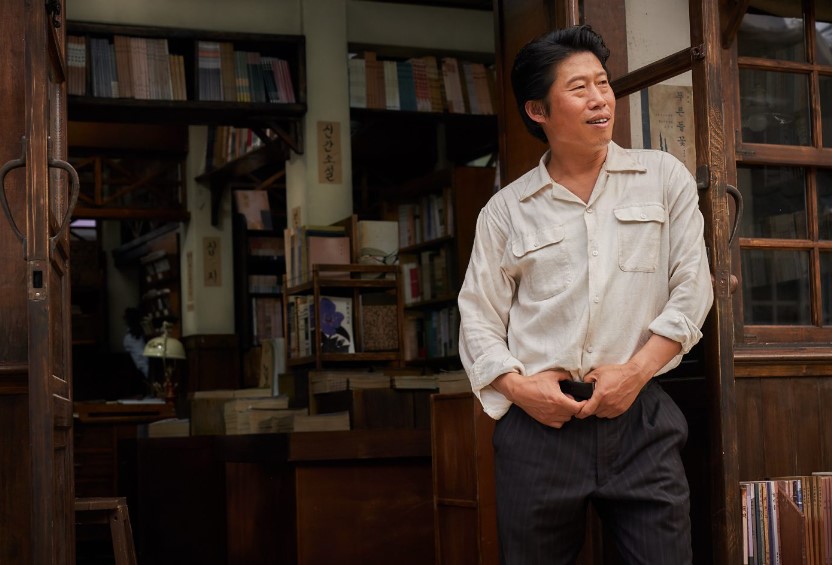
Dubbing is by Chinnen Takahashi.
A man who originally made his living as a pickpocket and has spent time in prison. He has a son named Duk-jin and a daughter named Sun-hee. He used to work at a theater in Gyeongseong during the Japanese occupation, but was fired when he was found to have been a pickpocket in cahoots with Pondoo and Chungsam. When she is having trouble paying her son's tuition fees, Gap-in, a long-time acquaintance, offers her a job at the Korean Language Institute. At first, however, she does not get along with Jung-hwan, and they clash repeatedly. As he spends time with Jung-hwan and other members of the Korean Language Society, he gradually comes to understand the significance of creating a dictionary and becomes an indispensable member of the society.
Ryu Jung-hwan (played by Yoon Gesang)
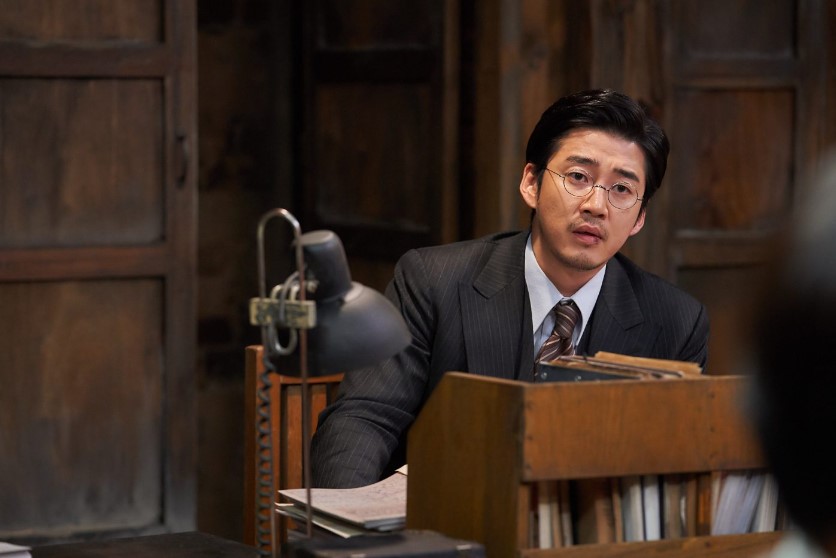
Dubbing is by Tatsunori Fukusato.
He is the president of the Korean Language Society and the son of Ryu Wang-taek, the president of Gyeongseong First Middle School, where Deok-jin attends. He became active in the Korean Language Society, which was established to study and maintain the Korean language, due to the influence of Wang-taek's teaching Korean to those around him when he was a child. Originally, he was cheerful and joking, but as he saw Korean language researchers and teachers being captured one after another, he stopped laughing. At first, he despises Pangsu, who is a pickpocket and cannot read, but gradually comes to recognize him as his one and only comrade.
Figures from the Korean Language Society
Cho Gap-in (played by Kim Hong-pa)
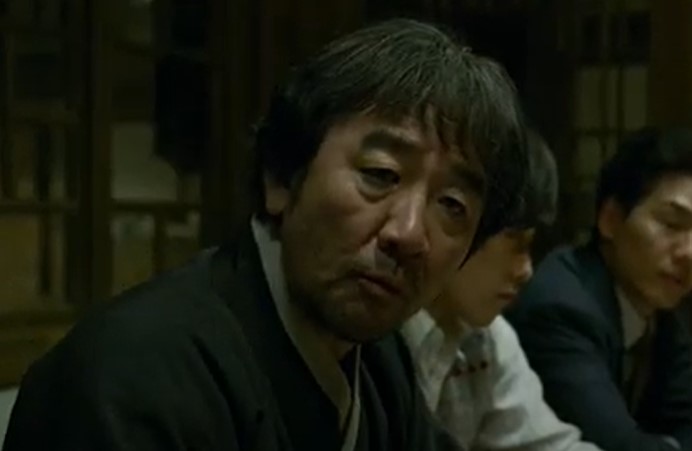
Dubbed by Shunsaku Nishigaki.
He is one of the members of the Korean Language Society. He is the number two in the society and is a good advisor to the other members. He is worried about Jung-hwan, who has stopped laughing, and hopes that bringing Pang-su into the society will bring about some positive chemical reactions. When the materials in the basement of the Mundang Bookstore were confiscated by Ueda, he was captured and severely beaten. He eventually died from the injuries he sustained at the time. After his death, it was discovered that he had transcribed all of the dictionary materials he had collected up to that point and kept them hidden.
Im Dong-ik (played by Woo Hyun)

Tags
Contents
- Outline of "Marmoi Kotoba Atsume
- The story of "Marmoi Kotoba Atsume
- encounter
- comrade
- public hearing
- 1945
- Characters in "Marmoi Kotoba Atsume
- key people
- Kim Pang-soo (played by Yoo Hye-jin)
- Ryu Jung-hwan (played by Yoon Gesang)
- Figures from the Korean Language Society
- Cho Gap-in (played by Kim Hong-pa)
- Im Dong-ik (played by Woo Hyun)
- Park Hoon (played by Kim Tae-hoon)
- Koo Ja-young (played by Kim So-young)
- Min Woo-chul (played by Min Jin-woong)
- Persons hostile to the Korean Language Society
- Ryu Wan-taek (played by Song Young-chang)
- Ueda (played by Ho Seong-dae)
- People around Pance
- Kim Duk-jin (played by Cho Hyun-do)
- Adult Duk-jin (played by Kim Dong-young)
- Kim Sun-hee (played by Park Ye-na)
- Seung Hee (played by Yoo Eun Mi) in junior high school
- Jang Choon-sam (played by Lee Sung-wook)
- PARK Pondoo (played by CHO Hyun-cheol)
- Optician's president (played by Yoon Kyung-ho)
- Collaborators of the Korean Language Society
- Jeju Teacher (played by Lee Jung-eun)
- Postman (Actor: Choi Gui Hwa)
- Cho Gap-Yoon (played by Ye Su-Jeong)
- Kim Doo-bong (played by Yoo Jae-myung)
- Terms for "Marmoi Kotoba Atsume
- era of Japanese colonial rule
- Korean Language Institute
- Urimaru/Urinara
- Gyeongseong (Prefecture)
- Governor-General of Korea
- the order forced on Koreans to change their names to Japanese ones
- General Federation of Korean Industries
- Gyeongseong First Middle School
- illiterate person
- public hearing
- Famous quotes, lines, scenes and scenes from "Marmoi Kotoba Atsume
- Koo, Ja-young: "Language is a vessel that contains the spirit of a people.
- Ryu Jung-hwan: "I'm an important comrade... please forgive me."
- Letter from Pance.
- Behind the Scenes, Trivia, Episodes, and Anecdotes of "Marmoi Kotoba Atsume" (Marmoi Kotoba Atsume)
- Director Yuna Ohm sublimates somber & dark themes into entertainment
- Korean People's Thoughts on "Urimaru
- The reality of the script that brings tears to the audience's eyes.
- Theme and insert songs for "Marmoi Kotoba Atsume
- Insert song: "반달 (Half Moon)" written by Yoon Kuk-young