

We have compiled a list of masterpieces of philosophy, ethics, and psychology that have been read around the world for many years. We have compiled basic information and reader feedback on each work, including "The State" by the ancient Greek philosopher Plato and "The Genealogy of Morals" by the German thinker Nietzsche. We have also compiled a list of books that are perfect for an introduction to philosophy.
This is a very reliable Japanese translation of the classic Wittgenstein book "A Philosophical Discussion of Logic." As the translator is Mr. Shigeki Noya, the author of "A Philosophical Discussion of Logic," the translation is easy to read and the translation is very extensive. "A Philosophical Discussion of Logic" can be used as a side reader that is very compatible with this book.
Source: www.amazon.co.jp
The translator's commentary at the end of the book includes a brief summary of the main text of "Essays" by the translator. I think it is no exaggeration to say that this book is not only a Japanese translation of the "Essays" but also an introduction to the "Essays.
Source: www.amazon.co.jp
However, there are some passages in the text where the interpretation is not clear, and there are passages where the translator's guess is limited to the end of the word (e.g., "~ is thought to be" or "~ is thought to be"). Beyond these passages, readers will need to think on their own. This is a book that allows the reader to think on his/her own while reading the Japanese translation with these points in mind, and thus provides a rich experience of reading the "Treatise".
Source: www.amazon.co.jp
ウィトゲンシュタインちょいすこなオタクなので論理哲学論考って本買いましたが、その道のプロじゃないと僕みたく初っ端から何言ってるのか全く理解できなくて笑います。マジで頭おかしいこいつって感じ。 pic.twitter.com/TQ33axxC55
— ponsai😈🌸 (@Riko_ponsai) October 9, 2017
死は人生の出来事ではない。ひとは死を体験しない。永遠を時間的な永続としてではなく、無時間性と解するならば、現在に生きる者は永遠に生きるのである。視野の内に視野の限界は現れないように、生もまた、終わりをもたない。(ウィトゲンシュタイン『論理哲学論考』)
— ツイート太郎 (@follow_mix19) October 16, 2017
Source: www.amazon.co.jp
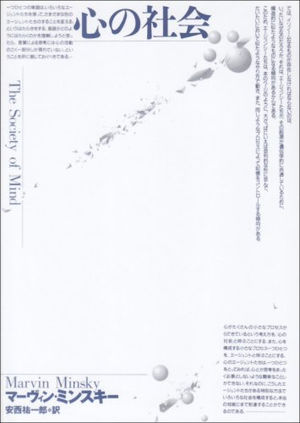
"The Society of the Mind" by Minsky
How does the mind work? The Society of the Mind provides a revolutionary answer to this age-old question.
This book presents a new way of thinking about human intelligence that Professor Minsky has elaborated on for a long time.
According to Minsky, the mind is a society made up of small agents who have no mind at all.
The book's content ranges from children's drawings to self-consciousness, from the power of negative thinking to the role of humor in everyday thinking.
Most people who are involved in software are at least familiar with Minsky's name as a researcher in the field of artificial intelligence. However, I did not know what kind of specific research he had done.
Source: www.amazon.co.jp
In fact, reading this book, I was once again impressed by the amazing people in the world.
I think the reason why the workings of the mind are examined so extensively and in such depth is because of the specific goal of creating artificial intelligence.
Source: www.amazon.co.jp
Minsky's theory is based on the idea that the mind is composed of a hierarchy of individual process units called agents.
At first I was a little uncomfortable with this idea, but as I continued reading, the workings of my own mind, of which I was normally not very conscious, gradually came to life.
Furthermore, it seems to me that objectively reaffirming the workings of the mind can be useful in reexamining one's own judgments and actions.
Source: www.amazon.co.jp
ジュンク堂池袋店、人工知能が流行ってるということでミンスキーの心の社会を平積みするあたり、最高だなあ
— raven (@raven_38_) January 30, 2017
ミンスキーの「心の社会」読んでいるのだが、人工知能の専門家の本に釈迦が引用されていたりするのは面白い。哲学を科学的に見る感じ。
— ArikaOmbuds (@k_brigeil) March 4, 2016
Source: www.amazon.co.jp
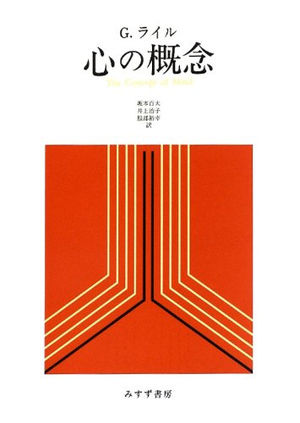
Lyle, "Concepts of the Mind."
The publication of Ryle's "The Concept of Mind" (1949) was "a pivotal event in postwar philosophy" (G.J. Warnock).
Together with Wittgenstein's "Philosophical Investigations," which was published around the same time, these two books were the first two books on philosophy in the latter half of the 20th century.
The influence of these two books on philosophy in the second half of the 20th century is immeasurable.
This book is a declaration of the establishment of the philosophical method of the so-called "everyday language school.
It is also a development of Wittgenstein's insight that "the meaning of language is its use.
Ryle's method fundamentally criticizes the philosophical tradition of mind-body dualism since Descartes, and presents a new conceptual map of the mind.
Ryle's approach offers a new conceptual map of the mind.
This book breaks down the concept of mind into intention, emotion, imagination, intelligence, etc., and explains each of them from the Gilbert Ryle's own consistent point of view.
Source: www.amazon.co.jp
The author argues, mainly on the linguistic side, that what we believe to be the workings of the mind is ultimately obtained by observation from the outside, and that there is nothing in the body other than the body, that is, there is no such thing as a "ghost in a machine."
I felt that I was a little drawn to English grammar, but maybe that's all right.
Source: www.amazon.co.jp
It's pretty funny, and there are some words that open your eyes here and there, but the page is a little less than 500, and the letters are small and there is a lot of volume, so it takes patience to read it all. If you think about reading it, well, good luck.
By the way, this book is the source of Arthur Koestler's book The Ghost in the Machine, and its title is the source of GHOST IN THE SHELL's Ghost in the Shell.
Source: www.amazon.co.jp
今日他のバンド観るのもDJの方も楽しみすぎるし、自分たちのライブがトリだし、お洒落な人多そうだしうわあ胸がドキドキだ〜落ち着こう落ち着かなきゃ、、うわああということで、デカルト的二元論に反旗を翻した戦後哲学史上の事件、ライルの『心… twitter.com/i/web/status/8…
— imy (@imaisatoshixx) 2017.08.12 13:47
> I was reading Lyle's "Concept of Mind," an incident in the history of post-war philosophy that rebelled against the Cartesian dualism. It has a deep flavor.
G.ライルの『心の概念』を読み始めた。世の中にはもっと早くに読んでおくべきだった本が多すぎる。
— kazy (@gakeau) March 23, 2014
Source: www.amazon.co.jp
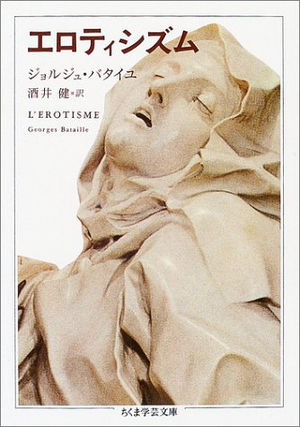
"Eroticism" by Bataille
The creation and organization of labor, the establishment of a system of prohibitions against the unrestricted expression of desires, and the taboos surrounding death.
The impulses of eroticism encroach upon them and lead to the highest life.
As long as human beings want their own survival, the ban will not go away.
But humans also have an insatiable excess of life.
In the endless conflict between prohibition and violation, Bataille looked at the nature of man.
Born from a long vortex of internal experience and universal economic thinking, this book, published in 1957, casts the first and decisive light on eroticism.
The core of the long-awaited paperback edition of Bataille, delivered in a clear new translation by the new generation of Bataille.
According to the translator's explanation, this book is a' theory book of sex.'
No way!
Source: www.amazon.co.jp
It is a book of human inner experience, and sex is one aspect of it.
What is man? What is religion? What is civilization?
This book answers these questions.
Source: www.amazon.co.jp
The eroticism of Bataille seems to be a work of literary rather than philosophical value, for, despite the diversity of difficult terms which are no different from those of philosophical books, it seems to me without question that eroticism is the exaltation of life to death by a chain of prohibitions and transgressions, although what I mean is very simple and may become the ultimate expression.
Source: www.amazon.co.jp
今までエロティシズムというとバタイユの思想を連想してしまいがちであった。しかし、そのようにエロティシズムを固定化、中心化するのは実は貧しさなのではないかと思い始めた。
— 王子 (@Prince17pf) 2017.09.25 16:53
高校時代の友人に明日会うんだけど
— 香椎あい (@Kasi_Ai2743) September 4, 2017
バタイユ読んでるって言ってどういう感じって聞かれたらにわかだからエロティシズムって言いたいだけの人になりそう
