

We have compiled a list of masterpieces of philosophy, ethics, and psychology that have been read around the world for many years. We have compiled basic information and reader feedback on each work, including "The State" by the ancient Greek philosopher Plato and "The Genealogy of Morals" by the German thinker Nietzsche. We have also compiled a list of books that are perfect for an introduction to philosophy.
This book is a Japanese translation of a very famous lecture that is said to have set the direction of linguistics in the 20th century.
Source: www.amazon.co.jp
This book is divided into six parts. In the introduction, it is devoted to defining what is the subject of linguistics. In the first part, the general principles of language are described, and the concept of symbols is defined. In addition, the study of languages is divided into synchronic and diachronic states. In the second part, which deals with synchronic linguistics, discussions are made on what kinds of problems should be dealt with. In this part, integration and association relations of languages are introduced. In the third part, which deals with diachronic linguistics, important matters in the study of language change are raised and discussed. In the fourth part, which deals with linguistic geography, problems related to the relationship between languages and geography, such as dialects, are taken up. In the fifth part, it deals with the perspective of diachronic linguistics, the re-structuring of old languages, and the relationship between anthropology and languages.
Source: www.amazon.co.jp
My impression of this book is that, in fact, much of it has been devoted to the question of diachronism. The lecture on which this book was based is famous as the beginning of synchronic linguistics, but this was very unusual. In addition, this book contains many well-known sections on important concepts of structural linguistics. While reading this book, I often felt that "this concept came from here." I thought that it was a classic that should be read even now.
Source: www.amazon.co.jp
まあそんなわけで、言語学を勉強したいなら、まずはソシュールがいいんじゃないかなって、その友人にはお勧めしておきました(結局結論それかい・笑)。いきなりソシュールの『一般言語学講義』から入ってもいいし、丸山圭三郎の『ソシュールの思想』から入ってもいいでしょうね。
— noburin (@noburin2828) January 4, 2017
新訳が出たソシュールの「一般言語学講義」はソシュール自身の著書ではないとはいえ、初版が出て今年は100年なんだねぇ!
— 糖類の上 (@tinouye) October 5, 2016
つまりは現代言語学の基礎が築かれて100年みたいなもん?

Source: www.amazon.co.jp
"Gravity and Grace" by Weil
Even if this body becomes sludge, I want to not defile anything -- the unhappiness that constantly attacks humans = gravity and humans who have to lower their own souls by gravity.
It is a vacuum state separated from good, beauty and meaning, and only Grace shows the way to escape from Kegare.
The book of Veille's deep introspection aimed at ultimate purity even in the midst of war.
A new revised edition from Kayeh, which conveys the true voice.
The translator said about this book, "The will of an unknown woman who died young at the age of 34 during the war (= World War II) was published in 1947, soon after the war. It caught the hearts of French people who were deeply hurt by the memory of defeat and occupation (against the Nazis)" (p. 429).
Source: www.amazon.co.jp
First of all, the author is an ascetic.
"Mere misery is not enough. Misery without consolation is necessary. There should be no consolation. Any representable consolation." (p. 31)
"It falls to the level of a plant and becomes nothing. Then God becomes food." (p. 72)
"I must love my own suffering, not because it is beneficial, but because it is there." (p. 145)
On the other hand, it criticizes Greek philosophy and Marxism and deals with labor issues.
"The great mistake of Marxists and of the 19th century in general is that they believed that if they could walk straight, they could rise into the air." (p. 296)
"The Greeks understood art and games, but not labor." (p. 302)
"Workers need poetry rather than food. Only one religion can be the source of this poetry." (p. 306)
In addition to frequent quotations from the Bible, he also shows an understanding of Indian philosophy (p. 240) and Lao-tzu (p. 170).
Source: www.amazon.co.jp
You can read and study more than 500 commentaries written by translators, or you can browse and enjoy your favorite phrases.
It is a strange book that can withstand various readings.
Source: www.amazon.co.jp
シモーヌ・ヴェイユの「重力と恩寵」っていう本が凄くて、ページめくってるだけでインスピレーションが湧いて来る。
— とよね (@Toyo_ne) October 17, 2017
シモーヌ・ヴェイユ、重力と恩寵読んだ。私には難しい本でしたが心に留めておきたい表現が幾つもありました。
— ひつじ (@hamotemple) June 10, 2017

Source: www.amazon.co.jp
"Introduction to Psychiatry" by Diltai
Wilhelm Christian Louis, Duke of Brunswick-Lüneburg Diltai (German: Wilhelm Christian Ludwig Dilthey, November 19, 1833 - October 1, 1911) was a German philosopher.
Source: ja.wikipedia.org
In 1882, he succeeded Hermann Lotze, who had died suddenly, as a professor at the University of Berlin. In the following year, he published the first volume of his major work, "Introduction to Psychiatry," and until his retirement in 1905, he was active as a professor, and in the era when natural sciences were flourishing, he tried to lay the foundation for "psychiatry," and published numerous articles on the contribution of this problem area to scientific methodology.
Source: ja.wikipedia.org
In Psychology, Diltai advocated descriptive and analytic psychology, and the flow became one of the flows of psychology as understanding psychology. It was Karl Jaspers who made an achievement in the world of psychopathology based on this. The philosophical interpretation of it is also known as philosophical hermeneutics. Martin Heidegger's "Being and Time" was the result of grafting the phenomenology which was popular at that time with this as a methodology.
Source: ja.wikipedia.org
著書に『精神科学序説』がある19世紀生まれのドイツの哲学者→ディルタイ
— 私が文キュが出来ないのは(以下略 (@bunkyu_bot) October 28, 2014
始まりと終わりの解釈学的循環。ディルタイは『精神科学序説』で、形而上学の始まりをその崩壊から叙述したという。(ガダマー『哲学の始まり』14ページ)
— ゲンロン形而上学クラブ (@superflat_2) June 4, 2012
Source: www.amazon.co.jp
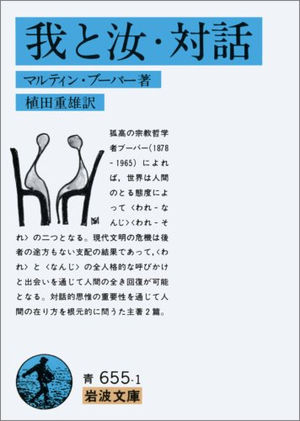
Buber, "I and Thou, Dialogue.
According to Buber, the great religious philosopher, the world is divided into "I-am" and "I-that," depending on the attitude of human beings.
The crisis of modern civilization is the result of the tremendous domination of the latter, and it is through the holistic call and encounter between "I" and "It" that the full recovery of man is possible.
These two major works fundamentally question the nature of human beings through the importance of dialogic thought.
Buber's goal is not the mechanization of the human being itself, which is the thrust of modern society, but the realization of a higher spirituality in the very being that keeps the human being itself and nature itself alive, the life of the human being.
Buber's goal is to realize a higher spirituality in the very being of reality that is here and now.
Source: www.amazon.co.jp
The story begins with the root language of "Nanji to Ware" and "Ware to Ware." It then asks the question of our perception of the world itself.
It's not a passive "thing" relationship in the ebb and flow of the world, it's not an awake relationship, it's not a mechanical relationship
The spark of life, the understanding of relationships through both intelligence and sensitivity based on unity, is what we should seek.
Source: www.amazon.co.jp
It is a wonderful, in-depth book that is Buber's masterpiece.
Source: www.amazon.co.jp
今日やっとこさ岩波文庫のブーバーおじさんの『我と汝・対話』を読み終わった。
— 妙珠美🥀🐈⬛ (@joomi_miao) August 11, 2015
我と汝の方は素直に「うん!私もそう思う!」ってテンションだったので、対話の方読むのはこわいなぁ…と思って間空けて読んだんだけども、対話は最後に否定する人にブーバーが熱く反論しててはらはらした。
<book>(M・ブーバー)「我と汝・対話」★★★★★難解。相手と自分を分離させた<われ-それ>のクールな世界と、相手と自分の間・関係に全てを見るホットな<われ-なんじ>の世界。<なんじ>の世界はまだ上手く掴めないけど、<それ>の世界の醜さを気付かせてくれた事だけでも本書に感謝。
— 千樹本 一 (@sakimotohitotsu) March 17, 2014

Source: www.amazon.co.jp
Wittgenstein, Treatise on the Philosophy of Logic.
Ending with the shocking words, "We must be silent about the unspeakable," this is the only philosophical book published by Wittgenstein (1889-1951) during his lifetime.
It is the only philosophical book published by Wittgenstein (1889-1951) before his death. It is a unique composition of systematically numbered short propositions, condensed to the utmost limit, and is a work of genius. It is a work of unfathomable charm and danger.
