
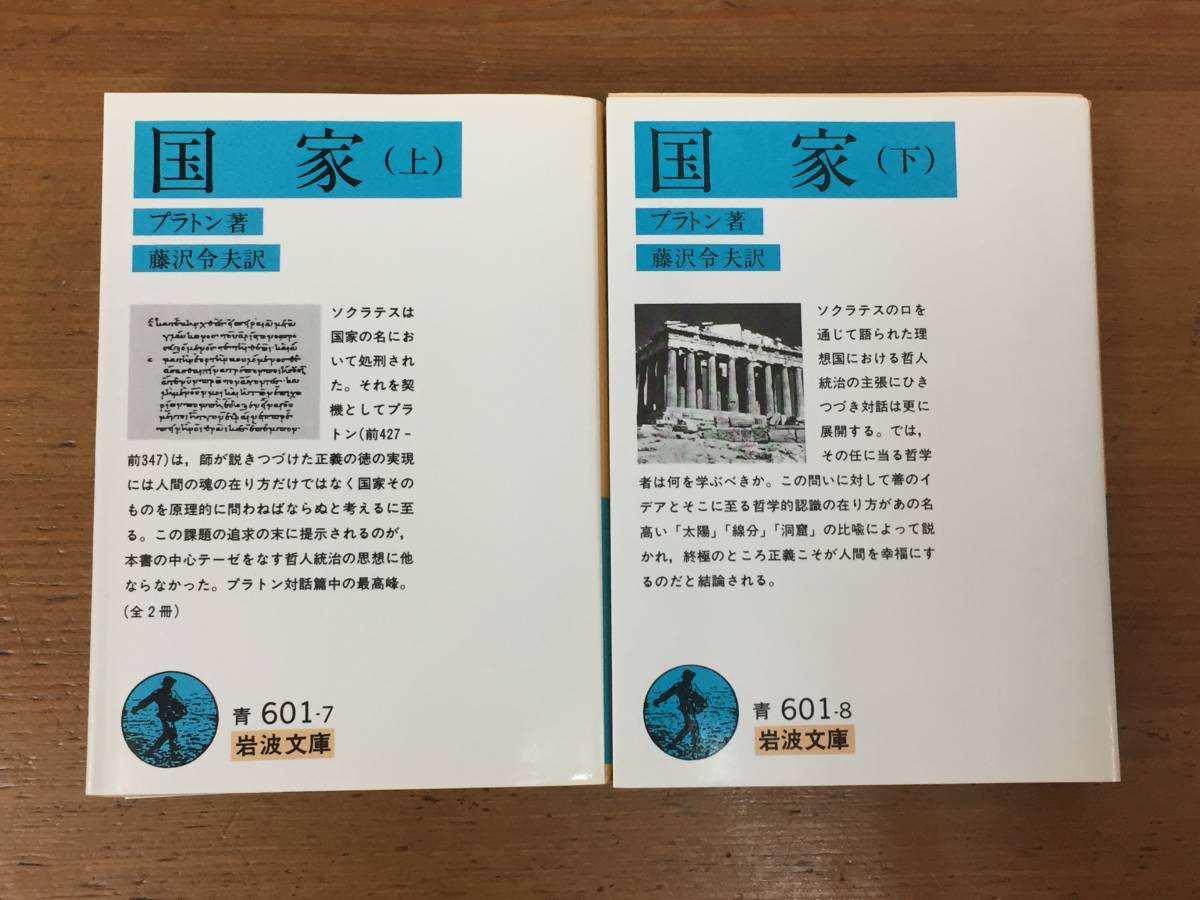
We have compiled a list of masterpieces of philosophy, ethics, and psychology that have been read around the world for many years. We have compiled basic information and reader feedback on each work, including "The State" by the ancient Greek philosopher Plato and "The Genealogy of Morals" by the German thinker Nietzsche. We have also compiled a list of books that are perfect for an introduction to philosophy.
Due to the expansion of science and technology, the world is definitely becoming smaller. As a result, many problems have appeared that cannot be dealt with by the conventional code of ethics. Of course, this book by Hans Jonas is not the only one, and I think there are things that are not easily accepted. However, this book, which is the work of his whole life, is something that is scary and overwhelming.
Source: www.amazon.co.jp
It is written in German, which is very difficult to read for some reason, but due to the efforts of the translators, it can be read in simple Japanese that is easy to understand. I would like not only people who are interested in environmental issues and medical care, but also the general public to have access to it.
Source: www.amazon.co.jp
We have no choice but to live as modern-day people. At first glance, things that seem to be normal come to bear on our shoulders. This is a very important book for thinking about environmental issues. How should we think about our scientific and technological capabilities in the modern era, which can easily destroy future generations?
Source: www.amazon.co.jp
ヨナス『責任という原理』読了。全く共感できないぶん、こんな意見もあるのかと思って興味深かった。原語では難文のようだが、同一メッセージのパラフレーズが続くし訳も分かりやすいので、この手の本としてはすこぶる読みやすいのでは。にしても、ここまでブロッホ批判に徹してるとは思わなかった。
— 荒木優太 (@arishima_takeo) August 7, 2016
勉強会なので、ヨナス『責任という原理』読み返してる.「必要性が強いる日々の強制は、不正を被っているという感情さえ押しつぶしてしまう」というのは、本当に今日的な問題だな.
— Rei (@uhlnebv) December 7, 2013
Source: www.amazon.co.jp
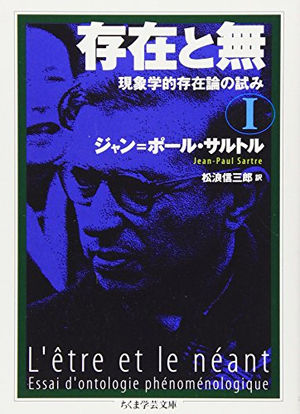
"Being and Nothingness" by Sartre
Sartre's philosophical main book, which analyzes the existence of human consciousness and explores the dialectic of existence and nothingness.
It has had an immeasurable impact on the world, with its existential psychoanalysis to find fundamental choices and its advocacy of absolute human freedom.
Based on Hussar's phenomenological method and Heidegger's approach to the analysis of the present existence, Hegel's' Sokuji' and' Taiji' are interpreted as the existence of things and the existence of consciousness, and the existence is grasped.
This is an immortal book that is regarded as a classic of French philosophy in the 20th century and the origin of various modern thoughts.
The first volume contains from the introduction in which' Sokuji' and' Taiji' are sharply distinguished to the second part in which the basic way of consciousness as' Taiji' is discussed.
Sartre's writings, which he began to read when he was a high school student, were both shocking and fascinating.
As I read, I remember being struck by the intense sensation that the world in front of my eyes collapsed with a sound and a new world appeared.
Source: www.amazon.co.jp
Among them, "existence and nothingness" was extremely difficult to understand, but since consciousness (i.e., nothing but myself) was fundamentally defined from all angles, if I could not understand this, it would be impossible to live a decent life in the future, and I agonized bravely and seriously.
Source: www.amazon.co.jp
When I thought that I could somehow understand, the people around me, including the teachers and all the adults, began to look like hopeless snobs.
The poison of Sartre was a powerful drug.
Since then, even after they went out into society, they were bound for a long time, though indirectly, while being dragged by the world view developed by' existence and nothingness.'
Source: www.amazon.co.jp
サルトル:人間はあらかじめ本質や定義を与えられている存在ではなく、自由な存在であり、自己を社会に投企し(投げ込み)、社会を変化させていくといった社会参加(アンガージュマン)をとおして自己および社会の自由を実現していく、と説く。主著『嘔吐』、『存在と無』、『弁証法的理性批判』
— 哲学ボット (@tetsugakubot) April 24, 2017
サルトル、「嘔吐」はすげー眠くなるけど「存在と無」は眠くならない
— chû (@chu_fuzimura) May 28, 2017
Source: www.amazon.co.jp
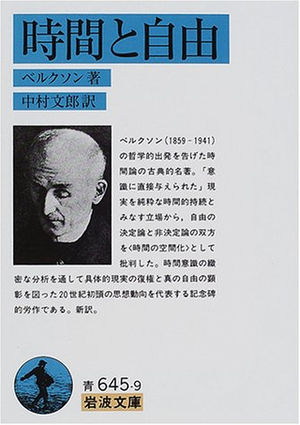
"Time and Freedom" by Bergson
A classic masterpiece on the theory of time that heralded Bergson's philosophical departure.
He criticized both determinism and non-determinism of freedom as a "spatialization of time" from the standpoint of regarding reality "directly given to consciousness" as a pure temporal persistence.
It is a monumental effort that represents the trend of thought in the beginning of the 20th century in which restoration of concrete reality and commendation of true freedom were attempted through a detailed analysis of time consciousness. New translation.
Only Bergson and Russell have won the Nobel Prize for Literature in philosophy. Sartre declined. It is a monumental effort that represents the trend of thought in the early 20th century.
Source: www.amazon.co.jp
Bergson (1859 - 1941), a French philosopher, presented his dissertation at the Sorbonne in 1888. The original title is "A Tentative Theory on What Is Directly Given to Consciousness."
The subject of this book is ` ` freedom'' and ` ` time'', as the preface says: ` ` Of many problems we have chosen the one common to metaphysics and psychology, that of freedom''.
Source: www.amazon.co.jp
In response to Kant's ideas of space and time, he argues that time has different characteristics from space.
In addition, he discusses determinism and liberalism, and discusses the problems of both.
On the traditional themes of philosophy, space and time, determinism and liberalism
The sense of Bergson, who shows his unique view from a new perspective, is impressive.
On the other hand, human beings, who are supposed to be able to be free, are not able to exercise their freedom because they are swept away by customs, etc.
He also criticized them for acting aimlessly.
Source: www.amazon.co.jp
ベルグソンの自由と時間を読む時間が欲しい
— 宮野 岳 (@miyanotakesi) November 9, 2014
僕がクラシックと言われる音楽をやって、やめて、今度はテクノと呼ばれるジャンルに傾倒して、その中で、ピアノや、テクノではシンセとかアシッドラインといったものに関して一貫して考え続けていたことが、ベルグソン「時間と自由」の中の、たった数行に集約されていた。
— Pさん (@pyidesu) February 11, 2014
Source: www.amazon.co.jp
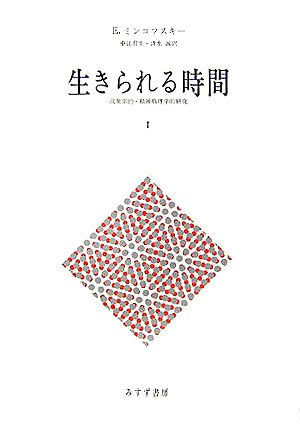
"Time to Live" by Minkowski
This book has long been expected to be translated as Minkowski's representative work and as a masterpiece of time theory.
The author of The Schizophrenic Mind in 1927 continued his search for a particular form of existence in schizophrenic patient time and space, a portal to a unique world, and this book, heavily shadowed by Bergson and Hussar, is an extension of this.
It is said that when "Ikiru ru Jikan" (Time to Live) was produced in 1993, 1,000 copies were printed at private expense.
Although it had become a rare masterpiece in Japan, it was finally republished in 1968 at the request of the world. Limited edition.
In 1927, the author of The Schizophrenic Mind continued to search for a particular form of existence in schizophrenic patient time and space, a portal to a unique world. This book, which is heavily influenced by Bergson and Hussar, is an extension of this. In 1933, when "Ikiru Jikan" (Time to Live) was born, it is said that he had 1,000 copies of it printed at his own expense. It had become a masterpiece in Japan, but in 1968 it was reprinted at the request of the world. Minkowski says in his preface:
Source: www.msz.co.jp
"The book which we now offer to the reader is a reprint of the original text, not a second (revised) edition. It was not because I was reluctant to do extra work, but because I had other motives, first of all, as a personal motive, that the work had flowed, so to speak, in one and only one soul; and, more generally, as a motive, I still believe, to a certain extent, that it has distinguished itself in modern thought.
Source: www.msz.co.jp
This work is characterized by its sub-title of Phenomenological and Psychopathological Studies, in which the two things are intimately connected, in which it is easy to find the influence of Henri Bergson, in which the notion of emotional contact has been replaced by a broader notion of vital contact. It is only one step from there that the philosophical trend in modern psychopathology emerges: that the companion which this so-called philosophical trend has revealed in psychopathology is "fact" rather than symbolism. "
Source: www.msz.co.jp
俺の書きたいものは、生きられる時間なんだよね。だから、ミンコフスキーの『生きられる時間』って本を知った時、猛烈に欲しくなった。
— お察しください (@st70521) 2014.10.24 03:08
ミンコフスキーの生きられる時間に影響を受けているので、御阿礼の子について考える時もそういう哲学の影響が出てしまうし、ベルクソン的解釈も必要になってしまい、小林秀雄か……ってなる
— お察しください (@st70521) 2015.12.10 23:25
Source: www.amazon.co.jp
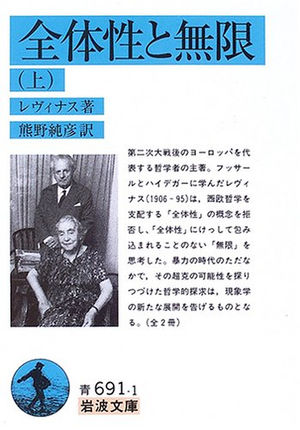
"Wholeness and Infinity" by Levinas
The main work of Levinas (1905 - 1995), who rejected the concept of "wholeness" that dominates Western philosophy, and thought of "infinity" that is never wrapped in "wholeness".
In the midst of an era of violence, the philosophical quest for its surcompetitive potential heralds a new development in phenomenology.
