

We have compiled a list of masterpieces of philosophy, ethics, and psychology that have been read around the world for many years. We have compiled basic information and reader feedback on each work, including "The State" by the ancient Greek philosopher Plato and "The Genealogy of Morals" by the German thinker Nietzsche. We have also compiled a list of books that are perfect for an introduction to philosophy.
- When the self wants to be the self while being related to the self, the self consciously bases itself in the forces that determined it.
This is Kierkegaard's formula for describing a state in which people are not in despair at all.
Mr. Kierkegaard says that almost all human beings are in despair. There are very few people who are not in despair. If there are, the above formula applies.
Source: www.amazon.co.jp
In this book, the various forms of despair are described in detail, abstractly and concretely. Each despair comes to mind.
Those who are buried in the daily hardships of life without thinking, those who are simply immersed in the pleasures of life, those who hold a grudge against and withdraw from the world, those who are successful and give plausible sermons to people (including, perhaps, the recent development of the Internet and their arguments on Facebook and Twitter), entrepreneurs, politicians, office workers who are tired of work, wives who are disgusted with their husbands, and even myself are beautifully depicted in this book.
Source: www.amazon.co.jp
Mr. Kirkegaard calls this book a work for indoctrination, which, on the face of it, of course means to believe in Christianity, and the conclusion of this book is that, on the face of it, there is no other way but to believe. in order to reach a state in which there is absolutely no despair, but I think that Christ really has nothing to do with it.
Just as the brain could not see the brain, because of the impossibility of description arising from the contradiction that the existence of the self, who sees the world, is included in the symmetrical world that it sees, because of the infinity of spin in the brain, I was forced to assume a God who embodies infinity, who makes the impossible possible.
Source: www.amazon.co.jp
マキャベリの君主論とキルケゴールの死に至る病、面白かった。こういう妄想が極限までいって論理化したようなのって、やっぱこういう時代のものが重厚で面白いわ。
— 高須賀とき (@takasuka_toki) February 7, 2015
キルケゴールが闇過ぎて 死に至る病とは絶望のことである。とか言っちゃうし、でも実在哲学めっちゃ面白いし頭おかしくなりそう
— はしもと こうやくん (@hasiko_) 2016.11.10 10:13

Source: www.amazon.co.jp
"The Aspects of Religious Experience" by James
It is a masterpiece that has an enduring name as the first exercise in the scientific method of religious psychology.
William James analyzed the psychological characteristics and religious tendencies of faith in the existence of the unseen, based on his own view of religion, which emphasized individual religious needs and religious experience.
A huge amount of materials are used, and phenomena such as conversion, virtue, and mysticism are thoroughly investigated.
He published the Gifford Lecture at the University of Edinburgh in England (1902).
It is said that this book was originally a lecture given at the University of Edinburgh by James, who was invited to the Gifford Lectures held at four universities in Scotland on the theme of natural theology. The way he spoke to the audience was friendly, and the essay was simple and clear for a lot of quotations.
Source: www.amazon.co.jp
The theme throughout the lecture is the question of what reality is. Different types of people, in different ways, feel that this is something that is real to them. As long as it is a fundamental vision that lays the foundation for human life, James's basic stance seems to be to recognize its significance and value, even if it is something that is denied or neglected by other people.
Source: www.amazon.co.jp
The reality that surrounds us is not one that can be explained in its entirety from a particular point of view. It is one that is infinitely deep and diverse. The aspects of the religious experience that James talks about illuminate the infinite depth of reality that manifests itself in so many different ways. This is almost the only point of view that points in a direction that is very beneficial to the challenges facing modern society, such as religious tolerance and religious pluralism.
Source: www.amazon.co.jp
ウィリアム・ジェイムズの『宗教的経験の諸相』(桝田啓三郎訳)を久しぶりに読み返している。ベルクソンがこの本にふれ、著者は幾多の宗教現象を網羅的に論じた、というのは全く的外れで、彼自身が神秘の次元の住人となったところに眼目がある、と語っているが本当だ。批評としても一流の作だと思う。
— 若松 英輔 (@yomutokaku) January 28, 2017
ジェイムズに言わせるとニーチェとショーペンハウアーは死にかけた2匹のネズミの断末魔の遠吠えである。なるほどこの意見には何か否定せざるものがある。宗教的経験の諸相、これには仏教に関する間違った知見もある。また他の人の本で大拙のフォルステルングを表象と理解できない学者がいた。
— ワダアキラ (@akira23141) June 14, 2017
Source: www.amazon.co.jp
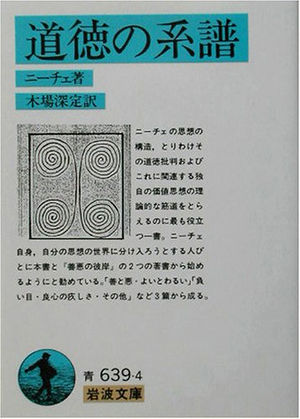
Nietzsche: Genealogy of Morality
A book that is most helpful in grasping the structure of Nietzsche's thought, especially its moral criticism and the theoretical logic of its own value thought related to it.
Nietzsche himself encourages those who want to break into his own world of thought to begin with two books, this one and The Cross of Right and Wrong.
It consists of three chapters such as' Good and Evil, Good and Evil' and' Imputation, Sincerity of Conscience, and Others.'
It's difficult, but I've managed to finish it. Reading this book, I feel humbled when I think of the various discussions that university students used to have. I'll study a little more.
Source: www.amazon.co.jp
In this book, Nietzsche proposes as the first person in human history to bring to a clear word a theme that will forever be a problem for mankind: the will to nothingness, a theme that could hardly be more vexing. The relevant passages are cited below.
". that there was a lack of something, that there was a huge void around man, that is what the ascetic ideal means. it was his problem that there was a lack of an answer to the cry of the question" For what do I suffer? "- and the ascetic ideal offered a meaning to mankind! (Omitted). the will to nothingness. man desires nothingness more than he does not desire it." ("The Genealogy of Morality," Third Thesis, Section 28)
Source: www.amazon.co.jp
Depending on what is substituted for this "nothingness," the history of mankind, and the life histories of individuals, are subject to an inexhaustible variety of, and in most cases very troubling, illusions.
Nietzsche's translation, if it is as successful as this book, will be a moving experience that will last a lifetime.
Source: www.amazon.co.jp
ニーチェの道徳の系譜学
— Yamauti (@Yamauti3) September 7, 2017
すごいなあ。文庫本で1000円でお釣がきて意味の通じる日本語になっててちゃんと世界観が変わる。
弾圧に適応することを自ら行なうべき道徳と信じこんだりする被支配層の気持ち悪さ。そして勝ちと負けが逆転して過労死するまで働くことがよい人生になったり
今「人はなぜ物語を求めるのか」を読んでいるのですが、ニーチェの「道徳の系譜学」の一説からまさか「アンパンマンのマーチ」の歌詞の一部へと接続されるとは思いもせず、全然関係ないと思っていた二者間の関係性になぜか不意に笑ってしまった pic.twitter.com/4NRJCEbltm
— 享楽 (@vita_t_t_t_act_) August 9, 2017

Source: www.amazon.co.jp
Bacon "Novum Organum"
A book to which Bacon devoted great effort as an integral part of his great project, the Great Innovation of Science.
He criticized the studies related to the traditional Aristotelian logic (organum), advocated a new method of logic, and paved the way for the modernization of various sciences.
It is the reason for the name of the Novum Organum. By this book, logic became a powerful instrument for the construction of learning for those who stood at the threshold of modern society.
https://www.iwanami.co.jp/book/b246699.html
Bacon expressed his ideas in a form of stacked short sentences known as aphorism, a criticism of the very idea of stacked logic.
Bacon criticized deductive thinking, arguing that humans can only know what they have directly observed or experienced.
Source: www.amazon.co.jp
He expresses a critical view not only of the logical development of man, but also of the direct sense of man itself, a basic skepticism of the existence of man, peculiar to England, which is echoed by Hume later.
These ideas never give rise to fanatical ideas.
Bacon criticizes not only the question of the form of thinking, but also the tendency at the time, which was strongly influenced by Christianity, not to allow critical viewpoints.
Source: www.amazon.co.jp
The problem which he has revealed in this book, that of prejudice by each of the so-called four idols, namely, the nature of man, the individual, the social life, and the perverse rules of argument, is still relevant today.
In modern Japan, where conventional ways of thinking and ways of looking at things are reaching their limits, I think this book should be read more in order to reexamine the reality before us from the beginning.
Source: www.amazon.co.jp
ベーコン『ノヴム・オルガヌム』
— 【小学生資産家】 (@sundenotokorode) July 17, 2017
アリストテレス論理学なんかを徹底的にこきおろす感じが楽しい
しかし楽観的だ。事実うまくいったんだけども。
第一千年紀は、アリストテレスの『オルガノン』の時代だった。 第二千年紀は、ベーコンの『ノヴム・オルガヌム』の時代だった。 第三千年紀は、ウスペンスキーの『ターシャム・オルガヌム』の時代である。
— イデア (@parudo6) 2016.08.04 17:41
Source: www.amazon.co.jp
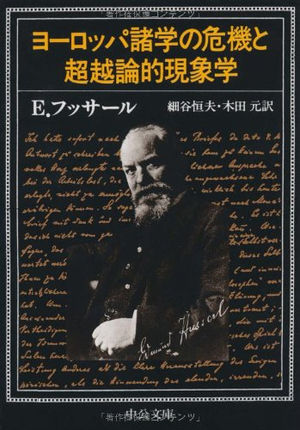
"Crisis of European Studies and Transcendental Phenomenology" by Hussain
This book is the culmination of the phenomenological philosophy that Huszar secretly inherited in his final years, when the storm of Nazi irrationalism was blowing.
He develops his period criticism as a critique of the entire history of the formation of modern European culture, seeking the motivation of his transcendental phenomenology within the very history that was the process of struggle over human ideas.
