
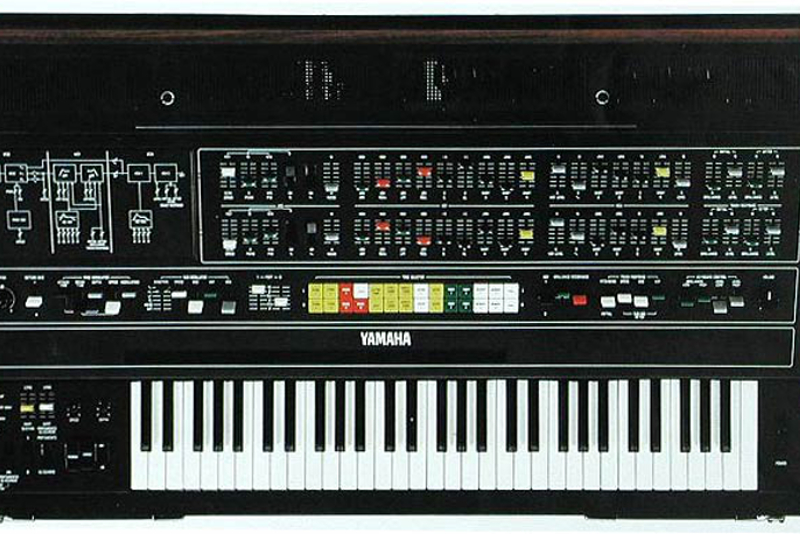
The vintage keyboards introduced so far have all been made overseas, but Japanese-made keyboards are no slouches either. Roland's Jupiter-8, introduced here, is said to be the best Japanese-made polyphonic synthesizer, and YAMAHA's CS-80 has been used by many famous musicians, both of which are worthy of the name "vintage keyboards. These are all worthy of the name "vintage keyboards." Here we introduce some of the best machines that symbolize "Monozukuri (manufacturing) Japan.
Representing Japan? Jupiter-8" polyphonic synthesizer
During the heyday of polyphonic synthesizers such as the Prophet-5 and OB-X series, Japanese instrument makers released vintage keyboards that rivaled their predecessors: Roland's Jupiter-8 and Yamaha's CS-80. Of the two, the Jupiter-8 was the most widely used at the time.

The Jupiter-8 was released in 1980, and although its price was quite high at 980,000 yen, it was about half that of foreign-made polyphonic synths (due in part to the fact that import agents were ripping off the market). Because of this, it was used by many musicians, and in Japan, Ryuichi Sakamoto is known to have used one. Overseas, Howard Jones and Journey's Jonathan Caine, among others, have used it. In the video below, the Jupiter-8 is the first instrument that symbolizes Howard Jones.
Was it more major overseas, CS-80?
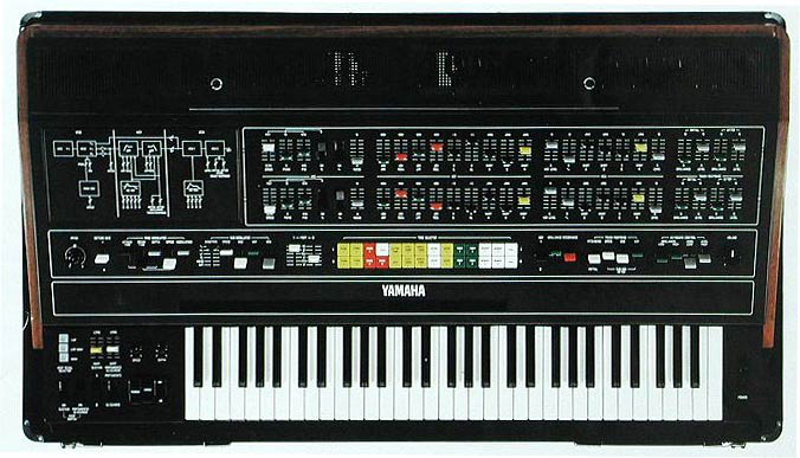
The other CS-80, on the other hand, was in the shadow of the Jupiter-8 in Japan at the time, with the same eight-note polyphonic, two oscillator system as the Jupiter-8, and the specification that each oscillator has its own independent filter and amplifier, but the CS-80 was superior to the Jupiter-8 in terms of performance. It was superior to the Jupiter-8. We do not know why it was overshadowed by the Jupiter-8, but perhaps one of the reasons was its price tag of 1,280,000 yen, slightly higher than the Jupiter-8.
Was it more major overseas?
In Japan, however, this is not the case at all, and it is known that the CS-80 was used in a wide variety of songs overseas. For example, the synth at the beginning of Bruce Springsteen's "Born in the U.S.A." is a CS-80, and the "TOTO horns" that took the world by storm could only be produced with a CS-80. Steve Porcaro, a member of TOTO at the time, seemed to be a fan of the CS-80, and is actually seen playing it in the PV for "99.
PV for TOTO "99"; Steve Porcaro (far left) can be seen playing the CS-80.
The "Monozukuri Japan" Gene Passed Down to the Present Day
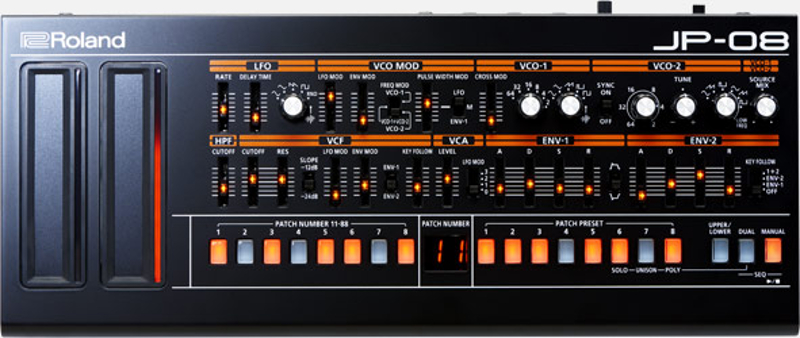
As for the Jupiter-8, its "genes" have been handed down to the present day. Roland's JP-08 sound source module, released last October, is a modern revival of the Jupiter-8 using digital technology. It is unfortunate that the number of notes is 4 instead of 8, but if you connect two modules together, you can get 8 notes. However, it is regrettable that the interface does not have much of the Jupiter-8's appearance.
The CS-80, on the other hand, was more often used by overseas musicians than in Japan, so when the French company Arturia announced that it would reissue the CS-80 in software form, there was quite a bit of surprise. In addition to Arturia's CS80-V, Memorymoon now offers a soft synth called ME80.
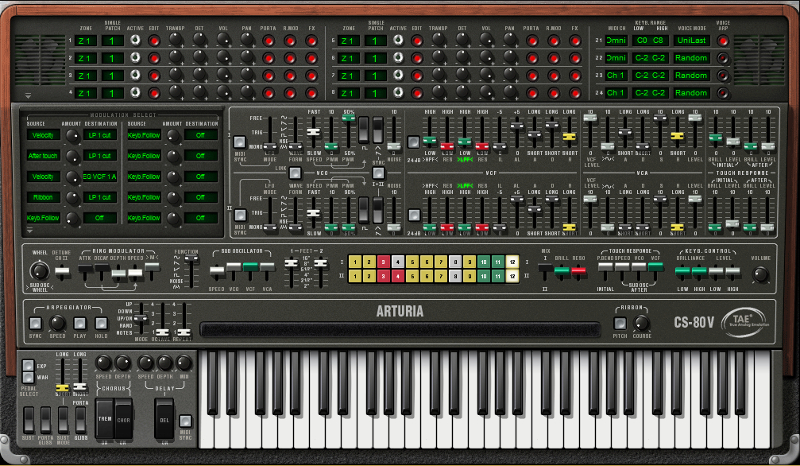
Arturia's CS80-V

Memorymoon's ME80
It is difficult to judge which one looks more like the actual device, but the CS80-V is priced at 99 euros while the ME80 is $40. Both are 64-bit compatible for both Windows and Mac, so you can choose the one you like best. In fact, it would be better if YAMAHA would reissue them themselves, as Roland did...
Related Articles
Useless Poop on Vintage Keyboards - Overseas Monophonic Edition - RENOTE
renote.net
There are instruments called "vintage," and there are keyboards that are also so called. For those who know them, it may seem nostalgic, "Oh, that instrument. For those who don't know it, it may seem like "what's that? for those who don't know it. I would like to introduce such vintage keyboards. We will start with two monophonic models released in the early days of synthesizers.
Useless Poop on Vintage Keyboards - Foreign Polyphonic - RENOTE
renote.net
At first, most synthesizers were monophonic, producing only single notes, but polyphonic ones, capable of producing chords, gradually decreased in size. Then came two vintage keyboards that became world-famous: the Prophet-5 and the OB-Xa. Even if you don't know the names of the instruments themselves, you may feel nostalgic when you hear the music they are used for.
Useless Poop on Vintage Keyboards - Price Destruction - RENOTE
renote.net
The price of polyphonic synthesizers, which had once been the height of luxury, gradually dropped to the level affordable by amateurs. It was not foreign products that brought about this wave of price destruction, but the domestically produced "Polysix" and "JUNO-106.
Useless Poop on Vintage Keyboards - Elepis - RENOTE
renote.net
Vintage keyboards are not only synthesizers, but some electric pianos are also called so. Two famous examples are the American-made Rhodes and the Yamaha CP-80. The Rhodes, which is unique and bears no resemblance to a piano, and the CP-80, which is an electronic version of a grand piano, have completely different sound characters, but they are no different in the sense that they were loved by many musicians.
