
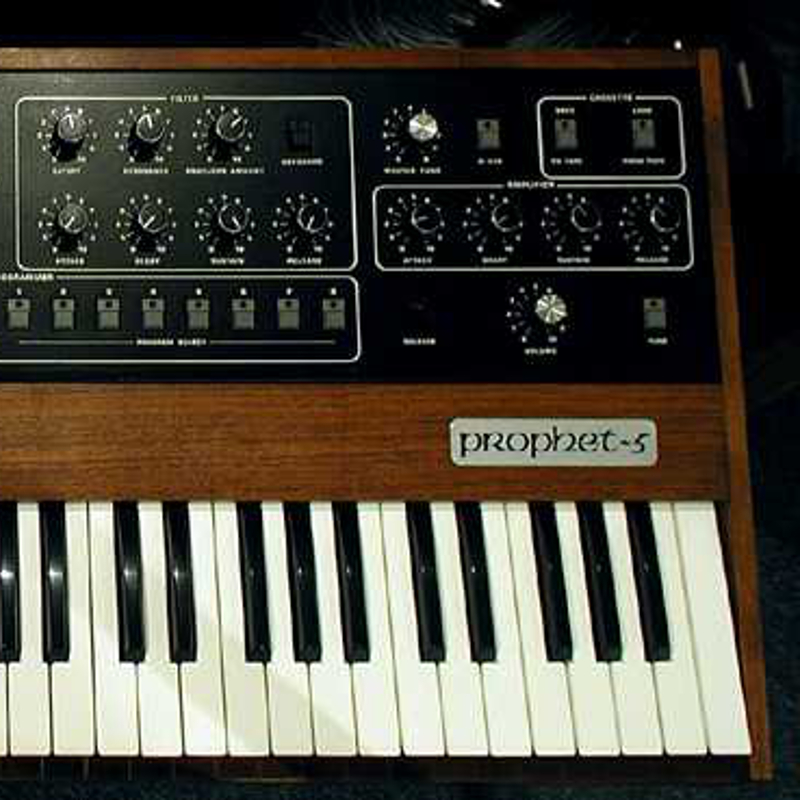
At first, most synthesizers were monophonic, producing only single notes, but polyphonic ones, capable of producing chords, gradually decreased in size. Then came two vintage keyboards that became world-famous: the Prophet-5 and the OB-Xa. Even if you don't know the names of the instruments themselves, you may feel nostalgic when you hear the music they are used for.
Prophet-5" used by both cats and dogs
The Prophet-5, developed by the late Sequential Circuits, was once such a famous instrument that if you listened to an album, it was filled with this sound. When it was released in 1978, synthesizers were basically monophonic, and the fact that it could produce chords, even if only five notes, was revolutionary.
Also revolutionary was the fact that it had a built-in recording device for the sounds it created; neither Minimoog nor Odyssey could store the sounds it created, and it was nearly impossible to reproduce them completely once created. This was also a cutting-edge feature at the time, making it a "state-of-the-art high-tech machine.

It is known to have been used by YMO, but a look at Wikipedia in Japanese and English shows that the main users include Isao Tomita, Kitaro, Kazumasa Oda, Kraftwerk, Phil Collins, Duran Duran, Hall & Oates, Peter Gabriel, and many other famous musicians and bands. Hall & Oates, Peter Gabriel, and many more. The sound was familiar for an analog synthesizer, and it seemed that everyone was using them.
The keyboard Ryuichi Sakamoto is playing is a Prophet-5, and it is amazing that it is still in use in 2012.
The Prophet-5 was imported and sold by Moridaira Musical Instruments at that time, and the list price was 1,700,000 yen. According to the English version of Wikipedia, the price was $4,495, and since the exchange rate in 1980 was about 225 yen to the dollar, the price was about 1,010,000 yen, simply calculated. Isn't that too much of a rip-off, even considering the commission?
OB-Xa" for the connoisseur's preference
Another leading name in foreign-made polyphonic synthesizers was Oberheim, which became a "competitor" of the Prophet-5 with the OB-X, released in 1979, the year after the Prophet-5, which, like the Prophet-5, had tone memory and was popular in its own right, It was its successor, the OB-Xa, released in 1981, that made Oberheim's name. It was priced at $4,595, slightly higher than the Prophet-5, and its sales price in Japan was similarly 2 million yen. But what is this price tag?

The OB-Xa was widely used as having "better output" than its successor, the OB-8. It is not as well known in Japan as the Prophet-5, but it is more of a "connoisseur's favorite" image. Incidentally, this song is the first one that comes to mind when I think of the music in which this OB-Xa is used.
Van Halen "Jump
The synthesizer sound that has been playing throughout the beginning of the song is OB-Xa. It is played by guitarist Eddie Van Halen.
Vintage bloodlines that remain in the present day
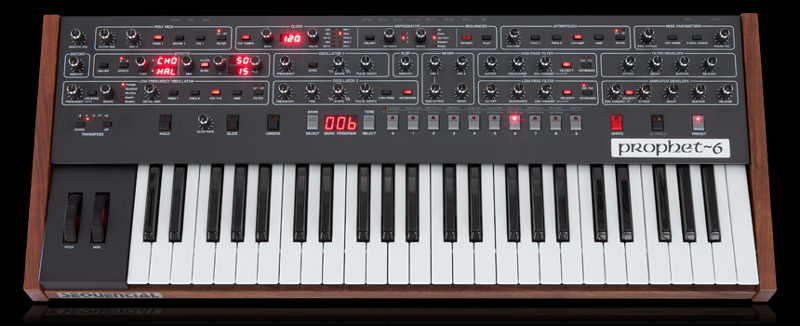
Since both Sequential Circuits and Oberheim are now deceased companies, it is difficult to obtain actual units, and Dave Smith, the main developer of the Prophet-5, is now producing the Prophet-6 from his own factory, which is in the Prophet-5 vein. The price is now reasonable at around 400,000 yen, but still expensive.
For you, there is the Prophet-V from the French company Arturia, a soft synth that reproduces the Prophet-5. The price is also low at 99 euros. As you would expect from a simulation of the real machine, the interface is very similar. The only thing that is missing is the effects that were not present on the actual machine. From the actual user's point of view, there is a slight difference in the output sound, but considering the price, it is probably not a problem.

As one would expect from a simulation of the actual machine, the interface is very similar. It is a pity that it is equipped with effects that were not on the actual machine. From the actual user's point of view, there is a slight difference in the output sound, but considering the time and effort required to find and maintain the actual device, the price is 99 euros, which is much cheaper than the actual device, so I guess it is not a problem.
On the other hand, the OB-Xa has no successor in the pure sense of the word, since Thomas Elroy Oberheim, who was the representative of Oberheim, has left the synth production scene. Whether or not Oberheim felt sorry for this situation, a soft synth simulating the OB-Xa is now being distributed free of charge. The software is called "OBXD.
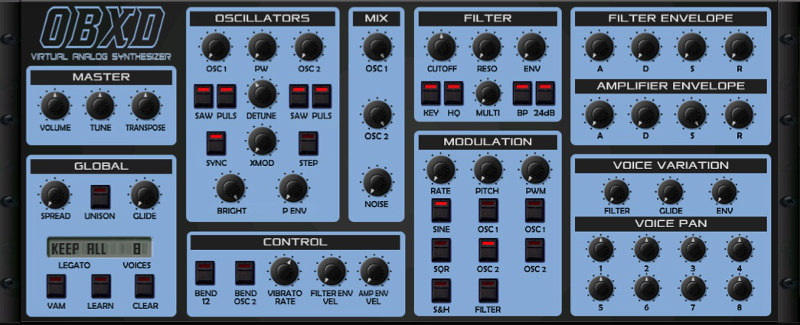
It's only free, and as you'd expect, it can't reproduce the GUI perfectly, but it's a nice touch, isn't it?
Related Articles
Useless Poop on Vintage Keyboards - Overseas Monophonic Edition - RENOTE
renote.net
There are instruments called "vintage," and there are keyboards that are also so called. For those who know them, it may seem nostalgic, "Oh, that instrument. For those who don't know it, it may seem like "what's that? for those who don't know it. I would like to introduce such vintage keyboards. We will start with two monophonic models released in the early days of synthesizers.
Useless Poop on Vintage Keyboards - Domestic Polyphonic - RENOTE
renote.net
The vintage keyboards introduced so far have all been made overseas, but Japanese-made keyboards are no slouches either. Roland's Jupiter-8, introduced here, is said to be the best Japanese-made polyphonic synthesizer, and YAMAHA's CS-80 has been used by many famous musicians, both of which are worthy of the name "vintage keyboards. These are all worthy of the name "vintage keyboards." Here we introduce some of the best machines that symbolize "Monozukuri (manufacturing) Japan.
Useless Poop on Vintage Keyboards - Price Destruction - RENOTE
renote.net
The price of polyphonic synthesizers, which had once been the height of luxury, gradually dropped to the level affordable by amateurs. It was not foreign products that brought about this wave of price destruction, but the domestically produced "Polysix" and "JUNO-106.
