
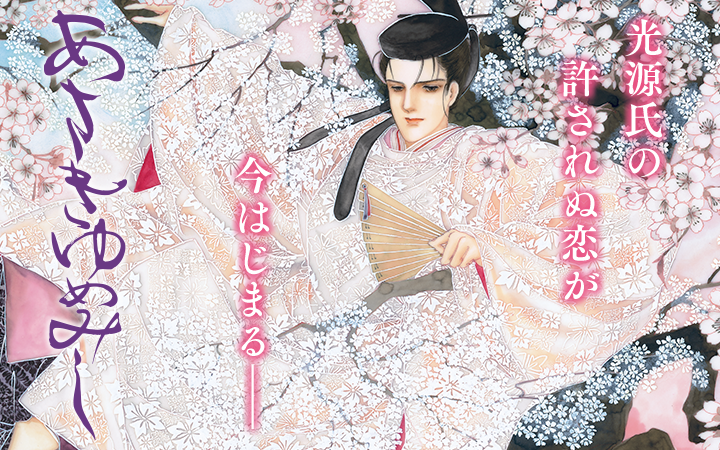
Asaki Yumemishi" is a manga series by Kazuki Yamato that was serialized in the monthly magazine "mimi" from 1979. It was later moved to "mimi Excellent" and completed in 1993. It is a manga adaptation of Murasaki Shikibu's "The Tale of Genji" and depicts the love affairs, power struggles, glory and downfall of aristocratic society in the Heian period through the main character Hikaru Genji, the son of the emperor. As a girls' manga, it faithfully depicts all 54 chapters of "The Tale of Genji" while incorporating modern interpretations and original episodes of the time. It has been translated into many languages for the international market, and has also been adapted into novels, stage plays, and many other forms.
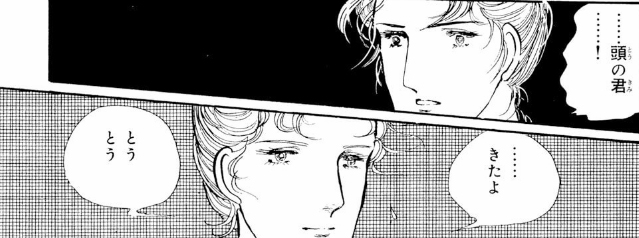
Hikaru Genji is discovered to be in love with Oborozukiyo, and is driven into a corner by a confrontation with the Minister of the Right, and goes into hiding in Suma.
Those who are reserved toward the Minister of the Right cease to associate with Genji.
Among them, only the head lieutenant visits him. To Genji's surprise, the head lieutenant smiles and says, "...here I am, at last.
The head lieutenant replies, "If such a thing were a crime, I would be exiled with him.
The two men are best friends as well as rivals, and the depth of their friendship is clearly shown in this scene. Although the two would later become political rivals, the fact that they never came to a decisive confrontation can be attributed to their underlying friendship.
Tamakazura: "I don't want to be swept away by anything any more... I want to stand here on my own feet...!
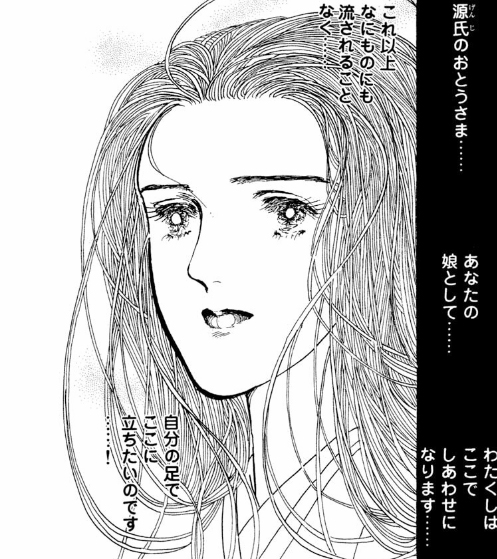
Tamakazura, the daughter of the head lieutenant and Yugao, and adopted daughter of Hikaru Genji, has lived her life being swept away by her surroundings and tossed about by fate.
Just before she is accepted into the service of the Emperor Reizei as his personal attendant, she is forcibly taken as his wife by the bearded black.
Tamakazura grieves, but as she lives with Bearded Black and comes into contact with his children, she feels that she has finally found her place in the world.
He says, "I want to stand here on my own feet and not be carried away by anything any more...! and decides to live strongly by his own will.
Although omitted from the story, Tamakazura, who was predeceased by Kuro Moustache, later in life, struggles with her children to rebuild her house, which has fallen into ruin.
On the purple: "Ah... from this world where this woman is not free I wish to leave as soon as possible..."
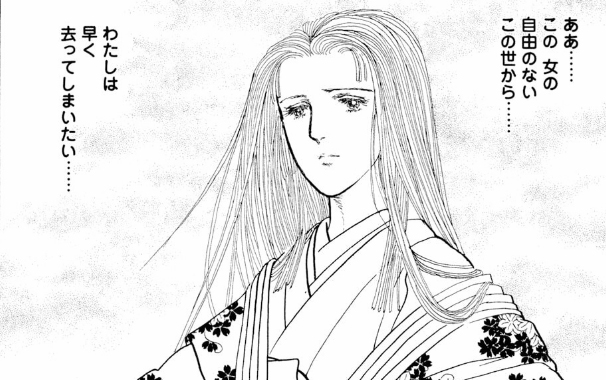
Murasaki no Ue is the woman most loved by Hikaru Genji and the woman who led the happiest life in his works.
However, even she is shocked when Minamoto no Miya takes the third court lady as his wife, and realizes how unstable she is.
Murasaki no Ue becomes increasingly troubled and thinks, "Ah...from this world where she has no freedom...I want to leave it as soon as possible..." Her sense of impermanence grows.
As Murasaki no Ue's sense of impermanence grows, the reader is reminded of the difficulties that women face in life, both in the past and in the present.
Hikaru Genji: "And now goodbye... all the wonderful women I have loved..."
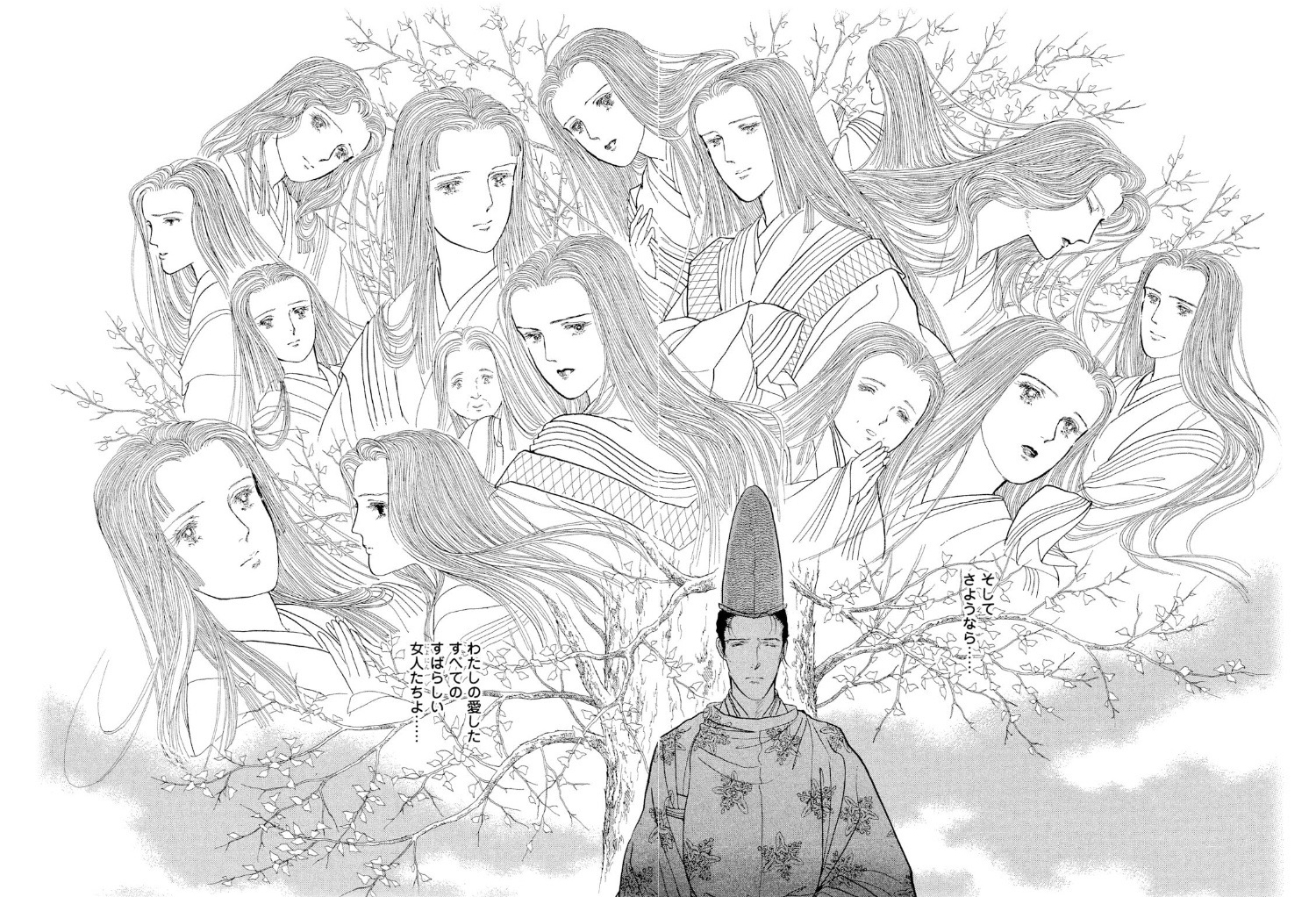
Hikaru Genji is deeply saddened by the loss of Murasaki no Ue. He begins to reflect on his past while sorting out his personal affairs, and spends his days in remorse and repentance for the things he has done to destroy the life that was supposed to make him happy.
He thinks of all the women he has loved and says goodbye to them, "And goodbye... to all the wonderful women I have loved..." and vows, "We will meet again someday..." and "I will mourn no more. We will meet again someday..." and "I will mourn no more.
After this, Genji left the priesthood and renounced the world.
Backstories, trivia, and small stories/episodes/anecdotes about "Asaki Yumemishi".
What is "The Tale of Genji"?
A full-length love story written by Murasaki Shikibu in the Heian period.
The novel depicts the inner workings of aristocratic society through the love life, ups and downs, and anguish of Hikaru Genji, who was born a prince of the emperor and blessed with good looks and many talents.
The last part of the novel features Kaoru, the son of Hikaru Genji, and is called "Uji Jucho" because it is mainly set in Uji.
It is considered "the world's oldest novel," and is widely known today as a work of world literature.
Asakayumemishi" as a gateway to the classics
Asaki Yumemishi" is a manga adaptation of the most famous of the classics, "The Tale of Genji," and is highly regarded as an introductory work that deepens understanding of the world of the work and encourages an interest in the classics.
It is also regarded as a "study manga," and is purchased by parents in preparation for entrance exams and by parents for their children, leading to increased sales every year during the exam and new semester seasons.
Because of this, the series boasts a long-lasting popularity.
In 2021, the TV Asahi program "Hayashi Osamu no Imadakatta! Lecture" broadcast by TV Asahi in 2021, it was ranked No. 8 in the list of "Manga for Study" chosen by students of the University of Tokyo.
Phantom Animation
Another of Kazunori Yamato's representative works is "Haikara-san ga Tsurugaru" ("Mr. Comes Through").
The anime version of "Haikara-san risetsu" was a hit, but it was abruptly cancelled due to the Moscow Olympics being broadcast during the same time slot.
Because of this, when "Asaki Yumemishi" was later adapted into an anime, the original author declined the offer, and the anime adaptation became a mirage.
The Marriage System in the Heian Period
In the story, Hikaru Genji has a series of love affairs, one after another, despite the fact that he has a full wife. Marriages in the Heian period were usually "commuter marriages" and "polygamous marriages," and it is difficult to understand the story without taking this into account.
At that time, "commuter marriage," in which the husband and wife lived separately and the husband commuted to the wife's home, was the norm. Both men and women were financially independent, and love was freely practiced.
Since women were not in the habit of showing their faces casually, men would look for a partner based on rumors and exchange letters without ever seeing the other person's face. They then ask their wives to guide them and crawl on them at night.
This is the reason why Hikaru Genji, Kuro Bearded, and Sagimiya force their way into the bedrooms of women, where they are surprised by the beauty and sometimes ugliness of their partners, and forcefully take them for themselves.
Because of "polygamy," a man has many wives and concubines, and the one with the highest status and the ability to organize the other wives joins the man's household as his official wife. The other wives become concubines.
Differences from the original "The Tale of Genji
The 54 chapters of "The Tale of Genji" including "Uji 10 Chapters" are depicted almost faithfully to the original work, but some alterations are made.
In the original, the description of Kiritsubo in the first chapter "Kiritsubo" is brief, but in this work, the story begins with the beginning of Kiritsubo's acquaintance with the emperor.
Other episodes are simplified or omitted, such as Tamakazura after her marriage to Bearded Black, Onnaichinomiya, and Makihashira.
In addition, Hanasazato, who was considered thin and shabby in the original story, is depicted as a buxom woman in this work. This is because in the Heian period (794-1185), it was considered more beautiful to be plump than to be slender, whereas today it is considered more beautiful to be slender.

![Asaki Yumemishi] "The Tale of Genji" drawn by various people is so chaotic and awesome! The Tale of Genji](https://renote.net/files/blobs/proxy/eyJfcmFpbHMiOnsiZGF0YSI6NzUyODUxMSwicHVyIjoiYmxvYl9pZCJ9fQ==--48f4311ace627b68e59ff9872f0804bc2f05ae54/512fc433cf668d5008f02562bfd2c37d596cf834_xlarge.jpg)
Tags
Contents
- Overview of "Asaki Yumemishi
- Synopsis and story of "Asaki Yumemishi
- The Birth of Hikaru Genji
- Retreat to Suma
- Glory in the capital
- the vicissitudes of life
- separation of wife and husband
- death of the Genji
- Uji Jucho (the oldest anthology of poems in existence)
- Characters in "Asaki Yumemishi
- protagonist
- Hikaru Genji
- Blood relatives of Hikaru Genji
- Emperor Kiritsubotei / Kiritsubo-in (Kiritsubo-in Temple)
- The Kiritsubo no Koui (The Tale of the Kiritsubo)
- Suzaku Tei / Suzakuin
- Emperor Reizei / Reizeiin
- Yugiri (evening mist)
- Akashi no Himekun (Princess of Akashi)/ Akashi no Nyogo (Lady of Akashi)/ Akashi no Chugu (Prince of Akashi)
- Kaoru
- Nio-no-Miya
- palace of the firefly tribe
- Hachinomiya (Shrine of the Eight)
- Wife and lover of Hikaru Genji
- The Palace of Fujitsubo / The Lady of Fujitsubo
- Aoi no Ue
- Murasaki no Ue / Wakamurasaki
- The Three Women's Palaces (Onna-san no Miya)
- Akashi no Ue / Akashi no Kimi / Akashi no Okata
- Six-jawed Sukusho (Six-jawed Sukusho)
- moonflower (Ipomoea alba)
- Hanachirusato
- Suezumuhana
- Gen no Nai-nosuke
- Oborozukiyo (Oboro Moonlit Night)
- The King of the Morning Glory
- Utsusemi
- House of Left-Handed Vassals
- Minister of the Left / Minister of the Left
- Head Commander (the middle general of the head)
- oak-tree
- red Japanese apricot
- Buddhist decoration engraved with various motifs, often made from gilt copper (e.g. for adorning the inner shrine of a temple)
- The Lord of Omi
- family of the Right Honorable Minister
- Minister of the Right / Minister of the Right
- Lady of Kobikiden
- Yugiri's relations
- clouded leopard (Neofelis nebulosa)
- Fujinosuke Fujinosuke
- Ochiba-no-Miya / Onna-ni-no-Miya
- Akashi no kun no kankei
- Akashi no Irimichi (The Way of the Akashi)
- Akashi no Ama-kun
- Related to Rokujo-no-Osumesho
- The Lady of the Plum Tubes / Akiko Muchu
- Sorasemi's relations
- Iyo-no-suke / Hitachi-no-suke
- People related to Tamakazes
- Daimu no Gen (Superintendent of the Supreme Court)
- black beard
- Makibashira
- Related to Hachinomiya
- Grand Minister
- The middle child
- floating boat
- Hikaru Genji's retainer
- Tadamitsu Fujiwara
- The Life Mother of Daisuke (Tayu Nayobu)
- Terms of "Asaki Yumemishi
- Status and official position
- The Middle Palace (Chugu)
- court lady
- changing clothes
- Sabbath
- Shozamurai
- Nasenosuke.
- title bestowed upon a woman by her employer
- Emperor Jundajo
- Chancellor of the Realm
- name
- Senior Chief
- Crown Prince
- Koudachi
- Wakamiya
- nursing mother
- Sai-gu Shrine
- nobleman's true wife
- Other
- imperial bridal party's entry into the court
- Imperial palace (in Kyoto)
- Famous quotes, lines, scenes, and scenes from "Asaki Yumemishi
- Aoi Aoi: "Love needs no words... when you love... just smile gently..."
- The head general "...here it comes, at last."
- Tamakazura: "I don't want to be swept away by anything any more... I want to stand here on my own feet...!
- On the purple: "Ah... from this world where this woman is not free I wish to leave as soon as possible..."
- Hikaru Genji: "And now goodbye... all the wonderful women I have loved..."
- Backstories, trivia, and small stories/episodes/anecdotes about "Asaki Yumemishi".
- What is "The Tale of Genji"?
- Asakayumemishi" as a gateway to the classics
- Phantom Animation
- The Marriage System in the Heian Period
- Differences from the original "The Tale of Genji