
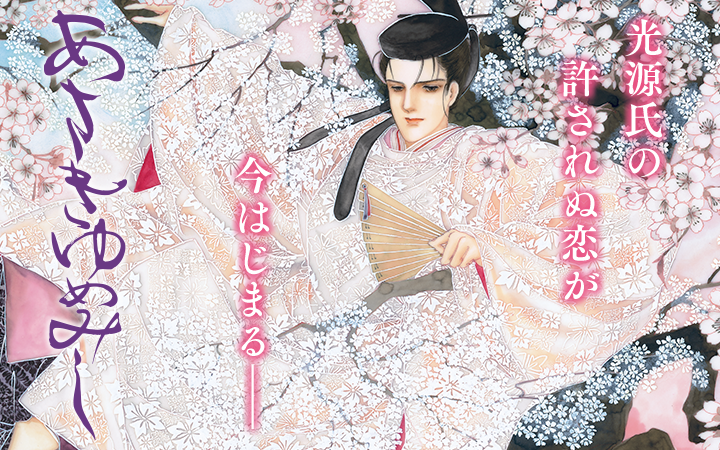
Asaki Yumemishi" is a manga series by Kazuki Yamato that was serialized in the monthly magazine "mimi" from 1979. It was later moved to "mimi Excellent" and completed in 1993. It is a manga adaptation of Murasaki Shikibu's "The Tale of Genji" and depicts the love affairs, power struggles, glory and downfall of aristocratic society in the Heian period through the main character Hikaru Genji, the son of the emperor. As a girls' manga, it faithfully depicts all 54 chapters of "The Tale of Genji" while incorporating modern interpretations and original episodes of the time. It has been translated into many languages for the international market, and has also been adapted into novels, stage plays, and many other forms.
Overview of "Asaki Yumemishi
Asaki Yumemishi" is a manga series by Kazuki Yamato, serialized irregularly in the monthly magazine "mimi" since 1979, and later moved to "mimi Excellent" until 1993.
The series has been published in book form (Kodansha Comics mimi, 13 volumes), in large editions (7 volumes), in paperback (7 volumes), and in complete editions (10 volumes), selling over 18 million copies in total. The series has been translated into various languages and published overseas as well.
The novels except for "Uji Jucho" were adapted into a novel by Yui Tokiumi (5 volumes) for Aoi Tori Bunko, a children's literature publisher, and in 2000, Takarazuka Revue Company adapted the novels into a stage play and film. In addition, a movie comic book was made available on UULA that visualizes this work with sound and special effects.
In 2016, the guidebook "The World of Asaki Yumemishi: The 50th Anniversary of Kazuki Yamato's Artwork" was published by Takarajimasya, and a new edition of "Asaki Yumemishi Emaki" (first and second volume) was published by Kodansha.
The main character, Hikaru Genji, the second prince of the Emperor Kiritsubo, is a man of luminous beauty and gifted in literary and military arts. His popularity far surpassed that of the first prince, and at one time he was even considered for the position of crown prince, but to avoid confusion, he was deposed and given the family name of Genji. He was said to have been in love with his stepmother Fujitsubo, who bore a striking resemblance to his late mother, and he sought to emulate her by taking the names Aoi no Ue, Murasaki no Ue, Onna-san-no-miya, Rokujo-no-miyasusho In the beginning and middle of the story, Hikaru falls in love with many women, including Utsusemi, Yugao, Suetsumuhana, Oborozukiyo, Hanachirusato, and Akashi no Ue. The story depicts the aristocratic society of the Heian period in a glamorous manner through the frustration, glory, and anguish of Hikaru Genji in the beginning and middle parts of the story, and the romantic history of Kaoru, Hikaru Genji's son, in the latter half.
The most famous of the classics, "The Tale of Genji," has been adapted into a girls' manga that has gained popularity and is highly acclaimed for broadening the audience for the classics.
Synopsis and story of "Asaki Yumemishi
The Birth of Hikaru Genji
Kiritsubo, the daughter of the previous Minister of the Left, entered the court without a powerful guardian.
She was shunned and harassed by other court ladies and court ladies, but she came to be favored by the emperor Kiritsubo.
Kiritsubo gave birth to a boy (later to become Hikaru Genji), who would become the second prince of the Kiritsubo family. Surrounded by the emperor and the beautiful Wakamiya, she was at the height of her happiness, but she was envied by those around her even more than before.
The resulting mental anguish caused her to break down, and she passed away, leaving Wakamiya to fend for herself.
Three years later, Wakamiya grew up to be even more beautiful, and people began to expect her to be the next emperor because of her cleverness.
However, because of a prophecy that the country would be in turmoil if she assumed the imperial throne, she was given the surname "Minamoto" and demoted to a vassal. The name "Hikaru Genji" means "shiningly beautiful Genji," and he came to be known as "Hikaru-no-kun" or "Genji-no-kun.
Some time later, the fourth daughter of the previous emperor entered the family and was called the Fujitsubo no Nyogo (Fujitsubo's daughter). Fujitsubo was a living copy of Genji's mother, Kiritsubo. Minamoto no Tsubasa followed the image of his mother in Fujitsubo, which turned into love.
At the age of 12, Genji had reached the age of retirement, and he could no longer see Fujitsubo as casually as before.
He takes Aoi no Ue, the daughter of the Minister of the Left, as his wife, but he does not get along with her. However, he became good friends with her elder brother, the head lieutenant, who was Genji's cousin.
Eventually, Genji became interested in Rokujo-no-Miyasusho, the widow of the previous Prince Higashinomiya and the most noblewoman of the day.
At first, Rokujo no Mikyasusho is annoyed by Genji, but she soon begins to look forward to his visits. She finally accepts Genji's insistence, but is afraid to let herself be carried away by her feelings for him.
One day, Genji goes to visit his nanny and notices evening glories blooming on the hedge of a neighboring house, and falls in love with Yugao no Kimi, the owner of the house. Yugao refuses to reveal her true identity, but Minamoto no Koto falls head over heels in love with her.
Meanwhile, when Rokujo no Musasho learns that Genji has a new lover, he begins to go mad with jealousy.
Genji takes Yugao to his deserted mansion as a place of rendezvous, but the spirit of Rokujo no Mistress appears and speaks bitterly against Genji. Yugao becomes possessed and falls into a coma, where she breathes her last.
In fact, Yugao was the wife of the head lieutenant, who had disappeared and gone into hiding in the city because of jealousy of the head lieutenant's wife. Genji, upon learning of this, tried to take her in, but was opposed by Koremitsu, a follower of his. In the meantime, Yugao's daughter disappeared.
After Yugao's death, Genji, who was not feeling well, visited a temple in Kitayama to pray, where he met a girl who resembled Fujitsubo. The girl was the daughter of Lord Hyobukyomiya, the elder brother of Fujitsubo.
Back in the capital, Genji is reunited with Fujitsubo, and they have a forced affair.
Meanwhile, the princess of Lord Hyobu's palace had also returned to the capital, but her grandmother, a Kitayama nun, had died and left her with no relatives. Genji learns of this and takes the princess back to his mansion, naming her "Murasaki" (purple).
Eventually, Fujitsubo became pregnant, but she was worried that it was not the son of the emperor Kiritsubo, but rather a child born of infidelity to Minamoto no Mikoto. Kiritsubo gave birth to a son, and Minamoto became his guardian.
After a banquet held in Shikinden, Genji enters Kohkiden and meets a young princess, whose identity he does not know, and they enter into a bond.
This princess was Oborozukiyo, the sixth consort of the Minister of the Right, who had been chosen to join the Crown Prince, Prince Higashinomiya.
Soon after, the Kiritsubo emperor abdicated and the Suzaku emperor, the elder brother of the Genji family, ascended the throne.
Wakamiya, born of Fujitsubo, became the Crown Prince, and the daughter of the Rokujo no Mikoto became the Saigu.
Meanwhile, Aoi no Kami, the wife of the Minamoto clan, became pregnant, and when Rokujo no Mistress learned of this, she became increasingly jealous.
On the day of the Kamo Festival, Aoi no Ue's group went to see the festival, and had a quarrel with Rokujo no Mikoto's group, which was also there to see the festival. Rokujo no Mikoto was humiliated by the violence of Aoi no Ue's group, and he deeply resented Aoi no Ue.
After that, Aoi no Ue was possessed by the spirit of Rokujo no Mikoto and fell ill. After a difficult delivery, Aoi no Ue gave birth to a baby boy, later called Yugiri, but he was killed by the spirit.
Rokujo no Mistress, fearing her own spirit, decides to go to Ise with her daughter when she becomes the Saiku of Ise. Genji visits Rokujo no Mikoto and bids her farewell.
Minamoto noji entrusted Yugiri to Aoi no Ue's parents, the Left Minister's family, and returned to his home, Nijoin Temple, for the first time in a long while.
He returned to his home, Nijoin Temple, for the first time in a long while. Genji forcibly exchanges vows with Murasaki no Ue, but Murasaki no Ue is shocked by the suddenness of their union.
Murasaki no Ue becomes depressed, but she eventually accepts Genji.
Retreat to Suma
Kiritsuboin collapsed due to illness. This increased the power of the Minister of the Right, and Genji, under the influence of the Minister of the Left, spent his days in depression.
He is unable to suppress his love for Fujitsubo, and goes to her secretly, but is strongly rejected. Fearing that her relationship with Genji would be exposed, Fujitsubo suddenly left the priesthood on the first anniversary of Kiritsubo's death.
Because of the publicity surrounding her relationship with Minamoto, Oborozukiyo was assigned to a lower position than she should have been, that of a shonoshi-kami.
Genji and Oborozukiyo secretly meet, but one night they are caught in the act by the Minister of the Right. Furious, the Minister of the Right and the Lady of Kokyo-den (the Lady of Kokiden) plot to bury Genji.
Genji, driven into a corner, decides to go into hiding in Suma. This was also to ensure that his successor, Prince Higashinomiya, would not suffer from the same fate.
After moving to Suma, Minamoto spent his days in solitude until he heard a rumor of a beautiful princess, the Akashi-no-kimi.
Soon after, Akashi's father, Akashi Ninodo, visited him and invited him to move to Akashi.
Akashi no Irimichi takes this opportunity to offer Akashi no Kimi to Minamoto, but Akashi no Kimi is unwilling to do so, saying that her status is too different from his.
Nevertheless, Minamoto exchanges letters with Akashi no Kimi, and is attracted by her personality and culture.
He eventually visits Akashi and they exchange vows.
In the capital, the Minister of the Right died, the Suzaku emperor suffered from an eye disease, and the lady-in-waiting of the Kobhidono Palace also became ill.
The Suzaku emperor decided to forgive Minamoto over the objections of the lady of Konohyden.
Minamoto no Mikoto returns to the capital, but Akashi no Mikoto, who is pregnant with Minamoto no Mikoto's child, laments the parting of their paths.
Glory in the capital
Upon his return to the capital, Genji was promoted to the position of Dainagon.
When Prince Azuma attained the age of majority, the Suzaku emperor abdicated and the Reizei emperor acceded to the throne. Minamoto was promoted to the position of Minister of the Interior, and the Left Minister was appointed Grand Minister of State.
The Princess Akashi gave birth to a princess, and Minamoto sent a nanny and gifts of congratulations.
At the same time, Rokujo no Mistress and her daughter Saigu returned to the capital.
Soon after, Rokujo no Mistress fell ill. Rokujo no Mistress, who knew she was dying, entrusted her future to Minamoto no Mikoto, who came to visit her, and passed away.
Minamoto adopted Saigu as his own daughter, and knowing Suzakuin's attachment to Saigu, he allowed her to join the court of the Reizei Emperor.
One of Genji's former lovers, Suetsumuhana (末摘花), lost her guardianship after Genji retired to Suma, and her life became extremely impoverished.
When Genji visits Hanachirusato, he passes by a dilapidated house and notices that it is Setsumuhana's house. Here he learns that Suetsumika is still waiting for him, and is so moved that he promises to shelter her.
Genji pays a visit to Ishiyama-ji Temple and meets a group of Utsusemi, the wife of Hitachi-no-suke.
Kusemi had been Genji's love interest when he was young, and after their one and only relationship, she had refused him, becoming an unforgettable presence in his life.
When Jochinosuke eventually dies, Sorasemi is seduced by his stepson Kawachi no Mamoru, and she leaves the family.
Genji took Sorasame back to his own Nijoin residence, with Hanasazato living on the western side and Suetsumika and Sorasame living on the northern side.
The Saigu, whom Minamoto had taken under his guardianship and admitted to the court, joined the Umezubo family and became the Lady of the Plum Tubes.
The emperor and the Lady of Umezubo-no-Nyogo shared a common interest in painting, which led to the Lady of Umezubo-no-Nyogo's favor with the emperor.
The head lieutenant, whose daughter had been admitted to the court earlier, began collecting masterpieces in an attempt to attract the attention of the Emperor.
This led to a showdown between the Lady of the Plum Tubes, on Hikaru Genji's side, and the Lady of the Koukouden, on the head lieutenant's side, in front of the Reizei Emperor.
Both sides exhibited their best paintings of the past and present, but Genji finally exhibited his own pictorial diary of Suma. The audience was moved by this, and the contest was won by the Lady of Umezubo.
From Akashi, Akashi-no-kun, the princess, and her mother, a nun, arrived in Tokyo.
Genji had intended to receive the Akashi no Kimi at the eastern side of Nijoin, but the Akashi no Kimi, anxious about life in the capital and her low status, was to live in a mountain villa near the Oigawa River.
The princess was entrusted to Minamoto and was to be raised as an adopted daughter of Murasaki no Ue.
At the beginning of the year, the Grand Minister of State died, and there was a series of natural disasters in the vicinity of the capital. Furthermore, Fujitsubo died of illness, and Genji was devastated.
Meanwhile, Emperor Reizei learns from a priest in Fujitsubo's service that he is in fact the son of the Minamoto clan. The shocked Emperor Reizei attempts to hand over the throne to Minamoto, but Minamoto is adamant.
Minamoto's son Yugiri and Kumoinokari, the daughter of the head lieutenant, the minister of the interior, are childhood friends and cousins. They grew up together and were secretly in love.
At the age of 12, Yugiri reached the age of court dress, but Genji did not give her preferential treatment, keeping her at a low rank and placing her in the university class. This was Minamoto's parental love for his son to develop his ability.
In the same year, Genji's adopted daughter, the Lady of Umezubo, became the chugu of the Reizei Emperor and took the name Akiko-no-Muchu-gu.
The Minister of the Interior, who had hoped that his own daughter would become the Chugu, now hoped that Kumoi-no-gane would become the Princess of Higashinomiya. In the midst of all this, he learns of the relationship between Yugiri and Kumoi no Geese, and angrily tears their relationship apart.
the vicissitudes of life
Tamakazura, the son of the Minister of the Interior, the Head Minister, and the late Yugao, moved to Tsukushi with her nanny and her family after Yugao's death, and grew up here.
She had been waiting for an opportunity to return to Kyoto, but was unable to do so, until a powerful local man forcefully asked her to marry him, and she finally fled back to Kyoto.
On her way to Hase-ji Temple, she runs into Ukon, who was Yugao's maid of honor.
Ukon had been in the service of Hikaru Genji since Yugao's death, and through her guidance, Tamakazura was adopted by him as his adopted daughter.
Tamakazura's beauty attracts the admiration of men, and even her adoptive father, Genji, makes advances toward her, which confuses her.
Soon after, Tamakazura was appointed to the post of Shozamurai (head of the household).
When the right general of the bearded black man, who was eagerly courting Tamakazura, learns of this, he asks his lady-in-waiting to force his way into her bedchamber and forcibly binds himself to Tamakazura.
Tamakazura is disappointed to find herself married to the rugged Bearded Black, and finally realizes that she had actually fallen in love with Genji.
Bearded Black begins renovating his house to welcome Tamakazura. The bearded black Kitanokata, who had a chronic illness of temper depression, despairs at the sight of this and says he will return to his parents' home.
Bearded Black, who has never lost his love for the Kitanokata, tries to hold him back, but the suddenly frenzied Kitanokata showers him with ashes from the incense burner.
This disgusts Bearded Black, and he becomes a frequent guest at Tamakazura's house, and Kitanokata's father, Prince Shikibu, seeing this, takes Kitanokata and her children back to his own residence while Bearded Black is away.
When Bearded Black learns of this, he visits the family, but is not allowed to see his wife and daughter, Makibashira, and is forced to take only his sons home.
As the new year dawned, Tamakazura remained in a state of depression, and Bearded Black, unable to bear the sight of her, suggested that she leave the court to serve.
Emperor Reisen was fascinated by Tamakazura's visit to the palace, but Bearded Black was upset to see her and took her back to his house.
Tamakazura comes to live at the Bearded Black residence, where she discovers the sincere and gentle but clumsy character of Bearded Black.
Tamakazura, who has been living as she has been swept away since she left Tsukushi, finally finds her own place here and decides to live as Bearded Black's wife.
separation of wife and husband
At the age of 18, Yugiri has received several offers of marriage, but Yugiri is not ready to simmer down.
When Kumoinogan heard the rumors of Yugiri's marriage proposal, he was shocked.
The head lieutenant of the Minister of the Interior, who had broken up the relationship between Yugiri and Kumoi no Goan several years before, was worried about how to deal with Kumoi no Goan.
Since then, he and Yugiri have been estranged, but he suddenly remembers that they had previously had a close relationship, like father and son, and decides to allow them to be together.
Yugiri and Kumoi's goose had been separated for many years, but they were finally able to marry.
At the same time, the Princess Akashi, daughter of the Minamoto clan, was accepted into the family.
Her foster mother, Murasaki no Ue, gave up her guardianship out of consideration for her own mother, Akashi no Kimi. Here, the two met for the first time, and both discovered and recognized the other's virtues.
Although Murasaki no Ue and Akashi no Kimi had been in competition for a long time, they began to see each other and open their hearts to each other.
Minamotoji is bestowed the rank of associate taijo emperor on the occasion of his 40th birthday.
Genji's elder brother, Suzakuin, is ordained, but he is not anxious about the future of his daughter, Onna-san-no-miya, who has no guardian.
Many noblemen were considered as candidates for his son-in-law, but after much deliberation, he decided to entrust Onasanomiya to Minamoto no Mikoto.
Minamoto no Miya is perplexed and tries to refuse, but he finally agrees to marry her because she is a princess related to Fujitsubo, whom he had long been in love with.
Murasaki no Ue, who had been his wife up to that point, is extremely upset, but she hides it and makes preparations to welcome Onasanomiya.
Genji marries the third daughter, but is disappointed to find that she is very young in spirit and does not resemble Fujitsubo in the slightest.
Meanwhile, Suzakuin has left the family, and her concubines have returned to the village. Genji learns that his former lover, Oborozukiyo, has also returned to her parents' home, and sends a messenger to see her for the first time in a long while.
Oborozukiyo refuses, but Genji pushes his way into her life, forcing her back into his arms.
Kashiwagi, the son of the head lieutenant who became the Grand Minister of State, had once hoped to marry Onasanomiya, but he still harbors lingering regrets even after her marriage to Genji.
When Kashiwagi visited Rokujoin Temple for a kemari (a Japanese game of foot ball), he happened to see Onasanomiya by chance.
Since then, Kashiwagi's feelings for Onnanomiya grow stronger and stronger.
The princess of Akashi, who had joined the court and become the "Lady of Akashi," became pregnant.
She returns to her family home, Rokujoin, and meets a nun, the mother of Akashi no Mikata and grandmother of Akashi no Mikata.
There she learns for the first time that she is the daughter of Akashi no Mikata, and the three of them shed tears of joy as they identify themselves for the first time as parent and child, grandmother and grandchild. Soon after, the Lady of Akashi gave birth to a boy.
Four years later, Murasaki no Ue began to wish to leave the priesthood, and she broached the idea to Genji, but he persuaded her to reconsider.
Later, Murasaki no Ue falls suddenly ill, and Genji takes care of her.
Murasaki no Ue once dies, but is barely revived. During this time, the spirit of Rokujo no Mikoto appears, and Genji is horrified to find that it has attached itself to Murasaki no Ue.
Meanwhile, Kashiwagi marries Onnanomiya, the elder sister of Onnanomiya, but is unable to forget Onnanomiya.
When Minamoto no Mikoto comes to take care of Murasaki no Ue and leaves the mansion empty, Kashiwagi takes advantage of this opportunity to have an illicit affair with Onnanomiya.
After a while, the third courtesan became pregnant, but it was Kashiwagi's child, not Minamoto no Miya's. Minamoto no Miya realized the truth of the matter and began to think about it. Minamoto no Miya realizes the truth of the matter, and when Kashiwagi learns of it, he is horrified by his sin and eventually falls ill.
The third daughter gave birth to a son, later named Kaoru, but he was completely weakened by the guilt of his crime.
Her father, Suzakuin, worried about her, came to visit her, but she strongly wished to be ordained, and on the same day, Suzakuin took her hair down by her hand.
Kashiwagi's illness became worse and worse, and he ended his life, regretted by all.
At first, Genji avoided Kaoru, but when he suddenly picked her up in his arms, he marveled at the beauty of her appearance. He saw in her the image of Kashiwagi and wept.
death of the Genji
Yugiri, who lost her best friend Kashiwagi, kept his will and paid repeated visits to his widow, a female second cousin called "Ochiba-no-miya".
Gradually, Yugiri became attracted to Ochiba-no-miya.
Ochiba-no-Miya moved to a mountain villa in Ono to attend to the illness of her mother, Ichijo-no-Miyasusho.
Yugiri visits the villa on the pretext of visiting Ichijo no Mikoto and tells Ochiba no Miya of her feelings for her, but she is rejected. Yugiri spends the night and returns home in the morning, and their relationship becomes the subject of public gossip.
When Ichijo no Mistress learned of this, she mistakenly believed that Yugiri was playing with Ochiba no Miya, and died suddenly of exhaustion. Ochiba-no-Miya was so sad that she wished to be ordained, but her father, Suzakuin, disapproved, and she fell into despair.
Yugiri, annoyed by Ochiba-no-Miya's refusal to open her heart, brings her back to the main residence at Ichijo and forcibly takes her as his wife.
This angers Kumoinogan, and the couple quarrels. While Yugiri was with Ochiba no Miya, Kumoinogan took the children and returned to his parents' home.
Murasaki no Ue was not feeling well after that, and she increasingly wished to leave the house. However, Genji would not allow it.
At Murasaki no Ue's request, a grand memorial service of 1,000 copies of the Lotus Sutra was held, and Akashi no Mikata and Hanasazato also visited the ceremony. Murasaki no Ue, having realized her own mortality, bids them farewell.
In autumn, Murasaki no Ue finally breathes her last and Minamoto no Ue is deeply saddened.
He reflects on his life and his feelings for the people he has loved.
Eventually, Minamoto contemplates ordaining himself and begins to sort out his personal affairs.
One day, Akashi no Onna noticed a beautiful cloud, the likes of which she had never seen before, hanging over the mountain where the ordained Minamoto no Onna was holed up.
Seeing this, Akashi no Onkata realized that Genji had passed away, and wondered if he and Murasaki no Ue had ever met again in those beautiful clouds.
Uji Jucho (the oldest anthology of poems in existence)
Several years have passed since the death of Hikaru Genji.
Kaoru, the son of Nio-no-Miya, the third consort of the Imagami Emperor, and Genji, is considered to be the most noble prince of his time.
Kaoru's body was naturally endowed with an aromatic fragrance, and because of her rivalry with him, she was known as "Lord Smell of the Warring States," or "Lord Smell of the Warring States," or "Lord Smell of the Lieutenant General.
Yugiri, Kaoru's elder brother, continued to visit the Geese of Kumoi and the Palace of Ochiba in one-day shifts, 15 days a month, in a disciplined manner.
Yugiri wishes to have Sadomiya as his son-in-law, but Sadomiya, who adores the Minamoto clan and prefers free love, has no desire to do so.
Kaoru is in anguish over her own promotion and doubts about her birth, and she begins to seek salvation in Buddhism.
One day, Kaoru learns from Ajari of Mount Uji about Hachinomiya, the son of Kiritsuboin and half-brother of Genji.
During the reign of Reizeiin, a plot was hatched by the lady of Koukouden to abolish this title and make Hachinomiya the Crown Prince. However, the plot did not succeed, and the Hachinomiya was subsequently forgotten by the world. She now lives in Uji, devotes herself to Buddhism in her secular life, and raises two princesses.
Kaoru learns of this and begins to visit Hachinomiya, becoming fascinated by these princesses. Upon hearing this story, Saginomiya also becomes interested in the princesses.
Hachinomiya, who had reached the age of misfortune, went to visit a mountain temple in Uji, where he suddenly fell ill and died.
Upon learning of this, Kaoru and Saginomiya visit Uji. Kaoru is attracted to her elder sister, Oikimi, and Nioiginomiya is attracted to her younger sister, Nakanokimi, but the princesses are reluctant to open their hearts to each other.
Oikun was determined to follow the will of Hachinomiya and remain celibate to protect the house of Uji, and he wanted Kaoru and the middle princess to get married.
Saginomiya continued to go to Uji, but was opposed by her mother, the Nakamiya of Akashi. She then decides to marry Roku no Kimi of Yugiri, whom she had been talking about for some time. When Naka-no-kun learns of this, she is saddened and grieves.
The Daikun, who had always been physically weak, collapses from exhaustion upon hearing this and dies at a young age. Kaoru was deeply saddened by the fact that she and the lord had a heart-to-heart talk in the end, but were unable to consummate their marriage.
When Prince Nakamiya of Akashi learns of Kaoru's grief, he realizes that it is understandable for her to be attracted to the sister of a woman who is so devoted to her, and forgives her relationship with Nakamiya.
Finally, she welcomed Naka-no-kun into her own mansion and took her as her wife. Yugiri, who had planned to marry Roku no Kimi to Nioiginomiya, now asks Kaoru to marry Roku no Kimi, but Kaoru refuses.
The Emperor Imajo was worried about the fate of his daughter Onnanomiya, who had lost her mother and had no powerful guardian. He therefore wishes her to marry Kaoru, to which Kaoru reluctantly agrees.
Yugiri learns of this and decides to give Roku no Kimi to Onnanomiya as a bride.
However, she is captivated by the beauty of Roku no Ki-kun, and she begins to visit Naka no Ki-kun less and less.
Kaoru consoles the depressed Naka-no-kun, but soon begins to have feelings for her. Naka-no-kun refuses, and in order to divert Kaoru's attention, she tells him that she has a half-sister, Ukifune, who resembles the deceased lord.
Ukifune is the daughter of Hachinomiya and his wife, Chusho-no-kun, but she was unrecognized by Hachinomiya and raised by Mutsu-no-kami, the wife of Chusho-no-kun from his second marriage.
She was betrothed to Sakon no Shosho, but when the wealth-seeking Shosho realized that Ukifune was not Mutsu no Mamoru's biological child, he switched her for his younger sister, who was his own daughter.
The Shogun takes pity on Ukifune and leaves her in the care of Nakano-kun. Here, Nioi no Miya sees Ukifune and, attracted by her beauty, tries to woo her. The chusho no kun is surprised to hear this and hides Ukifune in a hut in Sanjo.
Kaoru, who learns that Ukifune is hiding in Sanjo, visits her and takes her away to Uji.
On the other hand, Saginomiya, who cannot forget Ukifune, discovers that she is in Uji and visits her secretly, forcing her to enter into a contract with him.
Ukifune is attracted to the passionate Saginomiya, but is torn between her and Kaoru.
Eventually, Ukifune, in agony between Kaoru and Saginomiya, decides to die and throws himself into the Uji River.
When Ukishu learns of his death, the lieutenant general, Kaoru and Saginomiya are surprised and mournful.
Ukifune, who was thought to be dead, was saved by a group of priests of Yokogawa who happened to pass by, and was alive.
When Ukifune regains consciousness, he realizes that he had failed to die and wishes to be ordained.
Konoe Chuchujo, the husband of the deceased daughter of the nun who cared for him, asked Ukishu to marry him, but he kept refusing, and finally he was ordained while the nun was away.
Eventually, Kaoru hears that Ukifune is still alive. Kaoru tries to confirm that Ukifune is alive, but he continues to refuse.
She thinks that one day they will meet again as disciples of Gobutsu, transcending the boundary between man and woman, and that on that day they will be able to cross the floating bridge of their dreams and quietly hold each other's hands.
Characters in "Asaki Yumemishi
protagonist
Hikaru Genji
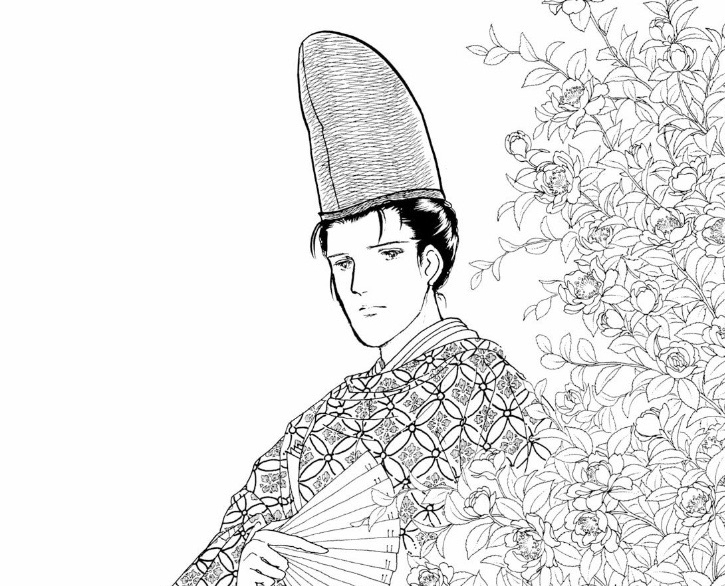
The main character from the beginning to the middle of the story.
The second prince of Emperor Kiritsubo. His mother was a Kiritsubo no Sarai.
From his childhood, he was blessed with good looks and talent, and was called "Hikaru-kun" (shining prince). When he reached the age of the first emperor, there were high expectations for him to become the next emperor, preferring the crown prince, but in order to prevent the world from being disturbed, he was demoted to a vassal and took the name of Gensei.
He fell in love with Fujitsubo, who resembled his late mother, Kiritsubo, and fell in love with a number of women in search of her likeness.
He has a daughter, Aoi no Ue, who is the daughter of the Minister of the Left, but the couple does not get along well, and he fosters Murasaki no Ue as his ideal woman. After Aoi no Ue's death, Murasaki no Ue became his de facto wife.
She eventually crossed the line with Fujitsubo, and when Fujitsubo gave birth to the prince who later became the Emperor Reizei, she served as his guardian.
In a dream fortune telling, it is said that she had three children, one of whom would become the emperor, one of whom would become the middle palace, and the lesser one in the middle would become the Grand Minister of State. This refers to the Emperor Reizei, who was born to Fujitsubo, the Middle Prince Akashi, who was born to Akashi no Mikata, and Yugiri, who was born to Aoi no Ue.
When Kiritsuboin died and the power of the Minister of the Right increased, he retired to Suma, partly due to pressure from the Minister of the Right and partly due to an ugly incident with Oborozukiyo. Here she was united with the Princess Akashi, who later became the Princess Nakamiya of Akashi.
Later, she was forgiven and returned to the capital, where she was reinstated as the guardian of the Crown Prince.
When the Suzaku emperor abdicated and the Reizei emperor ascended to the throne, he adopted the daughter of his former lover, the Rokujo no Mikoto, who later became the Saiku (Saiku's wife), who was to become the Umezubo-no-Mikoto and Akiyoshinakamiya, and made her the wife of the Reizei emperor.
He was promoted to the position of Grand Minister of State, and built a vast mansion, Rokujoin, where he took his wife and former lovers to live and cared for them.
When he reached the age of 40, he was given the title of "Associate Emperor Taisho" by the Reizei Emperor and enjoyed a period of great prosperity.
When Suzakuin was about to leave the court, he was asked to marry off his daughter, Onasanomiya. The three women were nieces of Fujitsubo, and their feelings for her were uncontrollable, so they accepted the marriage.
However, when they marry, he is disappointed with the young Onasanomiya.
Unable to accept Genji's love for her, she has an illicit affair with Kashiwagi and gives birth to Kaoru. The secret of her birth was kept secret, and she was raised as the second son of Minamoto no Mikoto.
After Murasaki no Ue's death, she went into seclusion in Saga and lived as an ordained priestess for the rest of her life.
Blood relatives of Hikaru Genji
Emperor Kiritsubotei / Kiritsubo-in (Kiritsubo-in Temple)

![Asaki Yumemishi] "The Tale of Genji" drawn by various people is so chaotic and awesome! The Tale of Genji](https://renote.net/files/blobs/proxy/eyJfcmFpbHMiOnsiZGF0YSI6NzUyODUxMSwicHVyIjoiYmxvYl9pZCJ9fQ==--48f4311ace627b68e59ff9872f0804bc2f05ae54/512fc433cf668d5008f02562bfd2c37d596cf834_xlarge.jpg)
Tags
Contents
- Overview of "Asaki Yumemishi
- Synopsis and story of "Asaki Yumemishi
- The Birth of Hikaru Genji
- Retreat to Suma
- Glory in the capital
- the vicissitudes of life
- separation of wife and husband
- death of the Genji
- Uji Jucho (the oldest anthology of poems in existence)
- Characters in "Asaki Yumemishi
- protagonist
- Hikaru Genji
- Blood relatives of Hikaru Genji
- Emperor Kiritsubotei / Kiritsubo-in (Kiritsubo-in Temple)
- The Kiritsubo no Koui (The Tale of the Kiritsubo)
- Suzaku Tei / Suzakuin
- Emperor Reizei / Reizeiin
- Yugiri (evening mist)
- Akashi no Himekun (Princess of Akashi)/ Akashi no Nyogo (Lady of Akashi)/ Akashi no Chugu (Prince of Akashi)
- Kaoru
- Nio-no-Miya
- palace of the firefly tribe
- Hachinomiya (Shrine of the Eight)
- Wife and lover of Hikaru Genji
- The Palace of Fujitsubo / The Lady of Fujitsubo
- Aoi no Ue
- Murasaki no Ue / Wakamurasaki
- The Three Women's Palaces (Onna-san no Miya)
- Akashi no Ue / Akashi no Kimi / Akashi no Okata
- Six-jawed Sukusho (Six-jawed Sukusho)
- moonflower (Ipomoea alba)
- Hanachirusato
- Suezumuhana
- Gen no Nai-nosuke
- Oborozukiyo (Oboro Moonlit Night)
- The King of the Morning Glory
- Utsusemi
- House of Left-Handed Vassals
- Minister of the Left / Minister of the Left
- Head Commander (the middle general of the head)
- oak-tree
- red Japanese apricot
- Buddhist decoration engraved with various motifs, often made from gilt copper (e.g. for adorning the inner shrine of a temple)
- The Lord of Omi
- family of the Right Honorable Minister
- Minister of the Right / Minister of the Right
- Lady of Kobikiden
- Yugiri's relations
- clouded leopard (Neofelis nebulosa)
- Fujinosuke Fujinosuke
- Ochiba-no-Miya / Onna-ni-no-Miya
- Akashi no kun no kankei
- Akashi no Irimichi (The Way of the Akashi)
- Akashi no Ama-kun
- Related to Rokujo-no-Osumesho
- The Lady of the Plum Tubes / Akiko Muchu
- Sorasemi's relations
- Iyo-no-suke / Hitachi-no-suke
- People related to Tamakazes
- Daimu no Gen (Superintendent of the Supreme Court)
- black beard
- Makibashira
- Related to Hachinomiya
- Grand Minister
- The middle child
- floating boat
- Hikaru Genji's retainer
- Tadamitsu Fujiwara
- The Life Mother of Daisuke (Tayu Nayobu)
- Terms of "Asaki Yumemishi
- Status and official position
- The Middle Palace (Chugu)
- court lady
- changing clothes
- Sabbath
- Shozamurai
- Nasenosuke.
- title bestowed upon a woman by her employer
- Emperor Jundajo
- Chancellor of the Realm
- name
- Senior Chief
- Crown Prince
- Koudachi
- Wakamiya
- nursing mother
- Sai-gu Shrine
- nobleman's true wife
- Other
- imperial bridal party's entry into the court
- Imperial palace (in Kyoto)
- Famous quotes, lines, scenes, and scenes from "Asaki Yumemishi
- Aoi Aoi: "Love needs no words... when you love... just smile gently..."
- The head general "...here it comes, at last."
- Tamakazura: "I don't want to be swept away by anything any more... I want to stand here on my own feet...!
- On the purple: "Ah... from this world where this woman is not free I wish to leave as soon as possible..."
- Hikaru Genji: "And now goodbye... all the wonderful women I have loved..."
- Backstories, trivia, and small stories/episodes/anecdotes about "Asaki Yumemishi".
- What is "The Tale of Genji"?
- Asakayumemishi" as a gateway to the classics
- Phantom Animation
- The Marriage System in the Heian Period
- Differences from the original "The Tale of Genji