

Psycho Romanchika" is a Japanese gag manga by Motoki Koide that crosses psychology and the daily lives of high school students. It was serialized in Monthly Shōnen Rival from 2014.
The main character, Ito, is a high school girl who has a crush on her childhood friend Abe. Fascinated by psychology, she decides to start a "psychology research club. In order for the club to be recognized as a club, it must have five members. There, Ito uses psychology to meet and recruit a variety of students, from dropouts to delinquents. This is a story filled with the slapstick daily lives of high school students and psychology that can be used from tomorrow.
Ash tuning experiment
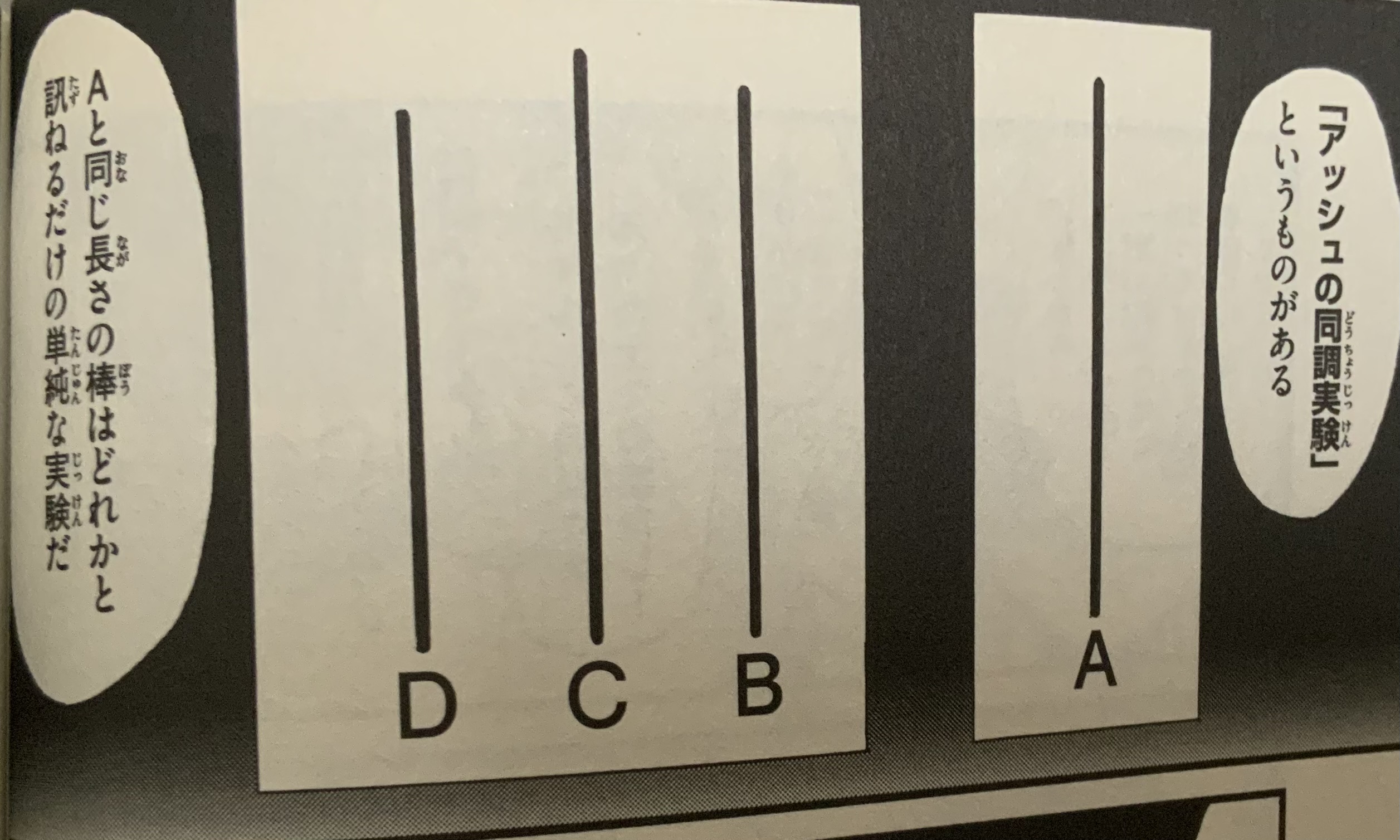
C is the same length as A, but you choose D when you are told by others that it is definitely D.
Ash's synchronization experiment is that if you choose the right one, but are denied by many others, you will agree with others.
For example, even if you think that "crows are black," when many other people tell you that "crows are white," you become anxious about your own opinion. Before long, you begin to say that "crows are white." This is called synchronization because it matches other people's ideas.
Psychodrama
A psychodrama is a form of psychotherapy in which one improvises a given role, and in the process of performing the role, one can naturally see one's own true feelings and the feelings of the other.
In this volume, Ito, who was asked by the vice-principal to rehabilitate delinquents and 宇堂, actually did it to 宇堂.
In the park, Abe played 宇堂's younger brother and Ito played 宇堂's younger sister, and they performed' 宇堂 Ke no Ichinichi' (A Day in the House of the Genji). As a result, they were able to understand the true feelings of 宇堂, and it became an opportunity for 宇堂 to face themselves.
Space-filling effect
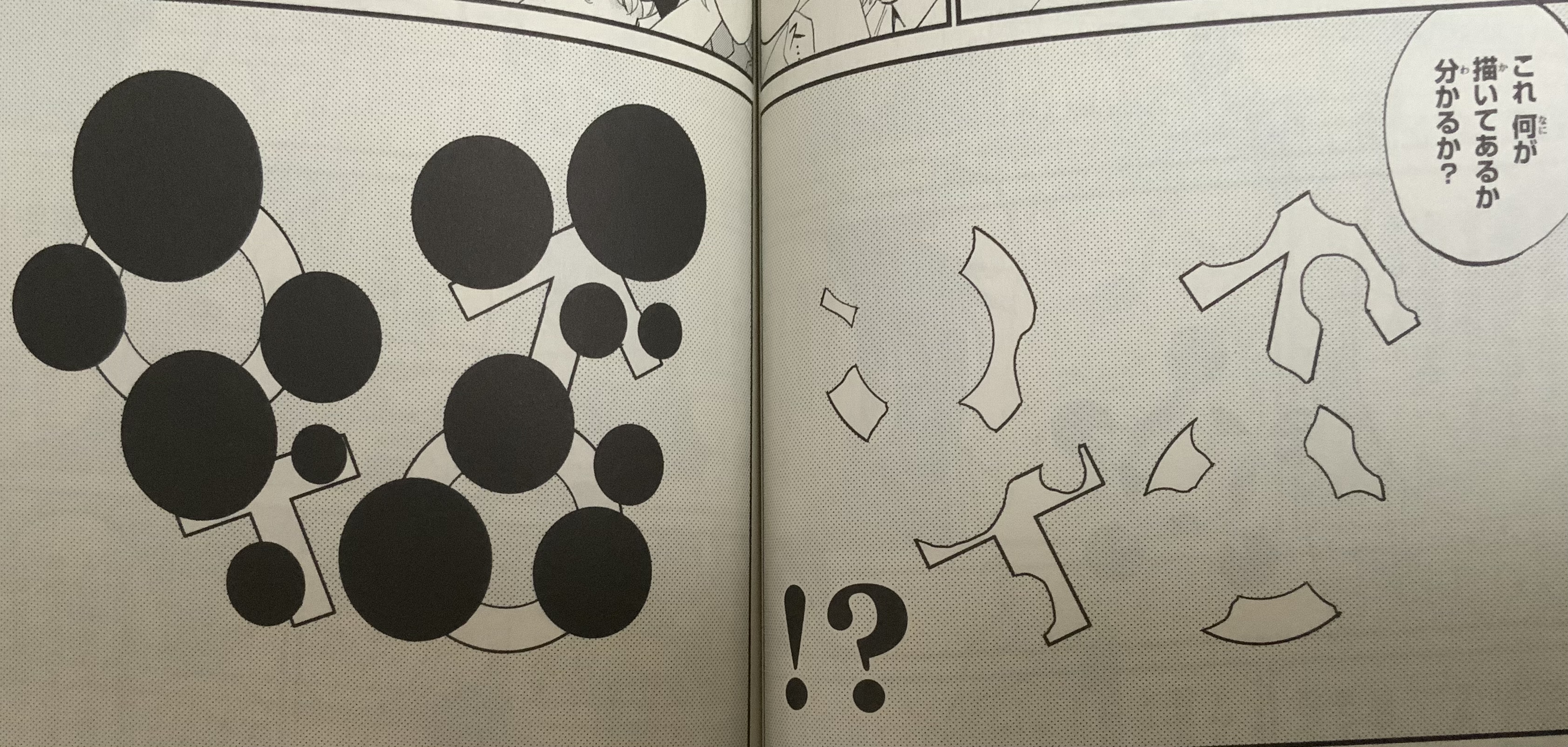
A type of psychology that predicts the image shown in the figure on the left by automatically complementing in the brain the figure on the right, which is an incomprehensible figure.
The void filling effect means that when a human sees a partially blocked object, he or she fills in the blocked part to predict the completed drawing.
Meravian's law
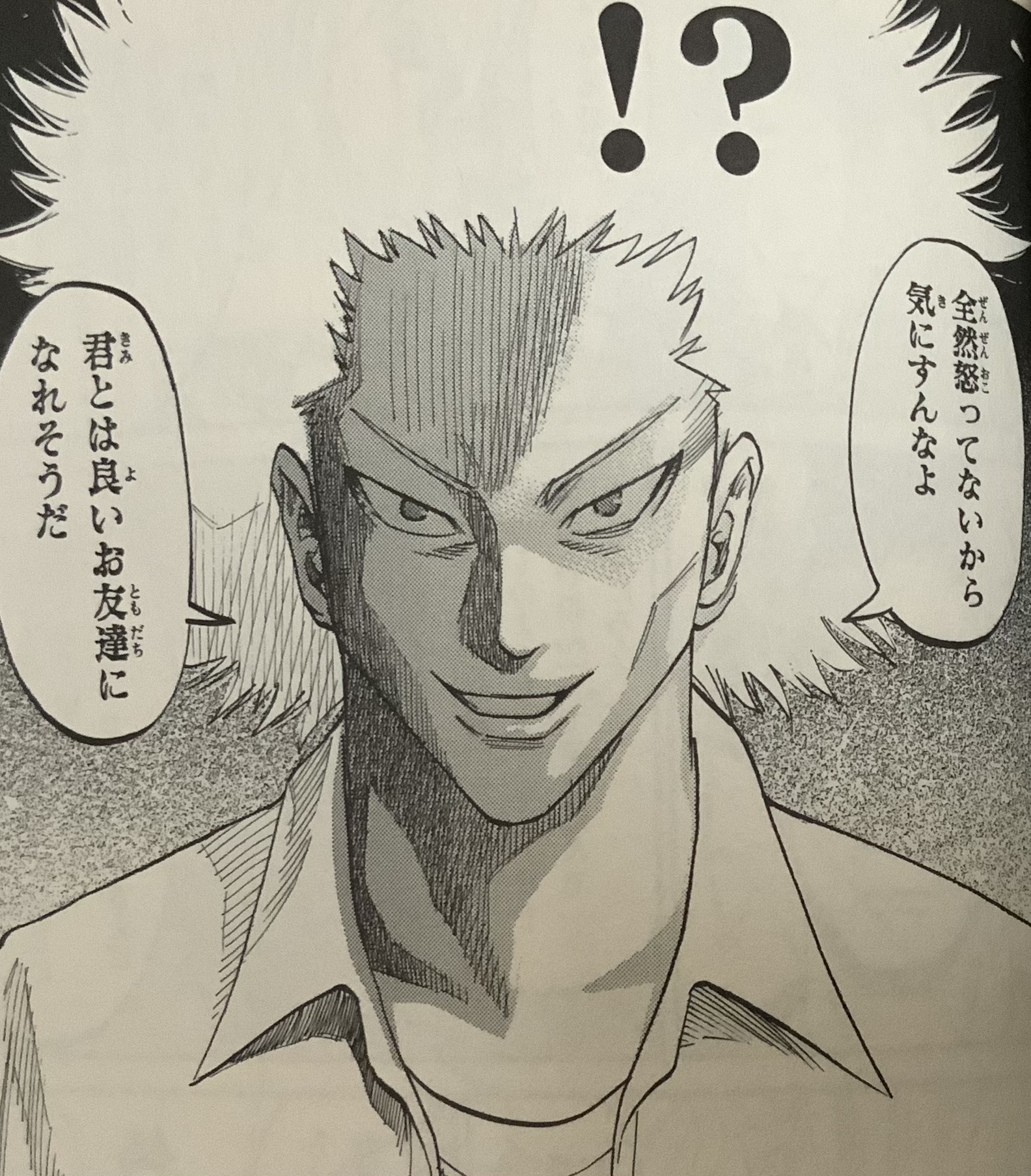
The words are friendly, but the expression and attitude are scary, so people feel "really angry" when they are told this.
According to Meravian's Law, people tend to put more weight on the person's attitude when there is a conflict between the person's words and the person's attitude.
On the other hand, if someone blushes and says, "I don't really like you," they tend to take it favorably because they put priority on their facial expression and attitude.
Functional fixation

It's hard to come up with the idea of using using it as a candle holder "because you can only see the box that contains the pushpin as a" box. "
Functional lock-in means that the original view blocks ideas for other uses.
Confirmation bias
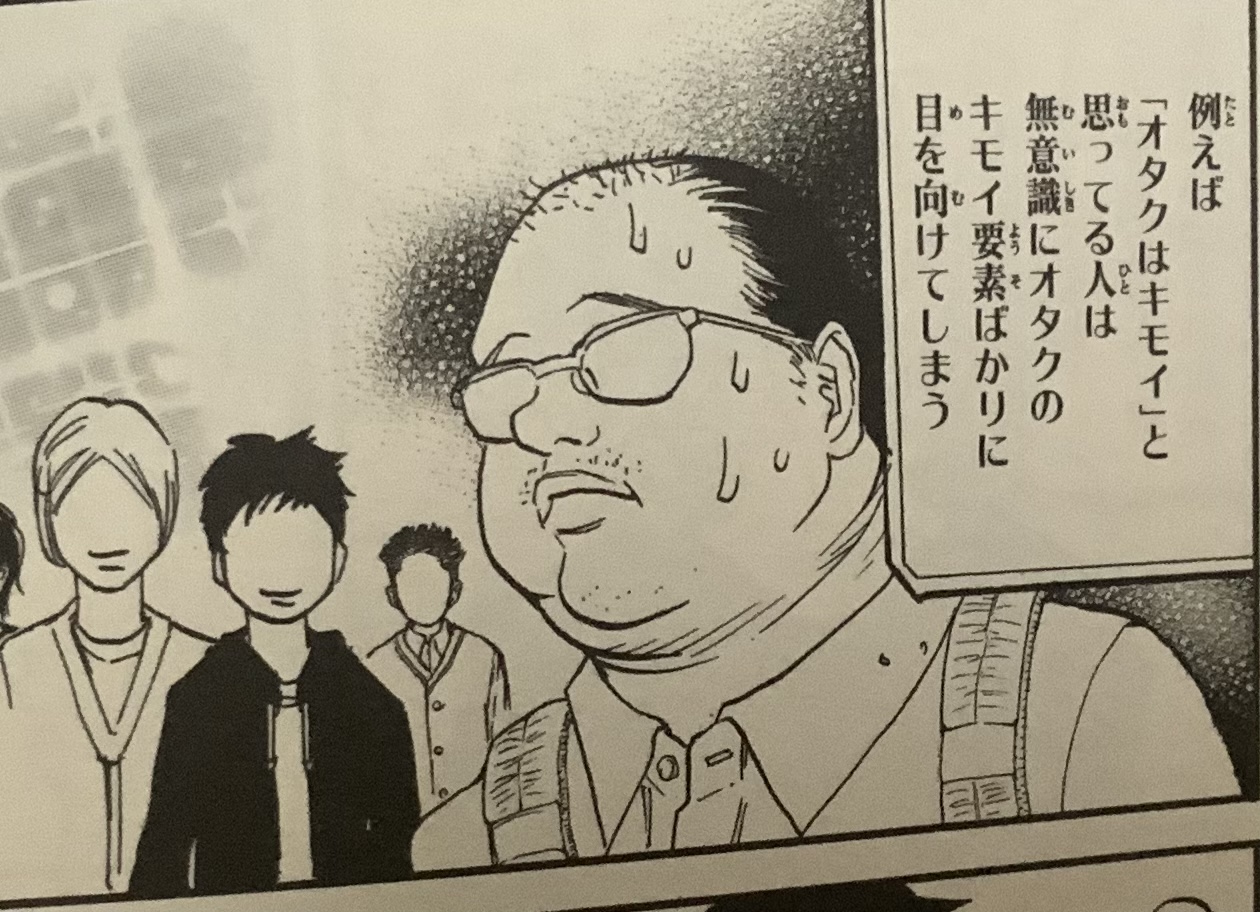
SOME OTAKU ARE CLEAN, BUT THOSE WHO THINK "OTAKU IS GROSS" ARE UNCONSCIOUSLY LOOKING FOR THE CREEPS OF OTAKU.
Confirmation bias refers to the psychological tendency to gather evidence that is favorable to the hypothesis you have identified.
For example, if you suspect that your girlfriend is having an affair, you might assume that even a minor event, such as a locked cell phone or a minor loss of contact, is evidence of an affair.
Positive transition
A positive transition is one in which previous experience leads to success or a clue to the next problem.
For example, a person who studied marketing at a university can use his or her knowledge to achieve good results when he or she takes a sales job. This is also a positive transition.
Self-inconsistency
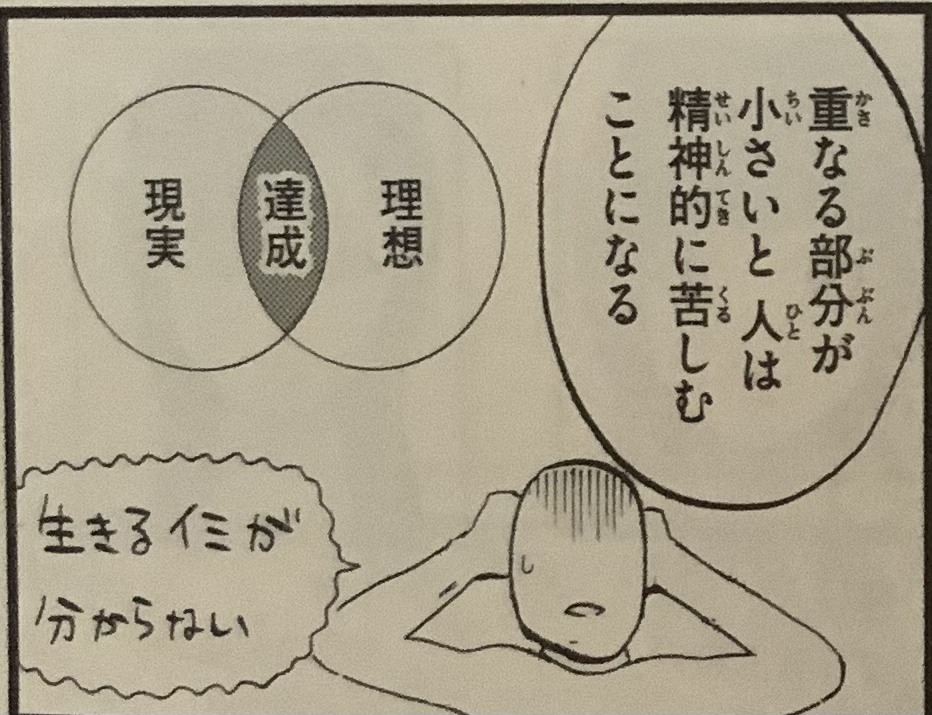
When there is little overlap between ideal and reality, people feel pain.
Self-inconsistency is a situation in which people suffer when the overlap between ideal and reality is small.
Human beings always have an ideal of "I want to be like this" and a real self that has not been achieved. If the ideal and the reality overlap a lot, people feel fulfilled, but if not, they feel stressed.
In this book, Kano of Hutumen, who belongs to a popular group in the class, caused this phenomenon.
He had ideals such as "I want to be popular in my class" and "I want to be respected in the group," but he felt frustrated by the reality that he did not become so.
There are only two ways to resolve this self-discrepancy: make the ideal real or lower the ideal to the level of reality.
Zeigarnik effect
The Zeigarnik effect says that people are more impressed with incomplete than complete things.
For example, if a TV show or cartoon ends with "Now!", it is a phenomenon that bothers us.

Tags
Contents
- Outline of "Psycho Romanchika"
- Outline and story of "Psycho Romanchika"
- Ito Launches "Psychology Research Department"
- Appearance of the fifth member, Senjo
- Love between Ito and Abe
- Characters in "Psycho Romanchika"
- Department of Psychology
- Ito
- Abe
- Ezaki
- Kyoichi 宇堂
- Senjo Naruko
- Friend
- Koi
- Mishima
- Tago
- Other students
- Kano
- Yagami (eight gods)
- 日々野
- Fuwa
- Yui HEYA
- Ikushima (Many Islands)
- Kuho
- Sachiko KAIYAMA
- 於田
- Medaki Fall
- Natsuki
- Faculty
- Soga
- Sakurako SERA
- Other
- Old buyer
- Term for "psycho-manchika"
- Psychology in the story
- Subjective contour
- Hello Effect
- Magical Number 7
- Priming effect
- Labeling Self-Fulfillment Prophecies
- Ash tuning experiment
- Psychodrama
- Space-filling effect
- Meravian's law
- Functional fixation
- Confirmation bias
- Positive transition
- Self-inconsistency
- Zeigarnik effect
- Sensory deprivation experiments
- Bystander effect
- Anchoring effect
- Foot in the Door
- Door in the Face
- Burnham effect
- Color bath effect
- Top-down effect
- Stanford Prison Experiment
- Motivation (dokezuke)
- Principle of small steps
- Cognitive dissonance
- Haider's theory of balance
- Eiko Yoku (Glorious Bath)
- Modeling
- Ringelmann effect
- Self-Disclosure and Refunding
- Psychological reactance
- Facial feedback hypothesis
- Bandwagon effect
- Snob effect
- Veblen effect
- Zinc pyrithione effect
- Status Quo Bias
- Learned helplessness
- Underdog effect
- Self-handy capping
- Pavlov dog (Pavlov dog)
- Sunk cost effect
- Error of basic attribution
- Holding effect
- Simple contact effect
- Reframing effect
- Broken window theory
- School-related
- Research School of Psychology
- Occult Research Club
- Drama Club
- Other
- Golden Bind
- Kichu Trading Card Game
- Words, lines, scenes, and scenes from "Psycho Romanchika"
- Ezaki: "I'll eat lunch with Koi."
- Ito: "Don't despair because you weren't born a lion! If you were born a hyena, fight as a hyena!"
- 宇堂: "I was miserable and frustrated, so I couldn't make a pass honestly. I'm sorry."
- Ito: "If only one person who can think' This person!' can tell me' Cute!' quietly, I can't talk about it in this world without the power to live to a foolish afterlife!"
- Ito: "If only I had once thought that something might have changed at this time. I could have gotten out of the deadlock at that time!"
- ABE: ". I. don't want to disband the psychology research department."
- Secret Stories, Trivia, and Small Stories / Episodes and Anecdotes of "Psycho Romanchika"
- Final episode that was not titled LAST
- Long-Term suspension and sudden termination
- The author's other work, "Airi Um," became a drama with "The Strangest Story."