
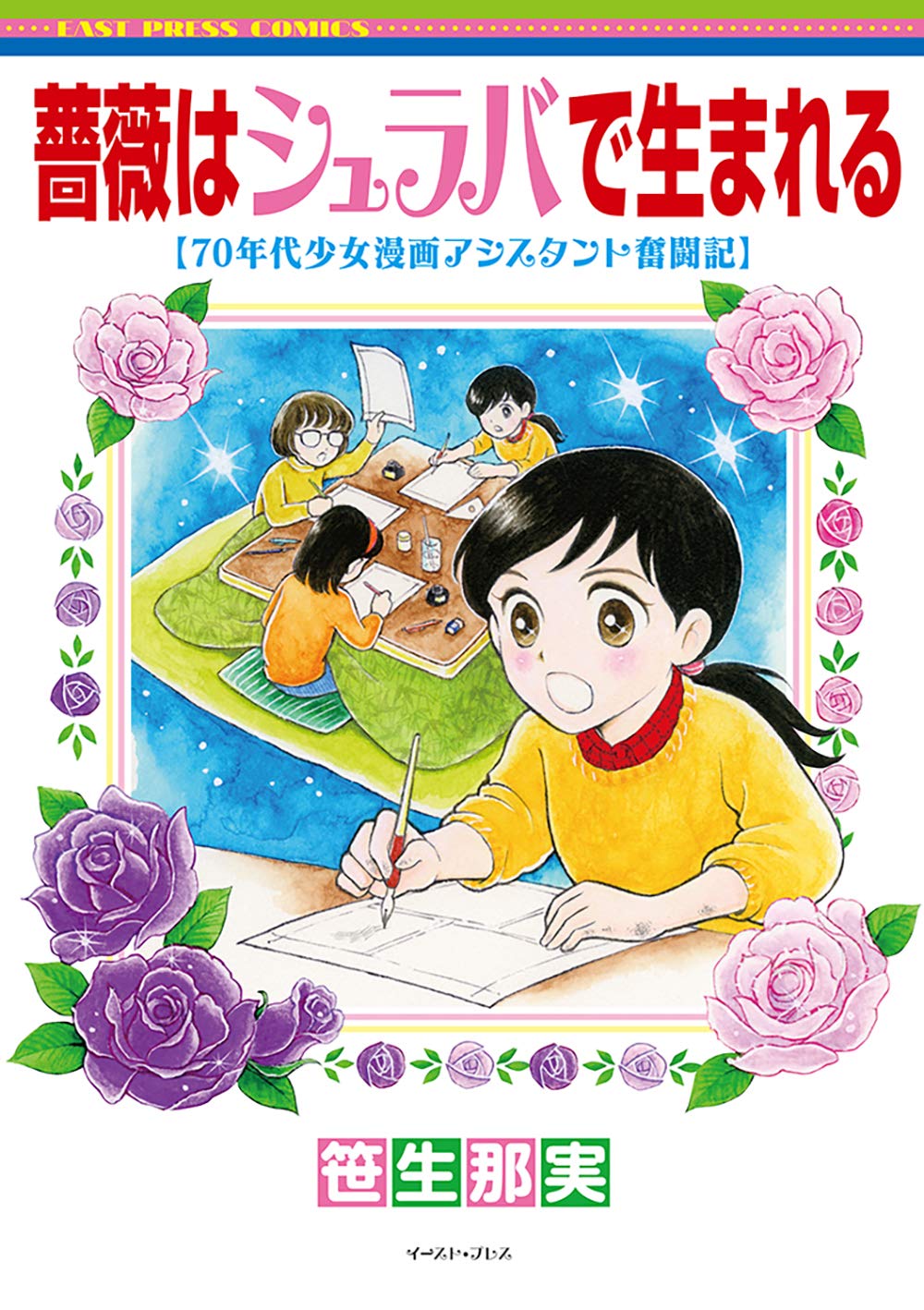
The year 1970 was known as the golden age of shoujo manga, and the author, who worked as an assistant to a manga artist at the time, was associated with many masterpieces. She sent the overall composition to each of the teachers for their approval, and when the names were ready, she checked them again, reread the works of the time, and created manga based on what she remembered. The author continued to see how masterpieces were created in the grueling workplace he called the manga artist's shul. This book is a record of that process.
Outline of "Roses are born in Shulava"
"Roses are born in Shulava" is a comic book published by East Press Co., Ltd. in 2020. It is a record of the time when cartoonist Nami Sasou worked as an assistant for a girl cartoonist in the 70s. The period from the early 1970s to 1980 is said to be the golden age of girls' comics. During this period, many masterpieces such as "Po-no Ichizoku," "Haikara-san ga Toru," "Mari and Shingo," "Kaze to Ki no Uta," "Eroica yori Ai wo Koite," "Versailles-no Bara," and "Wata-no Kuni Hoshi" were published. Among the works staged at Takarazuka were "Po-no Ichizoku," "Versailles-no Bara," "Tenwa Akai Kawa no Hoori," and "Haikara-san ga Toru." "GLASS MASK" was made into a TV drama, and "Versailles-no Bara," also known as the abbreviation for "Belbara," was made into a movie. The characteristics of girls' comics are that the main character is a young girl, the eyes are big and twinkling, eight heads are drawn, and the inner part of the heart is drawn. At that time, the teachers of manga artists who had been serialized in weekly and monthly magazines were busy with work every day, and the assistants who helped them continued their work by sparing time to eat and sleep with the teachers. They managed to make it in time for the magazine to be published. The work site where they worked in such a tense rush was called shulava among the manga artists and assistants. The masterpieces of the time were created from shulava. The author was an assistant who shared the same space with the writer, so he was able to see the moving scene where the masterpiece was created. She recalls that work was not only hard but also because she had such an impressive experience. She calls the time-consuming and harsh work site shulava, but at the same time, it is also said that it is a fragrant rose. The reason why this manga was published as a comic book was that the East Press, which purchased the author's work at the Doujinshi Exhibition, requested it to be published as a book. After that, over two years and nine months, the entire composition, plot, name with the approval of each teacher, and further checked by each teacher, completed the nonfiction work.
The plot and story of "Roses are born in Shulava"
Looking Shulava
Junior high school
When the author was a junior high school student, he went to a place called Kanzume Inn (Kagetsu Inn) where he met Suzue Miuchi. The author sent a fan letter to Suzue Miuchi every month. When she came to visit him, she found out that she was the one who always gave her a fan letter, and Miuchi happily showed her her work from her back. She also sings a song for the tense author. The name of the song is Tantan Tanuki. She also shows a stain of India ink on fusuma. Here at Kanzume Inn, she is described as Shurafa. The author at that time does not know what Shulava is and passes it on.
High school days
When the author became a high school student, he stopped drawing comic books. Bekuma Editor-in-Chief gave him a call and encouraged him to go to Mitsuaki Suzuki's study group, which was attended by Jun Ichikawa, Shinji Wada, Chieko Hara, Mineko Yamada, Tomoko Naka, Hazama Kuni, Takao Yaguchi, Jun Hayase, Shibata Akihiro, Yoshiko Nagaoka, and other prominent members. At the time, they were all very young (19 to 23 years old). The high school students who attended were Asakawa Mayumi, Kazuko Yumeno, Satoru Makimura, Yu Asagiri, and junior high school students like Kuramochi Tomoko and Chie Shinohara. The author, who was inspired by his participation in the meeting, posted his work for the first time in two years. He made his debut with "The Day of Meeting with the Wind."
After Debut
After her debut, she worked as an assistant at Minai-sensei's workplace. Suzue Miuchi was holding "Midori no Homura" (Green Flame) and "Ningyo no Haka" (The Doll's Grave), and the author was suddenly forced to draw the background of the story without any background material and with oral instructions. This was a tough job for a technically inexperienced author. Nevertheless, after a few days of not taking a bath or sleeping on a bed, she managed to finish 100 pages. However, at this time, she made a big mistake that she would continue to regret. Unfortunately, due to her poor skills, she couldn't draw long vertical lines well, so she drew the vertical lines on her face with curved lines. Then, without time to revise, it was published as it was. There was no word from the teacher to scold her. The author wanted to apologize, but unfortunately, she couldn't draw long vertical lines well. In the end, it will be seven years before she can apologize to the teacher. The author became a junior college student and was away from making comic books. At that time, she rushes to her close friend, Fusako Kuramochi, and works as an assistant. She also makes fun of drawing graffiti on the mobs and posters in the manga. Kuramochi-sensei says to her, "Draw score. However, she doesn't even look for a sample score. She replies," There is no Bach score. "She then draws a Chopin score instead of a Bach score and ends the scene. But looking at the drawing on the next page, she realizes that the scene is an image of Bach. The score had to be Bach. She is shocked to realize that she didn't understand Kuramochi-sensei's intention. However, there are still opportunities to assist Kuramochi-sensei in his work, and the author has a positive influence on Kuramochi-sensei. The author creates an opportunity to create one of Kuramochi-sensei's representative works, the" Ranmaru Dan "series.
I work in Shulava.
Scary story
After graduating from junior college, the author became a freelance assistant. Since there was a shortage of assistants at that time, teachers were called to many places, and he went to many places of work. What he found was that manga artists had to tell scary stories to keep themselves awake, and that not everyone liked scary stories. It was very scary for manga magazine editors to see that the writer had gone missing and that the manuscript would not be ready on time. The author noticed an emergency during the work by a phone call from the editor of Hana and Yume asking where Suzue Miuchi was. However, immediately after that, Minai-sensei himself appeared at work in the same way as usual, and he was relieved to know that it was not an emergency like a disappearance. He only overreacted when the editor noticed that the drawing of "GLASS MASK" had not been published in time. Minai-sensei confessed, "There was only one time that Minai-sensei really disappeared." Minai-sensei had a pleasant chat with everyone. Minai-sensei confessed, "There was only one time that Minai-sensei really disappeared." Minai-sensei said, "There was only one time that Minai-sensei really disappeared." Minai-sensei said, "There was only one time that Minai-sensei really disappeared." Minai-sensei said, "There was only one time that Minai-sensei really disappeared." Minai-sensei said, "There was only one time that Minai-sensei really disappeared." Minai-sensei said, "There was only one time that Minai-sensei really disappeared." Minai-sensei said, "There was only one time that Minai-sensei really disappeared." Minai-sensei said, "There was only one time that Minai-sensei really disappeared." Minai-sensei said, "There was only one time that Minai-sensei really disappeared." Minai-sensei said, "There was only one time that Minai-sensei really disappeared." Minai-sensei said, "There was only one time that Minai-sensei really disappeared." Minai-sensei said, "There was only one time that Minai-sensei really disappeared." Minai-sensei said, "There was only one time that Minai-sensei really disappeared." Minai-sensei said, "There was only one time that Minai-sensei really disappeared." Minai-sensei said, "There was only one time that Minai-sensei really disappeared." Minai-sensei said, "There was only one time that Minai-sensei really disappeared. Suzue Miuchi
"Tennin Karakusa"
When I worked as an assistant for Ryoko Yamagishi, I was surprised by what I learned. One of the characteristics of Yamagishi's manga is the square form of fukidashi. In' 77, during "Fantasie," an assistant who was visiting temporarily drew fukidashi using a ruler. The assistants around him were surprised, but Yamagishi did not instruct them to draw it again. This square form of fukidashi took root in Yamagishi's manga. What surprised me was that one time, a teacher at work made a bombshell that he did not want to draw this work. What he was drawing at that time was a work called "Tennin Karakusa", a masterpiece that would shock readers if it overturned the common sense of girls' manga after it was released. The author did not understand why the teacher said at that time that he did not want to draw this work.
Experience of a new cartoonist
In the late' 70s, s, Mr. Mitsuaki Suzuki established the "Mitsuaki Suzuki's Manga Class for Girls." This gave birth to many professional manga writers and assistants. Before this class was established, it was common for a debut manga writer to become an assistant, but after the class was established, people who wanted to become professionals became assistants. However, if an assistant became an assistant for the purpose of becoming a professional, then the assistant would have no time to draw his own works. Even so, everyone overcame this and made their own works. As for the author, he managed to draw up to two or three works, but then he stopped drawing because he couldn't come up with ideas for his own works. At that time, he went to work for Mr. Minori Kimura. What Mr. Kimura was drawing at that time was "40 - 0." This is a very shocking work. Mr. 樹村 talks to the author about the theme of why he was drawing this. And when the author stopped drawing new works, Mr. 樹村 advised, "You are a perfectionist. That's no good. New people can draw immature works. They can even draw failed works. You can learn by having the readers read them." Mr. 樹村 thus talks to new manga writers about the lessons he has learned from his experiences. Unfortunately, as a manga writer, the author could not make use of the advice of Mr. Minori Kimura, but the words he was told will never be forgotten.
The Truth of Shulava
In 1971, Minai and Shinji Wada began to use the word shulava. In 1976 and 1977, other teachers began to use the word shulava. In 1978, the word "shulava" became universally used. In 1979, the LP "Assist Cat" was written by Moto Hagio. The author had worked as an assistant at various teachers, and I believe that Suzue Miuchi's workplace is the most suitable workplace for the name shulava. Introducing the shulava at Suzue Miuchi's workplace, Mitsuaki Suzuki's book "Shoujo Manga Nyumon Shoho to Professionali" (Girls' Manga Basics to Becoming a Professional) contains Minai's words: "A manga artist must be prepared to sit up all night for three days and fast for a month and a day and a half." At Minai's workplace, Minai sleeps on his desk for 15 minutes, eats rice balls with his left hand, and continues to work with his right hand. He continues to work at his desk to meet the deadline, and he doesn't have time to stand up. The assistants' work clothes are dirty and stylish 0. Minai, who couldn't stand it, set up a place to change clothes and sleep when he built a new house. Thanks to this, the assistants who worked exclusively for the teacher after that were very clean. However, the author, who only came on a temporary basis, had the usual dirty work clothes. One time, the author finally had a chance to apologize for the blunder of seven years ago. It was a case where the vertical line on the forehead of the face was distorted. The author said, "I want to apologize after I die." However, the teacher forgave her blunder, saying, "I don't want my life, but I want my right arm." The author was deeply impressed, saying, "Is this kind of right arm OK!" and was able to get rid of the long-held feeling of heaviness through this conversation.
Farewell Schlaba
Since around 1979, he had started working mainly on his own works, so he had stopped working as an assistant. One day, he happened to see an interview with a nostalgic teacher on TV. The interviewers were Minori Kimura and Ryoko Yamagishi. During the interview, the interviewer said, "Mr. Minori Kimura has many works with children as the main characters in his early works." Mr. 樹村 answered, "Even children have various emotions just like adults do. I readers to feel those feelings the same way." While nodding, the author fondly remembers the words that the teacher used to say. In response to the interviewer's question, "Ryoko Yamagishi, what do you like best about your work?", Yamagishi answered, "It's' Tennin Karakusa'. By drawing that work, I have become able to express myself better." The words that came to mind for the author were the famous words from Hesse's book "Demian": "Chicks struggle hard to get out of their eggshells. To break the world and go out." When I heard Mr. Yamagishi mumbling, "I don't want to draw this work," when I was working as an assistant to the teacher, I realized that it was the very moment when the teacher was struggling to go out.
Dr. Suzue Miuchi.
Working as an assistant at Professor Suzue Miuchi's workplace was a lot of work that the author was not good at, such as drawing various backgrounds without materials, but there were also some perks that were unique to working as an assistant. The teacher takes great care of the name and takes time to create it. One time, I got two names, so I was asked to read them and tell them what I thought. This was one of the things I was happy about, not only because I did what I was told, but also because I was able to get involved in the direction of the work. There are also Professor Suzue Miuchi's tweets that I can listen to only because I am an assistant working very close to him.
First, the teacher, who was drawing the cartoon, looked up and said, looking far away, "Maya's hairstyle [in" GLASS MASK "] is the same all the time. So is Mr. Tsukikage's dress. That dress must be hot in summer."
It was something that everyone thought but couldn't say, so the assistants couldn't answer.
Second, when she watched the news of Momoe's marriage on TV, she said, "Momoe Yamaguchi was an inspirational girl. It's a shame she retired."
The inspiration for this is that in "GLASS MASK," Momoe and Tomokazu Miura used the phrase "first love declaration" to describe their "love declaration." Suzue Miuchi was good at scary stories and once told a ghost story to the author, who was taking a nap to get up and get involved in her work. When the author returned to her room, the teacher started the scary story by asking, "Did the ghost of Uchioake appear?" It was a story of the ghost of a girl in a pink dress with her bowl cut. The teacher's story, despite the ghost story, is lively and stimulating to the imagination. The author even thinks that this ghost girl will also show up at the teacher's place because she wants to listen to the teacher's story. The perks of being an assistant are being able to watch in real time the birth of a famous scene near various teachers. I was involved in the creation of the famous scene in the form of writing a manuscript, and I had the passion to create a work together with the teacher and other assistants around me. In particular, the expressive power of Suzue Miuchi's love is extremely wonderful, and the author used the teacher's method of expression as a reference for his manga work.
Epilogue

Tags
Contents
- Outline of "Roses are born in Shulava"
- The plot and story of "Roses are born in Shulava"
- Looking Shulava
- Junior high school
- High school days
- After Debut
- I work in Shulava.
- Scary story
- "Tennin Karakusa"
- Experience of a new cartoonist
- The Truth of Shulava
- Farewell Schlaba
- Dr. Suzue Miuchi.
- Epilogue
- Fictional character from The Rose Is Born in Shulava
- Key person
- Dr. Nami Sasou.
- Dr. Suzue Miuchi.
- Editor in Chief Konagai Betsuma
- Cartoonist teachers
- Jun Chiaki
- Dr. Mitsuaki Suzuki.
- Dr. Jun Ichikawa.
- Dr. Shinji Wada.
- Dr. Chieko Hara.
- Dr. Mineko Yamada.
- Toshie-sensei Kihara
- Kunisensei Hazama
- Dr. Takao Yaguchi.
- Dr. Jun Hayase.
- Dr. Masahiro Shibata.
- Dr. Yoshiko Nagaoka.
- ASAKAWA Mayumi SENSEI
- Dr. Kazuko Yumeno.
- Dr. Satoru Makimura.
- Dr. Yu Asagiri.
- Ms. Tomoko Kuramochi
- Dr. Chie Shinohara.
- Dr. Moto Hagio.
- Dr. Fusako Kuramochi.
- Dr. Jun Mihara.
- Dr. Hiromu Ono.
- Dr. Minori Kimura.
- Ms. Ryoko Yamagishi
- Performing at the House of Books
- Yuuri KONISHI
- East Press representative
- First Editor: Mr. Machida
- Mr. Kobayashi, the second editor
- Assistants who assisted the author
- Dr. Kazuko Yumeno.
- Dr. Mayumi 淡川
- Term for "the rose is born in Shulava"
- Infrastructure and Environment
- Shulava
- Kanzume Ryokan
- Reed
- Manga School Selection
- Mikazuki-e
- Mitsuaki Suzuki's comic book class for girls
- "Shoujo Manga: From Basics to Becoming a Professional" published by Mitsuaki Suzuki
- Hana no 24 Nen
- Dear Doji
- Technical section
- Name
- Background material
- Blonde line
- White
- Eraser
- 3 cloves strong
- Mob
- Fukidashi
- Phototypesetting
- Fall
- Painting
- Cartoon
- Tone
- Carex japonicus
- Stippling
- Beta
- Words, lines, scenes and scenes of "Roses are born in Shulava"
- Dr. Suzue Miuchi. "Do you see that beetle over there?"
- Mr. Suzue Miuchi: "Manga artists have to be prepared to stay up all night for three days, sit down for a month, and fast for a day and a half."
- Dr. Suzue Miuchi, "Wake me up in 15 minutes."
- THE AUTHOR, Nami Sasou SENSEI: "WELL, THEN, WHY DO N'T YOU JOIN THE Ranmaru SQUAD?"
- Dr. Jun Mihara, "Let's try."
- Dr. Minori Kimura: "I won't lose anything like that."
- Minori Kimura: "It's better not to be perfectionist. New people who have just debuted can learn by drawing immature works and having readers read them."
- MS. RYōKO YAMAGISHI: "I DO N'T WANT TO PAINT"
- Psychic: "You draw works as a memorial for the people of the past."
- Author Nami Sasou: "I want to apologize for my death"
- Behind the Scenes, Trivia, Small Stories / Episodes / Anecdotes of "Roses are born in Shulava"
- This is the sequel to Nami Sasou's "Roses are born in Shulava."
- Beshima Manga School held
- Suzue Miuchi Sensei! Tantan-tanuki
- Miss Fusako Kuramochi, happy Christmas.
- Moto Hagio Etranze