
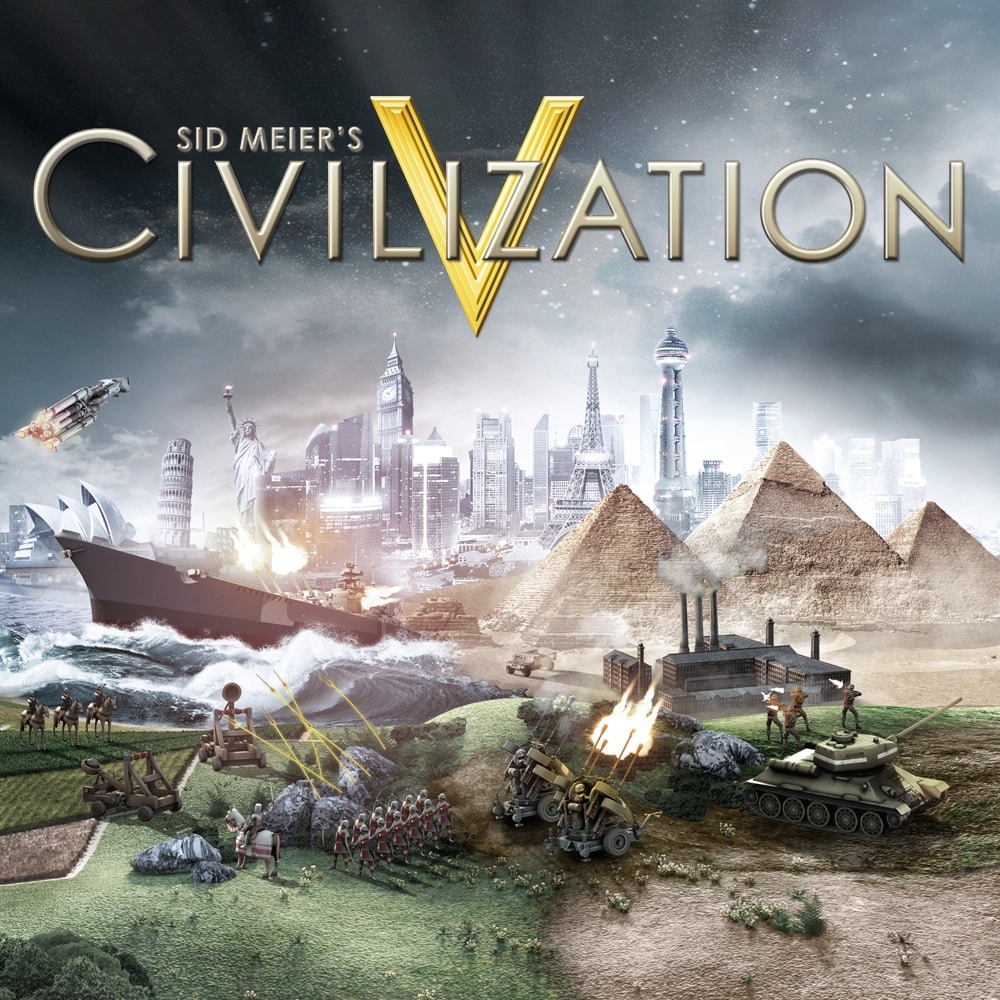
Sid Meier's Civilization V (Civ5) is the fifth title in the Civilization series, a turn-based simulation game inspired by civilization.
Players take on the role of the leader of a civilization and conduct internal affairs, diplomacy, and sometimes war in order to make their own civilization prosper.
The previous games in the series were difficult to play for beginners due to the difficulty of the system, but the system has been simplified in this title, making it relatively easy for beginners to play.
Diplomacy with other civilizations
In this game, you can conduct diplomacy with civilizations other than your own.
transactions
It is possible to exchange resources and money that one's own civilization has for those of other civilizations.
If used well, it is possible to obtain resources that exist only on distant continents.
Declaration of Friendship
Civilizations form alliances with each other.
When a declaration of friendship is concluded, there are advantages such as not being attacked by that country.
However, since the Declaration of Friendship can be easily broken, be aware that you may be attacked at once as a result of a unilateral breaking of the Declaration of Friendship.
statement of condemnation
Makes a statement condemning another civilization.
It will worsen relations with the civilization it condemns and with civilizations that have friendly relations with that civilization.
It also makes it easier to get along with a civilization that hates that civilization by taking a condemnatory stance toward it.
Most often, statements are made en masse against barbaric civilizations that are repeatedly at war with each other.
declaration of war
Declares war on another civilization.
The civilization that declares war is at war with the civilization that declared war.
It is also possible to ask a friendly civilization to fight an obstructing civilization instead, in which case it becomes a "request for war.
research agreement
An agreement that can be made with a civilization that has signed a Declaration of Friendship.
Both civilizations pay the same amount of money to boost their civilization's research capabilities after a certain number of turns.
This technique is more important the higher the difficulty level, as it advances technological research all at once.
city-state
City-states scattered throughout the country.
They have only one city, and they exist in a small territory.
Friendship is increased by sending money and fulfilling requests from city-states, and when the friendship level is high enough, city-states will offer units and resources.
You can also attack a city-state and destroy it, but be aware that other civilizations will issue a statement of condemnation if you do so.
City States of Culture
City-states that increase their friendship and become allies, bringing additional cultural power to their own civilization each turn.
military city-state
A city-state that produces military units and donates them to its own civilization every certain number of turns as it raises its friendship level and becomes an ally.
maritime city-state
A city-state that brings additional food each turn to its own civilization as it increases its friendship level and becomes an ally.
savage tribe
Barbarians who repeatedly plunder in various places.
They set up encampments at a short distance from each civilization and use them as a base from which to attack cities.
The barbarians can be attacked by military units of their own civilization, but if the encampments are not destroyed, the barbarians will spring up indefinitely.
condition of victory
There are "victory conditions" in this game, and the civilization that meets these conditions wins.

Contents
- Overview of Sid Meier's Civilization V
- Synopsis and story of Sid Meier's Civilization V
- The fateful year of the Vikings
- Rise of Mongolia
- Invasion of the New World
- Samurai Invasion of Korea
- Ancient Heritage
- Uncivilized Paradise
- Game System of "Sid Meier's Civilization V
- initial setup
- Civilization & Leadership
- map type
- Map Size
- Difficulty Level
- Game Speed
- terrain
- grasslands
- plain
- desert
- tundra
- poor volcanic soil
- hill
- mountains
- lake
- coastal waters
- open sea
- oasis
- jungle
- rivers
- atoll
- atomic dust
- wetlands
- forest
- flood plain
- glacier
- natural heritage
- Resource Utilization Facilities
- resources
- strategic resources
- Bonus Resources
- high level resources
- unit
- close combat unit
- Remote Attack Unit
- Aviation Unit
- Civic Unit
- Leveling up units
- city
- Urban Growth
- Urban Production
- Urban Territory
- World Heritage (cultural, natural, etc.)
- structure
- Technical Research
- ancient times
- classic
- Middle Ages
- Renaissance period
- Industrial Age
- modern times
- atomic age
- information age
- social system
- Tradition
- Liberty
- Honor
- Piety
- Cultural Patronage
- Aesthetics
- Commerce
- Exploration
- Rationalism
- Diplomacy with other civilizations
- transactions
- Declaration of Friendship
- statement of condemnation
- declaration of war
- research agreement
- city-state
- City States of Culture
- military city-state
- maritime city-state
- savage tribe
- condition of victory
- diplomatic victory
- scientific triumph
- conquest
- cultural victory
- time warp
- Characters and characters in Sid Meier's Civilization V
- Montezuma (Aztec)
- Washington, U.S.A.
- Haroon Allasheed (Arabia)
- Elizabeth, United Kingdom
- Hiawatha (Iroquois)
- Gandhi, India
- Ramses II (Egypt)
- Suleiman (Ottoman Turkey)
- Alexandros, Greece
- Ramkhamhaeng (Siam)
- Askia (Songai)
- Wu Li Tian (China)
- Bismarck, Germany
- Nobunaga Oda (Japan)
- Napoleon (France)
- Darius I (Persia)
- Augustus (Rome)
- Ekaterina, Russia
- Terms for Sid Meier's Civilization V
- OCC
- OX
- UA
- UB
- UI
- UU
- DLC for Sid Meier's Civilization V
- Civilizations to be added by DLC
- Pachacuti (Inca)
- Isabella, Spain
- King Sejong (Korea)
- Harar, Denmark
- Nebuchadnezzar II (Babylonia)
- Kamehameha (Polynesia)
- Genghis Khan (Mongolia)
- Maps to be added by DLC
- Gods and Kings, the first expansion pack for Sid Meier's Civilization V
- additional scenario
- To the Renaissance Era
- The Fall of Rome
- Empire under cloudy skies
- Additional elements/religion
- religious power
- pantheonism
- creation of religion
- Testimony of Faith
- religious pressure
- Additional elements and spies
- Establishment of Embassy
- New City-States
- religious city-state
- commercial city-state
- New Civilizations and Leaders
- Haile Selassie (Ethiopia)
- Maria Theresa (Austria)
- William, The Netherlands
- Dido (Carthage)
- Boudica (Celtic)
- Gustaf Adolf, Sweden
- Theodora (Byzantine)
- Attila (Hun)
- Pakal (Mayan Empire)
- Brave New World, the second expansion pack for Sid Meier's Civilization V
- additional scenario
- African Struggle for Africa
- (US) Civil War
- Additional elements and sightseeing
- Additional elements and masterpieces
- archeology
- Additional elements/ideas
- freedom
- order
- dictatorship
- Additional Elements, World Congress
- Additional civilizations and leaders
- Ashur Banipal (Assyria)
- Gadjah Mada, Indonesia
- Enrico Dandolo (Venice)
- Pocatello (Shoshone people)
- Shaka (Zulu)
- Pedro II (Brazil)
- Kazimierz III (Poland)
- Maria I (Portugal)
- Ahmad Al-Mansour (Morocco)
- Backstories, trivia, and small stories/episodes and anecdotes about "Sid Meier's Civilization V".
- Can abduct city-state workers.