
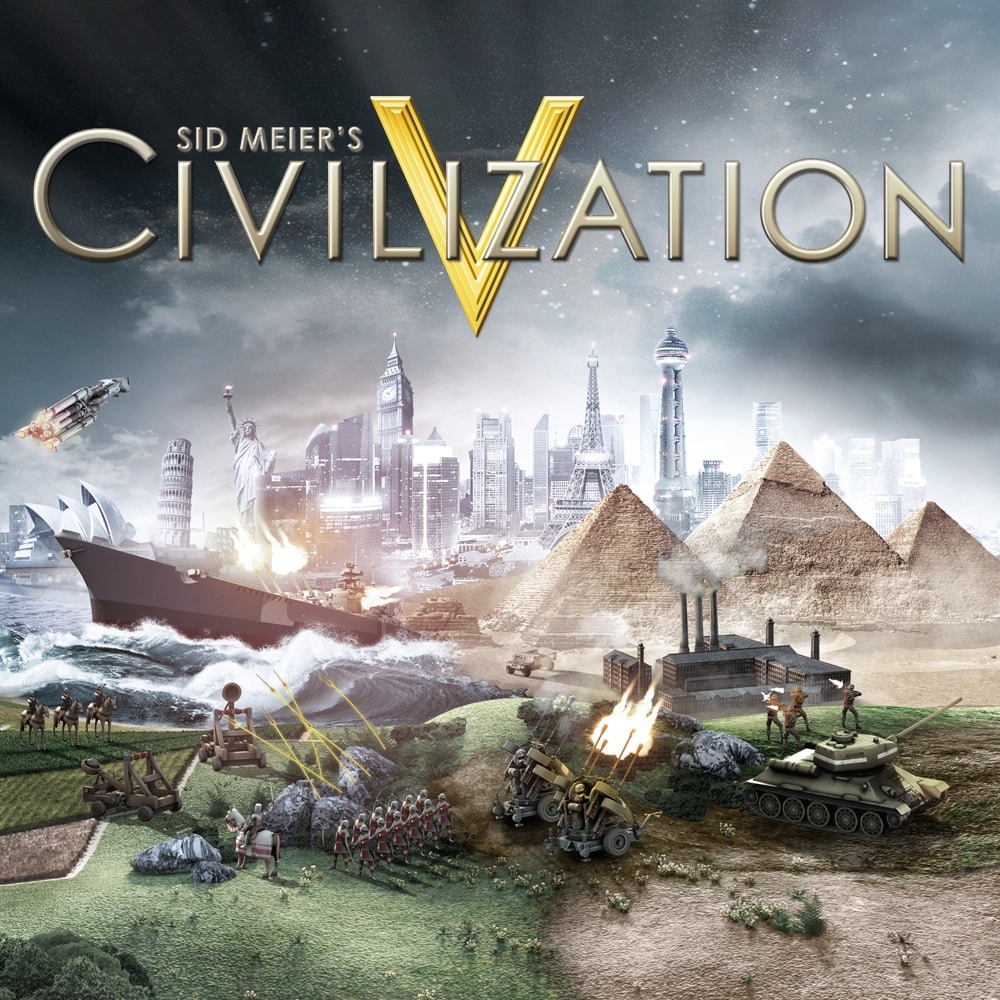
Sid Meier's Civilization V (Civ5) is the fifth title in the Civilization series, a turn-based simulation game inspired by civilization.
Players take on the role of the leader of a civilization and conduct internal affairs, diplomacy, and sometimes war in order to make their own civilization prosper.
The previous games in the series were difficult to play for beginners due to the difficulty of the system, but the system has been simplified in this title, making it relatively easy for beginners to play.
atomic age
The Next Modern Era.
The technologies of the Nuclear Age are Atomic Theory, Allied Forces, Penicillin, Radar, Computers, Ecology, Fission Reaction, and Rocketry.
information age
The Next Era after the Nuclear Age.
The technologies of the Information Age are "advanced ballistics," "lasers," "maneuver tactics," "robotics," "satellites," "long-distance communications," "globalization," "Internet," "nanotechnology," "fusion reactions," "particle physics," "stealth" and "future technologies.
social system
Once a certain amount of cultural power is accumulated, a "social system" can be adopted.
The social system is like a law for the entire civilization, and each city gains an internal administration bonus for adopting it.
There are nine social systems: Tradition, Liberation, Honor, Respect, Patronage, Aesthetics, Commerce, Exploration, and Rationalism.
Of these, Tradition, Liberation, Honor, and Respect and Abuse can be adopted since time immemorial, Cultural Patronage and Aesthetics since the Classics, Commerce since the Middle Ages, and Rationalism since the Renaissance.
Tradition
A social system useful for still smaller civilizations.
Adoption increases the rate of territorial expansion of all cities and allows "hanging gardens" to be built in the cities of their own civilization.
Liberty
This social system is useful for rapid territorial expansion.
Adoption adds cultural power to all cities and allows the construction of "pyramids" in the cities of one's own civilization.
Honor
A social system that strengthens the military of your own civilization.
Adoption of this system will allow you to deal 33% additional damage when fighting barbarians and to construct "Zeus statues" in the cities of your own civilization.
Piety
A social institution that increases the religious power of a civilization.
Adoption allows the construction of city structures "temples" and "temples" in half a turn, and allows the construction of "mud mosques" in the cities of one's own civilization.
Cultural Patronage
A social system that increases profits from trade with city-states.
Adoption of this system will reduce the decrease in friendship with city-states, and will also allow the construction of the Forbidden City in the cities of your own civilization.
Aesthetics
A social system that enhances the cultural power produced by a civilization.
Adoption of this system will enable the acquisition of many great writers, artists, and musicians, and the construction of the "Uffizi Gallery" in the cities of one's own civilization.
Commerce
A social system that allows people to acquire more money.
Adoption of this system will increase the money generated by the capital of your own civilization by 25% and will allow you to build "Big Ben" in the cities of your own civilization.
Exploration
This social system is useful when you want to expand your territory across the sea.
Adoption increases the mobility of naval units and allows the construction of a "Louvre" in the cities of one's own civilization.
Rationalism
A social system that increases the scientific power of a civilization.
Adoption increases the scientific power of one's own civilization by 10% and allows the construction of "Nanjing Pottery Tower" in the cities of one's own civilization.

Contents
- Overview of Sid Meier's Civilization V
- Synopsis and story of Sid Meier's Civilization V
- The fateful year of the Vikings
- Rise of Mongolia
- Invasion of the New World
- Samurai Invasion of Korea
- Ancient Heritage
- Uncivilized Paradise
- Game System of "Sid Meier's Civilization V
- initial setup
- Civilization & Leadership
- map type
- Map Size
- Difficulty Level
- Game Speed
- terrain
- grasslands
- plain
- desert
- tundra
- poor volcanic soil
- hill
- mountains
- lake
- coastal waters
- open sea
- oasis
- jungle
- rivers
- atoll
- atomic dust
- wetlands
- forest
- flood plain
- glacier
- natural heritage
- Resource Utilization Facilities
- resources
- strategic resources
- Bonus Resources
- high level resources
- unit
- close combat unit
- Remote Attack Unit
- Aviation Unit
- Civic Unit
- Leveling up units
- city
- Urban Growth
- Urban Production
- Urban Territory
- World Heritage (cultural, natural, etc.)
- structure
- Technical Research
- ancient times
- classic
- Middle Ages
- Renaissance period
- Industrial Age
- modern times
- atomic age
- information age
- social system
- Tradition
- Liberty
- Honor
- Piety
- Cultural Patronage
- Aesthetics
- Commerce
- Exploration
- Rationalism
- Diplomacy with other civilizations
- transactions
- Declaration of Friendship
- statement of condemnation
- declaration of war
- research agreement
- city-state
- City States of Culture
- military city-state
- maritime city-state
- savage tribe
- condition of victory
- diplomatic victory
- scientific triumph
- conquest
- cultural victory
- time warp
- Characters and characters in Sid Meier's Civilization V
- Montezuma (Aztec)
- Washington, U.S.A.
- Haroon Allasheed (Arabia)
- Elizabeth, United Kingdom
- Hiawatha (Iroquois)
- Gandhi, India
- Ramses II (Egypt)
- Suleiman (Ottoman Turkey)
- Alexandros, Greece
- Ramkhamhaeng (Siam)
- Askia (Songai)
- Wu Li Tian (China)
- Bismarck, Germany
- Nobunaga Oda (Japan)
- Napoleon (France)
- Darius I (Persia)
- Augustus (Rome)
- Ekaterina, Russia
- Terms for Sid Meier's Civilization V
- OCC
- OX
- UA
- UB
- UI
- UU
- DLC for Sid Meier's Civilization V
- Civilizations to be added by DLC
- Pachacuti (Inca)
- Isabella, Spain
- King Sejong (Korea)
- Harar, Denmark
- Nebuchadnezzar II (Babylonia)
- Kamehameha (Polynesia)
- Genghis Khan (Mongolia)
- Maps to be added by DLC
- Gods and Kings, the first expansion pack for Sid Meier's Civilization V
- additional scenario
- To the Renaissance Era
- The Fall of Rome
- Empire under cloudy skies
- Additional elements/religion
- religious power
- pantheonism
- creation of religion
- Testimony of Faith
- religious pressure
- Additional elements and spies
- Establishment of Embassy
- New City-States
- religious city-state
- commercial city-state
- New Civilizations and Leaders
- Haile Selassie (Ethiopia)
- Maria Theresa (Austria)
- William, The Netherlands
- Dido (Carthage)
- Boudica (Celtic)
- Gustaf Adolf, Sweden
- Theodora (Byzantine)
- Attila (Hun)
- Pakal (Mayan Empire)
- Brave New World, the second expansion pack for Sid Meier's Civilization V
- additional scenario
- African Struggle for Africa
- (US) Civil War
- Additional elements and sightseeing
- Additional elements and masterpieces
- archeology
- Additional elements/ideas
- freedom
- order
- dictatorship
- Additional Elements, World Congress
- Additional civilizations and leaders
- Ashur Banipal (Assyria)
- Gadjah Mada, Indonesia
- Enrico Dandolo (Venice)
- Pocatello (Shoshone people)
- Shaka (Zulu)
- Pedro II (Brazil)
- Kazimierz III (Poland)
- Maria I (Portugal)
- Ahmad Al-Mansour (Morocco)
- Backstories, trivia, and small stories/episodes and anecdotes about "Sid Meier's Civilization V".
- Can abduct city-state workers.