
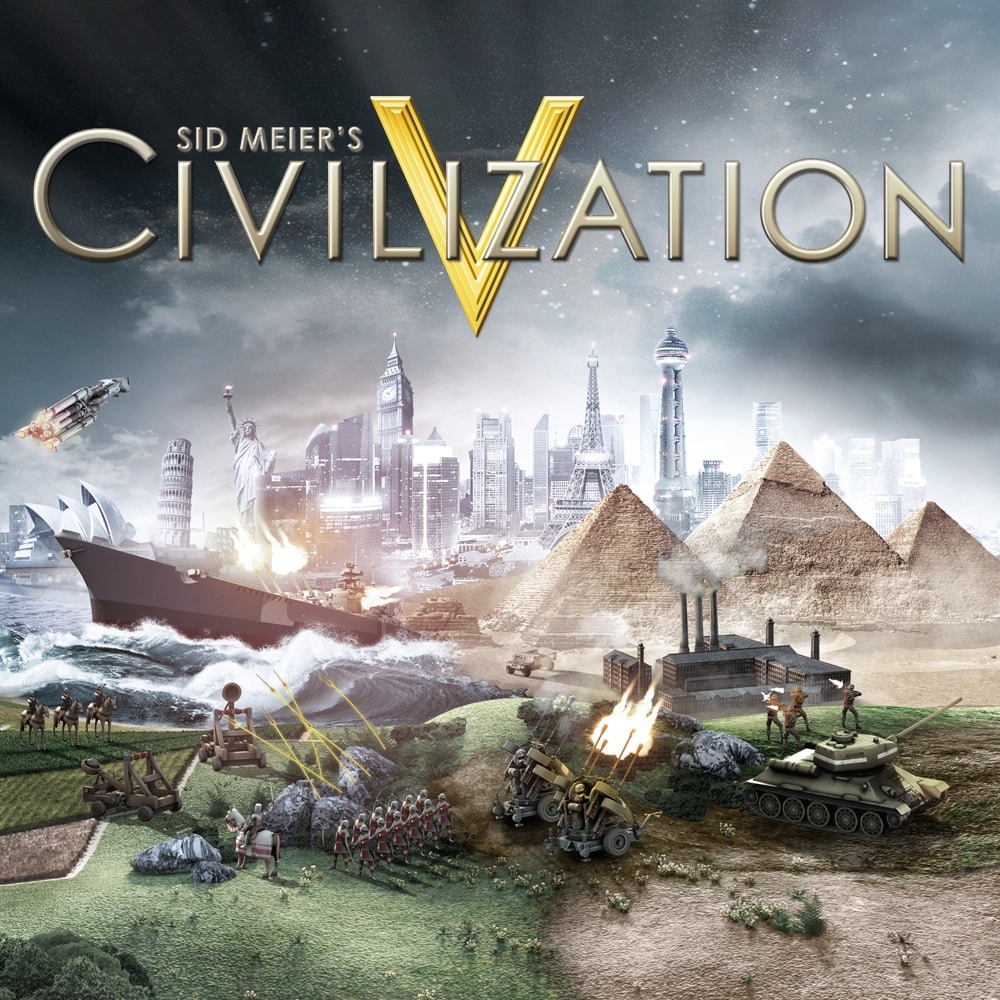
Sid Meier's Civilization V (Civ5) is the fifth title in the Civilization series, a turn-based simulation game inspired by civilization.
Players take on the role of the leader of a civilization and conduct internal affairs, diplomacy, and sometimes war in order to make their own civilization prosper.
The previous games in the series were difficult to play for beginners due to the difficulty of the system, but the system has been simplified in this title, making it relatively easy for beginners to play.
Urban Growth
When a city has enough food, its population grows.
As the population grows, the size of the city expands, allowing the city to utilize more of the resources around it.
In addition to food, "well-being" is necessary to increase the population.
The level of happiness can be increased by securing "happiness resources" within the city area or by constructing buildings in the city that increase the level of happiness.
Without sufficient happiness, the population will not grow even if there is plenty of food.
Urban Production
Cities have a "productive capacity," and the higher this capacity, the shorter the time it takes to build structures and create units in the city.
Buildings that can be erected in a city have various effects, such as increasing food, increasing productivity, and increasing happiness.
Urban Territory
A city's territory expands as it accumulates a certain number of cultural power.
Cultural power can be increased by building structures that increase cultural power in a city or by consuming "great man units".
World Heritage (cultural, natural, etc.)
World Heritage Sites can be built in cities.
Most World Heritage sites provide powerful benefits to cities, so if you can build them, you can advance the game.
However, there can only be one World Heritage Site in the world, so you will be competing with other civilizations.
If there is a World Heritage Site that you are targeting, you need to start building it as soon as possible.
structure
They can be built in cities.
Building a structure uses the city's productivity and takes several turns to complete.
The higher the productivity of the city, the shorter the number of turns it takes to complete.
The construction of a structure provides a city with various internal administrative bonuses.
At the beginning of the game, there are only a few buildings that can be built, but the number of buildings that can be built will increase as the player researches technology.
Technical Research
From the moment you establish your first city, you will need to continually "research technology".
By researching and acquiring technology, you will be able to produce new buildings and units, and discover new resources.
This is a very important element, and the war situation depends on how quickly you can acquire the technology you want before other civilizations do.
To acquire technology, you need research power. Research power comes from cities, and the more cities you have, the more research power you have.
The research power of a city can also be increased by utilizing its resources and buildings.
Each technology has its own era, and acquiring the technology of a new era plunges the civilization into a new era.
ancient times
The Most Ancient Period.
Ancient technologies include "agriculture," "animal husbandry," "archery," "mining," "pottery," "bronzes," "calendars," "masonry," "sailing," "wheels," "traps," and "writing.
classic
The next period of prehistoric times.
The classical technologies are Optics, Architecture, Riding, Mathematics, Currency, Drama and Poetry, Engineering, Philosophy, and Ironware.
Middle Ages
The next period after the Classics.
Medieval technologies are "officials," "guilds," "foundry," "theology," "compass," "chivalry," "education," "machinery," "physics," and "iron and steel."
Renaissance period
The period following the Middle Ages.
The technologies of the Renaissance period were acoustics, astronomy, banking system, gunpowder, letterpress, gunpowder, architecture, chemistry, economics, metallurgy, and navigation.
Industrial Age
The next period after the Renaissance Era.
The technologies of the Industrial Age are Archaeology, Fertilizer, Industrialization, Military Science, Life Rings, Scientific Theory, Biology, Dynamite, Electricity, and the Steam Engine.
modern times
The next era of the Industrial Age.
Modern technologies include: airplanes, wireless communications, railroads, refrigeration technology, common standards, ballistic missiles, internal combustion engines, electronics, and plastics.

Contents
- Overview of Sid Meier's Civilization V
- Synopsis and story of Sid Meier's Civilization V
- The fateful year of the Vikings
- Rise of Mongolia
- Invasion of the New World
- Samurai Invasion of Korea
- Ancient Heritage
- Uncivilized Paradise
- Game System of "Sid Meier's Civilization V
- initial setup
- Civilization & Leadership
- map type
- Map Size
- Difficulty Level
- Game Speed
- terrain
- grasslands
- plain
- desert
- tundra
- poor volcanic soil
- hill
- mountains
- lake
- coastal waters
- open sea
- oasis
- jungle
- rivers
- atoll
- atomic dust
- wetlands
- forest
- flood plain
- glacier
- natural heritage
- Resource Utilization Facilities
- resources
- strategic resources
- Bonus Resources
- high level resources
- unit
- close combat unit
- Remote Attack Unit
- Aviation Unit
- Civic Unit
- Leveling up units
- city
- Urban Growth
- Urban Production
- Urban Territory
- World Heritage (cultural, natural, etc.)
- structure
- Technical Research
- ancient times
- classic
- Middle Ages
- Renaissance period
- Industrial Age
- modern times
- atomic age
- information age
- social system
- Tradition
- Liberty
- Honor
- Piety
- Cultural Patronage
- Aesthetics
- Commerce
- Exploration
- Rationalism
- Diplomacy with other civilizations
- transactions
- Declaration of Friendship
- statement of condemnation
- declaration of war
- research agreement
- city-state
- City States of Culture
- military city-state
- maritime city-state
- savage tribe
- condition of victory
- diplomatic victory
- scientific triumph
- conquest
- cultural victory
- time warp
- Characters and characters in Sid Meier's Civilization V
- Montezuma (Aztec)
- Washington, U.S.A.
- Haroon Allasheed (Arabia)
- Elizabeth, United Kingdom
- Hiawatha (Iroquois)
- Gandhi, India
- Ramses II (Egypt)
- Suleiman (Ottoman Turkey)
- Alexandros, Greece
- Ramkhamhaeng (Siam)
- Askia (Songai)
- Wu Li Tian (China)
- Bismarck, Germany
- Nobunaga Oda (Japan)
- Napoleon (France)
- Darius I (Persia)
- Augustus (Rome)
- Ekaterina, Russia
- Terms for Sid Meier's Civilization V
- OCC
- OX
- UA
- UB
- UI
- UU
- DLC for Sid Meier's Civilization V
- Civilizations to be added by DLC
- Pachacuti (Inca)
- Isabella, Spain
- King Sejong (Korea)
- Harar, Denmark
- Nebuchadnezzar II (Babylonia)
- Kamehameha (Polynesia)
- Genghis Khan (Mongolia)
- Maps to be added by DLC
- Gods and Kings, the first expansion pack for Sid Meier's Civilization V
- additional scenario
- To the Renaissance Era
- The Fall of Rome
- Empire under cloudy skies
- Additional elements/religion
- religious power
- pantheonism
- creation of religion
- Testimony of Faith
- religious pressure
- Additional elements and spies
- Establishment of Embassy
- New City-States
- religious city-state
- commercial city-state
- New Civilizations and Leaders
- Haile Selassie (Ethiopia)
- Maria Theresa (Austria)
- William, The Netherlands
- Dido (Carthage)
- Boudica (Celtic)
- Gustaf Adolf, Sweden
- Theodora (Byzantine)
- Attila (Hun)
- Pakal (Mayan Empire)
- Brave New World, the second expansion pack for Sid Meier's Civilization V
- additional scenario
- African Struggle for Africa
- (US) Civil War
- Additional elements and sightseeing
- Additional elements and masterpieces
- archeology
- Additional elements/ideas
- freedom
- order
- dictatorship
- Additional Elements, World Congress
- Additional civilizations and leaders
- Ashur Banipal (Assyria)
- Gadjah Mada, Indonesia
- Enrico Dandolo (Venice)
- Pocatello (Shoshone people)
- Shaka (Zulu)
- Pedro II (Brazil)
- Kazimierz III (Poland)
- Maria I (Portugal)
- Ahmad Al-Mansour (Morocco)
- Backstories, trivia, and small stories/episodes and anecdotes about "Sid Meier's Civilization V".
- Can abduct city-state workers.