

One of the "Super Robot Wars" series, a crossover simulation RPG based on Super Robot anime works.
It is called this way because it is produced for portable game consoles sold by Nintendo.
Aiming to be a "Super Robot Taisen" series for young people, many new and unusual works have been entered in the series.
The series started with "Super Robot Taisen A" released in 2001, and as of January 2018, nine titles have been released.
Mobile Suit Gundam SEED" is the first Gundam of the 21st century and has gained tremendous popularity. One of the important characters is Miguel Ayman. He was the first in command of the Strike Gundam, which was piloted by the main character Kira Yamato, and although he became a warrior after only two episodes, he gained popularity by playing the main role in a drama CD.
The exception to most of these was the Nintendo handheld series. In J, in which Mobile Suit Gundam SEED was introduced, he repeatedly appears in front of the player as an enemy mid-boss, and in W, he helps the player's unit depending on the conditions.
Another character in a similar situation to Miguel Ayman is Heine Westenfurth from "Mobile Suit Gundam Seed Destiny. He appeared in the middle of the story as a companion of the main character, Aslan Zara, and his friends, and fought in multiple battles and met a spectacular end, but he fades out without fighting in the Super Robot Wars series.
He, too, was active in the Nintendo handheld series; in K, a survival flag exists, and he is depicted as looking down on the war situation obliquely, and he joins his army through persuasion; in L, he appears as an ally from the beginning, with no death events and a lot of appearances, much to the delight of fans of the series and the character.
The appearance and survival of these two characters is closely related to the unique circumstances of the Nintendo handheld series. Both characters are voiced by T.M. Revolution's Takanori Nishikawa. Although formally a guest appearance by the artist who sang the theme songs for both games, Nishikawa has gained considerable popularity and is himself a fan of the anime and its works, so the characters themselves have been carefully nurtured and have become an integral part of the series.
Nishikawa has been willing to appear in games in which the "Gundam Seed" series has been featured alone, but as a successful artist who is not a voice actor, scheduling and guarantee issues have arisen, and as of January 2018 he has only appeared in one other game, for which he sang the theme song.
Naturally, the Super Robot Wars series was not able to record Nishikawa's voice because of this, and these two characters were not able to play an active role in the series except for the Nintendo handheld series, which did not include battle voices.
Since the Nintendo handheld series had voices, both characters have not had a chance to appear in the series since it has been aired, and only after the story has ended.
Even though we are aware of the circumstances, fans still want to see them in action. Many players are eagerly awaiting the appearance of these characters and the opportunity to see them in action.
Wings of Destiny
From Super Robot Wars UX.
Festum, mankind's natural enemy, can "read" the thoughts of intelligent beings and cause "assimilation phenomena" with the objects it comes into contact with. As one of the countermeasures against them, mobile suits, humanoid mobile weapons, were created. However, the war that broke out shortly afterwards resulted in the mobile suits being used as conventional weapons.
Shin Asuka, an ace pilot who lost his family in the war, challenges a battle against Festum on Ryugu Island with his beloved Destiny Gundam, but is defeated. While his badly damaged Destiny Gundam is repaired, he boards the old Impulse Gundam and joins the Ultimate Cross, a player squad to fight against a new threat to humanity. The pilot of the Fafner, a weapon specialized for countering Festum, Ikki Makabe, respected Shin as a senior member of the team.
While Ultimate Cross is up in space, the human forces take over Ryugu Island, targeting their absence. The goal of the Humanity Army, which was regarded as a radical faction within the Earth Army, was to seize Fafner.
Shin admonishes Ikki, who is anxious to take back his hometown, Ryugujima, to think about how they can save the island together. If they were to attack the island, it would give the human forces an excuse to attack Ikki's family and friends.
Festum attacks Ryugujima. Most of the human army's weapons were unable to stand up against Festum, and they had to rely on the Ultimate Cross. Ultimate Cross rushes to Ryugu Island and enters a battle stance, forming a joint front against Festum, but Festum breaks through the human army's defenses and invades Ryugu Island. Shin's Impulse Gundam, which had overreached to intercept Festum, loses its legs and thrusters, becomes stuck, and becomes an object of Festum's assimilation.
The "Ikki" make contact with Festum in order to protect Shin. Ichiki's Fafner, Mark Zain, is able to withstand the assimilation phenomenon slightly, but if Shinn buys enough time to disengage, Ichiki will be assimilated. When Shin tells Ikki that there must be someone he should really risk his life to protect, and so he should stay back, Ikki replies that Shin is also an important friend he should protect, and moves the Impulse Gundam farther away.
If this continues, Ikki will not be saved. Shin wonders what to do. "Don't worry, fate is on your side," says the voice of Minashiro Otohime, a girl who can remotely control the Ryugujima system.
Then an unmanned Destiny Gundam appears and destroys the Festum, which was engaged in battle with the Ikki. The Destiny Gundam, which had been repaired and transported by Shin's superior, Aslan Zara, was put into operation, as was the island's system.
Encouraged by Aslan, Shinn switched to the Destiny Gundam. With the determination to carve out their own "destiny" for as long as they live.
The two riders, who had regrouped thanks to Shinn and the Destiny Gundam, worked together brilliantly to reap the Festum that was closing in on the island.
Crossover scenarios are a feature of copyrighted Super Robot Wars and are often seen in other works as well. In this scenario, "Mobile Suit Gundam Seed Destiny" and "Blue Sky Fafner" cross over.
What is truly noteworthy about this case is that the crossover elements are too elaborate and careful. The development process of mobile suits is fundamentally different (there is no way that the "Mobile Suit Gundam SEED" series has anything to do with Festum, the enemy of "Blue Sky Fafner"), but even in the game system, some mobile suits are designed to be compatible with Festum, making it easier for players to feel comfortable. This makes it easier for the player to feel a sense of discomfort. The game's design is also aided by the fact that Hisashi Hirai designed the characters for both works, so there is no sense of discrepancy between the two works in terms of artwork. The dialogue is interspersed with the theme songs and unique phrases of both works, and there are many elements that will make fans of the original grin if they can recognize these alterations.
The UX has a crossover and hot development that is close to this for almost the entire film, but the emotion and impact this scene had on the user was even greater. Fans nicknamed the Destiny Gundam "Mark Destiny" (the names of the main aircraft in "Soukyu no Fafner" have one thing in common: "Mark XX"), and this famous scene was even mentioned on the official Super Robot Wars series radio show "Umagari WAVE.
Backstories, trivia, and small stories/episodes/anecdotes about "Super Robot Wars (Nintendo handheld series)".
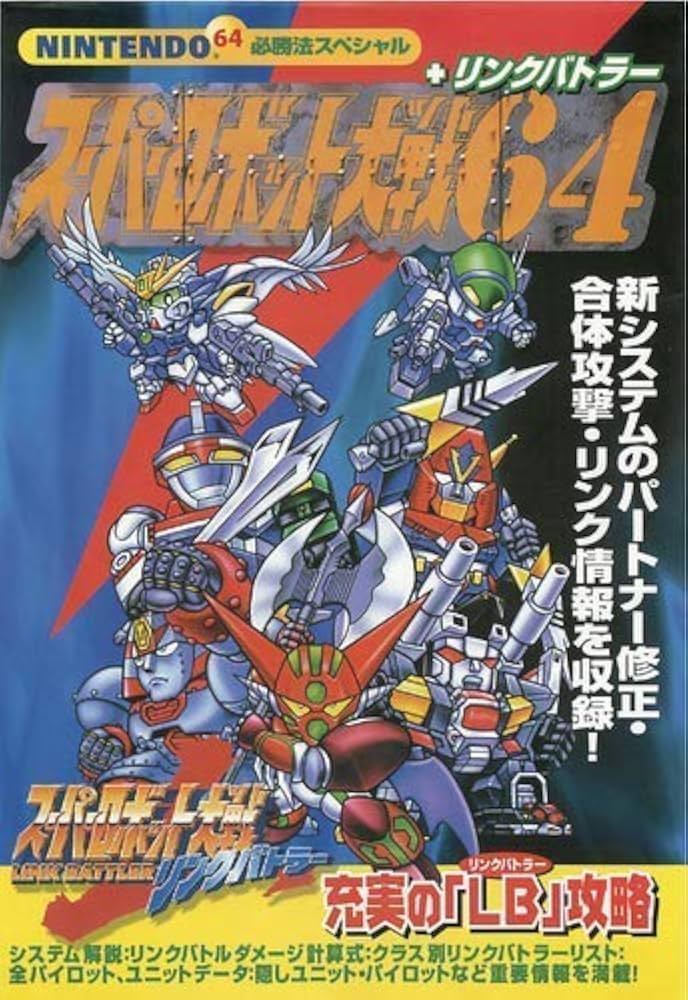
Super Robot Wars 64," the origin of the Nintendo handheld series
The original aircraft of A, the first in the Nintendo handheld series, has an original story. It was a group of original aircraft that appeared in "Super Robot Wars 64" released for the Nintendo 64.
Some of the scenarios in the game's lost data clearly show the connection between the two, suggesting that the original plan was to release the original aircraft from the same game as they were.
However, it is said that the original 64 aircraft could no longer be used because some of the copyrights belonged to A.I. and Banpresto, the developers of the Nintendo handheld series. Regardless of the fact, the series staff testified that the original A aircraft is a rebuild of the original 64 aircraft, and that 64 aircraft cannot be used.
The connection with the 64 is not only in the aircraft and hardware/software development company, but also in the series concept: the 64 was produced with the intention of targeting core users, and experimental elements such as route branching, in which even the organization to which the main characters belong, was changed, were introduced, and the ROM cartridges were utilized. It was the first to use ROM cartridges for fast-paced production and a combined attack system that used a large amount of data (for the time).
If we substitute "light users" for the "production stance aimed at specific users" in this title, it is very close to the direction taken by Nintendo's later portable series.
Sparobo for young people! One of the three pillars of the series
After "Super Robot Taisen Alpha" became the biggest hit of the series when it was released in 2000, Banpresto established three lines of future development for the series.
The first was a flagship console title that would continue the trend of "Super Robot Taisen Alpha," a stand-alone title that would use original aircraft from the Super Robot Taisen series, and the third was a portable title aimed at young players, namely the Nintendo handheld series.
With this announcement, users began to regard the copyrighted Super Robots released for Nintendo handhelds as a series of works called the Nintendo handheld series.
The youth-oriented element was carried over to BX, and the experimental element, which took advantage of the limited resources required for development, became a new feature, giving the Nintendo handheld series its own unique presence.
The Phantom Masterpiece "A Billion Thousand Light Years Away"
Several theme songs and promotional songs have been produced for the Super Robot Wars series. Among them, "A Billion Light Years Away" used for the promotion of "W" is known as a fantastic masterpiece.
This song is an up-tempo track with meaningful lyrics and has a high synergy with the scenario, but it has never been officially released.
A similar song, "Hot Souls" from "Super Robot Taisen 64" exists, but it was written to advertise "A Billion Light Years Away" and does not appear in the game at all, while "Hot Souls" was a song that used the in-game BGM. The fact that the song cannot be heard outside of the promotional PV makes this song a mirage.
The vocalist of this song is an employee of Banpresto, who did not want to actively release the song, so it was not released on CD.
If you have the opportunity to listen to this song, we hope you will enjoy it.
On the issue of plagiarism of BGM in Super Robot Wars K
Among the BGM included in "Super Robot Taisen K", there was a BGM that was stolen from "Estopolis Denki 2", a Super Nintendo Entertainment System (SNES) game by Taito Corporation, and "Chrono Trigger", a Super Nintendo Entertainment System (SNES) game by Square Enix Corporation.
NAMCO BANDAI Games conducted an internal investigation, acknowledged this fact, and after discussions with the copyright holders of both titles, reached a settlement and formally apologized.
The music director for "Super Robot Taisen K" was Kennosuke Suemura.
Suemura was also in charge of the music for "Super Robot Taisen W," and there had been allegations of plagiarism regarding the background music for that game as well. He has also been in trouble for his work on the female-oriented R-18 "False Charge," in which he formally admitted to plagiarism and apologized for his actions.
Since then, Suemura has not been involved in the "Super Robot Wars" series, and in "Super Robot Wars L" he was removed from the project and the music was completely replaced.
The BGM for "Super Robot Taisen W" was not explicitly announced as plagiarism. It should also be noted that the BGM that has been accused of plagiarism has nothing to do with the works in the series, and the copyright holders of the works in the series are not responsible for the BGM.

Related Articles

Summary of the successive packages of the Super Robot Taisen series [Super Robot Taisen series].
The "Super Robot Taisen" series is a crossover work featuring robots and characters from "Mazinger Z", "Mobile Suit Gundam", and various other robot animation works. The success of this series has led to a reevaluation of past robot works.
Read Article

Super Robot Wars (OG Series) Spoilers and Discussion Summary
A series derived from Super Robot Wars, a crossover simulation RPG based on Super Robot anime works. The game features original characters and robots from the Super Robot Taisen series. The spin-off works derived from this series are also called Super Robot Taisen OG Saga (OG stands for Original Generation), and form part of this series.
Read Article

Super Robot Wars (DC War Series) Spoilers and Discussion Summary
One of the series of "Super Robot Wars," a crossover of old and new robot animation works. Developed by Winky Soft and released by Banpresto. The genre is simulation RPG (SRPG). This series completed the foundation of the "Super Robot Taisen" series and led the series to become one of Japan's leading crossover series.
Read Article

Super Robot Wars (Alpha Series) Spoilers and Discussion Summary
A series of crossover simulation RPG "Super Robot Taisen" by Super Robot Anime works. Released by Banpresto and developed by Banpresoft. It began with "Super Robot Taisen Alpha" released in 2000, and was completed with "The 3rd Super Robot Taisen Alpha" in 2005. It is a full-length storyline consisting of four games, including one Gaiden game.
Read Article

Super Robot Wars 30 (Super Robot 30) Spoiler Commentary and Discussion Summary
Super Robot Wars 30" is a simulation RPG for Nintendo Switch, PlayStation 4, and Steam, released in 2021 by Namco Bandai Entertainment Inc. The title was created to commemorate the 30th anniversary of the "Super Robot Wars" series, a crossover work that brings together various robot anime from the past and present, and its appeal lies in its battle presentation that recreates the original story.
Read Article

シオニー・レジス(スーパーロボット大戦)の徹底解説・考察まとめ
『スーパーロボット大戦』のオリジナルキャラクター。初登場は『第2次スーパーロボット大戦Z 破界篇』。本項目では彼女の乗艦である「グレート・アクシオン」についても説明する。
Read Article

Lurking in the Game: Lost Data! Unused Data
In games, there is always some data that has been lost. There may be various reasons for this, but this time I would like to dig back and summarize such known lost data.
Read Article

Will it be realized? Illustration in the style of a Super Robot package
Super Robot Wars is a dreamlike game in which various robot anime co-star in a single game. However, heaven only knows if the robots you want to participate in the game will appear or not. This time, we would like to introduce a Super Robot Taisen package-style fan art that expresses this desire.
Read Article

Summary of the "Super Robot Wars" series from the beginning to the present
Many people know about Super Robot Wars (Super Robot Wars) nowadays, but there are only a few who know about the early days of Super Robot Wars. In fact, there are various quaint things about it, such as unexpected things and old-fashioned images. Here is a brief summary of such twists and turns of Super Robot based on the time period and history.
Read Article
A collection of strategies, wikis, and backstage information for "Super Robot Wars 64"! NINTENDO64
This article introduces a selection of sites that compile strategy, wiki, and behind-the-scenes information on "Super Robot Wars 64" for the Nintendo 64. This title is one of the "Super Robot Wars" series and the only software released for the Nintendo 64. The article includes sites that compile information useful for strategy, such as flowcharts of scenario strategies, key points, backstage techniques, and play diaries.
Read Article
![Super Robot] Nostalgic! Summary of Top 20 Cumulative Sales Ranking of Software for Sega Saturn [Tokimemo].](https://renote.net/files/blobs/proxy/eyJfcmFpbHMiOnsiZGF0YSI6NzQwNDk0MiwicHVyIjoiYmxvYl9pZCJ9fQ==--6d155c100ed364d8a9db80a6a56df3ae863db99f/9468.jpg)
Super Robot] Nostalgic! Summary of Top 20 Cumulative Sales Ranking of Software for Sega Saturn [Tokimemo].
The Sega Saturn is a stationary video game console released by Sega Enterprises in 1994. It also attracted a great deal of attention when actor Hiroshi Fujioka played the commercial character "Segata Sanshiro. The software genre is characterized by a wide variety of fighting games. This article introduces the cumulative sales ranking of the top 20 software titles for the Sega Saturn.
Read Article

Entry in Super Robot Wars! The World of Steel Warriors IF
Robot works that every man has longed to see. The Super Robot Taisen series is a cross-world work that connects such works. Among the many entries in the series, there are many who can be said to be regulars. In this article, we will introduce the three families of regular entries in the series.
Read Article
![A Masterpiece] I want to play it again before I die! Super NES Game 【Recommended】.](https://renote.net/files/blobs/proxy/eyJfcmFpbHMiOnsiZGF0YSI6MTgwNzkyLCJwdXIiOiJibG9iX2lkIn19--89a512c082c743fd6aa77efd98b378b2f9c670a1/z_5fb7b0d7ec722.jpg)
A Masterpiece] I want to play it again before I die! Super NES Game 【Recommended】.
I want to play it again before I die! This is a compilation of Super Nintendo Entertainment System (SNES) game titles. There are more than 1,000 Super Nintendo Entertainment System (SNES) game titles, so we took the time to compile this list. Generally, the further back you go, the older the release.
Read Article

Super Robot Wars Alpha strategy site and wiki summary! You can also get a good idea of the conditions for obtaining hidden units!
Here we have compiled a list of strategy sites and wikis for "Super Robot Wars Alpha". The sites include scenario float charts, pilot special skills, unit special abilities, information on reinforcement parts, and conditions for obtaining hidden units in an easy-to-understand format.
Read Article
Contents
- Outline of "Super Robot Wars (Nintendo handheld series)
- Introduction to the "Super Robot Wars (Nintendo handheld series)" series
- Super Robot Wars A
- Super Robot Taisen A Portable
- Entries in Super Robot Wars A and Super Robot Wars A Portable
- Super Robot Wars R
- Super Robot Wars R entries
- Super Robot Wars D
- Super Robot Taisen D entries
- Super Robot Wars J
- Super Robot Taisen J entries
- Super Robot Wars W
- Entries in Super Robot Taisen W
- Super Robot Wars K
- Super Robot Taisen K entries
- Super Robot Wars L
- Super Robot Taisen L entries
- Super Robot Wars UX
- Super Robot Wars UX
- Super Robot Wars BX
- Entries in Super Robot Wars BX
- Game system for "Super Robot Wars (Nintendo handheld series)
- Sortie Selection and Partner System
- remodeling
- Unit Pilot
- Transfer of Pilots
- special ability
- Major characters/units in Super Robot Wars (Nintendo handheld series)
- Amuro Rey.
- gundam
- Duminous.
- Myojin Takel (Japanese brand of rice)
- Godmothers
- Masato Akitsu
- great zeorimer
- Fei Yan HD
- Saotome Alto
- YF-29 Durandal
- Famous scenes from Super Robot Wars (Nintendo handheld series)
- That's my war.
- Twin Buster Rifle vs. Twin Satellite Cannon
- Miguel Aiman, Heine Westenfurth sorties.
- Wings of Destiny
- Backstories, trivia, and small stories/episodes/anecdotes about "Super Robot Wars (Nintendo handheld series)".
- Super Robot Wars 64," the origin of the Nintendo handheld series
- Sparobo for young people! One of the three pillars of the series
- The Phantom Masterpiece "A Billion Thousand Light Years Away"
- On the issue of plagiarism of BGM in Super Robot Wars K