

A series of crossover simulation RPG "Super Robot Taisen" by Super Robot Anime works. Released by Banpresto and developed by Banpresoft.
It began with "Super Robot Taisen Alpha" released in 2000, and was completed with "The 3rd Super Robot Taisen Alpha" in 2005.
It is a full-length storyline consisting of four games, including one Gaiden game.
Outline of "Super Robot Wars (Alpha Series)
As one of the "Super Robot Wars" series, the series started with "Super Robot Wars α" for PlayStation released in 2000. From "The Second Super Robot Taisen Alpha," the platform was moved to PlayStation 2, and many new systems were implemented.
The story takes place in a future where the information industry has been decimated by the fall of a giant meteorite, and science and technology have been developed through the use of outer space technology discovered in the meteorite.
The difficulty level has been lowered from the previous DC War series, while the battle animations have evolved significantly, making this series more suitable for all players.
Introduction of "Super Robot Wars (Alpha Series)
Super Robot Wars Alpha
Also known as "Alpha," it was released in May 2000. Software for PlayStation.
The first in the series. The production system was renewed, and the battles are now fully animated, and the battle animation can be turned on or off. When the battle animation is turned off, a simplified battle is displayed so that the results can be easily checked.
The development company was changed to BANPRESOFT, a direct subsidiary of BANPRESOFT, and the game was effectively produced in-house. In addition to the aforementioned visual enhancements, the game system and game balance had to be adjusted, the scenario volume increased, and several large-scale revisions had to be made during the development stage, including the cancellation of some of the entries.
The story takes place in the early stages of the Earth Civil War, similar to the DC War series, and eventually develops into a war in outer space, with the "Super Dimension Fortress Macross" series, the first entry in the series, playing a central role.
The scenario has been greatly expanded, with 27 copyrighted works, the largest number of works ever entered. The original story and crossovers are also carefully depicted, and the number of characters who participate in the series but have little to do in the game has been reduced.
Compared to the DC War series, the main character is more prominent as one of the main characters. The original work "Cho-Ki Taisen SRX" by Bumpresto, which made its debut in "New Super Robot Wars" but the series was cancelled and its detailed setting remained unknown, was also given a great deal of attention. This work will become an important element involved in the main storyline of the series.
The game system basically follows the DC War series, but various values from that series have been changed and adjusted to make the game very easy to play. While the DC War series had a high level of difficulty, this title has been adjusted to an easier level of difficulty, creating a game balance that does not stress light gamers. On the other hand, the game is also designed to accommodate heavy users by introducing a system in which the level of proficiency, an internal value, rises as experienced gamers play more and more, and the difficulty level changes accordingly.
Entries in "Super Robot Taisen Alpha
Mobile Suit Gundam
Mobile Suit Gundam 0080 War in the Pocket
Mobile Suit Gundam 0083 Stardust Memory
Mobile Suit Gundam Zeta Gundam
Mobile Suit Gundam Zeta
Mobile Suit Gundam F91
Mobile Suit Gundam Char of Counterattack
Mobile Suit V Gundam
New Mobile Suit Gundam W
New Mobile Suit Gundam W Endless Waltz
The Super Dimension Fortress Macross
The Super Dimension Fortress Macross: Ai Obo omoeme desu ka
Macross Plus
Saint Dunbine
Mazinger Z
Great Mazinger
Getter Robo
Getter Robo G
Shin Getter Robo (Original Manga Version)
Dancuga
Invincible Steel Man Daiturn 3
Yusha Raideen
Super Electromagnetic Robot Con Battler V
Super Electromagnetic Machine Voltes V
Aim for the Top!
Neon Genesis Evangelion
Giant Robo The Animation The Day the Earth Stood Still
BANPRESTO Original
Cho-Ki Taisen SRX
Magic Machine God THE LORD OF ELEMENTAL
The Super Dimension Fortress Macross", "The Super Dimension Fortress Macross: Ai Oboete ai", and "Macross Plus" made their first appearances in the Super Robot Wars series. In addition, although not credited, an aircraft from "Neon Genesis Evangelion: The Movie" appeared in the series and its story was also depicted, as well as enemy aircraft from the "Mazinger the Movie" series. Similarly, an aircraft from "Shin Getter Robo: The Last Day of the World" appeared based on the setting of "Getter Robo G," effectively making it an entry in the series.
Super Robot Wars Alpha for Dreamcast
Also known as "Alpha for DC", released in August 2001. It is the Dreamcast version of "Super Robot Taisen Alpha. Development of this multiplatform title began at the same time as "α," but it took a long time to model and create the battle scenes using 3D polygons, which was said to be the biggest difference between "α" and "α," and the release was delayed for more than a year. Also, "Combined Attack," a cooperative technique involving multiple units, which was not adopted in "Alpha," was added.
The postponement of the release of "α" resulted in feedback on the problems of the earlier "α" and the addition of a new route that can be completed independently of "α".
Entries in "Super Robot Taisen Alpha for Dreamcast
Mobile Suit Gundam
Mobile Suit Gundam 0080 War in the Pocket
Mobile Suit Gundam 0083 Stardust Memory
Mobile Suit Gundam Zeta Gundam
Mobile Suit Gundam Zeta
Mobile Suit Gundam F91
Mobile Suit Gundam Char of Counterattack
Mobile Suit V Gundam
New Mobile Suit Gundam W
New Mobile Suit Gundam W Endless Waltz
The Super Dimension Fortress Macross
The Super Dimension Fortress Macross: Ai Obo omoeme desu ka
Macross Plus
Saint Dunbine
Mazinger Z
Great Mazinger
Getter Robo
Getter Robo G
Shin Getter Robo (Original Manga Version)
Dancuga
Invincible Steel Man Daiturn 3
Yusha Raideen
Super Electromagnetic Robot Con Battler V
Super Electromagnetic Machine Voltes V
Aim for the Top!
Neon Genesis Evangelion
Giant Robo The Animation The Day the Earth Stood Still
BANPRESTO Original
Cho-Ki Taisen SRX
Magic Machine God THE LORD OF ELEMENTAL
Armored Armament G Breaker
In addition to the entries from "Alpha," characters and machines from the Dreamcast game "Sunrise Hero Tan" have also made guest appearances as "Armored Armed G-Breaker.
Super Robot Taisen Alpha Gaiden
Also known as "Alpha Gaiden," it was released in March 2001. Released in March 2001.
It was originally planned as a fan disc of "α", but the staff wanted to make it as a single work, and it was decided to make it as a stand-alone work.
Although it is called "Gaiden," the scenario is a "true history" that is closely connected to the previous and following works.
The story takes place on the Earth, where a gravitational wave generated by a space monster extermination mission at the end of "Alpha" is approaching. In the middle of the Aegis Project, which was designed to protect the Earth's sphere from gravitational waves, the player's unit is transported to a future Earth where the Aegis Project has failed. The player's unit is caught up in the war in the future world, but must find a way to return to the present day.
Due to the short development period, the game was released with some glitches. Later, a modified version was distributed to solve these problems. Later, the modified version was made available as a lower-priced version and as a downloadable version. The fatal bug is still present in the game in a form that can be encountered by anyone, so care should be taken when playing the original version.
The pilot parameter "Reaction" has been removed from this version, and "Defense" has been introduced in its place. Defense is now literally a parameter that determines defensive ability, and as the pilot's level increases, not only offensive ability but also defensive ability is increased. Mainly, the defense of main characters with low evasive ability is set higher.
Other new elements included the "cover" system that appeared in "Super Robot Taisen COMPACT 2" for the Wonder Swan, the "container" system arranged from the item search in "The 4th Super Robot Taisen," and the "bazaar" system that allows players to purchase and sell aircraft and enhanced parts. The "Bazaar" system allows the purchase and sale of aircraft and reinforced parts.
Entries in "Super Robot Taisen Alpha Gaiden
Mobile Suit Gundam 0083 STARDUST MEMORY
Mobile Suit Gundam Zeta Gundam
Mobile Suit Gundam Zeta
Mobile Suit Gundam Char of Counterattack
Mobile Suit V Gundam
New Mobile Suit Gundam W Endless Waltz
Mobile Suit Gundam X
∀Tribe Gundam
The Super Dimension Fortress Macross
The Super Dimension Fortress Macross
Macross Plus
Battle Mecha Zabungle
Mazinger Z
Great Mazinger
Getter Robo
Getter Robo G
Shin Getter Robo (original manga version)
Dancuga
Invincible Steel Man Daiturn 3
Yusha Raideen
Super Electromagnetic Robot Con Battler V
Super Electromagnetic Machine Voltes V
Ginga Senpu Braiger
BANPRESTO Original
Cho-Ki Taisen SRX
Magic Machine God THE LORD OF ELEMENTAL
Mobile Gundam X", "Tribe Gundam", "Battle Mecha Zabungle", and "Galactic Senpu Braiger" make their first appearance in the Super Robot Taisen series. All but "Galactic Whirlwind Braiger" have unique worldviews, such as "a devastated Earth" and "a future where all battles have once converged," and were considered difficult to enter in the previous series. In this work, the main stage is set in the future, making it possible for them to participate. The work that first appeared in this work has not appeared in the subsequent Alpha series.
In contrast, "Mobile Suit Gundam," "Mobile Suit Gundam 0080: War in the Pocket," "Mobile Suit Gundam F91," "New Mobile Gundam W," "Saint Dunbine," "Aim for the Top! Neon Genesis Evangelion," "Giant Robo The Animation: The Day the Earth Stood Still" (excluding "Armored Armed G Breaker" because it was released before "Alpha for DC"). Although no proper nouns or characters appear in the works, the development of "Aim for the Top" in "Alpha" is based on "Aim for the Top! is closely related to the storyline.
The 2nd Super Robot Taisen Alpha
Also known as "Nilpha", "Second Alpha", and "Alpha II". Software for PlayStation 2, released in March 2003.
The platform was moved to PlayStation 2, and the battle animations were greatly enhanced. The graphics were completely newly drawn, and evasion and bombardment motions were added to all aircraft. While previous titles used a "limited animation" technique in which only a portion of the aircraft was moved, this new title makes the entire body move even in minute movements and adds flashy effects (most notably in explosions) that utilize the entire screen. The number of "cut-ins," in which the pilots and aircraft are cut off from their normal battle animations, has been greatly increased, and when an enemy is killed with a certain weapon, a special destruction effect is added, making the battle animations much more powerful than in previous works.
In terms of systems, combined attacks have been officially introduced, and a "platoon" system has been introduced in which multiple aircraft can form a platoon. This system solves the problem of previous works in which the number of aircraft that could go into battle far exceeded the number of aircraft owned, preventing many of them from getting the chance to go into battle.
The story is set in the Earth sphere, and the threat from outer space, which was central to the story of "Alpha," does not appear. The story of the participating works is depicted with crossovers, and many of the battles in the earth sphere are brought to an end.
The four main characters are Kusuha Mizuha, Zenger Zomboldt, Ibis Douglas, and Arad Balanga. Although the number of main characters has decreased since "Alpha," the main characters in this work are very popular because each character is given a great deal of individuality in the scenarios and their growth is depicted in a way that keeps the main points in check.
Entries in "The 2nd Super Robot Taisen Alpha
Mobile Suit Gundam 0083 STARDUST MEMORY
Mobile Suit Gundam Zeta Gundam
Mobile Suit Gundam Zeta
Mobile Suit Gundam Char of Counterattack
Mobile Suit Gundam F91
Mobile Suit Crossbone Gundam
Bren Powered
Gundam W Endless Waltz
Invincible Steel Man Daiturn 3
Mazinger Z
Great Mazinger
Getter Robo
Getter Robo G
Shin Getter Robo (Original Manga Version)
Steel Jeeg
Super Electromagnetic Robot Con Battler V
Super Electromagnetic Machine Voltes V
Fighting General Deimos
Daikuuma Ryu Gaiking
Sengoku Majin Goshogun
King of Heroes GaoGaiGar
BANPRESTO Original
The first four works in the series are "Mobile Suit Crossbone Gundam," "Bren Powered," "Steel Jeeg," and "GaoGaiGar, King of the Braves. In addition, "Deimos the Warlord," "Gaiking the Great Sky Demon Dragon," and "Sengoku Majin GoShogun" made their first appearances in the Alpha series. Of the works that appeared in "Alpha" but did not appear in "Alpha Gaiden," "Mobile Suit Gundam F91" has returned. Mobile Suit Crossbone Gundam" is a comic book series about Mobile Suit Gundam that does not have an anime.
The appearance of "Steel Jeeg" and "GaoGaiGar, King of the Braves" in a game released by Banpresto, whose parent company is Bandai, a competing toy company, came as a surprise, since Takara, a toy company, sponsored and owned the merchandising rights to these works.
The previously credited Banpresto originals "Cho-Ki Taisen SRX" and "Magic Machine God THE LORD OF ELEMENTAL" will be integrated into the Banpresto originals after this title. No characters from "Magic Machine God THE LORD OF ELEMENTAL" will appear in this title, and only a few characters from "Cho-Ki Taisen SRX" will appear.
Although not listed in the entry, a machine from "Shin Getter Robo: The Last Day of the World" also makes a special appearance.
The 3rd Super Robot Taisen Alpha: Towards the End of the Galaxy
Also known as "Sarfa" and "3rd Alpha". released in July 2005. Software for PlayStation 2.
The final installment of the Alpha series. The largest number of works in the series (31) were brought together. It was the first in the series to have a subtitle.
Although many of the battle animations were taken from the previous work, "The Second Alpha," there was no strong criticism because of the high level of completion of the original work. In addition, image-related processing has been optimized, eliminating many of the processing glitches that occurred in the previous work. In addition, many other minor changes and additions have been made, including an increase in the number of special effects for defeating the enemy. For the first time in the series, the original animators were in charge of some of the battle animation.
The system is almost the same as in the "2nd Alpha," and users who have played the previous game will feel right at home. The most significant change is the ability to freely set the battle BGM. The music can be selected from a wide range of works, as long as it can be set to a particular song. This was suggested by Ichiro Mizuki, a well-known anime song singer and heavy user of this series.
The four main characters are Kusuha Mizuha, Touma Kanou, Quavray Gordon, and Selena Recital. As in "The Second Alpha," there are scenes where the storyline differs greatly from character to character. In addition, Zenger Zomboldt from "The Second Alpha" plays a supporting role in all the main characters' scenarios, Arad Baranga appears in Quavray Gordon's scenario, and Ibis Douglas appears in Serena Recital's scenario.
The storyline is divided into two major parts, one in the Earth's sphere and the other in outer space for the first time since Alpha, and is the largest in scale in the series. The enemy forces also approach with the largest quantity in the series, so there is a high affinity between the gameplay and the scenario. Many users have praised this work as a work that has been able to wrap up and complete the story without too much trouble, despite the large-scale war and the complicated worldview developed in this concluding work.
Entries in "The 3rd Super Robot Taisen Alpha: Towards the End of the Galaxy
Mobile Suit Gundam 0083 STARDUST MEMORY
Mobile Suit Gundam Zeta Gundam
Mobile Suit Gundam Zeta
Mobile Suit Gundam Char of Counterattack
New Mobile Suit Gundam W Endless Waltz
Mobile Suit Gundam SEED
The Super Dimension Fortress Macross: Ai Obo o Mochi o Mochi Dare ka?
Macross Plus
Macross 7
Mazinger Z
Great Mazinger
Getter Robo
Getter Robo G
Shin Getter Robo (Original Manga Version)
Steel Jeeg
Dancuga
Sengoku Majin Go Shogun
Invincible Steel Man Daiturn 3
Yusha Raideen
Super Electromagnetic Robot Con Battler V
Super Electromagnetic Machine Voltes V
Fighting General Deimos
Gaiking the Great Sky Demon Dragon
King of Heroes GaoGaiGar
King of Heroes GaoGaiGar FINAL
Densetsu Kyojin Ideon
Aim for the Top!
Neon Genesis Evangelion
Neon Genesis Evangelion The Movie
Dennou Senki Virtual-On Oratorio Tangram
Dennou Senki Virtual-On Mars
BANPRESTO Original
Mobile Suit Gundam SEED", "King of the Braves Gaogaiger Final", "Dennou Senki Virtual-Oratorio Tangram" and "Dennou Senki Virtual-Oratorio Mars" make their first appearance in the Super Robot Wars series. Macross 7" and "Densetsu Kyojin Ideon" also made their first appearances in the Alpha series. The Super Dimension Fortress Macross: Ai Oboete Kuru", "Macross Plus", "Dancouga", and "Raideen" returned to the α series.
Neon Genesis Evangelion: The Movie" is credited as an independent work from "Neon Genesis Evangelion" after this film. Like the previous work, "Cho-Ki Taisen SRX", a BANPRESTO original work, was combined into "BANPRESTO Original" and removed from the credits. Another BANPRESTO original, "Magic Machine God THE LORD OF ELEMENTAL," did not appear in the series.
Dennou Senki Virtual-Oratorio Tangram" and "Dennou Senki Virtual-Oratorio Mars" are the "Dennou Senki Virtual-Oratorio" series of game software sold by Sega, a game manufacturer that is a competitor of Bandai, the parent company of Banpresto, which sells this title. Following the appearance of the previous game, which was a competitor based on the toy maker standard, this time a game maker competitor that directly competes with the "Super Robot Taisen" series for users has appeared, again surprising users.
Although not listed in the entry, an aircraft from the game "Neon Genesis Evangelion 2" also makes an appearance.
Game System of "Super Robot Wars (Alpha Series)

Related Articles

Super Robot Wars (Nintendo handheld series) spoiler commentary and discussion summary
One of the "Super Robot Wars" series, a crossover simulation RPG based on Super Robot anime works. It is called this way because it is produced for portable game consoles sold by Nintendo. Aiming to be a "Super Robot Taisen" series for young people, many new and unusual works have been entered in the series. The series started with "Super Robot Taisen A" released in 2001, and as of January 2018, nine titles have been released.
Read Article

Summary of the successive packages of the Super Robot Taisen series [Super Robot Taisen series].
The "Super Robot Taisen" series is a crossover work featuring robots and characters from "Mazinger Z", "Mobile Suit Gundam", and various other robot animation works. The success of this series has led to a reevaluation of past robot works.
Read Article

Super Robot Wars (OG Series) Spoilers and Discussion Summary
A series derived from Super Robot Wars, a crossover simulation RPG based on Super Robot anime works. The game features original characters and robots from the Super Robot Taisen series. The spin-off works derived from this series are also called Super Robot Taisen OG Saga (OG stands for Original Generation), and form part of this series.
Read Article

Super Robot Wars (DC War Series) Spoilers and Discussion Summary
One of the series of "Super Robot Wars," a crossover of old and new robot animation works. Developed by Winky Soft and released by Banpresto. The genre is simulation RPG (SRPG). This series completed the foundation of the "Super Robot Taisen" series and led the series to become one of Japan's leading crossover series.
Read Article

Super Robot Wars 30 (Super Robot 30) Spoiler Commentary and Discussion Summary
Super Robot Wars 30" is a simulation RPG for Nintendo Switch, PlayStation 4, and Steam, released in 2021 by Namco Bandai Entertainment Inc. The title was created to commemorate the 30th anniversary of the "Super Robot Wars" series, a crossover work that brings together various robot anime from the past and present, and its appeal lies in its battle presentation that recreates the original story.
Read Article

Super Robot Wars Alpha strategy site and wiki summary! You can also get a good idea of the conditions for obtaining hidden units!
Here we have compiled a list of strategy sites and wikis for "Super Robot Wars Alpha". The sites include scenario float charts, pilot special skills, unit special abilities, information on reinforcement parts, and conditions for obtaining hidden units in an easy-to-understand format.
Read Article

Lurking in the Game: Lost Data! Unused Data
In games, there is always some data that has been lost. There may be various reasons for this, but this time I would like to dig back and summarize such known lost data.
Read Article

Will it be realized? Illustration in the style of a Super Robot package
Super Robot Wars is a dreamlike game in which various robot anime co-star in a single game. However, heaven only knows if the robots you want to participate in the game will appear or not. This time, we would like to introduce a Super Robot Taisen package-style fan art that expresses this desire.
Read Article

Summary of the "Super Robot Wars" series from the beginning to the present
Many people know about Super Robot Wars (Super Robot Wars) nowadays, but there are only a few who know about the early days of Super Robot Wars. In fact, there are various quaint things about it, such as unexpected things and old-fashioned images. Here is a brief summary of such twists and turns of Super Robot based on the time period and history.
Read Article
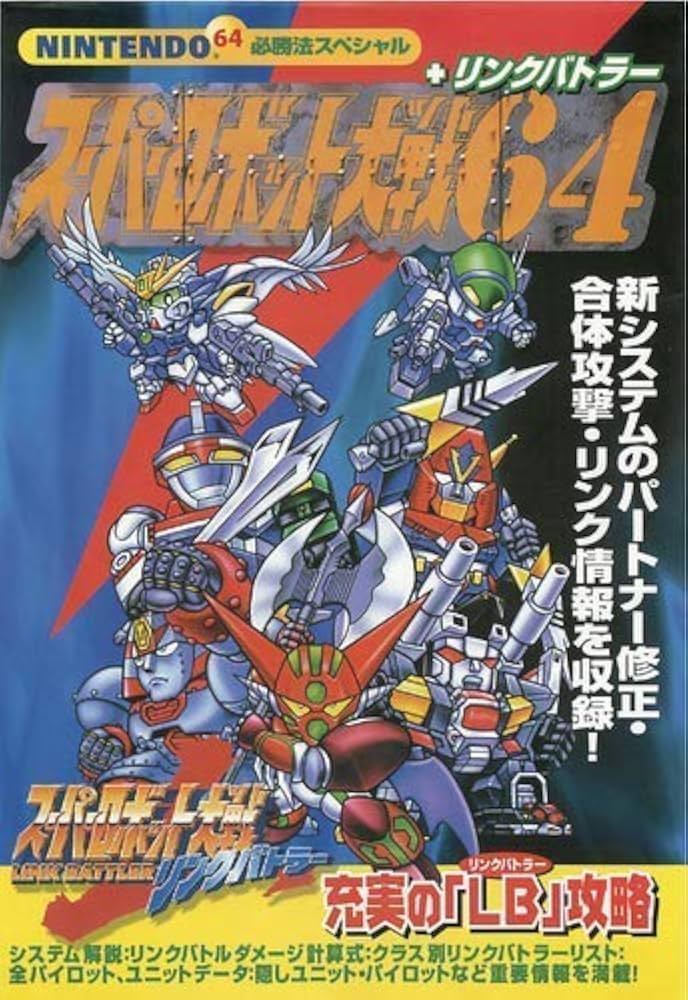
A collection of strategies, wikis, and backstage information for "Super Robot Wars 64"! NINTENDO64
This article introduces a selection of sites that compile strategy, wiki, and behind-the-scenes information on "Super Robot Wars 64" for the Nintendo 64. This title is one of the "Super Robot Wars" series and the only software released for the Nintendo 64. The article includes sites that compile information useful for strategy, such as flowcharts of scenario strategies, key points, backstage techniques, and play diaries.
Read Article
![Super Robot] Nostalgic! Summary of Top 20 Cumulative Sales Ranking of Software for Sega Saturn [Tokimemo].](https://renote.net/files/blobs/proxy/eyJfcmFpbHMiOnsiZGF0YSI6NzQwNDk0MiwicHVyIjoiYmxvYl9pZCJ9fQ==--6d155c100ed364d8a9db80a6a56df3ae863db99f/9468.jpg)
Super Robot] Nostalgic! Summary of Top 20 Cumulative Sales Ranking of Software for Sega Saturn [Tokimemo].
The Sega Saturn is a stationary video game console released by Sega Enterprises in 1994. It also attracted a great deal of attention when actor Hiroshi Fujioka played the commercial character "Segata Sanshiro. The software genre is characterized by a wide variety of fighting games. This article introduces the cumulative sales ranking of the top 20 software titles for the Sega Saturn.
Read Article

Entry in Super Robot Wars! The World of Steel Warriors IF
Robot works that every man has longed to see. The Super Robot Taisen series is a cross-world work that connects such works. Among the many entries in the series, there are many who can be said to be regulars. In this article, we will introduce the three families of regular entries in the series.
Read Article
![A Masterpiece] I want to play it again before I die! Super NES Game 【Recommended】.](https://renote.net/files/blobs/proxy/eyJfcmFpbHMiOnsiZGF0YSI6MTgwNzkyLCJwdXIiOiJibG9iX2lkIn19--89a512c082c743fd6aa77efd98b378b2f9c670a1/z_5fb7b0d7ec722.jpg)
Contents
- Outline of "Super Robot Wars (Alpha Series)
- Introduction of "Super Robot Wars (Alpha Series)
- Super Robot Wars Alpha
- Entries in "Super Robot Taisen Alpha
- Super Robot Wars Alpha for Dreamcast
- Entries in "Super Robot Taisen Alpha for Dreamcast
- Super Robot Taisen Alpha Gaiden
- Entries in "Super Robot Taisen Alpha Gaiden
- The 2nd Super Robot Taisen Alpha
- Entries in "The 2nd Super Robot Taisen Alpha
- The 3rd Super Robot Taisen Alpha: Towards the End of the Galaxy
- Entries in "The 3rd Super Robot Taisen Alpha: Towards the End of the Galaxy
- Game System of "Super Robot Wars (Alpha Series)
- platooning
- pilot
- Pilot Point (PP)
- transfer (trains, buses, etc.)
- unit
- remodeling
- taking over a round trip
- Major characters/characters/units from "Super Robot Wars (Alpha Series)
- rough-and-tumble
- Great Mazinger (i.e. Mazinger the Great)
- Shinji Ikari
- Evangelion first plane
- Kusuha Mizuha
- Dragon and Tiger King
- Lyusei Date
- Bumrah Os
- Famous Scenes from "Super Robot Wars (Alpha Series)
- air
- bond between brothers
- BEYOND THE TIME
- Backstory, Trivia, Small Stories/Episodes, Anecdotes from "Super Robot Wars (Alpha Series)".
- Staff Runaway? Why Combat Animation Has Evolved
- Unusual warning born out of "Second Alpha" promotion.