

One of the "Super Robot Wars" series, a crossover simulation RPG based on Super Robot anime works.
It is called this way because it is produced for portable game consoles sold by Nintendo.
Aiming to be a "Super Robot Taisen" series for young people, many new and unusual works have been entered in the series.
The series started with "Super Robot Taisen A" released in 2001, and as of January 2018, nine titles have been released.
Outline of "Super Robot Wars (Nintendo handheld series)
One of the series lineage of "Super Robot Wars" started with "Super Robot Wars A" for Game Boy Advance released in 2001. The genre is simulation RPG.
Among the Super Robot Taisen games, many of the entries are relatively new or rare, making it a game for young people. Another feature of this game is that it is supplied on a ROM cartridge with no disk access, allowing for fast-paced play. One of the initial features of the game was that it did not include voices, but from "Super Robot Taisen UX" onward, battles were fully voiced due to the evolution of hardware and the increased capacity of software.
Super Robot Taisen J" and up were released for the Game Boy Advance, "Super Robot Taisen W" through "Super Robot Taisen L" were released for the Nintendo DS, and "Super Robot Taisen UX" and up were released for the Nintendo 3DS.
Although the works are not related to each other and each has its own worldview, they are treated as a series due to the similarities in development backgrounds and the aforementioned entries and concepts. For this reason, the "Super Robot Taisen Original Generation" series, which has a different concept, and "Super Robot Academy," a command-type battle game that appropriates battle scenes from this series, are not included.
Introduction to the "Super Robot Wars (Nintendo handheld series)" series
Super Robot Wars A
A Game Boy Advance software released in 2001. The "Shadow Mirror," invaders from a parallel world, appear as an original organization in this title.
In addition, "Mobile Suit Gundam," which has often featured sequels in the series up to now, is spotlighted, with an unprecedented number of enemy characters, and the main character Gundam is also active as "a machine that has the potential to fight on the front lines, despite being old-fashioned.
The main character is Axel Almer, a man, and Ramia Lovelace, a woman, one of whom is chosen as the protagonist. The pilot chooses one of five aircraft: Soul Gain, Anjelg, Vaisaga, Ash Saver, and Lars Angriff.
The system is unique in that it follows the old Super Robot Taisen series and includes many elements unique to this title, due to the combination of the revamping of the entire Super Robot Taisen series and the launch of the Nintendo handheld series. As a result, the game feels very different from the other titles.
The light scenario by Soichiro Morisumi, who later worked on the "NAMCO x CAPCOM" and "PROJECT X ZONE" series, and the fast-paced battle animations and player-dominant game balance made it a popular title that can be played quickly and easily.
Super Robot Taisen A Portable
Released in 2008. A port of "Super Robot Wars A" for the PlayStation Portable.
Due to changes in hardware and the accumulated know-how of the series, the battle system was changed to one common to the Super Robot Taisen series, and battle voices were added. The battle animations were completely changed to those based on "Super Robot Taisen MX," which was ported to the PlayStation Portable before this title because of the many overlaps between this title and the other titles in the series, and thus could be easily adapted to the PlayStation Portable.
The first system introduced in this work is the "continuous target correction," which increases the hit rate for each missed attack, and the "random number preservation," which determines the result of random elements such as hit-and-run evasion ahead of time and prevents the result from changing when the game is reset. Both of these systems are intended to adjust the balance of the game.
The animation of the machines that did not appear in the aforementioned "Super Robot Taisen MX" was newly created for the handheld version with a good tempo. The new animations are said to be the best in the series, and the Gundam battle animations, which featured prominently in the original version, are especially well known for their "Super Robot Taisen A" style and high quality.
The remake was created with as few elements of the original as possible, and as a whole, it can be said to be a remake that greatly brushed up on the original version.
Entries in Super Robot Wars A and Super Robot Wars A Portable
Dragner
Mobile Battleship Nadeshiko
Super Electromagnetic Machine Vortez V
Mazinger Z
Great Mazinger
UFO Robot Grendizer
Getter Robo G
Getter Robo G
Shin Getter Robo (original manga version)
Mobile Suit Gundam (TV version)
MSV (only the machine)
Mobile Suit Gundam 08MS Platoon
Mobile Suit Gundam 0083 STARDUST MEMORY
Mobile Suit Gundam Zeta Gundam
Mobile Suit Gundam Zeta
Mobile Suit Gundam: Char of Counterattack
Mobile Suit Gundam G Gundam
Gundam W Endless Waltz
Super Electromagnetic Robot Con Battler V
Deimos, the General of Battle
Invincible Steel Man Daiturn 3
New entries "Kikai Senki Dragner" and "Mobile Battleship Nadesico". Dragner" is a light-hearted robot anime from the 80s and "Nadesico" is a representative of the 90s, and both were controversial when "Super Robot Taisen A" was first released.
Super Robot Wars R
Released in 2002. Game Boy Advance software.
The main character in this game is a choice between Raoul Graden (male) and Fiona Graden (female). The origin and settings are almost the same, so it effectively doubles as a gender selection. Later, when the characters from this work participated in the "Super Robot Wars: The Original Generation" series, they appeared together as siblings. Although the unit is a fixed Exalance, a robot developed for rescue, the unit has the ability to be retrofitted with a variety of equipment to suit the situation, and the player can select one of the six units to use.
The "R" in the title means "Reversal. The description of the future, which has a more catastrophic history than the original due to the intervention of a mastermind, and the early scenario, which depicts the stance of the protagonist, who has slipped back in time from the future to the present and adopts a cautious attitude, fearing the alteration of history, have caused controversy among users. However, these quirks are noticeable only in the early stages of the game, and as the story progresses, the protagonist prioritizes the avoidance of tragedy, and the story changes to a more royalistic one in which history is altered for the better.
The system has been greatly improved to make it easier to play, and the difficulty level has been significantly lowered compared to "Super Robot Wars A." Combined with a scenario that gives a lighthearted seal of approval that makes it hard to believe that it is dealing with a heavy theme of historical change, this game has evolved into a game that beginners and younger players can easily enjoy.
Super Robot Wars R entries
Mobile Suit Gundam Zeta Gundam
Mobile Suit Gundam Zeta
Mobile Suit Gundam: Char of Counterattack
Mobile Suit Gundam G Gundam
Gundam W Endless Waltz
Mobile New Century Gundam X
Mobile Battleship Nadeshiko
Mobile Battleship Nadeshiko the Movie: The prince of darkness
Invincible Superhero Zambot 3
Invincible Steel Man Daiturn 3
Mazinger Z
The Great Mazinger
Mazinger the Movie Series
Shin Getter Robo vs. Neo Getter Robo
Super Electromagnetic Robot Con Battler V
Super Electromagnetic Machine Vortez V
GEAR Warrior Dendo
New entries are "Shin Getter Robo vs. Neo Getter Robo," "Mobile Suit Nadeshiko the Movie: The prince of darkness," and "GEAR Warrior Dendo. All of these works were produced in the 90's, and the lineup clearly shows the direction of the series. The fact that the original Getter Robo series (Getter Robo and Getter Robo G, which were broadcast in the 1970s, and Shin Getter Robo (the original manga version), which is a direct descendant of the Getter Robo series), which had been a regular participant in the Super Robo series, was replaced by Shin Getter Robo vs. Neo Getter Robo, was a hot topic.
Super Robot Wars D
Released in 2003 for the Game Boy Advance.
The main character is chosen from one of Joshua Radcliffe (Josh) and Kriana Rimskaya (Lim). The one not chosen appears as the secondary protagonist. The player chooses from four aircraft: the realistic Yale Chevalier and Blanchneige, and the superheroes Ganadur and Strega. The aircraft of the secondary protagonist is selected from the same family that the player did not choose.
While the battle animation of "Super Robot Taisen ORIGINAL GENERATION" released at the same time focused on the animation of the aircraft, this work does not use much animation to differentiate itself, but uses cut-ins to enhance the intensity of the performance.
The most distinctive feature of the system is the "song system. This system was designed in conjunction with "Macross 7," in which the main character sings a song while riding his robot around the battlefield instead of fighting, and improves the status of his allies by singing. Also, as a new attempt, the "Tsume Super Robot," which clears the map under circumstances where attacks are always hit (the effects of mental commands are prioritized), was introduced. There are many difficult questions that can only be answered correctly by fully grasping the characteristics of this series and utilizing the system to its fullest extent, making players both thrilled and annoyed.
The difficulty level has been greatly increased since the previous title was pointed out to be too easy, and a back-and-forth map that forces players to fight a series of battles without being able to modify their aircraft or save their data has been introduced. It is often described as one of the most difficult in the Super Robo series.
The scenario of the previous title was controversial, so a harder style was adopted for this title. The scenario was written by Toshiya Kagami, who wrote the hard story in "Super Robot Wars 64. The story is based on "Shin Getter Robo: The Last Day of the World" and takes place on a devastated earth. The Earth disappears early in the film, and the Earth Federation Forces and the Neo Zeon Forces, which were originally hostile forces, cooperate to gather information about the situation, and many characters who had previously played hostile roles join their own armies. The game is one of the most unique in the series and is highly regarded as an experimental work in the Nintendo handheld series.
Super Robot Taisen D entries
Mobile Suit Gundam Zeta Gundam
Mobile Suit Gundam Zeta
Mobile Suit Gundam: Char of Counterattack
Mobile Suit V Gundam
New Mobile Suit Gundam W
Mazinger Z
Great Mazinger
UFO Robot Grendizer
Shin Getter Robo: The Last Day of the World
Future Robot D'Artagnus
Rokushin God Mars
THE BIG O
MEGAZONE 23
Macross 7
BANPRESTO Original
New entries are "Future Robo D'Artagnus", "Megazone 23", "Macross 7", and "THE Big O". In addition, "Shin Getter Robo: The Last Day of the World," in which only a part of the machine had appeared until now, also became the first official entry with the appearance of its character. In addition, although it is not included in the list of entries, the main character machine refined in the OVA "Rokushin God Mars: Legend of 17 Years Old" appears as a hidden machine (treated as a different machine from the main character machine in the TV version).
Super Robot Wars J
Released in 2005. Game Boy Advance software. It was the last in the series of handheld games for the Game Boy Advance.
The battle presentation has evolved significantly and detailed animations have been realized. The evolution is so advanced that the game often causes processing glitches. This animation was so highly developed that it was used in "Super Robot Taisen W," which was released on next-generation consoles with greatly improved specifications. The storyline also uses a single picture.
The main character chooses between Shikumo Tsuya and Calvina Koulange. The aircraft is selected from Berzelut, Kustwell, Gruntyd, and Volrent. There is no separation into super and realistic systems, as in previous works.
The most distinctive feature of the system is the partner system. The system itself allows one of the three heroines, who appear as secondary characters, to be assigned as a sub-pilot to the main character's aircraft. The sub-pilot can be changed using the transfer command. Unlike other sub-pilots, each heroine has a different ability bonus, and the sub-pilot's ability also influences the unlocking of special moves and the ending of the game, which is a feature not found in other works in the series. Another unique feature of this title is the "relaunch" function, which allows players to replace a unit on the mothership with another unit that has not yet been deployed.
The difficulty level itself is moderate. The enemy reinforcements are very numerous and the enemy AI is slightly smarter, and the game boasts a high succession capability that takes advantage of cover defense (an action to protect another unit of your own army, which also has a damage reduction effect in this title), so many maps are time-consuming.
In the scenario, the line breaks and the number of lines displayed in the game window do not match throughout the game, and the scenario suddenly does not add up from around episode 34, and the detailed settings are not unified. The scenarios do not add up, the detailed settings are not unified, and the descriptions of the original characters have changed significantly. For this reason, some fans were not sure whether to treat it as a completed work before giving it a high or low rating. Although Nobuhiro Kunishima is credited as a writer in addition to Toshiya Kagami, who was well received for the previous work, Kunishima's specialty is mechanical design and 3DCG, and he has never been involved in the literary aspect of games other than this work. It is clear that there were major problems in the scenario production, and fans have speculated that Kagami was forced to drop out of the project in the middle of writing and that Kunishima, despite his different field, was the pinch hitter, but the details have not been revealed until 2018. The situation itself is controversial, but relatively well received, with many fans lamenting that the work could have benefited from a minimum of polish.
Super Robot Taisen J entries
Mobile Suit Gundam
Mobile Suit Gundam SEED
SPT Reisner
Bren Powered
Mobile Battleship Nadesico
Space Knight Tekkaman Blade
Full Metal Panic!
Full Metal Panic! Fumofu
Mazinkaiser
Mazinkaiser: The Fight to the Death! Dark General
Super Electromagnetic Robot Con Battler V
Super Electromagnetic Machine Vortez V
DANCOUGA
Underworld Plan Zeorimer
New entries are "Mazinkaiser: Death Battle! The Dark General", "Space Knight Tekkaman Blade", "Full Metal Panic! Full Metal Panic? Fumofu". Full Metal Panic? Fumoffu" is an extra chapter of the robot anime "Full Metal Panic! and "Space Knight Tekkaman Blade" was a pure hero animation. Also, "Mobile Suit Gundam SEED," which was at the height of its popularity at the time, was the first robot to be entered in the series, but its release was postponed in order to give up its first entry in the series to the mainstream console title "The 3rd Super Robot Taisen Alpha. It was the first Super Robot Taisen series to feature the Space Century Gundam (from "Mobile Suit Gundam" to "Senko no Hathaway" at the time of its release, and was the first Super Robot Taisen series to feature the same worldview). ) and Getter Robo related works did not participate in the series, making it a highly experimental lineup.
Super Robot Wars W
Released in 2007. Exclusive software for the Nintendo DS.
The first Super Robot Wars for the Nintendo DS. As a new innovation, a two-part scenario was included. The usability of the game has been improved by using one of the two screens as a sub-window, taking advantage of the Nintendo DS's characteristic two screens (top and bottom). The game can be played without using the stylus, which is also a feature of the Nintendo DS, although it is partially compatible with the stylus.
The battle presentation continues to be highly acclaimed, and the quality of the background music and sound effects has been further enhanced with the improvement of hardware specifications. The battle scenes created for this title are attractive for their detailed motion and bold cut-in animation, and even the animation used in the previous title has been modified in minute detail and the sound effects have been replaced. The quality of the animation is comparable to that of new productions. Some users have said that the quality of the game is even better than that of the console.
In terms of the system, the focus was on utilizing the structure of the Nintendo DS as mentioned above, and only a few new systems were introduced. Among them, the W-slot system, in which various benefits can be obtained by using the Game Boy Advance software slot on the DS and loading the Super Robot Wars series released for the Game Boy Advance, is particularly impressive.
The scenario was the most well-received aspect of this work. The overall structure, which consistently depicts themes such as family love and the strength of feelings, and the large scale and natural crossover, which was unthinkable in previous titles, particularly impressed users. Among them, for three works, "Space Knight Tekkaman Blade" and "Space Knight Tekkaman Blade II," and "Detonator Organ," a work in a different lineage that is a tribute to "Space Knight Tekkaman," the original remake of these two works, crossovers across series and recombination of the time line were The bold modifications were made without destroying the charm of the works and without making the player feel uncomfortable, and it has become a popular story among fans.
The difficulty level is kept very low, and the game is recommended for beginners.
Entries in Super Robot Taisen W

Related Articles

Summary of the successive packages of the Super Robot Taisen series [Super Robot Taisen series].
The "Super Robot Taisen" series is a crossover work featuring robots and characters from "Mazinger Z", "Mobile Suit Gundam", and various other robot animation works. The success of this series has led to a reevaluation of past robot works.
Read Article

Super Robot Wars (OG Series) Spoilers and Discussion Summary
A series derived from Super Robot Wars, a crossover simulation RPG based on Super Robot anime works. The game features original characters and robots from the Super Robot Taisen series. The spin-off works derived from this series are also called Super Robot Taisen OG Saga (OG stands for Original Generation), and form part of this series.
Read Article

Super Robot Wars (DC War Series) Spoilers and Discussion Summary
One of the series of "Super Robot Wars," a crossover of old and new robot animation works. Developed by Winky Soft and released by Banpresto. The genre is simulation RPG (SRPG). This series completed the foundation of the "Super Robot Taisen" series and led the series to become one of Japan's leading crossover series.
Read Article

Super Robot Wars (Alpha Series) Spoilers and Discussion Summary
A series of crossover simulation RPG "Super Robot Taisen" by Super Robot Anime works. Released by Banpresto and developed by Banpresoft. It began with "Super Robot Taisen Alpha" released in 2000, and was completed with "The 3rd Super Robot Taisen Alpha" in 2005. It is a full-length storyline consisting of four games, including one Gaiden game.
Read Article

Super Robot Wars 30 (Super Robot 30) Spoiler Commentary and Discussion Summary
Super Robot Wars 30" is a simulation RPG for Nintendo Switch, PlayStation 4, and Steam, released in 2021 by Namco Bandai Entertainment Inc. The title was created to commemorate the 30th anniversary of the "Super Robot Wars" series, a crossover work that brings together various robot anime from the past and present, and its appeal lies in its battle presentation that recreates the original story.
Read Article

シオニー・レジス(スーパーロボット大戦)の徹底解説・考察まとめ
『スーパーロボット大戦』のオリジナルキャラクター。初登場は『第2次スーパーロボット大戦Z 破界篇』。本項目では彼女の乗艦である「グレート・アクシオン」についても説明する。
Read Article

Lurking in the Game: Lost Data! Unused Data
In games, there is always some data that has been lost. There may be various reasons for this, but this time I would like to dig back and summarize such known lost data.
Read Article

Will it be realized? Illustration in the style of a Super Robot package
Super Robot Wars is a dreamlike game in which various robot anime co-star in a single game. However, heaven only knows if the robots you want to participate in the game will appear or not. This time, we would like to introduce a Super Robot Taisen package-style fan art that expresses this desire.
Read Article

Summary of the "Super Robot Wars" series from the beginning to the present
Many people know about Super Robot Wars (Super Robot Wars) nowadays, but there are only a few who know about the early days of Super Robot Wars. In fact, there are various quaint things about it, such as unexpected things and old-fashioned images. Here is a brief summary of such twists and turns of Super Robot based on the time period and history.
Read Article
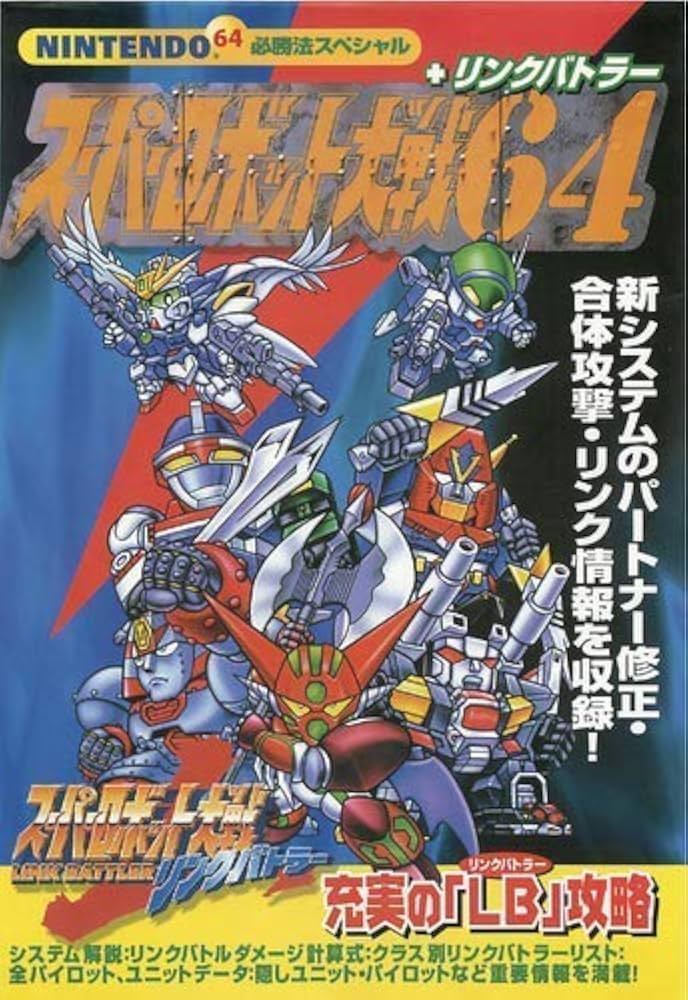
A collection of strategies, wikis, and backstage information for "Super Robot Wars 64"! NINTENDO64
This article introduces a selection of sites that compile strategy, wiki, and behind-the-scenes information on "Super Robot Wars 64" for the Nintendo 64. This title is one of the "Super Robot Wars" series and the only software released for the Nintendo 64. The article includes sites that compile information useful for strategy, such as flowcharts of scenario strategies, key points, backstage techniques, and play diaries.
Read Article
![Super Robot] Nostalgic! Summary of Top 20 Cumulative Sales Ranking of Software for Sega Saturn [Tokimemo].](https://renote.net/files/blobs/proxy/eyJfcmFpbHMiOnsiZGF0YSI6NzQwNDk0MiwicHVyIjoiYmxvYl9pZCJ9fQ==--6d155c100ed364d8a9db80a6a56df3ae863db99f/9468.jpg)
Super Robot] Nostalgic! Summary of Top 20 Cumulative Sales Ranking of Software for Sega Saturn [Tokimemo].
The Sega Saturn is a stationary video game console released by Sega Enterprises in 1994. It also attracted a great deal of attention when actor Hiroshi Fujioka played the commercial character "Segata Sanshiro. The software genre is characterized by a wide variety of fighting games. This article introduces the cumulative sales ranking of the top 20 software titles for the Sega Saturn.
Read Article

Entry in Super Robot Wars! The World of Steel Warriors IF
Robot works that every man has longed to see. The Super Robot Taisen series is a cross-world work that connects such works. Among the many entries in the series, there are many who can be said to be regulars. In this article, we will introduce the three families of regular entries in the series.
Read Article
![A Masterpiece] I want to play it again before I die! Super NES Game 【Recommended】.](https://renote.net/files/blobs/proxy/eyJfcmFpbHMiOnsiZGF0YSI6MTgwNzkyLCJwdXIiOiJibG9iX2lkIn19--89a512c082c743fd6aa77efd98b378b2f9c670a1/z_5fb7b0d7ec722.jpg)
A Masterpiece] I want to play it again before I die! Super NES Game 【Recommended】.
I want to play it again before I die! This is a compilation of Super Nintendo Entertainment System (SNES) game titles. There are more than 1,000 Super Nintendo Entertainment System (SNES) game titles, so we took the time to compile this list. Generally, the further back you go, the older the release.
Read Article

Super Robot Wars Alpha strategy site and wiki summary! You can also get a good idea of the conditions for obtaining hidden units!
Here we have compiled a list of strategy sites and wikis for "Super Robot Wars Alpha". The sites include scenario float charts, pilot special skills, unit special abilities, information on reinforcement parts, and conditions for obtaining hidden units in an easy-to-understand format.
Read Article
Contents
- Outline of "Super Robot Wars (Nintendo handheld series)
- Introduction to the "Super Robot Wars (Nintendo handheld series)" series
- Super Robot Wars A
- Super Robot Taisen A Portable
- Entries in Super Robot Wars A and Super Robot Wars A Portable
- Super Robot Wars R
- Super Robot Wars R entries
- Super Robot Wars D
- Super Robot Taisen D entries
- Super Robot Wars J
- Super Robot Taisen J entries
- Super Robot Wars W
- Entries in Super Robot Taisen W
- Super Robot Wars K
- Super Robot Taisen K entries
- Super Robot Wars L
- Super Robot Taisen L entries
- Super Robot Wars UX
- Super Robot Wars UX
- Super Robot Wars BX
- Entries in Super Robot Wars BX
- Game system for "Super Robot Wars (Nintendo handheld series)
- Sortie Selection and Partner System
- remodeling
- Unit Pilot
- Transfer of Pilots
- special ability
- Major characters/units in Super Robot Wars (Nintendo handheld series)
- Amuro Rey.
- gundam
- Duminous.
- Myojin Takel (Japanese brand of rice)
- Godmothers
- Masato Akitsu
- great zeorimer
- Fei Yan HD
- Saotome Alto
- YF-29 Durandal
- Famous scenes from Super Robot Wars (Nintendo handheld series)
- That's my war.
- Twin Buster Rifle vs. Twin Satellite Cannon
- Miguel Aiman, Heine Westenfurth sorties.
- Wings of Destiny
- Backstories, trivia, and small stories/episodes/anecdotes about "Super Robot Wars (Nintendo handheld series)".
- Super Robot Wars 64," the origin of the Nintendo handheld series
- Sparobo for young people! One of the three pillars of the series
- The Phantom Masterpiece "A Billion Thousand Light Years Away"
- On the issue of plagiarism of BGM in Super Robot Wars K