

A series of crossover simulation RPG "Super Robot Taisen" by Super Robot Anime works. Released by Banpresto and developed by Banpresoft.
It began with "Super Robot Taisen Alpha" released in 2000, and was completed with "The 3rd Super Robot Taisen Alpha" in 2005.
It is a full-length storyline consisting of four games, including one Gaiden game.
bond between brothers
From "Alpha Gaiden.
The player's unit is sent to the future world and joins up with the player's unit while being involved in a battle occurring in the future world. Great Mazinger pilot Tetsuya Ken discovers the enemy during a reconnaissance mission, and after an argument with Mazinger Z pilot Kouji Kabuto, he makes a preemptive attack. The scouting team is caught off guard by Tetsuya's belligerence and, unable to coordinate with each other, they rush into battle, putting a nearby town at risk. In order to protect the city, Benkei Kuruma, one of the pilots of the combined Getter Robot, dares to attack the city in a separated state, and is injured in the ensuing exchange of fire.
The reconnaissance members are blamed for Benkei's injury. Tetsuya leaves the unit amidst growing discord among the player units. As he works with Kouji, he harbors an unquenchable jealousy and rivalry toward his foster father, Kenzo Kabuto, who is Kouji Kabuto's real father.
The Getter Robo pilots, the Getter Team, also had a quarrel between their leader Ryoma Nagare and Hayato Kami. After a fistfight, the Getter Robo pilots set out to search for Tetsuya while still at odds with each other. Before them, the army of the Dinosaur Empire appears. The Getter Team is in danger as they are relentlessly targeted for an opportunity to merge, but it is Kouji, who has come to the rescue in search of Tetsuya.
Kouji and his team try to fight back, but they are confronted by Tetsuya Sword, who is controlled by the Dinosaur Empire. Kouji desperately tries to persuade Tetsuya, but he reveals his jealousy toward Kouji. Kouji learns of his feelings and offers his own life. He offers to give the life that Tetsuya once saved to bring Tetsuya back to his senses.
Tetsuya is deeply moved by Kouji's devotion. Tetsuya's pride as a warrior, and most importantly, the image of Kouji in front of him overlaps with that of Kenzo, the man who raised him, and Tetsuya regains his sanity.
With Tetsuya back on his side, the war seemed to have turned around, but the Dinosaur Empire had prepared a further plan. The Dinosaur Empire had prepared an even better strategy: it had sent out Picdron, a lightwave beast that could absorb and block any half-baked attack. Mazinger Z and Great Mazinger had already been damaged in battle, and Getter Robo, which could not yet combine with Mazinger Z, was a formidable enemy with no way out.
Tetsuya proposes self-destruction as a way out. Tetsuya says that no one will be saddened by his death, but Kouji tells him that he cannot abandon his brothers who have fought through the battle together. The Getter Team also succeeds in merging into the Getter Robot by taking on the life-threatening supersonic merging formation in a flash.
In a series of ups and downs, Kouji, Tetsuya, and the Getter Team are finally ready for battle. The Dinosaur Empire also challenges the battle with all its might, but the player team rushes in just in time. Kouji and Tetsuya win a fierce battle and defeat the Dinosaur Empire, confirming their mutual bond and vowing to return to the present day.
This scenario is known as one of the most famous scenes in the Alpha series. One of the reasons for its high reputation is that the original scenario sublimates the feelings of Tetsuya Kabuto, whose conflict with Kenzo Kabuto was not fully depicted in the original work. This is one of the reasons for the high evaluation of Alpha Gaiden.
BEYOND THE TIME
From "The Second Alpha.
Neo Zeon, and the Axis, a mobile asteroid base that is the basis of the Jupiter Empire, is on the move. Char Aznable, the general of Neo Zeon and once a member of the player squadron as Quattro Basina, entrusts the command of the stage to his trusted confidant Nanai Miguel, and prepares to launch a sortie. Haman Khan, who led Neo Zeon during Char's time away from Neo Zeon and is now attached to Char, has a final conversation with Char. Char encourages Haman, who had relied on him as a superior and as a man, that he is now ready to stand on his own. Haman, who had thought that he might be hesitant to fight his former comrade, hears Char's words, "We must win," and he puts aside his doubts and challenges Haman to battle.
Char's plan was to make the Axis fall to earth and turn it into a dead planet where life could not live. It is a counteroffensive against the Earth Federation government, which treats space dwellers unfairly and in an unjust manner, while establishing many space colonies in space. Many of those who live on Earth have an understanding of those who live in space. The player's unit cannot accept Char's aggressive measures and decides to cross blades with their former comrades.
The Jupiter Empire possesses many nuclear weapons, and if the Axis cannot be dropped, it can use these weapons to destroy the Earth's environment. Amuro Rei, the pilot of the Nu Gundam and the man who has a history with Char, tries to convince Char of the pointlessness of this battle, but Char refuses to listen.
With the Earth Federation forces, except for the player unit, held back by the Neo-Leon forces, the player unit, forced to fight alone, successfully defeats Char and Haman, and succeeds in destroying the Axis. However, fragments of the destroyed Axis enter a trajectory to fall to Earth. Charr, who has not given up, pays tribute to the player unit that is trying to destroy the fragments of the Axis and launches an interceptive attack.
The Jupiter Empire also deploys all of its super-massive weapons as a trump card, and a final battle begins in which both armies throw everything they have into the fight. The Player Unit manages to destroy all units of the Neo Zeon and Jupiter Empire, but the fragments of the Axis do not stop falling. The pilots of the Player Unit do not give up until the very end and try to push the Axis directly into space.
At that time, they receive a message from their comrades in the Player Unit, who have scattered to various locations. As if to respond to the rising morale of the player squads, the Nu Gundam begins to glow with light, as people focus their attention on the Psycho Frame, a part of the Nu Gundam that responds to the human mind, and it begins to display an extraordinary amount of power. With the help of Orphan, a relic that has surfaced from the ocean floor and, like the Psycho Frame, reacts to human consciousness, the ν Gundam and the other robots in the player squads display miraculous strength and push the fragments of the Axis back into space.
Based on "Mobile Suit Gundam: Char of the Counterattack," this scenario brings together the characters of the "Mobile Suit Gundam" series to settle their respective fates. Comprised of multiple maps, the scenario featured large-scale battles and a lot of drama, leaving players in awe. The BGM of the final map is "BEYOND THE TIME," the theme song of "Mobile Suit Gundam: Char's Counterattack. The BGM for the battle with Char was also fixed to the same song, and the combination of this scenario and the BGM left a strong impression on the players.
The climax of the game is similar to the end of "Mobile Suit Gundam: Char's Counterattack," but characters from other works are also involved in preventing the fall of the Axis, and supporting characters also show their faces in support of the story. The last character, Orphan, is the ruins from "Bren Powered," an animation by Yoshiyuki Tomino, creator of the "Mobile Suit Gundam" series, making this a fitting crossover to end the game.
In the game, there is a branch before this storyline, and depending on the choice, the one dropped to the earth changes from the Axis to Orphan. The storyline changes significantly accordingly, but in "The Third Alpha," the scenario introduced here is told as the canonical history. This is because "Bren Powered" did not participate in the "3rd Alpha".
Backstory, Trivia, Small Stories/Episodes, Anecdotes from "Super Robot Wars (Alpha Series)".
Staff Runaway? Why Combat Animation Has Evolved
In "Alpha," the first in the Alpha series, the battle scenes of all units became overwhelmingly more animated than in the past, much to the delight of fans.
After this, the "Super Robot Taisen" series, in which super robots from all ages and cultures co-starred, began to sell "beautiful battle animation" as a new selling point, and the impetus for this change came from the graphics designer Hidehiro Tsuchiya.
Tsuchiya was so enthusiastic about the battle animation of "Valcione R," his favorite robot, that he took the liberty of creating a fully animated version.
Originally, the battle animation for this work was to be increased to a "cut-in" effect with a single picture inserted, and no drastic changes were to be made, but this would not match the battle animation of "Valcione R" at all. Banpresto decided to improve the overall quality of the battle animation to make it look better, and decided to add motion to many of the units. This change was, as mentioned, a huge success.
One staff member's outburst of love even changed the direction of the series.
Unusual warning born out of "Second Alpha" promotion.
As mentioned earlier, the battle animation was a major selling point of the "Super Robot Wars" series. When information about the "2nd Alpha" was released, many users were interested in the completely redesigned battle animation. 2003 was a year when there was almost no video distribution on the Internet, so Banpresto used promotional videos shown in stores as important advertising. The company decided to promote this work by showing it on street visions in Akihabara prior to its release in stores.
When fans learned of the screening, they flocked to Akihabara on the day of the screening. The number of fans was so large that neither Banpresto nor the police station in charge of security could have anticipated the crowds, and the area around the street vision screenings became crowded and chaotic.
As a result, Banpresto received a warning from the police that they were prohibited from showing Super Robot Wars in their street visions with advance notice.
This is the one and only warning that has not been issued to any other game, nor to announcements of new music by popular artists, nor to distributors of Hollywood blockbusters. This incident is a testament to the high level of attention paid to the battle animations in this series and the confusion that ensued on the day of the event.

Related Articles

Super Robot Wars (Nintendo handheld series) spoiler commentary and discussion summary
One of the "Super Robot Wars" series, a crossover simulation RPG based on Super Robot anime works. It is called this way because it is produced for portable game consoles sold by Nintendo. Aiming to be a "Super Robot Taisen" series for young people, many new and unusual works have been entered in the series. The series started with "Super Robot Taisen A" released in 2001, and as of January 2018, nine titles have been released.
Read Article

Summary of the successive packages of the Super Robot Taisen series [Super Robot Taisen series].
The "Super Robot Taisen" series is a crossover work featuring robots and characters from "Mazinger Z", "Mobile Suit Gundam", and various other robot animation works. The success of this series has led to a reevaluation of past robot works.
Read Article

Super Robot Wars (OG Series) Spoilers and Discussion Summary
A series derived from Super Robot Wars, a crossover simulation RPG based on Super Robot anime works. The game features original characters and robots from the Super Robot Taisen series. The spin-off works derived from this series are also called Super Robot Taisen OG Saga (OG stands for Original Generation), and form part of this series.
Read Article

Super Robot Wars (DC War Series) Spoilers and Discussion Summary
One of the series of "Super Robot Wars," a crossover of old and new robot animation works. Developed by Winky Soft and released by Banpresto. The genre is simulation RPG (SRPG). This series completed the foundation of the "Super Robot Taisen" series and led the series to become one of Japan's leading crossover series.
Read Article

Super Robot Wars 30 (Super Robot 30) Spoiler Commentary and Discussion Summary
Super Robot Wars 30" is a simulation RPG for Nintendo Switch, PlayStation 4, and Steam, released in 2021 by Namco Bandai Entertainment Inc. The title was created to commemorate the 30th anniversary of the "Super Robot Wars" series, a crossover work that brings together various robot anime from the past and present, and its appeal lies in its battle presentation that recreates the original story.
Read Article

Super Robot Wars Alpha strategy site and wiki summary! You can also get a good idea of the conditions for obtaining hidden units!
Here we have compiled a list of strategy sites and wikis for "Super Robot Wars Alpha". The sites include scenario float charts, pilot special skills, unit special abilities, information on reinforcement parts, and conditions for obtaining hidden units in an easy-to-understand format.
Read Article

Lurking in the Game: Lost Data! Unused Data
In games, there is always some data that has been lost. There may be various reasons for this, but this time I would like to dig back and summarize such known lost data.
Read Article

Will it be realized? Illustration in the style of a Super Robot package
Super Robot Wars is a dreamlike game in which various robot anime co-star in a single game. However, heaven only knows if the robots you want to participate in the game will appear or not. This time, we would like to introduce a Super Robot Taisen package-style fan art that expresses this desire.
Read Article

Summary of the "Super Robot Wars" series from the beginning to the present
Many people know about Super Robot Wars (Super Robot Wars) nowadays, but there are only a few who know about the early days of Super Robot Wars. In fact, there are various quaint things about it, such as unexpected things and old-fashioned images. Here is a brief summary of such twists and turns of Super Robot based on the time period and history.
Read Article
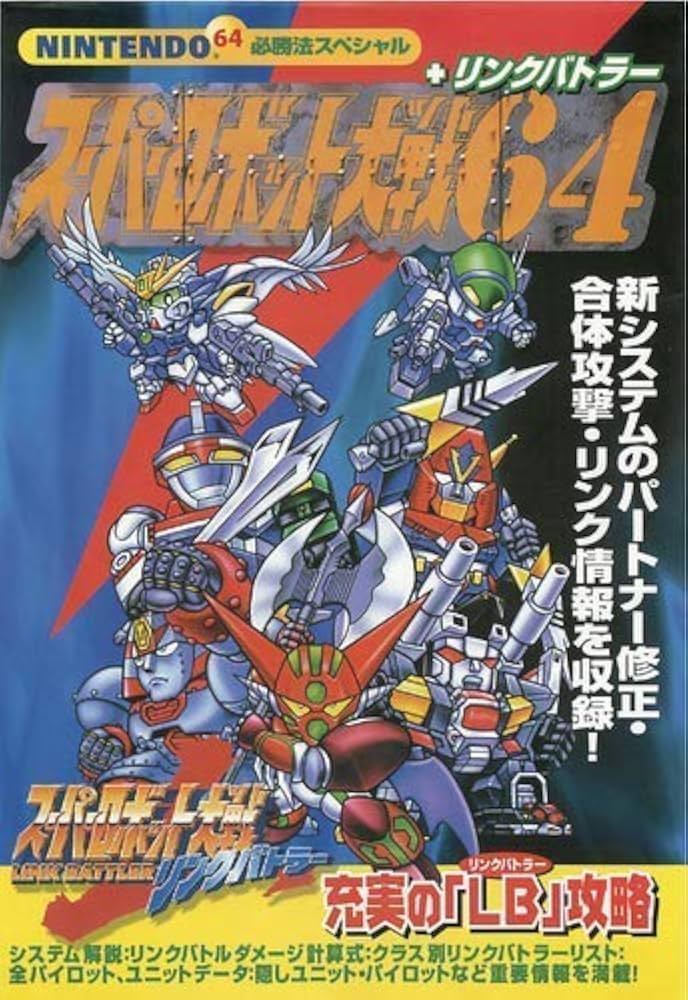
A collection of strategies, wikis, and backstage information for "Super Robot Wars 64"! NINTENDO64
This article introduces a selection of sites that compile strategy, wiki, and behind-the-scenes information on "Super Robot Wars 64" for the Nintendo 64. This title is one of the "Super Robot Wars" series and the only software released for the Nintendo 64. The article includes sites that compile information useful for strategy, such as flowcharts of scenario strategies, key points, backstage techniques, and play diaries.
Read Article
![Super Robot] Nostalgic! Summary of Top 20 Cumulative Sales Ranking of Software for Sega Saturn [Tokimemo].](https://renote.net/files/blobs/proxy/eyJfcmFpbHMiOnsiZGF0YSI6NzQwNDk0MiwicHVyIjoiYmxvYl9pZCJ9fQ==--6d155c100ed364d8a9db80a6a56df3ae863db99f/9468.jpg)
Super Robot] Nostalgic! Summary of Top 20 Cumulative Sales Ranking of Software for Sega Saturn [Tokimemo].
The Sega Saturn is a stationary video game console released by Sega Enterprises in 1994. It also attracted a great deal of attention when actor Hiroshi Fujioka played the commercial character "Segata Sanshiro. The software genre is characterized by a wide variety of fighting games. This article introduces the cumulative sales ranking of the top 20 software titles for the Sega Saturn.
Read Article

Entry in Super Robot Wars! The World of Steel Warriors IF
Robot works that every man has longed to see. The Super Robot Taisen series is a cross-world work that connects such works. Among the many entries in the series, there are many who can be said to be regulars. In this article, we will introduce the three families of regular entries in the series.
Read Article
![A Masterpiece] I want to play it again before I die! Super NES Game 【Recommended】.](https://renote.net/files/blobs/proxy/eyJfcmFpbHMiOnsiZGF0YSI6MTgwNzkyLCJwdXIiOiJibG9iX2lkIn19--89a512c082c743fd6aa77efd98b378b2f9c670a1/z_5fb7b0d7ec722.jpg)
Contents
- Outline of "Super Robot Wars (Alpha Series)
- Introduction of "Super Robot Wars (Alpha Series)
- Super Robot Wars Alpha
- Entries in "Super Robot Taisen Alpha
- Super Robot Wars Alpha for Dreamcast
- Entries in "Super Robot Taisen Alpha for Dreamcast
- Super Robot Taisen Alpha Gaiden
- Entries in "Super Robot Taisen Alpha Gaiden
- The 2nd Super Robot Taisen Alpha
- Entries in "The 2nd Super Robot Taisen Alpha
- The 3rd Super Robot Taisen Alpha: Towards the End of the Galaxy
- Entries in "The 3rd Super Robot Taisen Alpha: Towards the End of the Galaxy
- Game System of "Super Robot Wars (Alpha Series)
- platooning
- pilot
- Pilot Point (PP)
- transfer (trains, buses, etc.)
- unit
- remodeling
- taking over a round trip
- Major characters/characters/units from "Super Robot Wars (Alpha Series)
- rough-and-tumble
- Great Mazinger (i.e. Mazinger the Great)
- Shinji Ikari
- Evangelion first plane
- Kusuha Mizuha
- Dragon and Tiger King
- Lyusei Date
- Bumrah Os
- Famous Scenes from "Super Robot Wars (Alpha Series)
- air
- bond between brothers
- BEYOND THE TIME
- Backstory, Trivia, Small Stories/Episodes, Anecdotes from "Super Robot Wars (Alpha Series)".
- Staff Runaway? Why Combat Animation Has Evolved
- Unusual warning born out of "Second Alpha" promotion.