

A series of crossover simulation RPG "Super Robot Taisen" by Super Robot Anime works. Released by Banpresto and developed by Banpresoft.
It began with "Super Robot Taisen Alpha" released in 2000, and was completed with "The 3rd Super Robot Taisen Alpha" in 2005.
It is a full-length storyline consisting of four games, including one Gaiden game.

The basic game system is similar to a simulation RPG (SRPG). The game is divided into maps, and the campaign system is used to transfer levels and funds between maps.
In each map, the player is divided into two sides, and aims to achieve victory conditions while taking care not to meet defeat conditions.
The level of difficulty changes according to the level of proficiency. In "α", the timing of the skill level was not fixed, but since "α Gaiden", the timing has been changed to a format in which one skill level is added for each map by fulfilling the specified conditions.
platooning

In this series, "Alpha" and "Alpha Gaiden" are based on the "single unit sortie" system, while "2nd Alpha" and "3rd Alpha" are based on the "platoon" system. These series are divided according to whether the unit that goes out on the map is a single unit or a platoon. In platoon-based works, the cost of each unit is fixed, and a platoon is created with a maximum of four units and a total cost of five or less. The platoon is divided into a single platoon, with each platoon costing a maximum of four aircraft, with a total cost of five or less. The platoon leader can be designated as the platoon leader, and only the platoon leader can conduct normal attacks, while the other platoon members conduct support attacks. The platoon leader can be changed throughout the map. There are four types of attacks: normal attacks, in which only the platoon leader attacks; platoon attacks, in which support attacks are made by platoon members; general attacks, in which all units in the enemy platoon are attacked; and MAP weapon attacks, in which multiple enemy platoons are attacked. Normal attacks have the advantage of receiving support attacks from other platoons, although they reduce the number of moves. The weapon to be used by the platoon members during a platoon attack is predetermined (the unit status will indicate "PLA" for the weapon in question so that it can be checked in advance), and the platoon members cannot freely choose their weapons. The overall attack can only be used with specific weapons (weapons marked "ALL" in the unit status) and can attack a large number of enemy units, although the power is attenuated depending on the number of aircraft in the enemy platoon.
pilot

In this work, the pilot of an aircraft is called the pilot. Some units cannot be said to be piloted by a pilot, or may be fighting in the flesh to begin with, but even in these aircraft, the pilot and the unit are separated. Pilots have multiple statuses related to their attacks, special skills that express various characteristics, and special commands called "mental commands," which can have an overturning effect on the battlefield. The "Platoon Leader Skill" was added in the "2nd Alpha" to reflect the shift to a platoon system, and is exercised when the player becomes the platoon leader.
Pilot Point (PP)
It has been available since the "2nd Alpha. Pilots can spend these points to strengthen their pilots. In addition to status increases, special skills can also be acquired. In addition, the number of special skills that each pilot can possess is limited, and it is not possible to override skills that have already been acquired.
transfer (trains, buses, etc.)
Some pilots can switch to other aircraft in the same series. This is one of the features of the Super Robot Wars series. A powerful aircraft can be shared by multiple pilots, or a pilot can be placed on an aircraft suitable for a platoon member.
unit

In this work, weapons that participate in combat, such as robots, fighter planes, and battleships, are called units. Simple living creatures are also treated as units, and in the system, pilots are set up separately from units. The game is played by moving units on the map. In the "2nd Alpha" and onward, the game shifted to a platoon system, in which players control a platoon consisting of multiple units. Units have multiple statuses related to attack and movement, as well as special abilities that express the unit's characteristics.
remodeling
A system to modify and enhance units. This is one of the features of the Super Robot Wars series. Each unit's status and weapons can be modified. In "Alpha", each weapon was modified individually, but from "Alpha Gaiden" onward, all weapons are modified at once.
taking over a round trip
This system was added in Alpha Gaiden. By using the saved data after clearing the game, you can get benefits when you play the game for the second time or later. In "α Gaiden", you can restart the game with a certain amount of funds depending on the difficulty level at the time of clearing the game. From the "2nd Alpha", the player can restart with a percentage of the funds and PP earned in the game depending on the number of laps completed. 100% of the funds and PP can be transferred after 3 laps completed (4th lap) (no further increase). In the "3rd Alpha" game, players can play a special scenario in which all Bumplest original characters are present by using the lap takeover and filling in all the scenario charts.
Major characters/characters/units from "Super Robot Wars (Alpha Series)
Characters and units from the Alpha series will be introduced. Since the game is based on an original work, characters other than the Bumpless originals will be discussed as well as the exhibits.
rough-and-tumble

CV: Keiichi Noda
The main character of "Great Mazinger," a sequel to "Mazinger Z." An orphan, he was taken in by Kenzo Kabuto, the designer of the Great Mazinger, and raised as the pilot of the Great Mazinger.
He was an orphan, but was taken in by Kenzo Kabuto, the designer of the Great Mazinger, and raised as a pilot of the Great Mazinger. He undergoes rigorous training, and in addition to piloting the Great Mazinger, he is proficient in live combat and motorcycle operation, and calls himself a professional fighter.
His age was originally set at 22, but was changed to 18 during the airing. He is a character with various conflicts, such as his origins and his love-hate relationship with his strict adoptive father Kenzo, which is reflected in his usual nihilistic behavior. This conflict leads to a confrontation with Kouji Kabuto, who returns to Japan at the end of "The Great Mazinger," where he takes a stand that leads to a major crisis. He reconciles with Kabuto Kouji thanks to Kenzou's desperate attempts to overcome the situation and the persuasion of Kabuto Shirou, who was Kabuto Kouji's younger brother and Tetsuya's brother as well.
He calls Kabuto Kouji "Kouji-kun," or "Mr. Kabuto. In contrast, Kabuto calls Kouji "kun", "san", or "san", depending on the medium. This is due to the aforementioned change in the age of the characters and the differences in who is in charge of the characters in each medium. In the Super Robot Taisen series, Kouji is basically referred to as "san," and in the Alpha series he is also referred to as "san.
In the "Alpha" series, the characters are introduced in the early stages of the series, but do not join their own armies until the end. Unlike in the DC War series, in this case, he shows a slanted attitude toward his own troops, in accordance with the original story. In the later "Alpha Gaiden," he is even more strongly portrayed in this manner, and in particular, his feud with Kouji becomes more serious. In the later "Alpha Gaiden," the conflict with Kouji in particular becomes more serious, and the story depicts how he overcomes this and grows. In the future version, which is the main stage of this work, he is placed at the center of the story as "a person who can act alone," and he plays such an active role that he is described as the protagonist of "α Gaiden," in which the original protagonist does not appear.
He is a character who has played an active role as the "warp of the α series.

Related Articles

Super Robot Wars (Nintendo handheld series) spoiler commentary and discussion summary
One of the "Super Robot Wars" series, a crossover simulation RPG based on Super Robot anime works. It is called this way because it is produced for portable game consoles sold by Nintendo. Aiming to be a "Super Robot Taisen" series for young people, many new and unusual works have been entered in the series. The series started with "Super Robot Taisen A" released in 2001, and as of January 2018, nine titles have been released.
Read Article

Summary of the successive packages of the Super Robot Taisen series [Super Robot Taisen series].
The "Super Robot Taisen" series is a crossover work featuring robots and characters from "Mazinger Z", "Mobile Suit Gundam", and various other robot animation works. The success of this series has led to a reevaluation of past robot works.
Read Article

Super Robot Wars (OG Series) Spoilers and Discussion Summary
A series derived from Super Robot Wars, a crossover simulation RPG based on Super Robot anime works. The game features original characters and robots from the Super Robot Taisen series. The spin-off works derived from this series are also called Super Robot Taisen OG Saga (OG stands for Original Generation), and form part of this series.
Read Article

Super Robot Wars (DC War Series) Spoilers and Discussion Summary
One of the series of "Super Robot Wars," a crossover of old and new robot animation works. Developed by Winky Soft and released by Banpresto. The genre is simulation RPG (SRPG). This series completed the foundation of the "Super Robot Taisen" series and led the series to become one of Japan's leading crossover series.
Read Article

Super Robot Wars 30 (Super Robot 30) Spoiler Commentary and Discussion Summary
Super Robot Wars 30" is a simulation RPG for Nintendo Switch, PlayStation 4, and Steam, released in 2021 by Namco Bandai Entertainment Inc. The title was created to commemorate the 30th anniversary of the "Super Robot Wars" series, a crossover work that brings together various robot anime from the past and present, and its appeal lies in its battle presentation that recreates the original story.
Read Article

Super Robot Wars Alpha strategy site and wiki summary! You can also get a good idea of the conditions for obtaining hidden units!
Here we have compiled a list of strategy sites and wikis for "Super Robot Wars Alpha". The sites include scenario float charts, pilot special skills, unit special abilities, information on reinforcement parts, and conditions for obtaining hidden units in an easy-to-understand format.
Read Article

Lurking in the Game: Lost Data! Unused Data
In games, there is always some data that has been lost. There may be various reasons for this, but this time I would like to dig back and summarize such known lost data.
Read Article

Will it be realized? Illustration in the style of a Super Robot package
Super Robot Wars is a dreamlike game in which various robot anime co-star in a single game. However, heaven only knows if the robots you want to participate in the game will appear or not. This time, we would like to introduce a Super Robot Taisen package-style fan art that expresses this desire.
Read Article

Summary of the "Super Robot Wars" series from the beginning to the present
Many people know about Super Robot Wars (Super Robot Wars) nowadays, but there are only a few who know about the early days of Super Robot Wars. In fact, there are various quaint things about it, such as unexpected things and old-fashioned images. Here is a brief summary of such twists and turns of Super Robot based on the time period and history.
Read Article
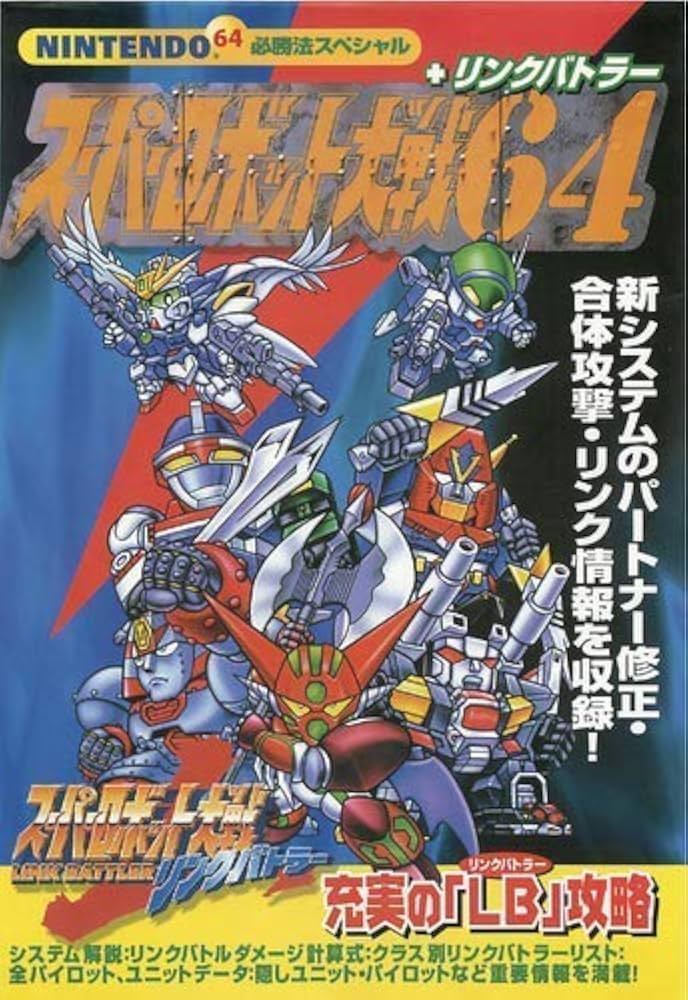
A collection of strategies, wikis, and backstage information for "Super Robot Wars 64"! NINTENDO64
This article introduces a selection of sites that compile strategy, wiki, and behind-the-scenes information on "Super Robot Wars 64" for the Nintendo 64. This title is one of the "Super Robot Wars" series and the only software released for the Nintendo 64. The article includes sites that compile information useful for strategy, such as flowcharts of scenario strategies, key points, backstage techniques, and play diaries.
Read Article
![Super Robot] Nostalgic! Summary of Top 20 Cumulative Sales Ranking of Software for Sega Saturn [Tokimemo].](https://renote.net/files/blobs/proxy/eyJfcmFpbHMiOnsiZGF0YSI6NzQwNDk0MiwicHVyIjoiYmxvYl9pZCJ9fQ==--6d155c100ed364d8a9db80a6a56df3ae863db99f/9468.jpg)
Super Robot] Nostalgic! Summary of Top 20 Cumulative Sales Ranking of Software for Sega Saturn [Tokimemo].
The Sega Saturn is a stationary video game console released by Sega Enterprises in 1994. It also attracted a great deal of attention when actor Hiroshi Fujioka played the commercial character "Segata Sanshiro. The software genre is characterized by a wide variety of fighting games. This article introduces the cumulative sales ranking of the top 20 software titles for the Sega Saturn.
Read Article

Entry in Super Robot Wars! The World of Steel Warriors IF
Robot works that every man has longed to see. The Super Robot Taisen series is a cross-world work that connects such works. Among the many entries in the series, there are many who can be said to be regulars. In this article, we will introduce the three families of regular entries in the series.
Read Article
![A Masterpiece] I want to play it again before I die! Super NES Game 【Recommended】.](https://renote.net/files/blobs/proxy/eyJfcmFpbHMiOnsiZGF0YSI6MTgwNzkyLCJwdXIiOiJibG9iX2lkIn19--89a512c082c743fd6aa77efd98b378b2f9c670a1/z_5fb7b0d7ec722.jpg)
Contents
- Outline of "Super Robot Wars (Alpha Series)
- Introduction of "Super Robot Wars (Alpha Series)
- Super Robot Wars Alpha
- Entries in "Super Robot Taisen Alpha
- Super Robot Wars Alpha for Dreamcast
- Entries in "Super Robot Taisen Alpha for Dreamcast
- Super Robot Taisen Alpha Gaiden
- Entries in "Super Robot Taisen Alpha Gaiden
- The 2nd Super Robot Taisen Alpha
- Entries in "The 2nd Super Robot Taisen Alpha
- The 3rd Super Robot Taisen Alpha: Towards the End of the Galaxy
- Entries in "The 3rd Super Robot Taisen Alpha: Towards the End of the Galaxy
- Game System of "Super Robot Wars (Alpha Series)
- platooning
- pilot
- Pilot Point (PP)
- transfer (trains, buses, etc.)
- unit
- remodeling
- taking over a round trip
- Major characters/characters/units from "Super Robot Wars (Alpha Series)
- rough-and-tumble
- Great Mazinger (i.e. Mazinger the Great)
- Shinji Ikari
- Evangelion first plane
- Kusuha Mizuha
- Dragon and Tiger King
- Lyusei Date
- Bumrah Os
- Famous Scenes from "Super Robot Wars (Alpha Series)
- air
- bond between brothers
- BEYOND THE TIME
- Backstory, Trivia, Small Stories/Episodes, Anecdotes from "Super Robot Wars (Alpha Series)".
- Staff Runaway? Why Combat Animation Has Evolved
- Unusual warning born out of "Second Alpha" promotion.