

One of the series of "Super Robot Wars," a crossover of old and new robot animation works. Developed by Winky Soft and released by Banpresto. The genre is simulation RPG (SRPG).
This series completed the foundation of the "Super Robot Taisen" series and led the series to become one of Japan's leading crossover series.
CV: Hikaru Midorikawa
Original character created by Banpresto. The underlying setting, added later, was created by Masahiko Sakata of Winky Soft. He appeared as the main character in the fictional work "Magic Machine God Cybuster" and actually played the main role in the "Magic Machine God" series, a spin-off of this series. He has appeared in all the works in the series.
He is a boy from Japan who was summoned to the underground world of LaGeas. He is a hot-blooded, athletic man. He is active as a psybuster operator. He is extremely directionless, and even though he has a high-performance Laplace computer for navigation, he once circled the earth several times before meeting up with his army. He has a black-and-white cat named Familia (the messenger demon in "Magic Machine God Psybuster") with him.
In the "2nd" series, "Seisen-Shi Dunbine," which was scheduled to participate in the series, was not able to appear (the reason for this is unknown), and an alternative character was needed in the scenario. The "Tertiary" was a work that was a tribute to the same work. In "The Third," it is said that he came from the underground world of LaGuise, and we can glimpse the setting of LaGuise to some extent. In "EX," La-Geas is the setting of the work, and Masaki's background is described in detail. In "EX," Masaki's background is described in more detail, and the two actors also appear together in a long-awaited collaboration with "Saint Dunbine," the film that pays homage to the original.
In "The Second Stage," Masaki is described as having experience in battle like the other members of his army, but his army is wary of him because he is an unidentified figure whose details are unknown.
His piloting skills are excellent in attack, but his evasive maneuvers leave a little to be desired when handling the Psybuster, which boasts high mobility but is vulnerable to strikes. Depending on the work, Masaki's status is often unbalanced with that of the Psybuster. In addition, reflecting the fact that the "Magic Machine God" series is set in LaGeas, an alternate world where space does not exist, he is not good at fighting in space, which is a promise at the end of the series. However, it is said that this is due to the PsyBuster's powerful map weapon "PsyFlash," and its mental command structure is designed to be extremely compatible with "PsyFlash," so it has advantages that more than compensate for its weaknesses. The statuses of both the character and the unit have been adjusted to take advantage of the fact that they are not transferable.
By taking full advantage of the PsyBuster's speed and "PsyFlash," the PsyBuster is expected to be very successful when used as a cutthroat.
Cybuster.

Original robot created by Banpresto. The underlying setting, added later, was created by Masahiko Sakata of Winky Soft. It appeared in the "Secondary" as the lead robot in the fictional work "Magic Machine God Psybuster. In the later development of the "Magic Machine God" series, he actually plays the leading role as the main robot. Appears in all the works in the series.
The "Magic Machine" (the generic name for robots in the "Magic Machine" series) was built in the Kingdom of Sacred Lang Lang, the nation of LaGuise. A magical machine is a robot that can be moved by making a contract with a spirit, and Psybuster boasts immense power as a "magical machine god" that has made a contract with a high-ranking spirit. The contracted spirit is the wind spirit "Cyphis. It can transform into a high-speed flying form, Cyberbird.
Although not reproduced in this series, it has a strong fantasy element, such as the use of "prana," the spiritual power of the pilot (the generic term for the pilot in the "Magic Machine God" series), as part of its motive power. These are homages to the fantastical robot anime "Saint Dunbine," which was scheduled to appear in the "2nd" series but was cancelled in the middle of production. The transformation mechanism was inspired by Birvine, the main robot in the latter half of the same work.
In this series, the control mechanism often malfunctioned, limiting the robot's armament. This was done to prevent the use of powerful and unparalleled attacks in the early stages of the series, and for the same reason, many of the robots in the later works in the series also appeared with unusable armaments.
The main weapons are the sword Discatter (Vanity Ripper in the latter half of the second series) for close-range combat, the map weapon Psyflash, which can be used after movement and is the most powerful weapon in the series because it can identify friend and foe so that allies are not involved, and the remote weapon operated by Masaki's Familiar, who is the operator of the High Familiar. The unit's special moves include the Akashic Buster, which summons firebirds to charge at the enemy, and the Cosmo Nova, four balls of light that are released by consuming a large amount of Masaki's prana.
As a unit, its characteristics are basically focused on dodging enemy attacks and striking psi-flashes at the center of enemy forces. In the "2nd" series, there was a system limitation of up to two armaments for each unit, but this unit's armaments of choice were the "Discatter to Vanity Ripper" and the "Psyflash," and the Psyflash is known by fans as synonymous with this unit.
The High Familiar's high mobility, abundant ammunition, and excellent evasion capabilities also make it possible to fight in the midst of enemy forces, drawing attacks and cutting down enemy forces with counterattacks. However, the ability of Masaki, the manipulator, to dodge through an opponent's attack leaves some uncertainty, so it is necessary to assess the opponent.
Famous Scenes from Super Robot Wars (DC War Series)
Threatening Weapons Rhino-Flash
From "The Second Stage.
The Londo Bell team is on its way to capture the Divine Crusaders' fortress. The Londo Bell team is struggling against a large number of fixed batteries when a mysterious robot, the Psybuster, appears. Masaki, the pilot of the Psybuster, offers to help, and uses his Psyflash to destroy all the fixed batteries.
The Psybuster rushes into the interior of the fortress alone and disappears.
A strong first appearance of an original character. The power of the Psyflash, the only map weapon in this work, is demonstrated without regret, leaving a lasting impression whether we like it or not. Its sudden appearance in a natural setting, during the attack on an impregnable fortress, had a tremendous impact on the player. With only a few lines of dialogue and the use of a weapon, the "unidentified powerful mecha" is successfully presented.
General Bian's intentions
From "The Second Stage.
The Londo Bell Squadron defeats the most powerful unit, the Last Battalion, and finally overtakes the Divine Crusaders' commander-in-chief, Bian Zoldark, who has been cornered. Biane tells the members of the Londo Bell squadron to "face the threat that will soon come," and dies while thinking of her daughter, Ryune.
The White Base squadron, while chewing on their victory, feels a sense of discomfort, as if they have been dancing in Bian's hands, and they sense a sense of disquiet in Bian's words that foreshadow the next battle.
An ending that continues into the next film. The graceful end of Bian's professed desire for world domination and the words he left behind fueled expectations. As a result, the series continues and Bian's words become reality. It is an impressive scene that will leave you with a different emotion if you play through the series.
ragnarok
From "The Tertiary.
In the final battle against the alien "Inspectors," the Londo Bell team defeats the alien leader, Wendro. Immediately after that, Shu Shirakawa, who had been cooperating with the Londo Bell team, challenges the Londo Bell team to a battle by himself.
Shu declares that he will destroy everything on earth, and awakens his robot Granzon into its true form, Neo Granzon, and uses Valcyon, which once tormented the Londo Bell Squad, as a pawn in a deadly battle with the Londo Bell Squad.
A direction related to the hidden map. If the number of turns at the time of clearing the final map is less than a certain number, Shu, who has been a member of his own army, suddenly betrays him. The purpose of Shu, who has always hinted at an aim other than peace on earth, is revealed, opening the way to the hidden map, which boasts an intense level of difficulty.
The impact of this scene is stronger in the actual death struggle that unfolds. Shu and Neo Granzon are incomparably stronger than their previous opponents. In this title, the player does not know the damage or remaining HP until the enemy's remaining HP is below 10,000, and Shu will attempt to recover by using the "Dokonetsu" mental command when the enemy's HP drops below a certain level. Many players were wondering if their attacks were really working or if they could win the battle even if they knew their attacks were working. The process of finally winning a battle to the death is a powerful experience that stays with the player. This is a way of leaving a lasting impression that only a game can leave.
The Glory of the Fallen Sun
From "The Fourth.
The Titans, a special unit within the Earth Federation Forces formed to rehire former soldiers of the Divine Crusaders, became increasingly isolated within the Federation Forces due to their repeated arbitrary actions. The Titans became increasingly isolated within the Federation Forces, and their connection to the terrorist organization "Neue DC" formed by the remnants of the Divine Crusaders was also exposed, and they were hunted down. The Londo Bell squadron is divided into two teams: the A Team, which is to attack the opposing forces on Earth, and the B Team, which is to participate in the battle in space ahead of the A Team, and the A Team goes to a decisive battle with the Titans. The Titans, led by Jamaican, the leader of the Titans, gather in Lhasa and join forces with those who agree with the Titans' ideology and the forces from the other world, Byston Well, to fight a final battle.
Like the aforementioned Ragnarok, this map will leave a lasting impression on players, depending on what they play. While the division of the forces reduces the strength of the allies, the final battle is a showdown between the mighty enemy forces and the battle to decide who will win the battle. In addition, the timing for the division of units is right after the completion of the previous map, and the previous map, "Singularity Collapse," boasts a fairly high level of difficulty, so there is little time to finish replacing pilots in anticipation of the division, or to make adjustments so that powerful units remain in their own forces. The player is forced to take up the challenge of decisive battles with inadequate preparation. Players must overcome repeated battles with powerful enemies and reinforcements to overcome this map. It is a map that leaves a strong impression, even being called "traumatic" among users.
Confession of love
From "The Fourth Order."
An act just before the final battle on Mars against the alien radicals, the Guests.
The protagonist expresses his feelings to the secondary protagonist before the final battle.
This event does not occur unless the protagonist and secondary protagonist go into battle at the same time at least a certain number of times.
Since the secondary protagonist is less capable than the protagonist, it is difficult for the protagonist and the secondary protagonist to go into battle at the same time if the player focuses on efficiency.
In other words, this exchange is a kind of fan service event for users who have patronized the protagonist and secondary protagonists.
Naturally, the content of the event changes depending on the gender and personality of the protagonist. Particularly popular are the events when the protagonist is a "theorist but heterosexual".
Mazinger Z vs. Getter Robo G
From "F".
The Photon Power Laboratory receives an urgent call from the Saotome Research Institute. Baron Ashura has taken the Getter Dragon, which is being adjusted. Kouji Kabuto boards Mazinger Z and rushes to the Saotome Institute with the main character, who has come to observe the Photon Power Institute. Dr. Saotome advises him that there is no other way but to destroy it, and Kouji Kabuto joins the boss, who is also ahead of him, to challenge the Getter Robo G to battle.
This is the first episode of "F," and it is an event that demonstrates the power of the next-generation machine. The scene of Mazinger Z's launch is a movie extracted from the original anime, with newly recorded voices, and the scene of the boss (for the characters as well as for the player) is a DVE (Dramatic Voice Event, an abbreviation for "Dramatic Voice Event"). The bosses' appearance scenes are presented in DVE (Dramatic Voice Event, a voiced event that has been included in this title). In particular, movies extracted from the original animation are unique to the DC War series, making this a one-of-a-kind production.
Backstory, Trivia, and Small Stories/Episodes/Anecdotes from "Super Robot Wars (DC War Series)".
From the "Compatible Hero" series to the "Super Robot Wars" series
There is a game series called the "Compatible Hero" series. This is a series of crossover games in which two-scale deformed characters from "Ultraman," "Kamen Rider," "Mobile Suit Gundam," "Sentai Heroes," and even "Godzilla" gather together to fight battles and engage in sports.
Launched by Banpresto, an affiliate of Bandai, which holds the merchandising rights to many of these works, the series surprised the industry by overturning the conventional wisdom of crossovers that transcended corporate boundaries.
The realization of this series was largely due to the personal connections of then Banpresto President Yukimasa Sugiura. Having worked for toy giants Popy and Bandai, he had connections with many copyright holders. He succeeded in obtaining permission from each company to make the game into a video game. The reason why this crossover, which was unusual at the time, was realized was because he only went out to obtain permission to make the game.
The "Compatible Hero" series became popular because the "Super Deformation" (commonly known as "SD") line of deformed products was a big hit at the time.
The first title in the "Super Robot Taisen" series, "Super Robot Taisen," was born out of this trend. This title was released as a derivative of the "Compatible Hero" series, and featured robots from the "Mobile Suit Gundam" series, "Mazinger" series, and "Getter Robot" series, all of which are robot anime, as deformed anthropomorphic characters. The heroic scenario of saving the earth from a crisis was well received and became a smash hit, leading to the decision to continue the series.
When producing the second film, it was the developer Winky Soft's idea to change the direction of the series by having the pilot appear instead of the anthropomorphized robot. The result was "The Second Super Robot War," which marked the beginning of the DC War series.
Censoring crisis and a weepy one
The "2nd Super Robot Taisen" was produced in a little more than six months. However, the "Seisen-Shi Dunbine" that was scheduled to participate in the game became unavailable during the production, forcing the company to use the fictional "Magic Machine God Cybuster" as a replacement, and other difficulties were encountered. Combined with the headwind of being produced for the Family Computer at the end of 1991, when users' interest and purchasing power were shifting toward the next-generation Super Nintendo Entertainment System (SNES), this resulted in a significant drop in sales.
While serious consideration was given to discontinuing the series, WinkySoft pleaded with the company to discontinue the series, but the decision was based on the sales of the next title.
WinkySoft's enthusiasm for the series was so strong that they were even considering taking the project to another company if the series was terminated.
Thus, the decision was made to release "The Third Super Robot War," in which the battle against aliens suggested in "The Second" would unfold.
From sluggish sales to "fantastic software" - The miracle of "The 3rd Super Robot War" -.
The 3rd Super Robot Taisen" moved to the Super Nintendo Entertainment System (SNES) platform, and the graphics, sound, scenario, and system were all greatly enhanced. Sales were sluggish when it was first released, but after a while, game information magazines began to notice the appeal of this title and began to actively feature it in their articles. This led to its recognition by many gamers, especially by fans of robot animation, and it was stocked out of game stores in various regions. At one point, the number of users who wanted this title increased so much that it was sold at high prices in second-hand stores, and it became a rare software that was hard to find in the first place, leading to an emergency decision to increase production. It was around this time that the series was recognized by Ichiro Mizuki, famous singer of "Mazinger Z" and other animated songs, and other people in the industry. Sales of the first "Super Robot Taisen" exceeded those of the first "Super Robot Taisen," and after much demand from users, two sequels were decided: "Super Robot Taisen EX," an offshoot of the first "Super Robot Taisen" featuring the "Magic Machine God Cybuster," which had been in the second series and whose details have yet to be revealed. The other is "The 4th Super Robot Taisen," the final installment of the series.

Related Articles

Super Robot Wars (Nintendo handheld series) spoiler commentary and discussion summary
One of the "Super Robot Wars" series, a crossover simulation RPG based on Super Robot anime works. It is called this way because it is produced for portable game consoles sold by Nintendo. Aiming to be a "Super Robot Taisen" series for young people, many new and unusual works have been entered in the series. The series started with "Super Robot Taisen A" released in 2001, and as of January 2018, nine titles have been released.
Read Article

Summary of the successive packages of the Super Robot Taisen series [Super Robot Taisen series].
The "Super Robot Taisen" series is a crossover work featuring robots and characters from "Mazinger Z", "Mobile Suit Gundam", and various other robot animation works. The success of this series has led to a reevaluation of past robot works.
Read Article

Super Robot Wars (OG Series) Spoilers and Discussion Summary
A series derived from Super Robot Wars, a crossover simulation RPG based on Super Robot anime works. The game features original characters and robots from the Super Robot Taisen series. The spin-off works derived from this series are also called Super Robot Taisen OG Saga (OG stands for Original Generation), and form part of this series.
Read Article

Super Robot Wars (Alpha Series) Spoilers and Discussion Summary
A series of crossover simulation RPG "Super Robot Taisen" by Super Robot Anime works. Released by Banpresto and developed by Banpresoft. It began with "Super Robot Taisen Alpha" released in 2000, and was completed with "The 3rd Super Robot Taisen Alpha" in 2005. It is a full-length storyline consisting of four games, including one Gaiden game.
Read Article

Super Robot Wars 30 (Super Robot 30) Spoiler Commentary and Discussion Summary
Super Robot Wars 30" is a simulation RPG for Nintendo Switch, PlayStation 4, and Steam, released in 2021 by Namco Bandai Entertainment Inc. The title was created to commemorate the 30th anniversary of the "Super Robot Wars" series, a crossover work that brings together various robot anime from the past and present, and its appeal lies in its battle presentation that recreates the original story.
Read Article
![A Masterpiece] I want to play it again before I die! Super NES Game 【Recommended】.](https://renote.net/files/blobs/proxy/eyJfcmFpbHMiOnsiZGF0YSI6MTgwNzkyLCJwdXIiOiJibG9iX2lkIn19--89a512c082c743fd6aa77efd98b378b2f9c670a1/z_5fb7b0d7ec722.jpg)
A Masterpiece] I want to play it again before I die! Super NES Game 【Recommended】.
I want to play it again before I die! This is a compilation of Super Nintendo Entertainment System (SNES) game titles. There are more than 1,000 Super Nintendo Entertainment System (SNES) game titles, so we took the time to compile this list. Generally, the further back you go, the older the release.
Read Article

Lurking in the Game: Lost Data! Unused Data
In games, there is always some data that has been lost. There may be various reasons for this, but this time I would like to dig back and summarize such known lost data.
Read Article

Will it be realized? Illustration in the style of a Super Robot package
Super Robot Wars is a dreamlike game in which various robot anime co-star in a single game. However, heaven only knows if the robots you want to participate in the game will appear or not. This time, we would like to introduce a Super Robot Taisen package-style fan art that expresses this desire.
Read Article

Summary of the "Super Robot Wars" series from the beginning to the present
Many people know about Super Robot Wars (Super Robot Wars) nowadays, but there are only a few who know about the early days of Super Robot Wars. In fact, there are various quaint things about it, such as unexpected things and old-fashioned images. Here is a brief summary of such twists and turns of Super Robot based on the time period and history.
Read Article
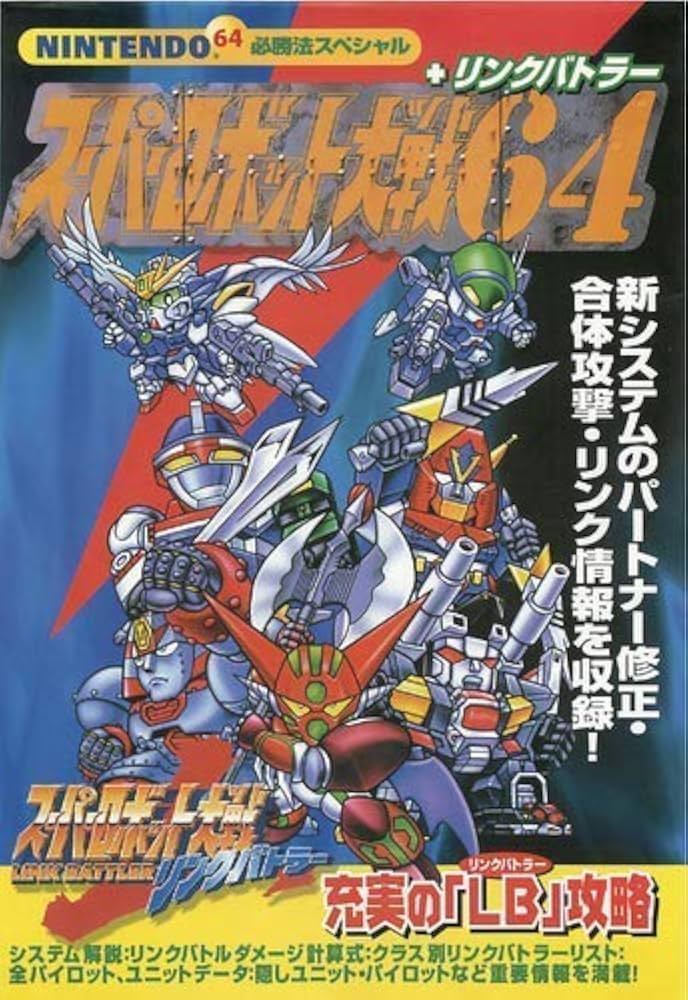
A collection of strategies, wikis, and backstage information for "Super Robot Wars 64"! NINTENDO64
This article introduces a selection of sites that compile strategy, wiki, and behind-the-scenes information on "Super Robot Wars 64" for the Nintendo 64. This title is one of the "Super Robot Wars" series and the only software released for the Nintendo 64. The article includes sites that compile information useful for strategy, such as flowcharts of scenario strategies, key points, backstage techniques, and play diaries.
Read Article
![Super Robot] Nostalgic! Summary of Top 20 Cumulative Sales Ranking of Software for Sega Saturn [Tokimemo].](https://renote.net/files/blobs/proxy/eyJfcmFpbHMiOnsiZGF0YSI6NzQwNDk0MiwicHVyIjoiYmxvYl9pZCJ9fQ==--6d155c100ed364d8a9db80a6a56df3ae863db99f/9468.jpg)
Super Robot] Nostalgic! Summary of Top 20 Cumulative Sales Ranking of Software for Sega Saturn [Tokimemo].
The Sega Saturn is a stationary video game console released by Sega Enterprises in 1994. It also attracted a great deal of attention when actor Hiroshi Fujioka played the commercial character "Segata Sanshiro. The software genre is characterized by a wide variety of fighting games. This article introduces the cumulative sales ranking of the top 20 software titles for the Sega Saturn.
Read Article

Entry in Super Robot Wars! The World of Steel Warriors IF
Robot works that every man has longed to see. The Super Robot Taisen series is a cross-world work that connects such works. Among the many entries in the series, there are many who can be said to be regulars. In this article, we will introduce the three families of regular entries in the series.
Read Article

Tags
Contents
- Outline of "Super Robot Wars (DC War Series)
- Super Robot Wars (DC War Series)
- The 2nd Super Robot War
- Entries in "The Second Super Robot Taisen
- The 2nd Super Robot War G
- Entries in "The 2nd Super Robot Taisen G
- The 3rd Super Robot War
- Entries in "The 3rd Super Robot Taisen
- Super Robot Wars EX
- Entries in "Super Robot Taisen EX
- The 4th Super Robot War
- Works of "The 4th Super Robot Taisen
- The 4th Super Robot Wars S
- Super Robot Taisen F" / "Super Robot Taisen F Complete
- Entries in "Super Robot Taisen F" / "Super Robot Taisen F Complete
- Super Robot Wars Complete Box
- Game System of "Super Robot Wars (DC War Series)
- basic system
- unit
- pilot
- intermission
- remodeling
- Reinforced parts
- combat system
- mental command
- Special Abilities/Special Skills
- map weapon
- Two actions
- System of "The Second Super Robot Taisen
- Introduction of major characters/units in Super Robot Wars (DC War Series)
- armoured warrior
- Mazinger Z
- Mazinkaiser
- promoted bishop (shogi)
- getter dragon
- True Getter 1
- Amuro Rey.
- gundam
- nu Gundam
- Quattro Basina
- Sotheby's
- Masaki Ando
- Cybuster.
- Famous Scenes from Super Robot Wars (DC War Series)
- Threatening Weapons Rhino-Flash
- General Bian's intentions
- ragnarok
- The Glory of the Fallen Sun
- Confession of love
- Mazinger Z vs. Getter Robo G
- Backstory, Trivia, and Small Stories/Episodes/Anecdotes from "Super Robot Wars (DC War Series)".
- From the "Compatible Hero" series to the "Super Robot Wars" series
- Censoring crisis and a weepy one
- From sluggish sales to "fantastic software" - The miracle of "The 3rd Super Robot War" -.
- Series established, and becoming "Japan's leading crossover series