

One of the series of "Super Robot Wars," a crossover of old and new robot animation works. Developed by Winky Soft and released by Banpresto. The genre is simulation RPG (SRPG).
This series completed the foundation of the "Super Robot Taisen" series and led the series to become one of Japan's leading crossover series.
Also known as "4th S. Released in January 1996.
A port of the "4th S" to PlayStation. All of the entries and systems are the same as "The 4th S." New battle voices were added to some characters.
New battle voices were added for some characters. The voice actors for the added characters are all the same voice actors from the TV anime. For this reason, the voices were not introduced for "UFO Robot Grendizer," for which the original voice actor was in the hospital, and "Invincible Superhero Zambot 3," for which the original voice actor had received little new work.
Other changes in the specifications include a change in the scenario structure (to allow characters with voices to appear for a longer period of time) and some balance changes.
In addition, the hardware was changed from the Super Nintendo Entertainment System (SNES) using ROM cassettes to the PlayStation® using disk media, which caused loading time to occur. (The BGM was changed from "MAP→Combat→MAP" twice per battle to "MAP or previous battle→Combat" only once per battle).
The game is available as a PS Archives download for PlayStation Portable and PlayStation 3.
Super Robot Taisen F" / "Super Robot Taisen F Complete
Also known as "F"/"F Complete". Software for Sega Saturn. The "F" in the title comes from "FINAL". It was released as the first and second installments. F" was released in September 1997, and "F Final" in April 1998.
It is a remake of the "4th", the final work in the series, with major modifications. The entries in the series were also changed significantly, and the storyline was described in more detail.
Additional entries include "Neon Genesis Evangelion," which dominated the market at the time; "Gundam W," a popular work that captivated female anime fans; "Densetsu Kyojin Ideon," a milestone that transcended the boundaries of robot animation and changed the history of anime since 1980; "Top Aim for the Top! which completed the commercial model of OVAs, and other extremely popular and talked-about works that succeeded in attracting a large number of users.
Due to a sudden decision to sell the game in installments due to problems during the development process, "Densetsu Kyojin Ideon" and "Aim for the Top! appeared in "F" only in the preview part of the "Final Arc" after the game was cleared, and "Gundam W" appeared in "F" only as an enemy or guest character.
The performance of enemy units and additional allied units appearing in "F: The Last Arc" is unusually high. As a result, the battle balance became inflated, and even experienced players of the series found the difficulty level too high.
The game was also ported to PlayStation®, and the PlayStation® version is available as a PS Archives download for the PlayStation®Portable and PlayStation®3.
Entries in "Super Robot Taisen F" / "Super Robot Taisen F Complete
Mobile Suit Gundam
Mobile Suit Gundam 0080 War in the Pocket
Mobile Suit Gundam 0083 Stardust Memory
Mobile Suit Gundam Zeta Gundam
Mobile Suit Gundam Zeta
Mobile Suit Gundam: Char of the Counterattack
Mobile Suit Gundam F91
Mobile Suit Gundam F91
New Mobile Suit Gundam W
Mazinger Z
Great Mazinger
Getter Robo
Getter Robo G
Shin Getter Robo (original manga version)
Super Electromagnetic Robot Con Battler V
Invincible Steel Man Daiturn 3
Sengoku Majin Goshogun
Dancuga: The Super Beast Machine God
Densetsu Kyojin Ideon
Dunkoga: The Legendary Giant God Ideon
DANBINE
Heavy War Machine El-Gaim
Neon Genesis Evangelion
The first series of "Densetsu Kyojin Ideon," "Aim for the Top! Neon Genesis Evangelion" made its first appearance in the series. Also, "New Mobile Suit Gundam W" made its first appearance in the DC War series. Although "Mobile Fighter G Gundam" is a return entry in terms of release date and timeline, it is treated as a new entry in the scenario and has a parallel relationship with the "2nd G." The "4th G" series is the first entry in the series.
UFO Robot Grendizer," "Invincible Superhero Zambot 3," "Yusha Raideen," and "General Deimos" did not appear in the "4th G" series.
Super Robot Wars Complete Box
Released in June 1999, this software ported the "2nd," "3rd," and "EX" games to the PlayStation, which had been difficult to play due to changes in hardware.
The basic system is the same as that of "F", but the unit values have been changed to match those of "Tertiary", and the pilot data has also been adjusted for "F" based on "Tertiary". Units and pilots that did not appear in "Tertiary" were adjusted individually. The maps and scenarios are faithful to the original port, with only minor changes to the storyline.
The battles are fully voiced, as in "F," but if the cast of the original version is unable to appear, a substitute is substituted.
The game is presented on two discs, with disc 2 containing various materials and an extra mode.
The data was based on the status of the "Tertiary" game, which did not fit the "F" system, and for some reason the adjustments made during the porting were kept to a minimum, making the balance of the game very unstable. In particular, the small amount of funds that could be acquired was considered a problem.
Soon after its release, "2nd," "3rd," and "EX" were sold in installments. The price was reduced to about 1/3 of the original version, and the amount of money earned from shooting down enemies was uniformly increased by 1.5 times.
The split-sale versions are available as PS Archives downloads for the PlayStation Portable and PlayStation 3.
Game System of "Super Robot Wars (DC War Series)
The game systems of this series will be introduced. Since the "2nd Super Robot Taisen" differs significantly from later works, it will be introduced collectively at the end as the "System of the "2nd Super Robot Taisen.
basic system

Screen is from "4th S".
The genre of this series is simulation RPG, which basically adopts a campaign style in which players lead their own troops to defeat enemy troops and a third force to clear a map and move on to the next map.
The scenario is explained through conversations before and after each map, and there are inter-missions between maps.
unit
A generic term for robots, battleships, aircraft, and other mechanical devices that can be controlled by the player or CPU in this series. In this series, however, the frame is treated as a combination of two elements, the "pilot" and the "mechanic that the pilot rides," so a convenient name was needed for the "mechanic that the pilot rides," and the name "unit" was used. The name "unit" was used. The term "unit" is also used simply to refer to "frames" placed on the map, and some maps specify "escape of all allied units" as a victory condition.
The basic structure of the "unit" consists of robots and battleships, with aircraft and other aircraft appearing as support units, but in "The Second Super Robot Taisen G" and "Super Robot Taisen F," flesh-and-blood humans appear as units. This "human unit" was introduced to reproduce the "Mobile Mutant G Gundam" in which there are many depictions of robots defeating enemy robots with their own bodies, and both the player and the CPU rarely have the opportunity to use them.
pilot
A generic term for a character in this series who participates in combat on the map. To be precise, creatures and consciousnesses that are not pilots are also treated as pilots. Like the aforementioned units, this concept is based on the existence of two elements: the "pilot" and the "mechanic that the pilot rides". Characters that do not participate in combat on the map are called non-pilots or NPCs, and are treated separately from pilots.
The existence of the unit and the pilot became clear after the differentiation of the unit and the pilot at the time of the "Tertiary". Since pilots and units are treated separately, some pilots are able to transfer to other units. Units that can be switched are basically limited to aircraft of the same series.
intermission
A screen that is inserted between each map to prepare for the next map. This screen is also where you can save your game, so it also serves as a break or a break in the game.
Pilots can be changed, aircraft can be modified, and parts can be reinforced. Even in battles that are sequential in the storyline, these commands can be executed during intermissions.
remodeling
Modifications are made to the unit. A certain amount of funds is required for modification. This system is one of the well-known features of this series and symbolizes the fact that this series is "an SRPG that depicts battles fought by robots ridden by pilots.
In the "3rd" series, only unit status could be modified, but in the "EX" series, weapon attack power can also be modified. The increase in status due to modification is constant. The amount of increase in weapon attack power has been differentiated since "F", so that the weapon used in everyday use does not easily exceed the attack power of special moves. The number of modification levels available is 7 for the "3rd" to "4th" and "2nd G," 5 for "F" and the middle of "F Complete", and 10 for "F Complete" and "Complete Box". The cost of modification increases with the level of modification, so players are left to decide whether to focus on modifying certain units to give them outstanding performance, or to modify several units to some extent to increase their overall strength.
In the beginning, when a unit was replaced, the modification stages were uniformly reset, but in the "4th" version, the modifications are carried over to the unit being replaced. This means that, for example, when Mazinger Z is equipped with Jet Scrander and is registered as a new unit in the army as Mazinger Z (equipped with Jet Scrander), the modifications made to Mazinger Z will be carried over to the new unit. This eliminates the need to hesitate about modifying Getter Robo or Mazinger Z, which will automatically switch to the successor unit.
Note that the modification stage is not carried over if the unit can be used in the game as another unit. For this reason, strategic consideration is required when modifying a robot that has many powerful units, each of which remains in the game data in a form that can be switched.
From "F Complete," a full modification bonus was introduced. By modifying all of a unit's statuses by 10 levels, additional statuses can be raised significantly. The status that can be raised is selected from among those offered, and not all of the full modification bonuses can be obtained. In the "Complete Box," the value of the full modification bonus is much higher than that of several levels of modification, and the full modification has been changed so that the user can gain a large advantage.
Also from "F Complete Box", some weapons can be fully modified to add more powerful armaments. The weapons that can be added are enhanced versions of the original weapon, variations, map weapons, etc. You can obtain extremely useful map weapons and powerful special moves by modifying the added weapons.
Reinforced parts
An item that can be equipped on a unit. It has been available since the "4th" series. In "F" and later, however, they can be obtained by defeating enemies. There are three types of items: items that increase status, items that grant special properties to units, and recovery items that can be used on the map. Some items are so powerful that they can drastically change the operation of a unit. In the "2nd G," units undergoing full modification are automatically equipped with reinforcement parts, which are in effect a full modification bonus.
combat system

Map screen of "F Complete

Related Articles

Super Robot Wars (Nintendo handheld series) spoiler commentary and discussion summary
One of the "Super Robot Wars" series, a crossover simulation RPG based on Super Robot anime works. It is called this way because it is produced for portable game consoles sold by Nintendo. Aiming to be a "Super Robot Taisen" series for young people, many new and unusual works have been entered in the series. The series started with "Super Robot Taisen A" released in 2001, and as of January 2018, nine titles have been released.
Read Article

Summary of the successive packages of the Super Robot Taisen series [Super Robot Taisen series].
The "Super Robot Taisen" series is a crossover work featuring robots and characters from "Mazinger Z", "Mobile Suit Gundam", and various other robot animation works. The success of this series has led to a reevaluation of past robot works.
Read Article

Super Robot Wars (OG Series) Spoilers and Discussion Summary
A series derived from Super Robot Wars, a crossover simulation RPG based on Super Robot anime works. The game features original characters and robots from the Super Robot Taisen series. The spin-off works derived from this series are also called Super Robot Taisen OG Saga (OG stands for Original Generation), and form part of this series.
Read Article

Super Robot Wars (Alpha Series) Spoilers and Discussion Summary
A series of crossover simulation RPG "Super Robot Taisen" by Super Robot Anime works. Released by Banpresto and developed by Banpresoft. It began with "Super Robot Taisen Alpha" released in 2000, and was completed with "The 3rd Super Robot Taisen Alpha" in 2005. It is a full-length storyline consisting of four games, including one Gaiden game.
Read Article

Super Robot Wars 30 (Super Robot 30) Spoiler Commentary and Discussion Summary
Super Robot Wars 30" is a simulation RPG for Nintendo Switch, PlayStation 4, and Steam, released in 2021 by Namco Bandai Entertainment Inc. The title was created to commemorate the 30th anniversary of the "Super Robot Wars" series, a crossover work that brings together various robot anime from the past and present, and its appeal lies in its battle presentation that recreates the original story.
Read Article
![A Masterpiece] I want to play it again before I die! Super NES Game 【Recommended】.](https://renote.net/files/blobs/proxy/eyJfcmFpbHMiOnsiZGF0YSI6MTgwNzkyLCJwdXIiOiJibG9iX2lkIn19--89a512c082c743fd6aa77efd98b378b2f9c670a1/z_5fb7b0d7ec722.jpg)
A Masterpiece] I want to play it again before I die! Super NES Game 【Recommended】.
I want to play it again before I die! This is a compilation of Super Nintendo Entertainment System (SNES) game titles. There are more than 1,000 Super Nintendo Entertainment System (SNES) game titles, so we took the time to compile this list. Generally, the further back you go, the older the release.
Read Article

Lurking in the Game: Lost Data! Unused Data
In games, there is always some data that has been lost. There may be various reasons for this, but this time I would like to dig back and summarize such known lost data.
Read Article

Will it be realized? Illustration in the style of a Super Robot package
Super Robot Wars is a dreamlike game in which various robot anime co-star in a single game. However, heaven only knows if the robots you want to participate in the game will appear or not. This time, we would like to introduce a Super Robot Taisen package-style fan art that expresses this desire.
Read Article

Summary of the "Super Robot Wars" series from the beginning to the present
Many people know about Super Robot Wars (Super Robot Wars) nowadays, but there are only a few who know about the early days of Super Robot Wars. In fact, there are various quaint things about it, such as unexpected things and old-fashioned images. Here is a brief summary of such twists and turns of Super Robot based on the time period and history.
Read Article
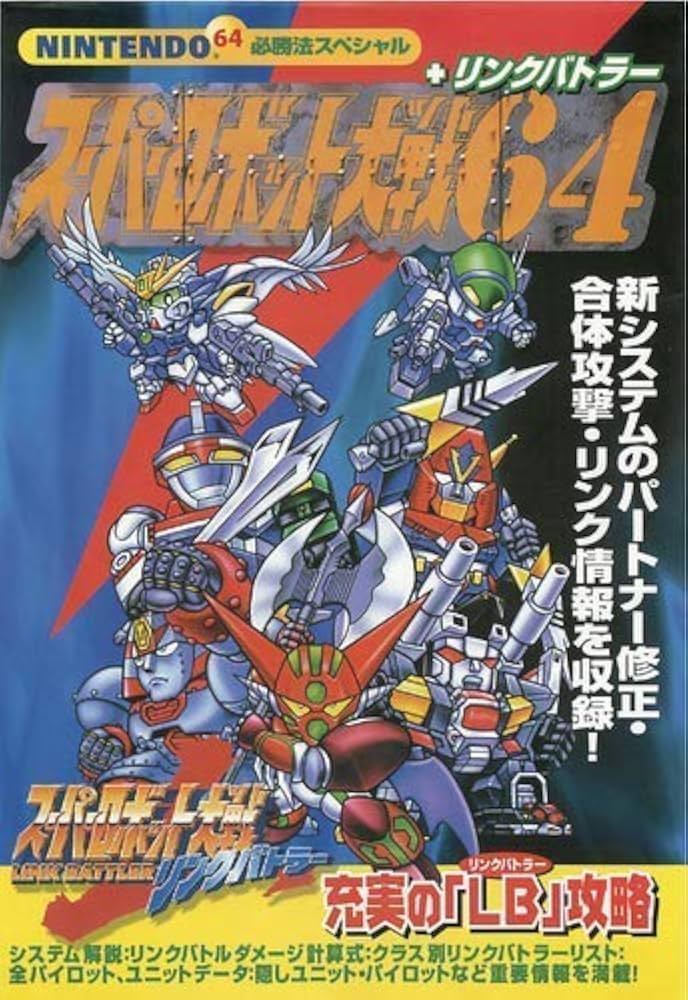
A collection of strategies, wikis, and backstage information for "Super Robot Wars 64"! NINTENDO64
This article introduces a selection of sites that compile strategy, wiki, and behind-the-scenes information on "Super Robot Wars 64" for the Nintendo 64. This title is one of the "Super Robot Wars" series and the only software released for the Nintendo 64. The article includes sites that compile information useful for strategy, such as flowcharts of scenario strategies, key points, backstage techniques, and play diaries.
Read Article
![Super Robot] Nostalgic! Summary of Top 20 Cumulative Sales Ranking of Software for Sega Saturn [Tokimemo].](https://renote.net/files/blobs/proxy/eyJfcmFpbHMiOnsiZGF0YSI6NzQwNDk0MiwicHVyIjoiYmxvYl9pZCJ9fQ==--6d155c100ed364d8a9db80a6a56df3ae863db99f/9468.jpg)
Super Robot] Nostalgic! Summary of Top 20 Cumulative Sales Ranking of Software for Sega Saturn [Tokimemo].
The Sega Saturn is a stationary video game console released by Sega Enterprises in 1994. It also attracted a great deal of attention when actor Hiroshi Fujioka played the commercial character "Segata Sanshiro. The software genre is characterized by a wide variety of fighting games. This article introduces the cumulative sales ranking of the top 20 software titles for the Sega Saturn.
Read Article

Entry in Super Robot Wars! The World of Steel Warriors IF
Robot works that every man has longed to see. The Super Robot Taisen series is a cross-world work that connects such works. Among the many entries in the series, there are many who can be said to be regulars. In this article, we will introduce the three families of regular entries in the series.
Read Article

Tags
Contents
- Outline of "Super Robot Wars (DC War Series)
- Super Robot Wars (DC War Series)
- The 2nd Super Robot War
- Entries in "The Second Super Robot Taisen
- The 2nd Super Robot War G
- Entries in "The 2nd Super Robot Taisen G
- The 3rd Super Robot War
- Entries in "The 3rd Super Robot Taisen
- Super Robot Wars EX
- Entries in "Super Robot Taisen EX
- The 4th Super Robot War
- Works of "The 4th Super Robot Taisen
- The 4th Super Robot Wars S
- Super Robot Taisen F" / "Super Robot Taisen F Complete
- Entries in "Super Robot Taisen F" / "Super Robot Taisen F Complete
- Super Robot Wars Complete Box
- Game System of "Super Robot Wars (DC War Series)
- basic system
- unit
- pilot
- intermission
- remodeling
- Reinforced parts
- combat system
- mental command
- Special Abilities/Special Skills
- map weapon
- Two actions
- System of "The Second Super Robot Taisen
- Introduction of major characters/units in Super Robot Wars (DC War Series)
- armoured warrior
- Mazinger Z
- Mazinkaiser
- promoted bishop (shogi)
- getter dragon
- True Getter 1
- Amuro Rey.
- gundam
- nu Gundam
- Quattro Basina
- Sotheby's
- Masaki Ando
- Cybuster.
- Famous Scenes from Super Robot Wars (DC War Series)
- Threatening Weapons Rhino-Flash
- General Bian's intentions
- ragnarok
- The Glory of the Fallen Sun
- Confession of love
- Mazinger Z vs. Getter Robo G
- Backstory, Trivia, and Small Stories/Episodes/Anecdotes from "Super Robot Wars (DC War Series)".
- From the "Compatible Hero" series to the "Super Robot Wars" series
- Censoring crisis and a weepy one
- From sluggish sales to "fantastic software" - The miracle of "The 3rd Super Robot War" -.
- Series established, and becoming "Japan's leading crossover series