
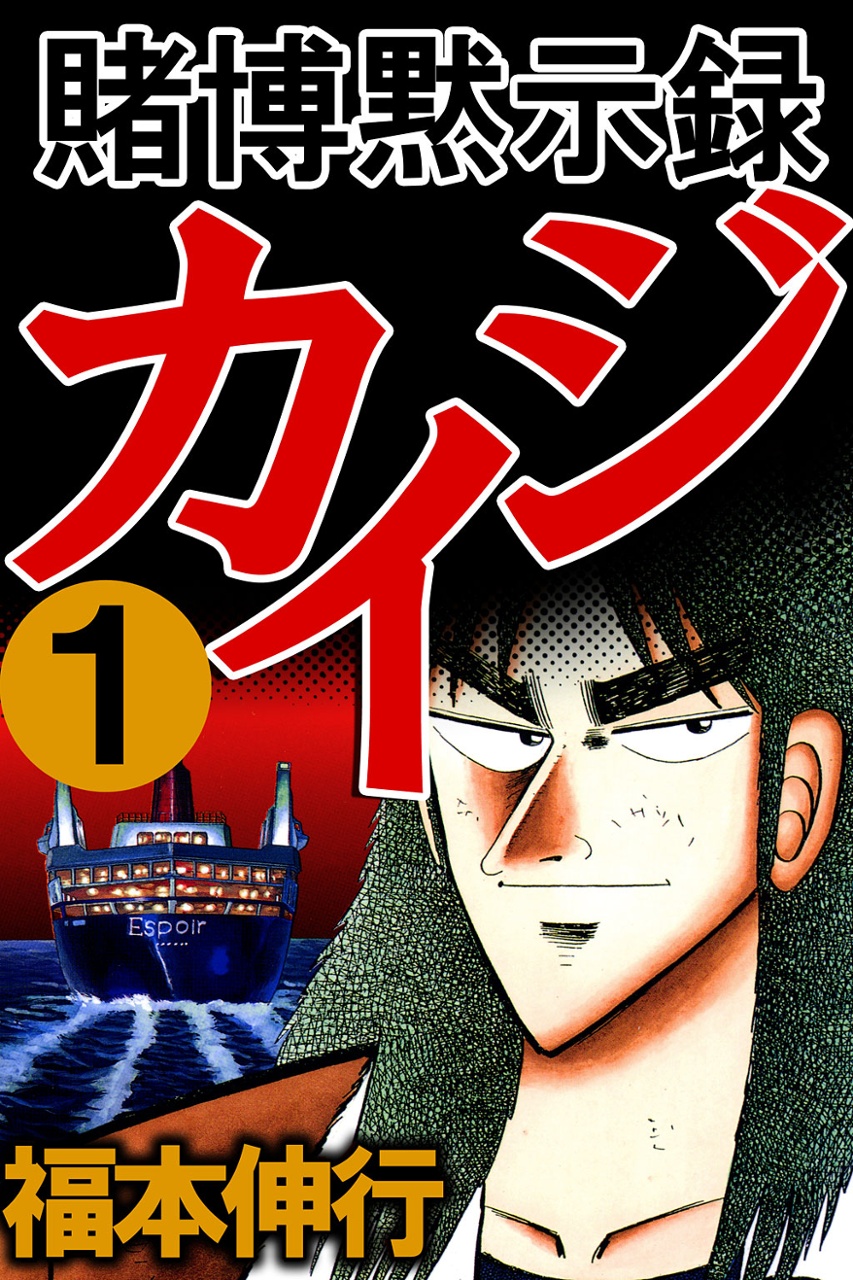
A gambling manga by Nobuyuki Fukumoto serialized in Weekly Young Magazine from 1996 to 1999, as well as an anime and movie based on the manga. The story follows Kaiji, a young man who spends his days working, drinking, and gambling, and who enters the world of gambling to pay off the debt of his former part-time job partner as a guarantor, and then takes on a variety of gambling challenges.
E-card
Tonegawa, who had given up during the race in response to Kaiji's demand for the prize money (even though he did not accept it at the time), takes the heat and tells him that he will be stripped of his right to win the prize money. Hyodo, the chairman of the Teiai Group, appears before Kaiji, who is furious, and offers him "one more chance" to face Tonegawa in an "E-card" match.
Tonegawa explains the rules. There are three types of cards to be used: Emperor, Citizen, and Slave. The players are divided into two groups: the "Emperor's side" with four "Citizen" cards and one "Emperor" card, and the "Slave's side" with four "Citizen" cards and one "Slave" card. The cards are not played at the same time, but rather the Emperor side plays one card first, and the slave side puts it on top of the Emperor's. The order of the cards is changed after each turn. In this psychological game, the emperor and the slave players take turns every three rounds, and the emperor and the slave players try to read each other's timing for playing the "emperor" and "slave" cards.
After explaining the rules to Kaiji, Tonegawa asks him to make a choice. Eyes? The ear? In this game, in which the players compete for the balance of all 12 rounds, the penniless Kaiji has no money to wager. Therefore, the organ is proposed as a good bet. The emperor would win 100,000 yen for each millimeter, and the slave would win 500,000 yen for each millimeter. Kaiji, annoyed by Tonegawa's arrogance, who compares Kaiji and his dead friends to sheep and claims that they are different from wolves, presses him to get down on his knees if he wins the game. Tonegawa accepts without hesitation. The battle for the "distance to the eardrum," the money, and Tonegawa's down on his knees begins.
1-10 rounds
Tonegawa says that it took him two rounds to see through Kaiji's pattern, but from now on, he will just dance in my hands. True to his word, Tonegawa won again and again from the third round onward as if by divine grace. Then came the 9th round. Kaiji's heart is on the verge of breaking, and he shies away from making the winning move, which he had already decided in his mind. Instead of playing "Emperor," he plays "Citizen," which postpones the game. Kaiji regrets his decision, but Tonegawa's card is "Slave. He unexpectedly wins the game.
Hyodo suddenly strikes Tonegawa with his cane, saying that he has lost his fun. This could be taken as unreasonable, as is common with a one-man top management who does not tolerate even the slightest mistake by his subordinates, but Kaiji cannot shake off the feeling of discomfort when Hyodo says, "It is natural that you win. How can he be so sure? Is it cheating? Then how? There is no camera and no card gun. At that moment, he notices that Tonegawa's gaze is unnaturally fixed not on the card but on his wristwatch. He is receiving some kind of information on his wristwatch. Then, where is the machine transmitting the data? Kaiji looks around the room and a thought strikes him. The device closest to Kaiji, the one about to pierce his ear, could this be the sensing and transmitting machine that was reading his pulse, blood pressure, or temperature and transmitting information about his agitation and excitement?
The tenth round is lost without a move, but Kaiji decides to surrender himself to this realization.
11th-12th round
Kaiji, who has already lost 27 millimeters of the 30 millimeters that the needle needs to reach the eardrum and has only 3 millimeters left to bet, demands that the upper limit of the device, which completely penetrates the eardrum and destroys it further, be 45 millimeters, or 18 millimeters less than the distance to the eardrum. Despite Tonegawa's protest, Hyodo admits it with a look of amusement on his face. Kaiji then stands in the bathroom and begins to smash the mirror by hitting his head against the wall. Kaiji continues his rampage, heedless of the restraints of his friends who came to check on him after he lost the steel frame race. Tonegawa, who senses Kaiji's state of excitement on his wristwatch, interprets this as Kaiji's attempt to disturb the figures by putting his own body in an abnormal state, but Kaiji's move is far more insane than that.
Holding his bloody head with a towel, he returns and begins the 11th round with Kaiji. Despite his bloody appearance, his decreasing numbers indicate a level of excitement that is not high at all. Tonegawa, convinced of his victory, plays "Emperor," as his pulse, body temperature, and perspiration levels indicate that he is not in the condition he is in at the moment of winning the game. Tonegawa is so proud of his victory that Kaiji, looking desperate, opens the card "Slave". He wins. Tonegawa is not convinced by the unmoving numbers and learns of Kaiji's strategy. The side of his head, hidden by a bloody towel, is missing an ear. The figure Tonegawa was seeing was that of a fellow player clutching an ear cut off by a piece of mirror in a different place.
And then there was a further 12th round. Kaiji made a strategic move with a card in his right hand, in addition to the two cards left on the table from the 11th round. Kaiji wipes off the blood splattered on the two cards on the table and puts another 18-millimeter bet on them. Tonegawa, who has been clocked out of the game and is being dragged into a serious game for the first time without a handicap, cannot help but notice the bloodstains left on the table. The first card with blood on it is "Citizen. A card that had indeed been used in the previous eleventh round. Finally, on the fourth and final choice, Kaiji finally plays the second card with blood stains. Is it "Slave" after all? Tonegawa grabs the "Citizen" card, but stops himself just before he grabs it, and asks himself the same question. Would he really make such a simple oversight? No, the essence of the man in front of him is a "snake" that poisons with impunity. The bloodstain is a trap. Tonegawa, having come to this conclusion, plays the "emperor" card in order to go against Kaiji's ruse. Probably, the "Slave" card had already been replaced when the blood stain was found. The card that was turned over was the "Slave" card. Kaiji takes advantage of Tonegawa's "awareness" and reveals that he did not replace the card after holding it in his hand. The game is settled, and Kaiji wins approximately 20 million yen.
Settlement and Defeat
Hyodo speaks up angrily, dismayed at Kaiji's demand for a promised apology. If the apology is heartfelt, not just verbal, it should be made wherever it is made. He then forces him to get down on his knees for more than 10 seconds on the burnt iron plate, or "yaki-knezuke. Seeing Tonegawa complete his own yaki-kneeling, Kaiji realizes that it is Chairman Hyodo who must be defeated, and he challenges Hyodo to a game in order to avenge the deaths of himself and his friends who have died through gambling.
Hyodo is reluctant at first, but Kaiji insists and Hyodo agrees. The event is a "Tissue Box Lottery," which Kaiji thought up on the spot and pretends to be a lottery. He came up with the idea when he happened to learn, while stopping bleeding on the head, that the structure of a tissue box allows simple, unopened items to be placed inside from the sides of the box and held in place. He succeeded in tricking a box of tissues at a nearby tissue store to allow him to win the game with a box of tissues that had a winning lottery ticket in it. The game was for the 20 million he had just won plus four fingers of Kaiji (20 million yen per finger) and 100 million yen of Hyodo's money. Kaiji is convinced that he will win, but his plan is foiled by Hyodo, who has already figured out all his tricks, and he also fails to notice Hyodo's marker for the winning lottery ticket.
Having lost his winnings from the game with Tonegawa, Kaiji vows to take revenge while holding his lost fingers and ears.
Terms for "Gambling Revelation Kaiji
limited rock-paper-scissors game
Gambling on board the large cruise ship Espoir. Players are dealt 12 cards, four each of Goo, Choki, and Poo, and each player is also given three star-shaped badges, which they compete for by playing rock-paper-scissors-paper with their cards.
Once used, the cards are discarded on the spot and the total is tallied. The number of cards with "Goo," "Choki," and "Poo" remaining is displayed in real-time by an electric light. To win, first-time players must have three stars and repeaters must have four stars when all cards are used up. If the player loses, the remaining cards and stars are confiscated and the player is sent to another room and branded with a number. A player loses if (1) he/she runs out of stars, (2) there are still cards left at the end of the 4-hour time limit, (3) the number of stars has not been reached after the 10-minute trading time for stars, or (4) any other prohibited behavior (such as discarding cards unrelated to the game or committing violence) is committed.
Before the game, a minimum of 1 million yen and a maximum of 10 million yen (maximum of 5 million yen for those over 30 years old) in cash will be loaned to all participants at an interest rate of 1.5% compounded for 10 minutes. The loan can be used in any way. If the winner survives, the organizers will pay all debts incurred prior to boarding the ship, except for the debt incurred on board the ship. The organizers will also buy back any stars left over at the end of the tournament for 4 million yen each.
E-card
A card game for two players used in the showdown between Tonegawa and Kaiji.
Three types of cards are used: "Emperor," "Citizen," and "Slave.
The player is divided into two groups: the "Emperor side" with four "Citizen" cards and one "Emperor" card, and the "Slave side" with four "Citizen" cards and one "Slave" card.
The relationship between the three types of cards is the same as in rock-paper-scissors-scissors: Emperor > Citizen, Citizen > Slave, and Slave > Emperor. In other words, the slave side wins if the slave side can play a "slave" card on the turn when the emperor side plays an "emperor" card. The emperor wins if the slave side can avoid the slave card.
The cards are not played at the same time, but the emperor plays a card first, and then the slave side plays a card on top of it, but the order of the cards is changed every turn. In other words, the emperor's side plays first in turns 1 and 3, and the slave's side plays in turns 2 and 4.
The reward for winning on the slave side, which must guess 1/5, is five times the reward for winning on the emperor side. Originally, both sides played a total of 12 rounds with cash (or chips) at stake, but in the game between Kaiji and Tonegawa, the game was over when the needle reached the eardrum, even if they had not played 12 rounds, because the penniless Kaiji had bet 30 millimeters to the eardrum.
kneeling down on the ground after having been burned to death
This is a method of apology, based on Hyodo's belief that if one is sincere, one should be able to get down on one's knees even on a burnt iron plate, which he has seen countless verbal apologies for. In the film, Hyodo orders Tonegawa to do this after he loses the game with Kaiji, to show that his apology is sincere to himself and to his friends who have been scattered by his previous gambling.
Main characters
Kaiji / Kaiji Ito
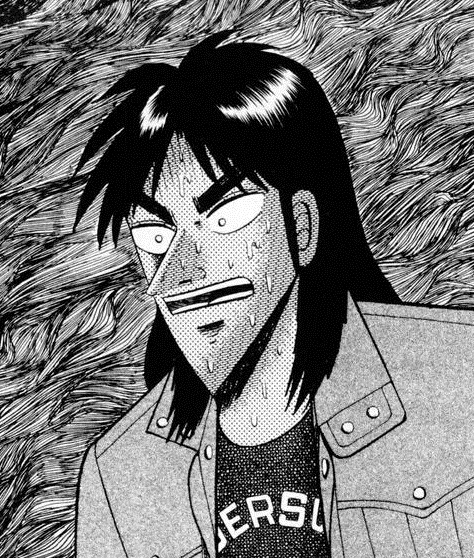
CV: Masato Hagiwara
The protagonist of the film. He spends his days drinking and gambling, and when his daily frustrations get the best of him, he finds illegally parked luxury cars and goes around messing with them. In normal times, he is a self-indulgent sociopath, but when his life is on the line, he displays exceptional resourcefulness backed by superior logical thinking and genius ideas. He is basically a trusting person, and because of this, he has often been betrayed by those whom he has placed his trust in. At best, he is kind; at worst, he is naive.
Yuuji Endo
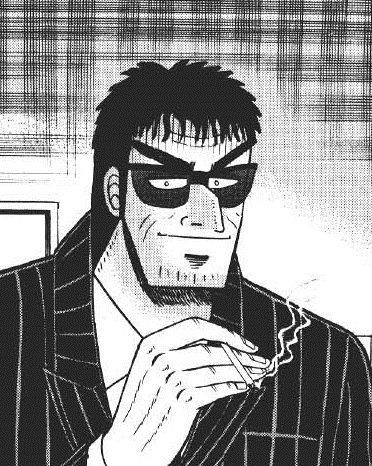
CV: Naoya Uchida
A yakuza who runs Endo Finance, a subsidiary of the Teiai Group. He is the one who encouraged Kaiji, the guarantor of Furuhata's debt, to gamble at Espoir, which led Kaiji to enter the world of gambling. He is a skilled talker, and he demonstrates his skill without regret when he invites Kaiji to Espoir. He is a ruthless and vicious person, and says that there is no way he is a good person.
Takeshi Furuhata

Related Articles
Spoiler commentary and discussion of Chuenchu Kankeiroku Tonegawa (manga and anime)
Chushin Kanriroku Tonegawa" is a spin-off of Nobuyuki Fukumoto's popular "Gambling Revelation Kaiji" featuring Yukio Tonegawa as the main character. The work is based on the anguish and conflict of Yukio Tonegawa, a so-called middle manager who is in charge of organizing his subordinates, the black suits, while at the same time trying to please Chairman Hyodo. It was broadcast on AnichU, Nippon Television's late-night anime slot, from July to December 2018. The book is complete with a total of 10 volumes released.
Read Article
Spoiler commentary and discussion of Kamikyo Seikatsu Roku Ichijo (manga).
Kamikyo Seikatsuroku Ichijo" is a manga written by Tenharu Hagiwara (original story), Motomu Uehara and Kazuya Arai (manga), and Nobuyuki Fukumoto (cooperation). It is a spin-off of Fukumoto's masterpiece "Gekaku Bakkairoku Kaiji" featuring Seiya Ichijo, the owner of a backroom casino under the Teiai Group, which is mainly a consumer finance company. This is a gag manga about Ichijo's days as a smoker who moved to Tokyo from Okayama after graduating from high school before joining Teiai, where he would later rise to the upper echelons of Teiai by developing the "swamp," a devilish pachinko machine that costs 4,000 yen per ball.
Read Article
Spoiler commentary and discussion of Gambling Breakthrough Kaiji (Nobuyuki Fukumoto)
A gambling manga by Nobuyuki Fukumoto serialized in Weekly Young Magazine from 2001 to 2004, as well as an anime and movie based on the manga. It is a sequel to the previous work "Kaiji: The Gambling Revelation," which depicted Kaiji, a self-defeating and helpless man who throws himself into the world of gambling to repay the debts of his former part-time job partner as a guarantor, and again shows Kaiji's struggle in the world of gambling.
Read Article
Spoiler commentary and discussion of Gambling Fallen Kaiji (Nobuyuki Fukumoto)
Gambling manga by Nobuyuki Fukumoto, serialized in Weekly Young Magazine since 2004. It is a sequel to "Gambling Revelation Kaiji," which depicts how Kaiji became absorbed in the world of gambling when he was forced to take on the debt of a former part-time worker as a guarantor, and how he was forced to work underground as compensation for his ballooning debt, and how he returned to the surface. The story again depicts Kaiji's struggles in the world of gambling.
Read Article
Spoiler commentary and discussion of Ichinichi Guroku Hancho (manga).
1 DAY OUT ROKU HANCHO" is a manga written by Tenharu Hagiwara (original story), Motomu Uehara and Kazuya Arai (manga), with the cooperation of Nobuyuki Fukumoto (manga). It is a spin-off of Fukumoto's masterpiece "Gambo Hakkairoku Kaiji" featuring Taro Ootsuki, a.k.a. Hancho, who is seen between the main character and Chinchillo gambling. The Teiai Group, a consumer finance company, has many bad debtors interned in an underground forced labor facility. The highest value work incentive option is a "one-day pass" to encourage them to work there. This is a gag manga about how Ootsuki, who frequently buys "one-day pass", enjoys his limited day.
Read Article
Silver and Gold (Nobuyuki Fukumoto) Spoiler Commentary and Discussion Summary
Silver and Gold" is a manga by Nobuyuki Fukumoto serialized in "Action Pizzazz" (Futabasha) from 1992 to 1996, as well as a TV drama and V-cinema based on the manga. Tetsuo Morita jumped into the underworld after meeting Ginji Hirai, a man who controls the underworld business world called the Silver King. The film depicts their deadly money wars, including stock speculators' wars and huge gambling, in pursuit of the dark veins of money that are groaning in the post-bubble era.
Read Article
Akagi - The Genius Who Descended into Darkness (Nobuyuki Fukumoto) Spoiler Commentary and Discussion Summary
Mahjong manga by Nobuyuki Fukumoto. It was serialized in "Bessatsu Kindai Mahjong" (July 1991 issue). It was later transferred to "Kindai Mahjong". This is a spin-off work featuring the "legendary mahjong player" Akagi Shigeru, who appears in "Ten Tenwa Dori no Kaiohonji. The story follows young Akagi's encounter with mahjong at a mahjong parlor where he sneaks in to hide after an incident involving a gang of delinquents, and his competitions with a number of famous substitute mahjong players, culminating in a final battle with his ultimate enemy, Iwao Washizu.
Read Article
[Trauma] A compilation of manga with painful scenes.
Manga is, after all, "pictures". Even so, the fact that the emotion of "pain" comes to mind when reading them is evidence of the writer's excellence in expression. So I have compiled a list of manga with "painful" scenes.
Read Article
Appetizing! Summary of "Manga Meshi
Whether it is a cooking manga or not, there are certain dishes in manga that are very appetizing. We have compiled a list of 10 such "manga meshi.
Read Article
![Memetaa] A compilation of various onomatopoeias that appear in manga!](https://renote.net/files/blobs/proxy/eyJfcmFpbHMiOnsiZGF0YSI6NzIwMCwicHVyIjoiYmxvYl9pZCJ9fQ==--cda9b94c960b9803180ac78dcbda543354772e0c/memetaa.jpg)
Memetaa] A compilation of various onomatopoeias that appear in manga!
In manga without background music or sound effects, various actions are accompanied by onomatopoeia. In this article, we will introduce some unusual onomatopoeias that appear in such manga.
Read Article
![Akagi] Nobuyuki Fukumoto Manga Quotes and Great Lines [Kaiji](https://renote.net/files/blobs/proxy/eyJfcmFpbHMiOnsiZGF0YSI6ODUyNzgzLCJwdXIiOiJibG9iX2lkIn19--330c1988e8df0fae5dc14e6ba0bb144beea5ccbc/SID0002540.jpg)
Akagi] Nobuyuki Fukumoto Manga Quotes and Great Lines [Kaiji
Nobuyuki Fukumoto is known for his many masterpiece gambling manga such as "Kaiji," "Akagi," and "Silver and Gold. Did you know that many of his works are filled with quotes that hint at how to turn your life around? We will bring you a number of such quotes and famous lines that will surely make you "zawa...zawa...".
Read Article
Delicious-looking foods in anime and manga that make you drool just looking at them.
Food scenes often appear in anime and manga. However, in reality, food has different color gradations and different light absorption and reflection rates, making it extremely difficult to depict in pictures. However, there are anime and manga that depict such unique foods in an extremely delicious manner. In this issue, we have compiled a list of many delicious-looking foods, focusing on such scenes.
Read Article
Seven Gambler Manga
"I learned to play mahjong from this manga. "I got a glimpse of the depth of the gambling world. I have compiled a list of manga that could be a bible for those who want to start gambling.
Read Article
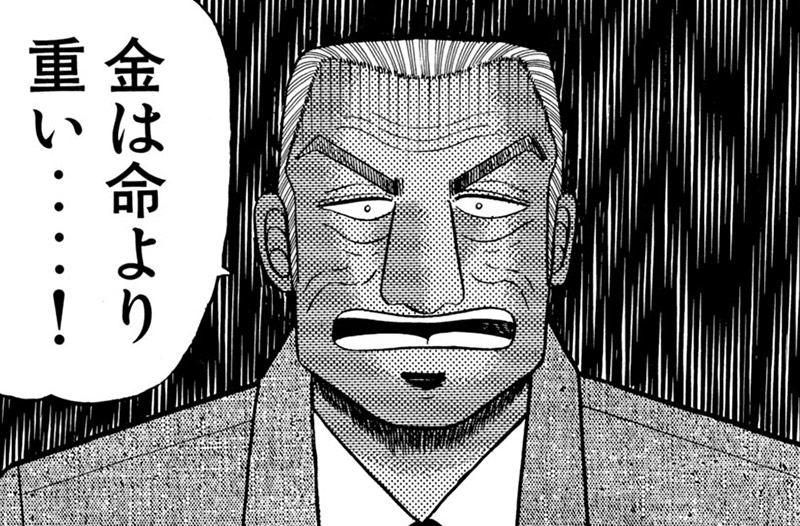
Impact game! Images of Manga Quotes and Great Lines [Gambling Revelation Kaiji, etc.].
Here we have compiled a collection of images of famous manga scenes, famous quotes and lines, and one frame that is immensely persuasive. The images include famous works such as "Gambling Revelation Kaiji," "Doraemon," "Yotsuba! You can use them as stamps on your LINE, etc., and they might be popular with your friends.
Read Article
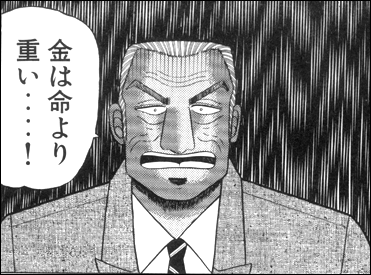
Learn a saying from the Kaijus!
Have you ever heard the saying, "Money is heavier than life?" This is a quote from the famous Kaiji. Thus, there are so many things you can learn from Kaiji, which may be very useful for your life. So, I would like to introduce some quotes from Kaiji. After reading this, I am sure you will be very serious about money. If you are too severe, you may not like it. Be careful!
Read Article
Contents
- Overview of "Gambling Revelation Kaiji
- Synopsis and story of "Gambling Revelation Kaiji
- Chapter 1 Ship of Hope
- Programming in Logic
- departure
- outbreak of war
- cornering (market)
- stagnation
- Betrayal and Settlement
- Chapter 2: Castle of Despair
- trying again
- human horse racing
- Skyscraper Steel Crossing
- E-card
- 1-10 rounds
- 11th-12th round
- Settlement and Defeat
- Terms for "Gambling Revelation Kaiji
- limited rock-paper-scissors game
- E-card
- kneeling down on the ground after having been burned to death
- Main characters
- Kaiji / Kaiji Ito
- Yuuji Endo
- Takeshi Furuhata
- Yukio Tonegawa
- Mamoru Ando
- Joji Funai, Senior Executive Director
- Koji Ishida
- Kitami
- Okabayashi
- Sawara
- Kazutaka Hyodo
- Famous quotes, lines/scenes, and scenes from "Kaiji: The Gaming Apocalypse
- If the adults in the world won't tell the truth, I will! Money is worth more than life.
- Ishida, silent fall
- Life should be treated with more care! Life... life... is stagnant and rotten when it is treated too carefully.
- "Stretch out your chest..! When you lose painfully... take heart...!
- Kaiji: The Game of Life Reversal
- summary
- Main Cast
- Kaiji 2: The Game of Reclaiming Your Life
- summary
- Main Cast