
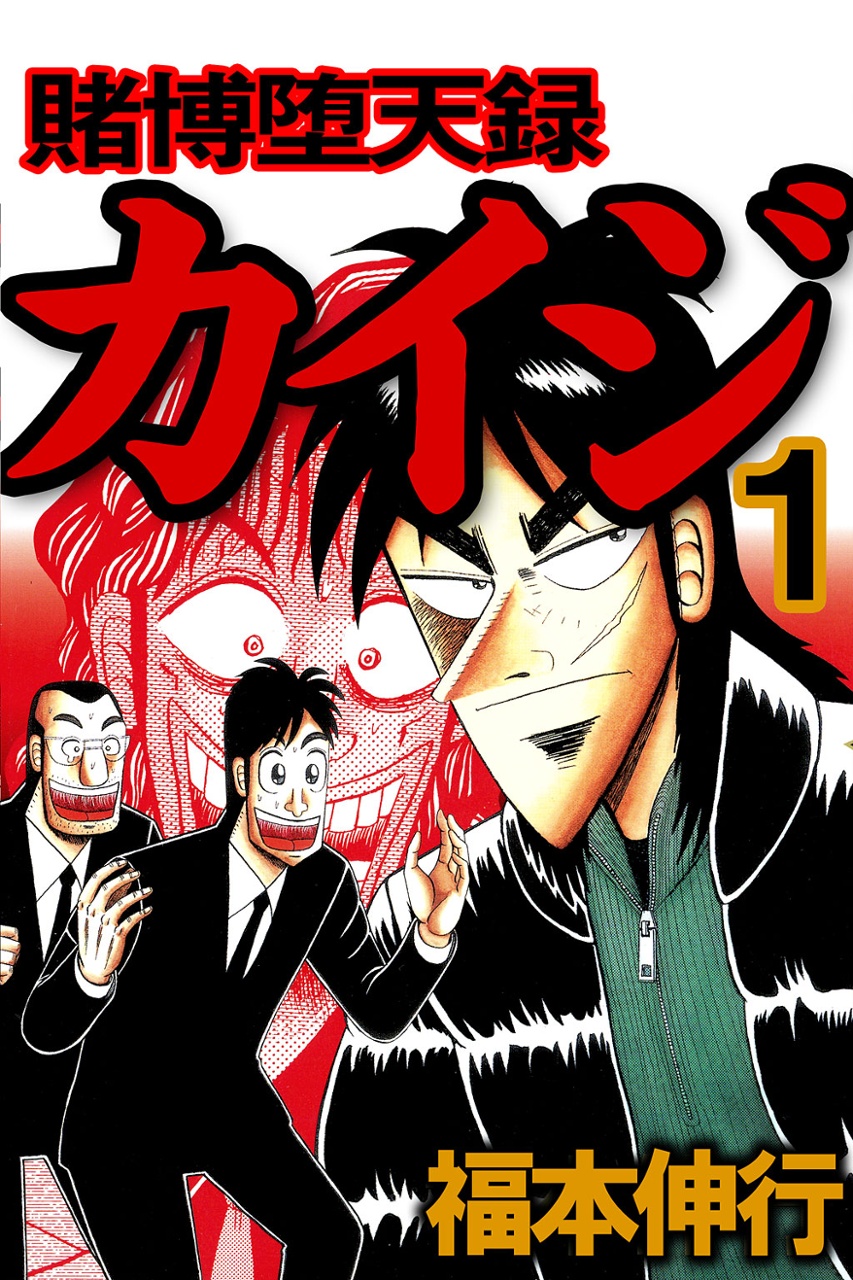
Gambling manga by Nobuyuki Fukumoto, serialized in Weekly Young Magazine since 2004. It is a sequel to "Gambling Revelation Kaiji," which depicts how Kaiji became absorbed in the world of gambling when he was forced to take on the debt of a former part-time worker as a guarantor, and how he was forced to work underground as compensation for his ballooning debt, and how he returned to the surface. The story again depicts Kaiji's struggles in the world of gambling.
Overview of "Gambling Fallen Kaiji
Tobaku Datenroku Kaiji (賭博堕天録カイジ) is a gambling manga by Nobuyuki Fukumoto that has been serialized in Weekly Young Magazine since 2004. It is a sequel to "Gambling Revelation Kaiji", which depicted how Kaiji became absorbed in the world of gambling when he was forced to take on the debt of a former part-time worker as a guarantor, and how he was forced to work underground as compensation for his ballooning debt, and how he returned to the surface. The story again depicts Kaiji's struggles in the world of gambling.
The series has been published under different titles, "Gekaku Tekienroku Kaiji: Kazuya Hen" since 2009 and "Gekaku Tekienroku Kaiji: One Poker Hen" since 2013.
The story behind "Gambling Fallen Kaiji.
The previous two works, "Gambling Revelation Kaiji."
Kaiji, who has been living a self-defeating and helpless life, is forced to take on the debt of a former part-time worker as a guarantor, which leads him to board the gambling ship "Espoir" operated by the giant corporation "Teiai". He manages to survive the "limited rock-paper-scissors" gambling game held on board, but his debts continue to mount, and he is forced to play another game. He cleared the "Skyscraper Crossing" held on a new day, and won the "E Card" duel with his nemesis Tonegawa, which temporarily brought him 20 million yen, but Kaiji lost the "Tissue Box Lottery" duel with the mastermind, Teiai Group General Hyodo for the prize money, losing all four fingers and a large sum of money. Kaiji lost four fingers and a large amount of debt.
Previously titled "Gambling Destruction Record Kaiji."
Having increased his debt to about 10 million yen, Kaiji is forced to spend about 15 years in forced labor at the Teiai Group's underground facility. Under the poor working environment, Kaiji decides to escape as soon as possible. He wins a game against Otsuki, who was making a fortune by cheating in the "underground chinchillorin" gambling game held underground, through a joint fight with his friends in the "45 group," and succeeds in coming above ground for a limited period of time. Aiming to pay off his and the 45's debts, which totaled approximately 60 million yen, he set his sights on the "swamp," a pachinko machine at the Teiai Group's backroom casino that charges 4,000 yen per ball. Through a joint effort with Sakazaki and Endo, Kaiji and his team succeeds in conquering the "swamp" and earns over 700 million yen, but Endo's betrayal reduces Kaiji's income to almost nothing.
Gambling Fallen Kaiji."
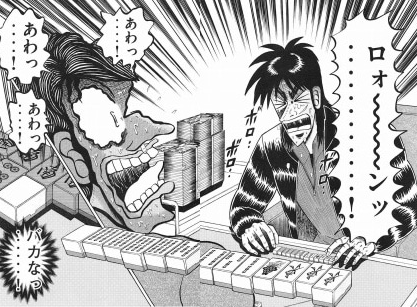
変則二人麻雀「17歩」で村岡(左)を下すカイジ(右)
After a fierce battle over the "Swamp," Kaiji is left penniless, but all his debts have been wiped out. However, the loss of his goal has brought back his natural tendency toward self-indulgence, and he spends his days doing nothing in particular but living in the house of Sakazaki, with whom he fought together in the "Swamp". Kaiji is finally forced out of his house by Sakazaki, who can't stand the sight of him, and is forced to leave, along with 3 million yen in severance pay.
Kaiji is kicked out of his house, and is asked by Miyoshi and Maeda, his friends from Underground 45, to collect his gambling salary from Muraoka, the president of the backroom casino where he started working after they went above ground. Using the 3 million yen they received from Sakazaki as a source of money, they challenge Muraoka to a game. The game is an irregular two-person mahjong game called "Mine Game. The players start the game by making a set of tiles from the pile of tiles in front of them (34 tiles) on a fully automatic mahjong table to make a hand of tenpai (tenpai) with a hand of at least mangan. The remaining 21 tiles not used for the hand are cut one by one, starting with the player who is ahead, and the game is played until one of the players goes out or the game is over after 17 rounds.
The game was initially guaranteed to be won due to a sign from Miyoshi, an insider of the enemy, but as the game progressed, the betrayal of his friends was revealed. The game was in progress, however, when the betrayal of his friends was revealed.
Kaiji was now at a disadvantage. The game was a tug of war, and at the end of the game, at least 160 million yen was at stake. Kaiji, with only 3 million yen in his pocket, decides to borrow money from Hyodo's son, Kazuya, who happens to be there and witnessed the game, using his body as collateral to continue the game. The 13th round arrives. As soon as Kaiji leaves the table to go to the restroom, Muraoka takes advantage of the opportunity to steal a look at the tiles on the table. He turns over all the face-down tiles left on the table and takes a digital camera picture of them to reveal the hand that Kaiji took with him. After the game resumes, Muraoka calmly cuts out the "white" tile, which would normally be an impossible cut, and Kaiji calls for Ron. Kaiji, who had foreseen Muraoka's sneak attack, had pasted a piece of paper on one of the tiles in the left and right piles, which would normally be unused, to disguise the "white" tile, thus misidentifying the "white" tile in his hand as the "4-square" tile. With this move, Kaiji won the game against Muraoka and won a huge amount of money, 480 million yen.
"Gambaku Tekkenroku Kaiji: Kazuya Arc."
After the settlement with Muraoka, Kazuya offers him a match, and Kaiji accepts. He is taken to a members-only restaurant under the Teiai Group, which puts on inhumane shows every night, where he is told of Kazuya's goal of being recognized as a novelist. Kazuya's theme is the reality of human nature, such as betrayal and self-centeredness that appear at the verge of life and death, and the reality that resides in the final moments of a person's life. However, Kaiji denies all of Kazuya's activities. The argument that began there led to an experiment in human nature through "Rescue," a game to confirm friendship.
The rules of the game were that the rescuers, who were fixed in a row of stair-like seats and randomly selected each round from among three people wearing special helmets, would succeed if they could press the "release button" within 30 seconds to one minute, and fail if they couldn't. The prize money increased with each successive round, and after 16 consecutive successful attempts the prize money of 100 million yen would be reached. The prize money increases with each successive round, and the player reaches the 100 million yen prize when he or she succeeds 16 consecutive times. In the event of failure, the helmets worn by the two rescuers are pressed down until they crush the rescuer's skull, and the rescuer is awarded the prize money accumulated so far as a survivor. The purpose of the game is to see if the chosen rescuers will be able to resist their egoism and continue rescuing their friends.
The participants are Mitsuyama, a company owner, and his two foreign workers, Mario and Chang, who are about to be sent to an underground labor facility when Mitsuyama, unable to repay a large debt due to hepatitis B, offers to donate his organs in order to pay off his debt, but Mitsuyama stops them. The three were bought out by Kazuya, who was attracted by the strength of the bond between the three.
Despite Kazuya's attempts to break the bond by inducing doubt and suspicion, the game entered its final stages. In the 15th round, Mitsuyama, unable to resist his doubts about his fellow players and the idea of self-preservation that comes from self-love, finally fails to press the "release button" within the time limit, despite his superficial repentance, and the game ends. The game was over. Kazuya's claim of "human nature" was revealed. As the helmets of Mario and Chan, now the losers, gradually press down on their skulls, Kazuya's suspicions turn to Kaiji, who desperately tries to stop the execution. Isn't that reaction, a hypocritical performance? If not, he should be able to pay the approximately 70 million yen in prize money accumulated in the game so far in order to save them both. Kaiji eventually saves them both, despite his objection to the unreasonableness of the proposal. Kazuya is furious at Kaiji's behavior, calling it a pseudo friendship, and the two enter into a confrontation in a new gambling game called "One Poker," which he proposes to destroy Kaiji and the others.
Gambaku Tengenroku Kaiji: One Poker Edition.
Kazuya moves to a tower in a warehouse owned by Teiai and explains the rules of "One Poker". The cards used are dozens of cards arbitrarily removed from three sets of playing cards, minus the joker. Players choose one of the two cards they are dealt, and compete on the strength of the cards (2 being the weakest and A being the strongest, but only A can beat 2). This is a two-player poker game in which players can recognize each other's card composition in the form of "Down" (2 to 7)/"Up" (8 to A), and call/raise/drop is selected based on the composition of the cards in hand and the signs and expressions of the opponents. Gambling begins with a minimum bet of 200 million yen, with "one life" as the chip, a unit of 200 million yen, the lifetime wage of a salaryman.
In the first round, Kaiji had the worst cards in his hand, but when he killed "A" with "2", he caught the flow and won five straight games. However, in the 6th round, Kazuya raised to Kaiji, who had saved his strong cards in favor of a game plan for the future. Kaiji chose to drop his strong cards, but Kazuya's card was a "3". In the seventh round, Kaiji won the game, but his strongest card, K, was eaten by a 3, and he was caught in Kazuya's bluffs one after the other. The tide turned, and Kaiji gave up all the chips he had accumulated at the beginning of the game. In the 12th round, Kaiji raises to Kazuya with the long-awaited strong "K" card, but he is destroyed by "A" and loses all the chips he has. Kaiji continues the game by converting a "fall" from the tower in the warehouse into chips, but he loses before Kazuya's two consecutive "A "s of good luck. However, just before the execution, Mario and Chang, who had saved his life in the previous game, offer their own lives as chips to Kaiji, thus avoiding the fall. In the fourteenth round, Kaiji wins Kazuya's drop by bluffing with all his might, involving Mario and Chan. With this one win, the tide turned, and he went on to win six straight games with a draw in between. Kazuya finally turned over his chips in the worst possible flow of the game and abruptly backed away from Mario and Chan's cheering, which he should have tolerated until now, calling them "annoying. Immediately afterward, in the 23rd round, he instantly and forcefully puts over a raise. Kaiji, on a last-minute hunch, chooses to drop, and the card that opens is "A". Kaiji suspects cheating because of the unnatural left hand gesture and the strong card against the flow, and discovers a cheating box containing three "A" cards planted on the table. Kazuya also recognizes that Kaiji has discovered the hidden box, and the 24th round of the game, which includes cheating, is played in an unspoken way (until the 12th volume of the book).
Terms for "Gambling Fallen Kaiji
Mine game "17 steps"
An irregular two-person mahjong game played between Kaiji and Muraoka.
The players start the game by flipping over a Dora tile from the pile on the left or right of the player facing them among the piles on the fully-automatic mahjong table. The remaining 21 tiles not used for the hand are cut one by one, starting with the player who made the first move, until either one of the players goes out or the game is finished after 17 rounds and the game is over.
The betting amount is decided before the game begins, and is based on a multiplier of 1 for mangan, 1.5 for ripple, 2 for doubled mangan, 3 for trebled mangan, 4 for yakuman, and 8 for double yakuman. In case of Null Round, the wager is doubled and carried over to the next round.
For the sake of convenience, the East (East) and the West (West) are treated as the Parent (East) and the Child (West), but the Parent's advantage of 1.5 times the win point does not exist.
Friendship check game "Rescue
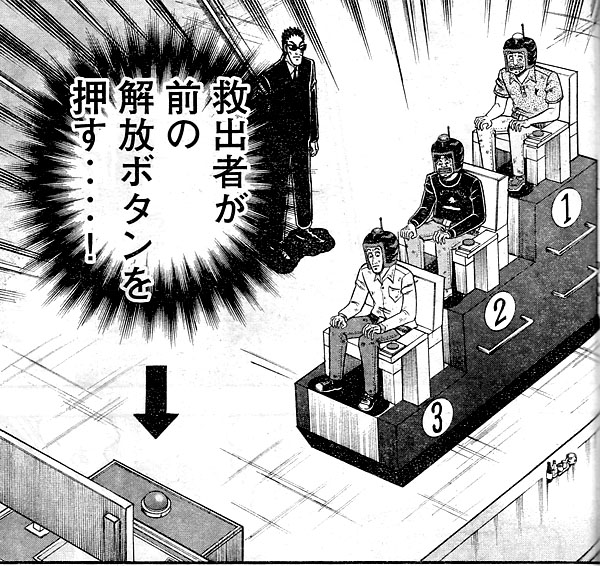
A life-threatening game invented by Kazuya to check the friendship of participants.
Challengers wear helmets with a special structure that plays music and prevents audio communication, and are fixed to a row of seats in a staircase-like configuration. Due to the structure of the seats, the top seat can see the two people below it, the second seat can see only the bottom, and the bottom seat can see no one. Two "hostages" and one "rescuer" are chosen at random from among the three people. The rescuers can be identified by the lights on their helmets, but they cannot confirm this themselves. The game is cleared when the rescuer is able to recognize the hostage by himself/herself and press the "hostage release button" within 30 seconds to 1 minute and 1 second from the start of the game. Each time the game is cleared, the wager is doubled, and the challengers win when the wager exceeds 100 million yen. However, if the rescuer presses the hostage release button within less than 30 seconds, he or she is disqualified. All players will be spared, but their bets will be forfeited. If one minute and one second elapses without a rescuer pressing the hostage release button, or if a hostage presses the hostage release button, the game fails. The helmets of the two hostages will compress and crush the skull and brain over time. In case of rescue failure, the surviving rescuer is considered the winner, and the game itself ends there, with the rescuer keeping the prize money accumulated to that point to himself. Therefore, the game allows players to confirm the strength of the bond between the three participants through the temptation of "if I kill the two hostages, I can keep the prize money all to myself" and the fear of "if I don't kill the hostages quickly and keep the prize money all to myself, I will be killed by the other side.
one-poker game
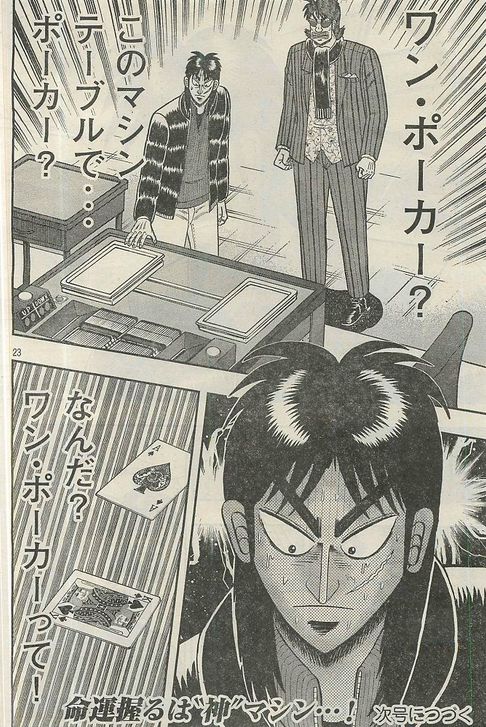
This is a two-player poker game played during the game between Kazuya and Kaiji, in which the players play with a single card.
The game begins with dozens of cards arbitrarily removed from three sets of playing cards (minus jokers) and placed in the "Mother Sophie," a machine dedicated to one-poker, which is in charge of the game. Thereafter, most of the game's operations are carried out by this machine, including card dealing, determining winners and losers, and executing the players as described below.
The winner is determined by the strength of one of the two cards selected by the player (2 is the weakest and A is the strongest, but 2 can only beat A). The winner is determined by choosing to call, raise, or drop, with each player being able to recognize the composition of the other's cards as "Down" (2 to 7) / "Up" (8 to A). Cards used are discarded at that point and the hand is replenished one by one each game, with the game ending when either player runs out of chips in his or her hand. If the player wishes, he or she can continue the game by exchanging his or her life for a chip, but if he or she loses it, "Mother Sophie" activates the "Loser's Execution System. If she loses the chip, "Mother Sophie" activates the "Loser's Execution System," which turns the chair upside down and causes it to fall from the tower.
Main characters

Related Articles
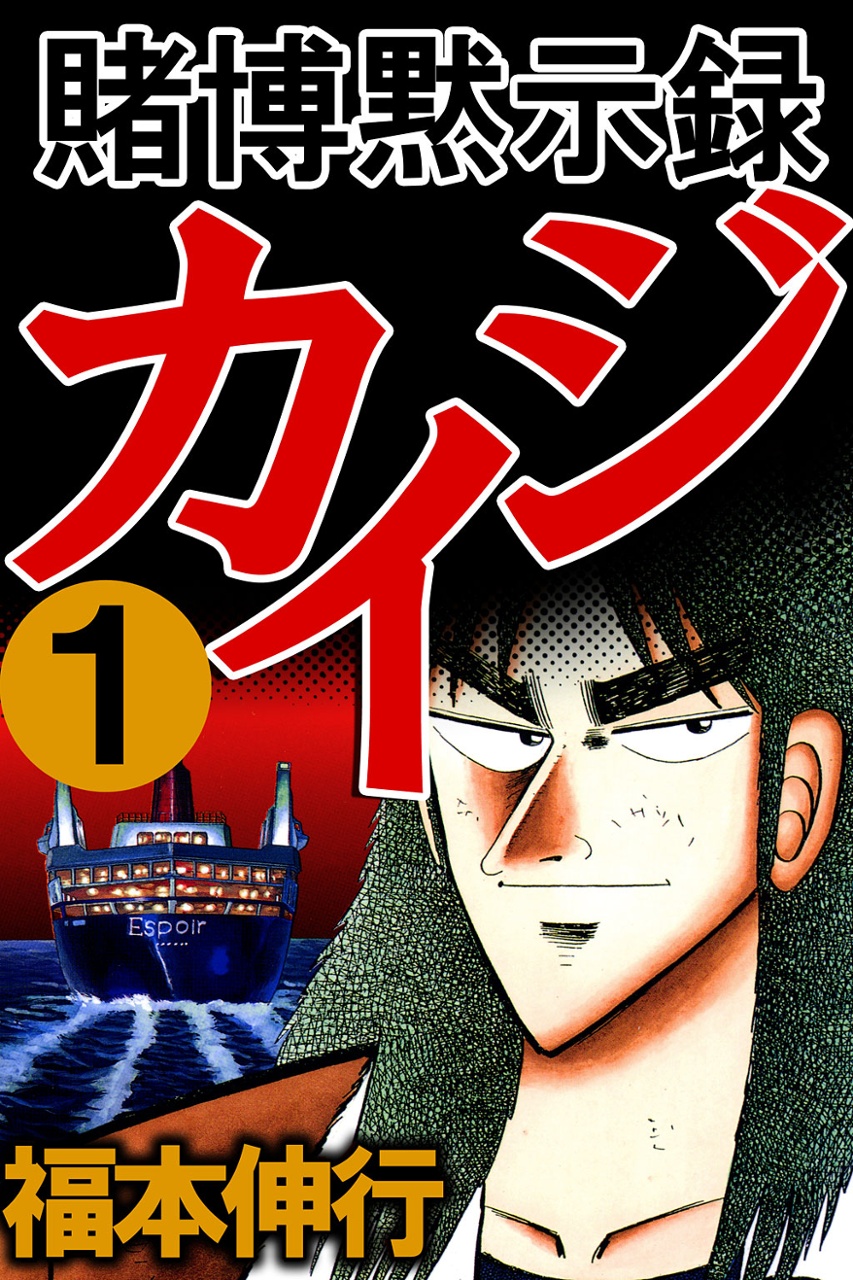
Spoiler commentary and discussion of Gambling Revelation Kaiji (Nobuyuki Fukumoto)
A gambling manga by Nobuyuki Fukumoto serialized in Weekly Young Magazine from 1996 to 1999, as well as an anime and movie based on the manga. The story follows Kaiji, a young man who spends his days working, drinking, and gambling, and who enters the world of gambling to pay off the debt of his former part-time job partner as a guarantor, and then takes on a variety of gambling challenges.
Read Article
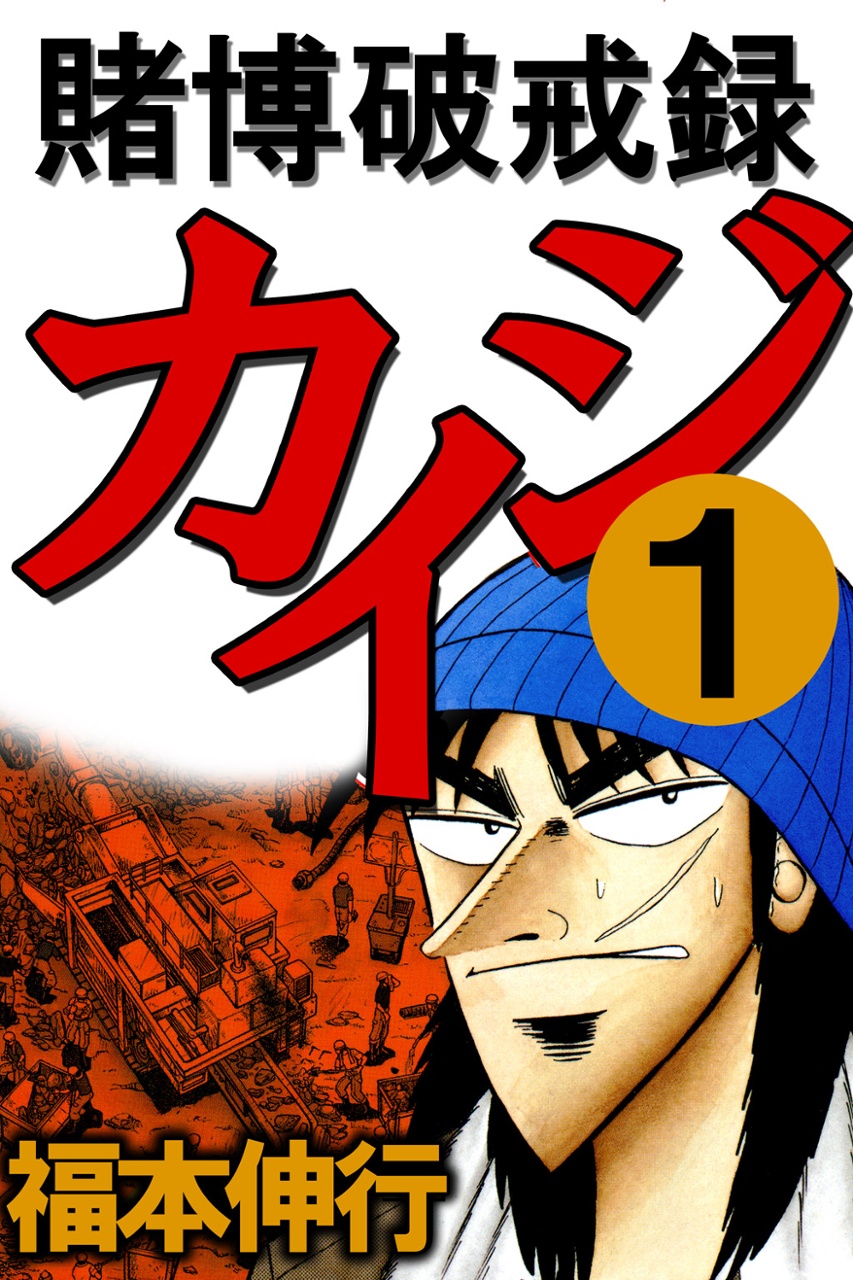
Spoiler commentary and discussion of Gambling Breakthrough Kaiji (Nobuyuki Fukumoto)
A gambling manga by Nobuyuki Fukumoto serialized in Weekly Young Magazine from 2001 to 2004, as well as an anime and movie based on the manga. It is a sequel to the previous work "Kaiji: The Gambling Revelation," which depicted Kaiji, a self-defeating and helpless man who throws himself into the world of gambling to repay the debts of his former part-time job partner as a guarantor, and again shows Kaiji's struggle in the world of gambling.
Read Article
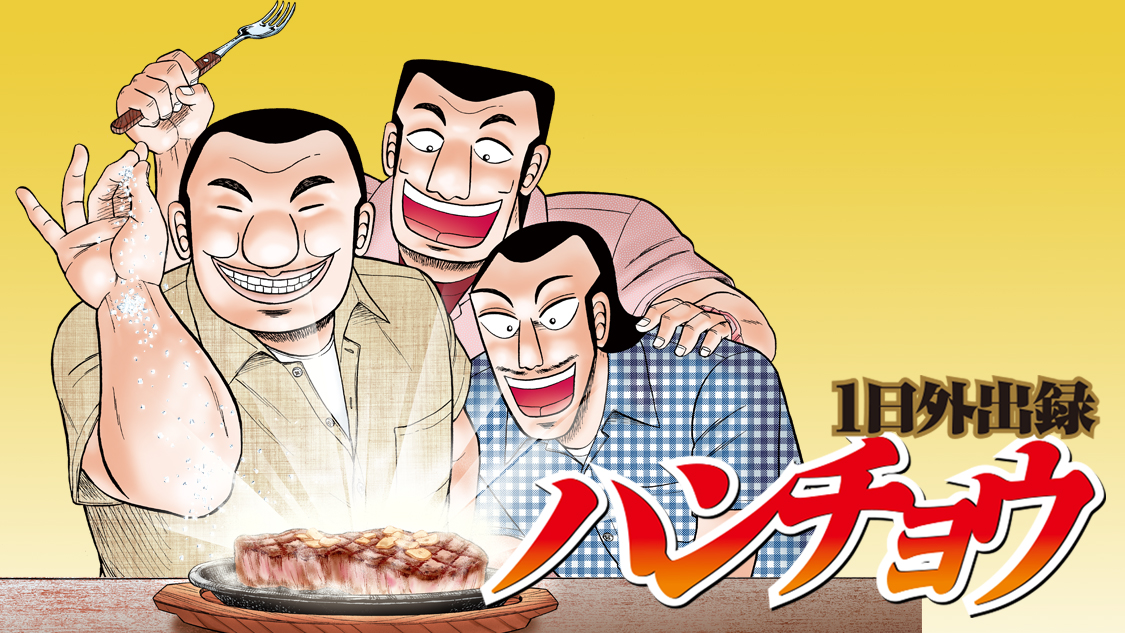
Spoiler commentary and discussion of Ichinichi Guroku Hancho (manga).
1 DAY OUT ROKU HANCHO" is a manga written by Tenharu Hagiwara (original story), Motomu Uehara and Kazuya Arai (manga), with the cooperation of Nobuyuki Fukumoto (manga). It is a spin-off of Fukumoto's masterpiece "Gambo Hakkairoku Kaiji" featuring Taro Ootsuki, a.k.a. Hancho, who is seen between the main character and Chinchillo gambling. The Teiai Group, a consumer finance company, has many bad debtors interned in an underground forced labor facility. The highest value work incentive option is a "one-day pass" to encourage them to work there. This is a gag manga about how Ootsuki, who frequently buys "one-day pass", enjoys his limited day.
Read Article
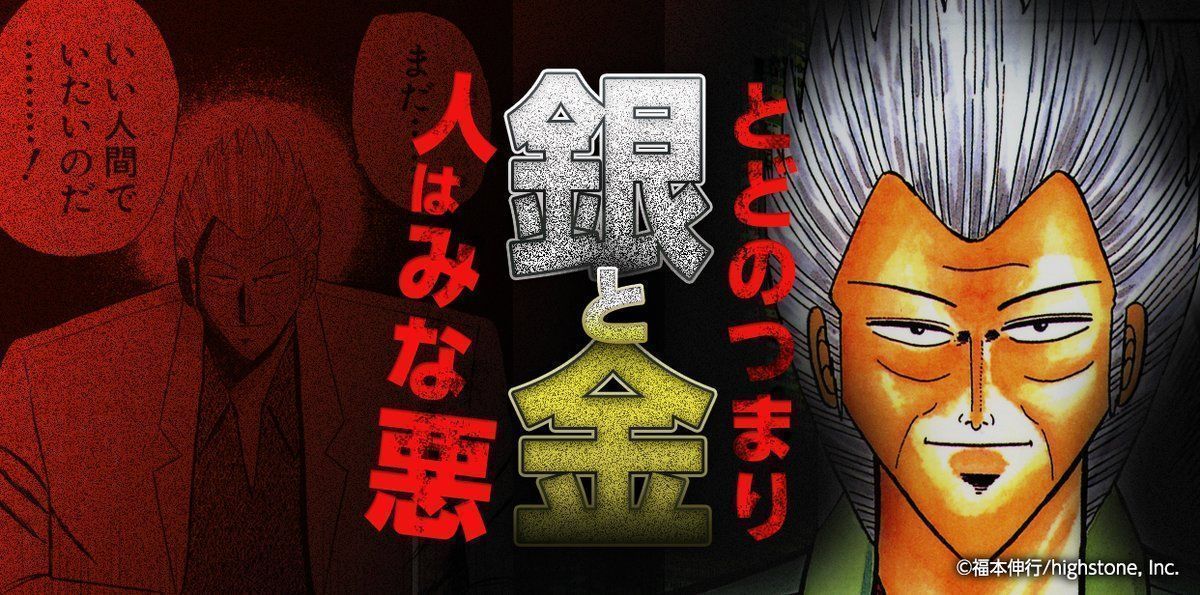
Silver and Gold (Nobuyuki Fukumoto) Spoiler Commentary and Discussion Summary
Silver and Gold" is a manga by Nobuyuki Fukumoto serialized in "Action Pizzazz" (Futabasha) from 1992 to 1996, as well as a TV drama and V-cinema based on the manga. Tetsuo Morita jumped into the underworld after meeting Ginji Hirai, a man who controls the underworld business world called the Silver King. The film depicts their deadly money wars, including stock speculators' wars and huge gambling, in pursuit of the dark veins of money that are groaning in the post-bubble era.
Read Article
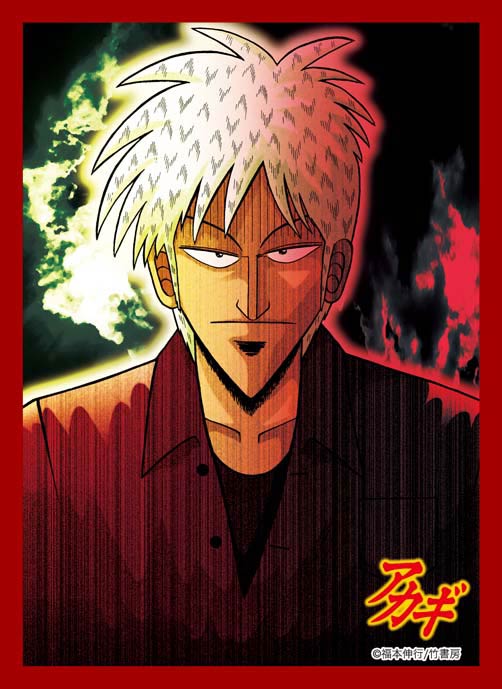
Akagi - The Genius Who Descended into Darkness (Nobuyuki Fukumoto) Spoiler Commentary and Discussion Summary
Mahjong manga by Nobuyuki Fukumoto. It was serialized in "Bessatsu Kindai Mahjong" (July 1991 issue). It was later transferred to "Kindai Mahjong". This is a spin-off work featuring the "legendary mahjong player" Akagi Shigeru, who appears in "Ten Tenwa Dori no Kaiohonji. The story follows young Akagi's encounter with mahjong at a mahjong parlor where he sneaks in to hide after an incident involving a gang of delinquents, and his competitions with a number of famous substitute mahjong players, culminating in a final battle with his ultimate enemy, Iwao Washizu.
Read Article
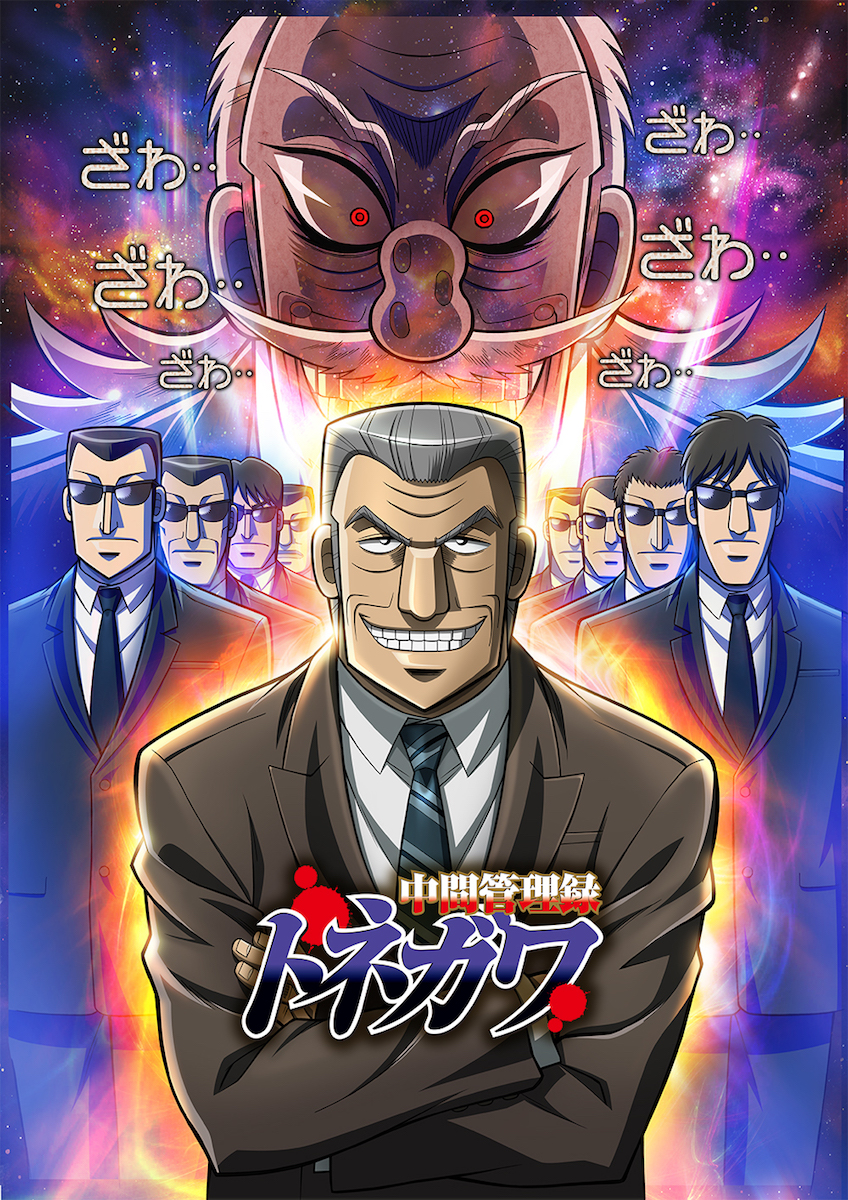
Spoiler commentary and discussion of Chuenchu Kankeiroku Tonegawa (manga and anime)
Chushin Kanriroku Tonegawa" is a spin-off of Nobuyuki Fukumoto's popular "Gambling Revelation Kaiji" featuring Yukio Tonegawa as the main character. The work is based on the anguish and conflict of Yukio Tonegawa, a so-called middle manager who is in charge of organizing his subordinates, the black suits, while at the same time trying to please Chairman Hyodo. It was broadcast on AnichU, Nippon Television's late-night anime slot, from July to December 2018. The book is complete with a total of 10 volumes released.
Read Article
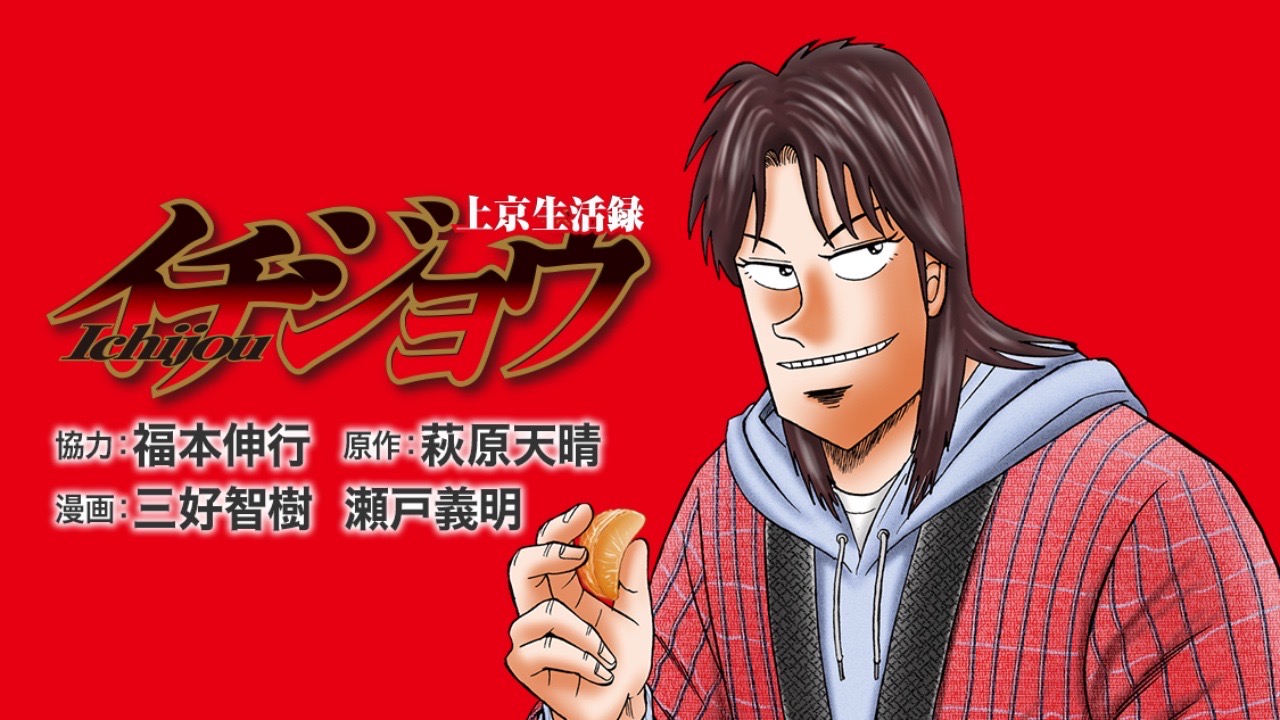
Spoiler commentary and discussion of Kamikyo Seikatsu Roku Ichijo (manga).
Kamikyo Seikatsuroku Ichijo" is a manga written by Tenharu Hagiwara (original story), Motomu Uehara and Kazuya Arai (manga), and Nobuyuki Fukumoto (cooperation). It is a spin-off of Fukumoto's masterpiece "Gekaku Bakkairoku Kaiji" featuring Seiya Ichijo, the owner of a backroom casino under the Teiai Group, which is mainly a consumer finance company. This is a gag manga about Ichijo's days as a smoker who moved to Tokyo from Okayama after graduating from high school before joining Teiai, where he would later rise to the upper echelons of Teiai by developing the "swamp," a devilish pachinko machine that costs 4,000 yen per ball.
Read Article
![Akagi] Nobuyuki Fukumoto Manga Quotes and Great Lines [Kaiji](https://renote.net/files/blobs/proxy/eyJfcmFpbHMiOnsiZGF0YSI6ODUyNzgzLCJwdXIiOiJibG9iX2lkIn19--330c1988e8df0fae5dc14e6ba0bb144beea5ccbc/SID0002540.jpg)
Akagi] Nobuyuki Fukumoto Manga Quotes and Great Lines [Kaiji
Nobuyuki Fukumoto is known for his many masterpiece gambling manga such as "Kaiji," "Akagi," and "Silver and Gold. Did you know that many of his works are filled with quotes that hint at how to turn your life around? We will bring you a number of such quotes and famous lines that will surely make you "zawa...zawa...".
Read Article
Delicious-looking foods in anime and manga that make you drool just looking at them.
Food scenes often appear in anime and manga. However, in reality, food has different color gradations and different light absorption and reflection rates, making it extremely difficult to depict in pictures. However, there are anime and manga that depict such unique foods in an extremely delicious manner. In this issue, we have compiled a list of many delicious-looking foods, focusing on such scenes.
Read Article
Seven Gambler Manga
"I learned to play mahjong from this manga. "I got a glimpse of the depth of the gambling world. I have compiled a list of manga that could be a bible for those who want to start gambling.
Read Article
Impact game! Images of Manga Quotes and Great Lines [Gambling Revelation Kaiji, etc.].
Here we have compiled a collection of images of famous manga scenes, famous quotes and lines, and one frame that is immensely persuasive. The images include famous works such as "Gambling Revelation Kaiji," "Doraemon," "Yotsuba! You can use them as stamps on your LINE, etc., and they might be popular with your friends.
Read Article
Learn a saying from the Kaijus!
Have you ever heard the saying, "Money is heavier than life?" This is a quote from the famous Kaiji. Thus, there are so many things you can learn from Kaiji, which may be very useful for your life. So, I would like to introduce some quotes from Kaiji. After reading this, I am sure you will be very serious about money. If you are too severe, you may not like it. Be careful!
Read Article
[Trauma] A compilation of manga with painful scenes.
Manga is, after all, "pictures". Even so, the fact that the emotion of "pain" comes to mind when reading them is evidence of the writer's excellence in expression. So I have compiled a list of manga with "painful" scenes.
Read Article
Appetizing! Summary of "Manga Meshi
Whether it is a cooking manga or not, there are certain dishes in manga that are very appetizing. We have compiled a list of 10 such "manga meshi.
Read Article
![Memetaa] A compilation of various onomatopoeias that appear in manga!](https://renote.net/files/blobs/proxy/eyJfcmFpbHMiOnsiZGF0YSI6NzIwMCwicHVyIjoiYmxvYl9pZCJ9fQ==--cda9b94c960b9803180ac78dcbda543354772e0c/memetaa.jpg)
Memetaa] A compilation of various onomatopoeias that appear in manga!
In manga without background music or sound effects, various actions are accompanied by onomatopoeia. In this article, we will introduce some unusual onomatopoeias that appear in such manga.
Read Article
Contents
- Overview of "Gambling Fallen Kaiji
- The story behind "Gambling Fallen Kaiji.
- The previous two works, "Gambling Revelation Kaiji."
- Previously titled "Gambling Destruction Record Kaiji."
- Gambling Fallen Kaiji."
- "Gambaku Tekkenroku Kaiji: Kazuya Arc."
- Gambaku Tengenroku Kaiji: One Poker Edition.
- Terms for "Gambling Fallen Kaiji
- Mine game "17 steps"
- Friendship check game "Rescue
- one-poker game
- Main characters
- Kaige Ito
- Takashi Muraoka
- Tomohiro Miyoshi
- Maeda.
- Kazuya Hyodo
- Mitsuyama
- asphalt
- Mario.
- Famous quotes, lines/scenes, and scenes from "Gekaku Fauten Roku Kaiji".
- Kaiji wins the Triple-Man Waza-Ri with a single "white" hand.
- Kozan's repentance
- Ah...! The core of my heart goes numb...! It's gambling, isn't it?