
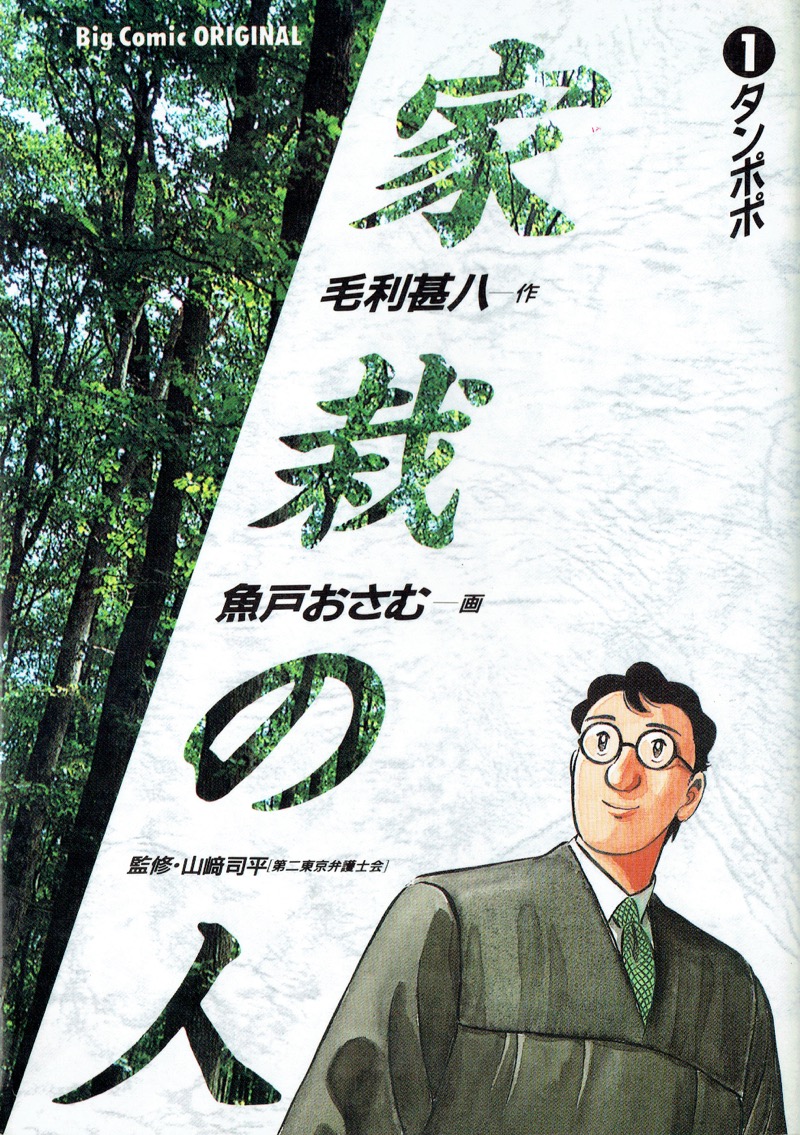
Iesai no Hito" is a humanistic youth manga about a court case written by Jinpachi Mohri and illustrated by Osamu Uodo and serialized in "Big Comic Original" from 1988 to 1996, as well as a TV drama based on this work. This humanistic manga describes the emotions of the people involved in the trial as the family court judge, Kuwata Yoshio, proceeds with the case. Through the trial, Kuwata helps people who come to the court with many worries and problems. Also fascinating are the unique court officials who are involved with Kuwata, who have various feelings for him.
Kuwata heard from Secretary Takasaki that a newspaper criticized the probation of a motorcycle gang boy who had committed an injury case. Kuwata said, "For a long time, we have been tormented by the midnight noise made by the motorcycle gang boys. On top of that, there are citizens who have been seriously injured for two months. If we return the boys to the town again, does the court expect us citizens to live with fear." Kuwata said to Takasaki, "If the town doesn't raise them, who will raise them?" Kuwata went on to say, "More than that, there is something I want you to think about, Takasaki-san." Kuwata said, "What should I plant after this flowerbed cosmos?"
Kuwata: "It is the result of your education that your child stands here now. How are you going to make up for this? Please tell me how you are going to raise him."
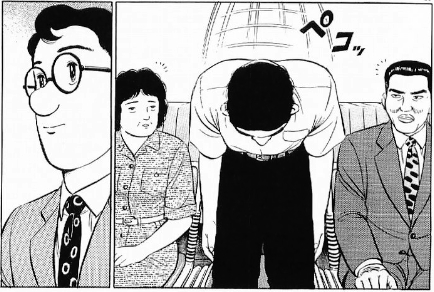
A boy who bows at the end of a conversation between Kuwata and his father. He just wanted to shake off his father's oppression.
The father of the boy, who was sent to the family court for extortion, is said to have taught his son judo and brought up his son with a hard time. However, at the court, Kuwata said to his father, "If you raise your son in such a way, anyone will become delinquent." To the father, who returns that he has raised many children through judo, he continues, "The other boys have homes to go home. Haven't you tied your son up with something else, not as a father?" The father gets angry and shouts, "My son's delinquency is not my fault!" Kuwata says to him, "No! Your child standing here now is the result of your education. How are you going to make up for this? Please tell me how you are going to raise him from now on." He gets upset and says, "Now that you say so. I don't know what to do. I don't know at all." The boy bows to Kuwata when he sees his father.
Kuwata: "We are gathered here to raise that 10-year-old child. Even if he is 10 years old, doesn't he have his own world?"
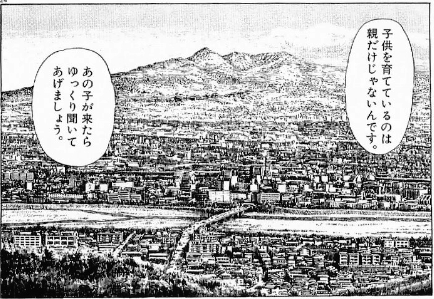
The line that not only parents but also towns are important factors for children to grow up.
The daughter of a couple who had been having a dispute over which child to take after their divorce went missing. Kuwata says, "Let's listen to the child in this mediation." The mediator replies, "She is only a 10-year-old child." Kuwata says, "We are gathering here to raise that 10-year-old child. Even if she is 10 years old, doesn't she have her own world?" Kuwata suggests that there are reasons for children to decide their place other than their relationship with their parents and grandparents. Children did not want to leave their homes or friends.
Kuwata: "What we can do with boys is small. But there are too many people who are ashamed of their small size and put them away."
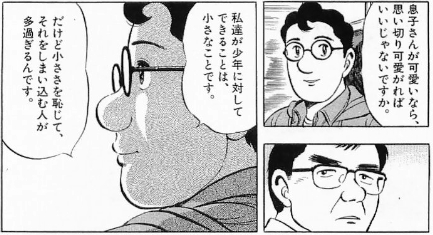
Reply to Kondo, who told him about his son's problems
Kondo, a veteran investigator, told Kuwatani that his relationship with his son had become poor since he was assigned to be in charge of his son's friends. He said, "I think I'm too old to bump into a boy. I'm talking big with my mouth, but I realized that I can't raise my own child." To him, Kuwata said, "If your son is cute, why don't you love him as much as you want?" He said, "What we can do for a boy is small. However, there are too many people who are ashamed of their small size and put them away." He told Kondo that there are still things he can do. On the night of that day, Kondo told his son that he was wrong and made peace with him.
A scene where a Shibuya investigator carries his mother on his back to meet his son.
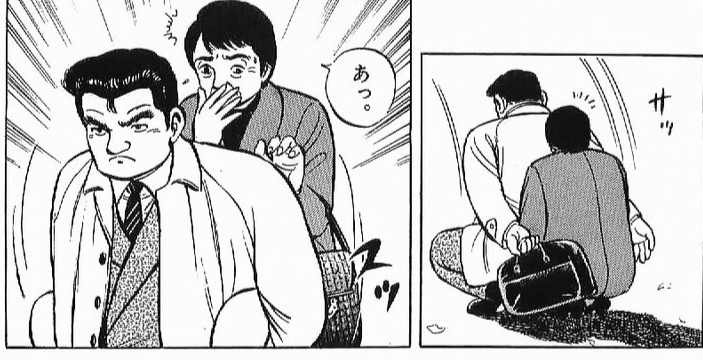
In order to have her son resume the life of a woman who had once left her son behind, Shibuya goes to her son with her. However, the woman, who feels guilty about meeting her son stops walking along the way. Shibuya says, "Think of me as a strange investigator," and takes the woman to her son on her back. She could not leave her alone in Shibuya, where her mother is also evaporating.
A scene where a girl who was assaulted at work meets a wounded boy on her way home.
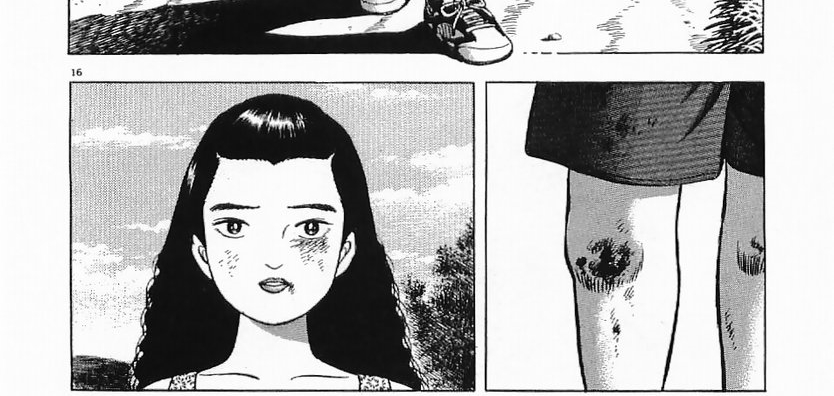
Yayoi, a girl who earns her living by, is assaulted and injured in the face after having an argument with a customer. On her way home, Yayoi meets a boy who is walking along the riverside and is full of wounds. She talks to him because she is worried about the boy's wounds, but on the other hand, she is worried about Yayoi's wounds. Yayoi, who feels the same thing as herself in the boy, takes him home. The boy was also bullied at the orphanage and ran away.
Kuwata: "You just don't know. What kind of face people laugh with. when they get out of that terrible circle."
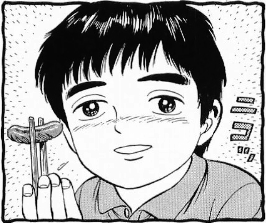
Ishimine escapes from the orphanage, finds the mother of a boy who would otherwise return to the orphanage, reunites her with the girl, and gives her time to dine with her.
Judge Ishimine, who is concerned about the treatment of the juveniles, criticizes Kuwata and takes the juvenile case lightly.
"Juvenile cases may seem boring to you. There are certainly many children who can't speak. There are also many desperate children who don't wear anything. However, when you look at the boys for a long time, you can understand some things."
"More or less, everyone has a history of being bullied in their lives. Small children are big children, powerful children are smart children, smart children are adults, women are normal men, normal men are strong men, strong men are organizations, organizations are stronger organizations. Tracing the causes leads to endless."
"I am an ordinary person, but if I use the Juvenile Law, I may be able to break the link."
"You just don't know. How a man would laugh. when he got out of that terrible circle."
Ishimine had not yet understood Kuwata's words at that time, but the girl who saved her after much consideration learned from her letter that she was saved by the smile of the boy who was saved from the circle.
Behind the Scenes, Trivia, Small Stories / Episodes and Anecdotes of "家栽 no Hito"
The word' 家栽' on the manhole of the Fukuoka Family Court
Manhole cover Fukuoka [Nishinihon Shinbun me]
www.nishinippon.co.jp
The word' 家栽' in "家栽 no Hito" is used for cultivation, not for judicial purposes, and the word' saishi' is also written on a manhole in the Fukuoka Family Court. Moreover, the word' saishi' seems to have been created around 1975, 12 years before the start of the series, because the word' saishi' was not intended for "家栽 no Hito" and the word' saishi' was misspelled.
Two non-plant titles

Tags
Contents
- Overview of "家栽 no Hito"
- Outline and story of "家栽 no Hito"
- Edited by Midoriyama Family Court
- A single volume' Dandelion'
- Two volumes of the book,' Violet'
- Volume 3,' Yuri' (lily)
- Edited by Harukawa Branch, Iwasaki District Court
- Volume 4: "Cosmos"
- Volume 5,' Rape Flower'
- Volume 6,' Sunflower'
- Volume 7: "Sasanqua"
- Volume 8' Momo' (peach)
- Volume 9,' MISS HOKUSAI'
- Volume 10,' Clarkia amoena' (Diary)
- Collection of 11 volumes,' Magnolia'
- Volume 12, "Casablanca"
- Kogen District Court
- Volume 13, "Deutzia crenata"
- Volume 14,' Gumi'
- Volume 15,' Nederlands Dianthus'
- TV drama "家栽 no Hito"
- Characters in "家栽 no Hito"
- Protagonist
- Yoshio Kuwata (played by Tsurutaro Kataoka, Saburo Tokito, and Eiichiro Funakoshi)
- Midoriyama Family Court Official
- Hiroshi Yamamoto
- Shigezo SHINOHARA
- Risa Ito
- Director Kanematsu
- Director Hamaguchi
- Hiromi Kirishima
- Midoriyama Police Station
- Ukon HOSOKAWA
- Employee of Harukawa Branch, Iwasaki District Court
- Kazutomo Chokai (played by Yosuke Saito)
- Kuramoto Akira
- Ryuzo TOI
- Mataji TAKASAKI (played by Hatsuo Yamaya)
- Naomasa Shibuya (played by Akira Emoto)
- OTAKI Makoto (Otaki Makoto, portrayed by Toru Kazama)
- Nishikyo IMANISHI (played by Nobuko Sendo)
- Maruya Maisamu
- Tomekichi MEGURO
- Kazuki KUBO
- Wataru ISHIMINE
- Iwasaki District Public Prosecutors Office, Chunhe Branch
- Higashiyama dried sweet potatoes Seishiro
- Tokugawa government
- Lawyer
- Saburo MITSUKOSHI
- Satoru Tanigawa
- Matsunosuke KIRA
- Hanabusa Kentaro
- Sakae Junior High School
- Terao Osushi
- Machida
- Akira Kawakami
- Atsushi Yokochi
- Teacher, Sakae Junior
- Ogata (Ogata)
- Adachi
- Tsurumaki
- Ryoji SEKI
- Officials of the Kogen District Court
- Shingo YAKUSHIJI
- Yusuke SAEKI
- Other people
- Yoshinori MATSUKADO
- A scholar who lives in a forest of ghost houses
- Ishimine Seira
- Mamoru KUWATA
- Sudo
- Terao no Haha
- Katsumata (Katsumata)
- The term "people of 家栽"
- Midoriyama Family Court
- Iwasaki District Court, Chunhe Branch
- Ghost House Forest
- Kogen District Court
- Kogen Municipal Sakae Junior High School
- Words, lines, scenes and scenes of "家栽 no Hito"
- Kuwata: "No matter how long the punishment is given, the boy will return to society. He will live next door to someone. When that happens. isn't it a judge's job to look for the possibility that the boy is living with a smile?"
- Kuwata: "If the town doesn't raise them, who will raise them?"
- Kuwata: "It is the result of your education that your child stands here now. How are you going to make up for this? Please tell me how you are going to raise him."
- Kuwata: "We are gathered here to raise that 10-year-old child. Even if he is 10 years old, doesn't he have his own world?"
- Kuwata: "What we can do with boys is small. But there are too many people who are ashamed of their small size and put them away."
- A scene where a Shibuya investigator carries his mother on his back to meet his son.
- A scene where a girl who was assaulted at work meets a wounded boy on her way home.
- Kuwata: "You just don't know. What kind of face people laugh with. when they get out of that terrible circle."
- Behind the Scenes, Trivia, Small Stories / Episodes and Anecdotes of "家栽 no Hito"
- The word' 家栽' on the manhole of the Fukuoka Family Court
- Two non-plant titles
- Unique color circle' Chinese lantern'
- Author Jinpachi Mori's posthumous work, "Will from' 家栽 no Hito' to Kimi, Sasebo Koichi Classmate Murder Case and Juvenile Law"
- Theme song and insert song of "家栽 no Hito"
- Tokyo Broadcasting System version drama theme song: Taeko Onuki "Haru no Tegami"