
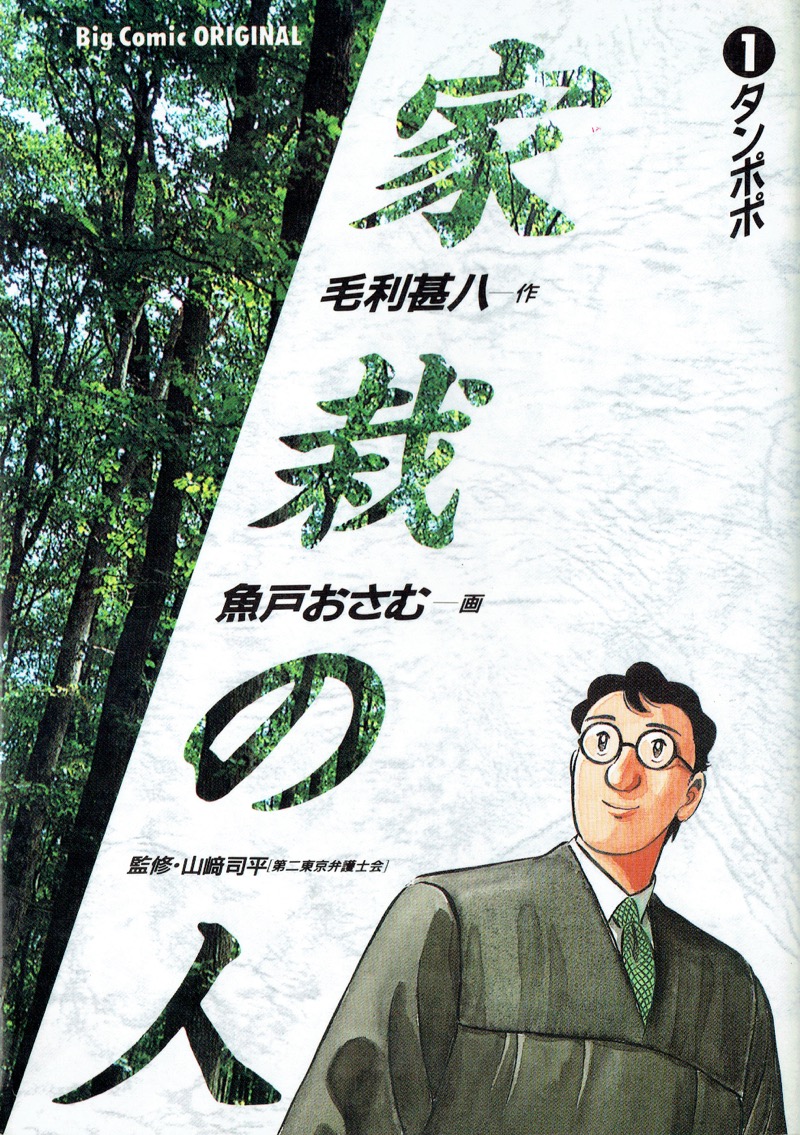
Iesai no Hito" is a humanistic youth manga about a court case written by Jinpachi Mohri and illustrated by Osamu Uodo and serialized in "Big Comic Original" from 1988 to 1996, as well as a TV drama based on this work. This humanistic manga describes the emotions of the people involved in the trial as the family court judge, Kuwata Yoshio, proceeds with the case. Through the trial, Kuwata helps people who come to the court with many worries and problems. Also fascinating are the unique court officials who are involved with Kuwata, who have various feelings for him.
The chief of the Meguro branch, assistant judge Kirishima, and Kuwata were in charge of the trial of a boy who had committed an injury resulting in death and had been sent back to the district court. The trial proceeded with the advantage of the prosecution, but Kuwata doubts that the time elapsed was short despite the fact that the scene of the crime and the place of arrest were far apart. Meguro also had Judge Kuramoto drive his car and moved the scene of the crime and the place of arrest to question the guilt of the criminal and to issue a verdict of not guilty for the injury resulting in death. The prosecutor, Seiji TOKUGAWA, who became interested in Kuwata because of this incident, approached Meguro, his contemporary, and told him that Kuwata was dating an outrageous person.
The scholar whom Kuwata met in' Ohaunted House Forest' was famous as an eccentric, and he had a previous criminal record of breaking into a residence and obstructing the execution of official duties, and was also a Quasi-Incompetent. Meguro, who knew the relationship between Kuwata and the scholar, persuaded Kuwata to associate with the scholar, but Kuwata did not listen and continued to associate with the scholar.
Collection of 11 volumes,' Magnolia'
Amidst the unrest, Wataru Ishimine (Wataru Ishimine) is transferred from the Tokyo District Court to the Shunhe Branch as a judge. Ishimine, who enjoys photography, and his wife, Sailor, travel around Chunhe City to take pictures, and along the way they meet Kuwata, who is enthusiastically observing the grass with his children. At first Ishimine looks at Kuwata with pity, calling him "a fossil from a previous era," but eventually realizes that he is not enjoying the moment in the slightest and leaves him. But then, for some reason, he ran into Kuwata every time he went out to take pictures. Ishimine began his duties at the Chunhe Branch, but he considered the job of a family court judge to be only a decoration. He did not want to stall mediation and forced himself to cut it short, and he was not well received by Kuwata-inspired officials like Investigator Shibuya and Clerk Takasaki. At one point, Shibuya reports a juvenile who is likely to commit a second offense as a non-prosecutor, and the juvenile re-offends. Ishimine confronted Shibuya, who said that he did it to encourage the boy to reflect on his behavior and that Kuwata had taught him how to do so. Ishimine's distrust of Kuwata thus deepens.
At first, Ishimine ignored Shibuya's opinion that the boy was sufficiently remorseful and that probation was appropriate and decided to send him to a juvenile reformatory. However, when he meets the boy again, he sees that he has reflected on his behavior and is mature, and although he is not sure about his decision, he finally decides to send him to a middle juvenile reformatory. However, this makes him lose faith in his own judgment. In the next story, Ishimine is assigned to another juvenile who has inhaled paint thinner, and is visited by Saburo Mitsukoshi, a lawyer hired as the juvenile's attendant. Mitsukoshi is an unusual character, having switched from being a truck driver to a lawyer and bringing his three children to court with him. Mitsukoshi confronts him with the fact that there is no evidence that the boy was a daily thinner addict, only a confession taken by the police. Ishimine decided not to send the boy to a juvenile reformatory, as he had originally planned, and instead placed him on probation. However, the boy immediately inhaled paint thinner again. When the boy's mother called him to the scene, Mitsukoshi was told that the mother had bought the thinner herself because she was afraid the boy would act out. After talking to the boy, Mikoshi is told by the boy that he can go to a juvenile reformatory, that since his father became a drunk, his wife has been following him around, and that "I am not a replacement for my father! I'm not replacing my father! In order to get the boy to stop using paint thinner and to consider his feelings, Mitsukoshi buys some from the same dealer and snuffs it in front of the boy and his parents. Meanwhile, Ishimine consults with Branch Chief Meguro and his colleague, Assistant Judge Kirishima, about the difficulty of adjudicating juvenile crimes, but his hesitation remains. At Kirishima's suggestion, he consulted Kuwata, who told him that he could not make a judgment without starting from the cause of drug dependence and the treatment for it. So he went to a counseling facility for drug addiction, and to his surprise, he found Mitsukoshi there. There, he told me, "Severely addicted patients cannot recover even if they are isolated in a juvenile reformatory. They have become friends with drugs," he explained. They can only get back on their feet when they feel a 'bottoming out,' a deep-seated sense of 'I can't go on like this,' and they start to think about trying to live again. Finally, as a first step, the two men show up at a tavern where the boy's father, the cause of discord in the boy's family, is drinking. They began drinking together, calling themselves "friend pushers," and shared the father's feelings of insecurity.
Volume 12, "Casablanca"
Yayoi Nakayama is a 17-year-old girl who earns her living by in Chunhe City. Due to her rebellious nature, she is beaten by guests at the hotel, but on her way home she meets a 9-year-old boy. Realizing that the boy has no place to go home, Yayoi takes him back to her apartment and starts living together, strengthening the bond like a family. One day they go into the woods to avoid the police, where they meet Kuwata and a friend who is a scholar. When Yayoi meets Kuwata again at night, she is taught how to use chopsticks by Kuwata for a boy who can't use them. However, Ishimine, an assistant judge who happens to pass by, sees her. After that, Yayoi is sent back to her apartment by a guest who follows her to the apartment and asks Yayoi for help.
Ishimine became in charge of a case in which a girl who made a living by had a trouble with a customer at home and stabbed her with a kitchen knife after a push-and-talk. Ishimine met the girl and immediately realized that she was the girl who had been with Kuwata before. Ishimine casually told Kuwata about the incident, but Kuwata answered, "Open your eyes and take a good look at the boy." On the other hand, the boy who lost his place was visiting a forest where scholars were.
When he found out that the girl was not eating at the detention center, he thought it was a threat from the girl. In the midst of this, he saw a picture written by the girl in which the girl and the boy were eating, and a lily flower was displayed there, which reminded him that Kuwata had gone out looking for lily seeds during lunch break. When he met the girl again, he made up his mind to have the girl repent and rescue her, but when he heard from Kirishima that Kuwata had declined the judgment on the girl because he was acquainted with the girl, he found the boy, Kuwata, and the scholar who were trying to convey the message from the other side of the fence of the detention center. It seemed that he had secretly followed Kuwata. When he was called to the chief's office, he was told about the boy's past and that it was probably the boy who stabbed the victims of the incident. When he felt the unusual atmosphere of the place, he changed his usual cold way to have Yayoi and the boy meet and eat together. The girl was sent to a short-term juvenile training school and the boy was taken in by his mother who was found by the court. However, although it was not mentioned in the story, Kuwata probably took responsibility for this incident and left Chunhe. That was why the atmosphere in the chief's office was strange.
After KUWATA left, the staff of the Chunhe branch lost their spirits, but one day a neighbor offered to take care of the branch's garden in return for Kuwata's help. Kuwata was taking a walk and solving the problems of many people in the town. Ishimine consulted with Meguro about the offer, but was told to make his own decision. Ishimine accepted the offer and helped him with the work.
Kogen District Court
Volume 13, "Deutzia crenata"
KUWATA was assigned to work at the Takahara District Court in Takahara City. A small fire broke out at Sakae Chuei Junior High School, where students Terao and MACHIDA were suspected. OGATA (Ogata), the teacher in charge, believed them and invited them to his home to eat yakiniku (grilled meat), saying that he would listen to them. However, they were actually doing a katsuage on their way home. OGATA's teacher, who found out about this, took them to a marsh at night, packed them in a hemp bag, tied them up with a rope, and sank them into the marsh. Later, Terao's mother visited a lawyer's office in the town, where there was a lawyer, MITSUKOSHI Sanro, who was an attendant for a boy who had been sent to a family court using thinner in Harukawa. He had a fight with his father-in-law, who was the director of the office, and rushed out. Hearing about the corporal punishment, Terao heard that Kuwata's mother had been introduced to this place by Kuwata, and Mitsue was eager to see her in court. On the other hand, Kuwata's son, Mamoru, told Kuwata that he did not want to go to school.
Terao's classmate, Kawakami, was found by her teacher, Adachi, to have been studying in the nurse's office while neglecting physical education. Kawakami, who is fond of aquariums, came to the marsh to collect waterweeds, and there was Terao and a Mamoru who was swimming in the marsh. Mamoru was forbidden to swim in the marsh when he was alone, so he called out to Terao, who was smoking thinner on the riverbank, and brought her to the marsh. Kuwata also came to the marsh, and the four of them deepened their friendship. In the midst of this, the case of corporal punishment at Sakae Junior High School drew public attention when it was reported in the newspaper. On the other hand, Terao's mother decided to go to court and demanded 10 million yen in compensation from the school, which refused and went to court.
One day, bored, Mamoru suggests building a hut on a marsh tree where everyone can play in winter. In addition to the three of Mamoru, Terao and Kawakami, Terao and Machida, who had been subjected to corporal punishment along with Kawakami, and Atsushi Yokochi, a student who refuses to go to school and a friend of Kawakami, work together to complete the hut.
Shingo YAKUSHIJI, who was to serve as the presiding judge in a trial of corporal punishment at Sakae Junior High School, secretly followed Kuwata after learning that his colleague, Kuwata's son was a truant and that Kuwata was teaching after work, and Yakushiji saw Shingo talking with Terao's mother, who was the complainant, and became interested in Shingo, so Yakushiji made Kuwata participate in the trial knowing that he was acquainted with the complainant.
Volume 14,' Gumi'
The trial was about to begin, but the plaintiffs' attorney, Mitsukoshi, proposed an on-the-spot inspection. At the scene, Kuwata and Judge Yusuke Saeki also entered the marsh. It was thought that the trial would proceed in the plaintiffs' favor, but the second attorney, Hanabusa Kentaro, provided by the defendants, insisted that the plaintiffs' weaknesses should be found.
Around that time, Terao was told by KAWAKAMI that he was the one who set fire to the Kakugeba, and Katsumata (Katsumata), the leader of a delinquent junior high school next door, saw him and threatened him. After that, Hide contacted Terao and set fire to Terao while riding on his motorcycle. In the midst of this, OGATA, who was suspected of leaking information to the newspaper at the meeting of the teachers, tried to commit suicide in the marsh out of anxiety, but was saved by the guards. OGATA, who talked with Terao and KAWAKAMI, became aware that he himself hated corporal punishment. The next day, KAWAKAMI was ordered to give supplementary lessons of judo to ADACHI, but OGATA appeared to take the supplementary lessons of judo on his behalf, and was thrown to ADACHI. OGATA was convinced that ADACHI enjoyed hurting the weak, and declared that he would change the school.
So far, the plaintiffs have had an overwhelming advantage in the trial, but when Terao stands on the witness stand, Britain appears and pursues that Terao had committed far more delinquent acts than the school had recognized. In a hurry, Terao shows off to the people around him, and the judge's image is greatly damaged.
Volume 15,' Nederlands Dianthus'
Terao, depressed by what he had done, saved Kawakami when he was forced to shoplift by Katsumata, and regained his energy. After that, Terao stopped coming to the marsh, but Mamoru and Kawakami broke into the court to save Terao and told Yakushiji that it was not Terao who set fire to the Kakugiba. Kawakami appeared in court and confessed that he had set fire and that the students were scared every day by the violence of Adachi and Tsurumaki.
After finding out that Terao and Kuwata that and Kuwata have a friend, and tries to take a picture of them and use it. He takes a picture of them together in the marsh, but when Terao becomes alone, Katsumata appears with his men. Katsumata orders Terao to set fire to the hut he built as an apology for humiliating him, but Terao disagrees and severely injures Katsumata, who is arrested by the police. The teachers are pleased with the opportunity to turn things around, but the principal, Ryoji Seki, confesses that he told the newspaper about the corporal punishment in order to correct the corporal punishment in order to correct their distortions.
As a last resort, Britain threatened Kuwata by showing him a picture of Kuwata and Terao. However, Kuwata persuaded him by saying, "Since the Terao boy, his mother, and the accused teachers were brought to court, they can be said to be the victims of the case," "Even so, this trial may be the key to solving the same tangled case that will occur next," and "Why don't we make a good trial so that the suffering of Terao kun and the worries of the teachers will not be in vain?" Britain did not mention the picture at the trial. The trial resulted in the city paying 2 million yen and the teachers 100,000 yen in compensation.
Kawakami moved to Tokyo, and after entering a juvenile training school, Terao worked for a volunteer probation officer and went their own way. Mamoru went to a school in Tokyo that gathered truant children, and Kuwata also returned to the Harukawa branch near Tokyo.
TV drama "家栽 no Hito"
It has been made into a TV drama three times by TBS and twice by TV Asahi.
In 1993, 12 episodes were broadcast starring Tsurutaro Kataoka, and in 1996, it was broadcast as a special.
In 2004, it was adapted into a single drama' Wednesday Premier' starring Saburo Tokito, and the contents are original.
It was broadcast on TV Asahi in 2020 and 2021, starring Eiichiro Funakoshi. Eiichiro Funakoshi is said to be a fan of this comic.
The first drama starring Tsurutaro Kataoka is set not at the Shunkawa Branch but at the Shunkawa Family Court. The characters are similar to those of the Shunkawa Branch, such as Inspector Shibuya and Judge Chokai, but in the special, Sanae IMIZU (played by Misa SHIMIZU) appears as a new investigator. In the special, the case of Yayoi, a girl who makes a living by, is depicted in the 12-volume comic book.
The setting of the Saburo Tokito version is the Urushibara Family Court, and the contents are completely original. The Eiichiro Funakoshi version is also original as well, but it features a story based on the story of' Biwa' in the fifth episode of the sixth volume of the book.
Characters in "家栽 no Hito"
Protagonist
Yoshio Kuwata (played by Tsurutaro Kataoka, Saburo Tokito, and Eiichiro Funakoshi)
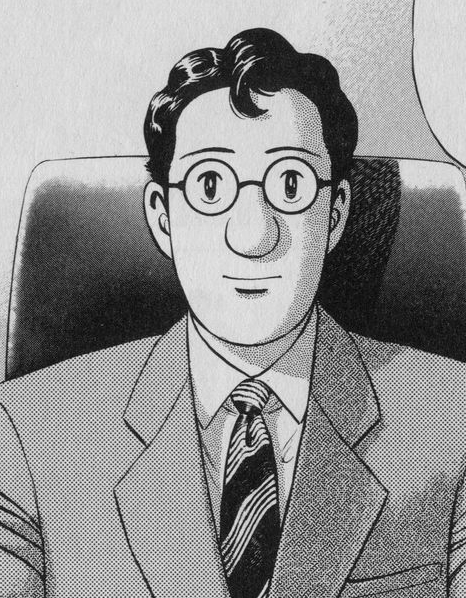
A judge of the Midoriyama Family Court who was later transferred to the Harukawa Branch of the Iwasaki District Court and then to the Kogen District Court. He is very gentle and polite to everyone, but on rare occasions he takes a stern attitude toward the boy and his parents at the trial. He always appears to be absent-minded, so many people feel suspicious at first. However, he is a very good judge, and he resolves cases with his insight into suspicious points in cases, his energy to carry out investigations with confidence on holidays, and his strong belief in saving the boys.
His hobbies are looking at and growing plants and taking walks. He always takes care of the court garden, and the flowers of the four seasons bloom in the court where Kuwata is. When he talks, he often compares his story to plants, which can be confusing for people around him. He spends much of his lunch break and holidays taking walks, finding plants and looking at them carefully. He writes the location of the plants in his system notebook, and he is very familiar with the geography of the town, which can be useful at work.
He was asked to transfer to Tokyo because he passed the bar exam with one shot, achieved excellent results when he was a legal apprentice, and had excellent administrative skills as a judge, but he refused. In the story, he was asked to transfer to the Supreme Court investigation officer, but he refused and wanted to transfer to the Chunhe branch. In response to this, he says that there are more than 50 kinds of wild violets, but he has finally come to be able to tell the difference between several kinds, but the boys are the same and come with different worries every day, and he wants to think about them.
He has a wife and a son, Mamoru, who is an elementary school student. His wife does not appear in the story at all, but Mamoru appears at the end of the story, and he is treated as the leading character in the case of corporal punishment at Sakae Junior High School, which is the last case in the story. His father is the President of the High Court (and the Supreme Court judge in the story), and he lives alone in Tokyo. He really wants Kuwata to come to Tokyo and live with him.
Midoriyama Family Court Official
Hiroshi Yamamoto
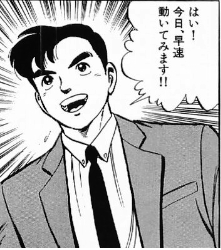
An assistant investigator (later promoted to investigator) working for the Midoriyama Family Court. He respects Kuwata and enthusiastically works for the boys.

Tags
Contents
- Overview of "家栽 no Hito"
- Outline and story of "家栽 no Hito"
- Edited by Midoriyama Family Court
- A single volume' Dandelion'
- Two volumes of the book,' Violet'
- Volume 3,' Yuri' (lily)
- Edited by Harukawa Branch, Iwasaki District Court
- Volume 4: "Cosmos"
- Volume 5,' Rape Flower'
- Volume 6,' Sunflower'
- Volume 7: "Sasanqua"
- Volume 8' Momo' (peach)
- Volume 9,' MISS HOKUSAI'
- Volume 10,' Clarkia amoena' (Diary)
- Collection of 11 volumes,' Magnolia'
- Volume 12, "Casablanca"
- Kogen District Court
- Volume 13, "Deutzia crenata"
- Volume 14,' Gumi'
- Volume 15,' Nederlands Dianthus'
- TV drama "家栽 no Hito"
- Characters in "家栽 no Hito"
- Protagonist
- Yoshio Kuwata (played by Tsurutaro Kataoka, Saburo Tokito, and Eiichiro Funakoshi)
- Midoriyama Family Court Official
- Hiroshi Yamamoto
- Shigezo SHINOHARA
- Risa Ito
- Director Kanematsu
- Director Hamaguchi
- Hiromi Kirishima
- Midoriyama Police Station
- Ukon HOSOKAWA
- Employee of Harukawa Branch, Iwasaki District Court
- Kazutomo Chokai (played by Yosuke Saito)
- Kuramoto Akira
- Ryuzo TOI
- Mataji TAKASAKI (played by Hatsuo Yamaya)
- Naomasa Shibuya (played by Akira Emoto)
- OTAKI Makoto (Otaki Makoto, portrayed by Toru Kazama)
- Nishikyo IMANISHI (played by Nobuko Sendo)
- Maruya Maisamu
- Tomekichi MEGURO
- Kazuki KUBO
- Wataru ISHIMINE
- Iwasaki District Public Prosecutors Office, Chunhe Branch
- Higashiyama dried sweet potatoes Seishiro
- Tokugawa government
- Lawyer
- Saburo MITSUKOSHI
- Satoru Tanigawa
- Matsunosuke KIRA
- Hanabusa Kentaro
- Sakae Junior High School
- Terao Osushi
- Machida
- Akira Kawakami
- Atsushi Yokochi
- Teacher, Sakae Junior
- Ogata (Ogata)
- Adachi
- Tsurumaki
- Ryoji SEKI
- Officials of the Kogen District Court
- Shingo YAKUSHIJI
- Yusuke SAEKI
- Other people
- Yoshinori MATSUKADO
- A scholar who lives in a forest of ghost houses
- Ishimine Seira
- Mamoru KUWATA
- Sudo
- Terao no Haha
- Katsumata (Katsumata)
- The term "people of 家栽"
- Midoriyama Family Court
- Iwasaki District Court, Chunhe Branch
- Ghost House Forest
- Kogen District Court
- Kogen Municipal Sakae Junior High School
- Words, lines, scenes and scenes of "家栽 no Hito"
- Kuwata: "No matter how long the punishment is given, the boy will return to society. He will live next door to someone. When that happens. isn't it a judge's job to look for the possibility that the boy is living with a smile?"
- Kuwata: "If the town doesn't raise them, who will raise them?"
- Kuwata: "It is the result of your education that your child stands here now. How are you going to make up for this? Please tell me how you are going to raise him."
- Kuwata: "We are gathered here to raise that 10-year-old child. Even if he is 10 years old, doesn't he have his own world?"
- Kuwata: "What we can do with boys is small. But there are too many people who are ashamed of their small size and put them away."
- A scene where a Shibuya investigator carries his mother on his back to meet his son.
- A scene where a girl who was assaulted at work meets a wounded boy on her way home.
- Kuwata: "You just don't know. What kind of face people laugh with. when they get out of that terrible circle."
- Behind the Scenes, Trivia, Small Stories / Episodes and Anecdotes of "家栽 no Hito"
- The word' 家栽' on the manhole of the Fukuoka Family Court
- Two non-plant titles
- Unique color circle' Chinese lantern'
- Author Jinpachi Mori's posthumous work, "Will from' 家栽 no Hito' to Kimi, Sasebo Koichi Classmate Murder Case and Juvenile Law"
- Theme song and insert song of "家栽 no Hito"
- Tokyo Broadcasting System version drama theme song: Taeko Onuki "Haru no Tegami"