
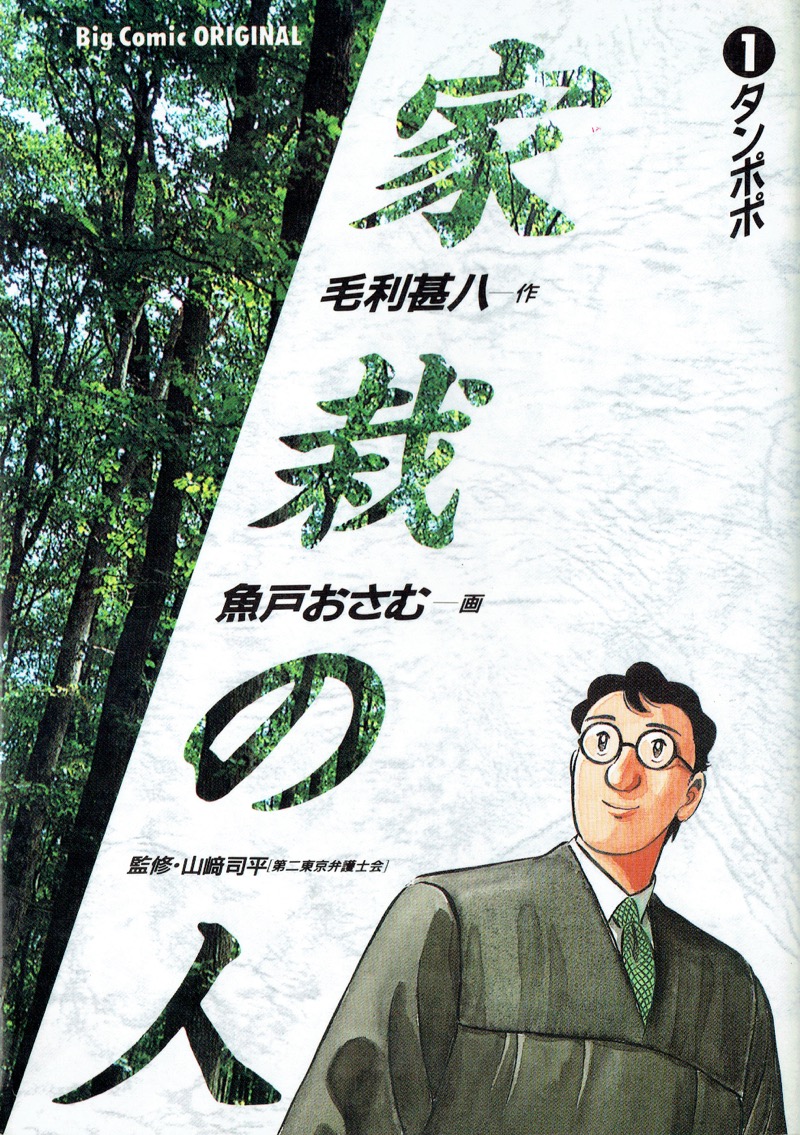
Iesai no Hito" is a humanistic youth manga about a court case written by Jinpachi Mohri and illustrated by Osamu Uodo and serialized in "Big Comic Original" from 1988 to 1996, as well as a TV drama based on this work. This humanistic manga describes the emotions of the people involved in the trial as the family court judge, Kuwata Yoshio, proceeds with the case. Through the trial, Kuwata helps people who come to the court with many worries and problems. Also fascinating are the unique court officials who are involved with Kuwata, who have various feelings for him.
The title of each story of this work is the name of a plant or a word related to a plant, but only' mountain, river, grass and trees' in the ninth episode of the twelfth volume and' marsh' in the eighth episode of the fifteenth volume are different.
Unique color circle' Chinese lantern'
"家栽 no Hito" has comedic scenes, but the story is basically serious. However, this episode of "Chinese lantern" is completely different. The story was developed from the viewpoint of the chief of the Meguro branch, the officers were allowed to dress freely in order to change the authoritarian court, and the judges were obliged to dress according to the living environment of the other party, so Meguro dressed like his father in a tavern and entered the tavern style court, and the trial was held in the Nagoya dialect where the accused was from. There was also a "green court" covered with plants, and Meguro chatted with the officers over lunch in the garden. The scenes that were far from the reality continued, and Meguro woke up and realized that it was all a dream. However, Meguro looked somewhat lonely.
Author Jinpachi Mori's posthumous work, "Will from' 家栽 no Hito' to Kimi, Sasebo Koichi Classmate Murder Case and Juvenile Law"
This book was published by Kodansha Ltd. in 2015, the year of the death of the original author Jinpachi Mori. The author, who had been suffering from the fact that he had placed a character who was far from reality as the main character of "家栽 no Hito" (The Man of Osaka), is a book that warns against the issue of the post-war Juvenile Law and the thoughtless beating of the Juvenile Law while fighting against the terminal cancer of the cafeteria.
In the first half of this book, the author examines the problems of the courts and legal circles in the post-war period, reports on the Kobe child serial killing case and the Hikari City mother and child murder case, and interviews with Yoshihiro Noguchi, chairman of Noguchi Oil Co., Ltd., who continues to employ juvenile delinquents, and Katsuyoshi Fujioka, president of Fujisemi, a cram school that supports the advancement of children from juvenile classification homes and juvenile training schools.
In the second half a letter written in response to the murder of a classmate at Sasebo High School.
Contents
Part 1: The Post-War History of the Juvenile Law: The Author's Delusion
Chapter I Looking Back at the People of 家栽
Chapter II Considering the Fifteen Years of Beating the Juvenile Law
Chapter III World of Juvenile Training Schools
Chapter IV Man Who Employed 100 Juvenile Delinquents
Yoshihiro Noguchi, Chairman of Noguchi Oil Co., Ltd. (Kitakyushu City, Fukuoka Prefecture)
Chapter V Advancement to University from Juvenile Classification Home, Undertaken
Katsuyoshi Fujioka (Fukuyama City, Hiroshima Prefecture), president of Juku (cram school) Fujisemi
PART II: LETTERS TO SASEBO NO KIMI
Chapter VI First Communication over-busy summer
Chapter VII Second Shin Enter the Supreme Court
Chapter VIII Chapter III Faith Death when I encounter puberty
Chapter IX The Fourth Faith at the Feet of Yuimazume
Theme song and insert song of "家栽 no Hito"
Tokyo Broadcasting System version drama theme song: Taeko Onuki "Haru no Tegami"
Spring Letter (song, lyrics, music: Taeko Onuki)

Tags
Contents
- Overview of "家栽 no Hito"
- Outline and story of "家栽 no Hito"
- Edited by Midoriyama Family Court
- A single volume' Dandelion'
- Two volumes of the book,' Violet'
- Volume 3,' Yuri' (lily)
- Edited by Harukawa Branch, Iwasaki District Court
- Volume 4: "Cosmos"
- Volume 5,' Rape Flower'
- Volume 6,' Sunflower'
- Volume 7: "Sasanqua"
- Volume 8' Momo' (peach)
- Volume 9,' MISS HOKUSAI'
- Volume 10,' Clarkia amoena' (Diary)
- Collection of 11 volumes,' Magnolia'
- Volume 12, "Casablanca"
- Kogen District Court
- Volume 13, "Deutzia crenata"
- Volume 14,' Gumi'
- Volume 15,' Nederlands Dianthus'
- TV drama "家栽 no Hito"
- Characters in "家栽 no Hito"
- Protagonist
- Yoshio Kuwata (played by Tsurutaro Kataoka, Saburo Tokito, and Eiichiro Funakoshi)
- Midoriyama Family Court Official
- Hiroshi Yamamoto
- Shigezo SHINOHARA
- Risa Ito
- Director Kanematsu
- Director Hamaguchi
- Hiromi Kirishima
- Midoriyama Police Station
- Ukon HOSOKAWA
- Employee of Harukawa Branch, Iwasaki District Court
- Kazutomo Chokai (played by Yosuke Saito)
- Kuramoto Akira
- Ryuzo TOI
- Mataji TAKASAKI (played by Hatsuo Yamaya)
- Naomasa Shibuya (played by Akira Emoto)
- OTAKI Makoto (Otaki Makoto, portrayed by Toru Kazama)
- Nishikyo IMANISHI (played by Nobuko Sendo)
- Maruya Maisamu
- Tomekichi MEGURO
- Kazuki KUBO
- Wataru ISHIMINE
- Iwasaki District Public Prosecutors Office, Chunhe Branch
- Higashiyama dried sweet potatoes Seishiro
- Tokugawa government
- Lawyer
- Saburo MITSUKOSHI
- Satoru Tanigawa
- Matsunosuke KIRA
- Hanabusa Kentaro
- Sakae Junior High School
- Terao Osushi
- Machida
- Akira Kawakami
- Atsushi Yokochi
- Teacher, Sakae Junior
- Ogata (Ogata)
- Adachi
- Tsurumaki
- Ryoji SEKI
- Officials of the Kogen District Court
- Shingo YAKUSHIJI
- Yusuke SAEKI
- Other people
- Yoshinori MATSUKADO
- A scholar who lives in a forest of ghost houses
- Ishimine Seira
- Mamoru KUWATA
- Sudo
- Terao no Haha
- Katsumata (Katsumata)
- The term "people of 家栽"
- Midoriyama Family Court
- Iwasaki District Court, Chunhe Branch
- Ghost House Forest
- Kogen District Court
- Kogen Municipal Sakae Junior High School
- Words, lines, scenes and scenes of "家栽 no Hito"
- Kuwata: "No matter how long the punishment is given, the boy will return to society. He will live next door to someone. When that happens. isn't it a judge's job to look for the possibility that the boy is living with a smile?"
- Kuwata: "If the town doesn't raise them, who will raise them?"
- Kuwata: "It is the result of your education that your child stands here now. How are you going to make up for this? Please tell me how you are going to raise him."
- Kuwata: "We are gathered here to raise that 10-year-old child. Even if he is 10 years old, doesn't he have his own world?"
- Kuwata: "What we can do with boys is small. But there are too many people who are ashamed of their small size and put them away."
- A scene where a Shibuya investigator carries his mother on his back to meet his son.
- A scene where a girl who was assaulted at work meets a wounded boy on her way home.
- Kuwata: "You just don't know. What kind of face people laugh with. when they get out of that terrible circle."
- Behind the Scenes, Trivia, Small Stories / Episodes and Anecdotes of "家栽 no Hito"
- The word' 家栽' on the manhole of the Fukuoka Family Court
- Two non-plant titles
- Unique color circle' Chinese lantern'
- Author Jinpachi Mori's posthumous work, "Will from' 家栽 no Hito' to Kimi, Sasebo Koichi Classmate Murder Case and Juvenile Law"
- Theme song and insert song of "家栽 no Hito"
- Tokyo Broadcasting System version drama theme song: Taeko Onuki "Haru no Tegami"