
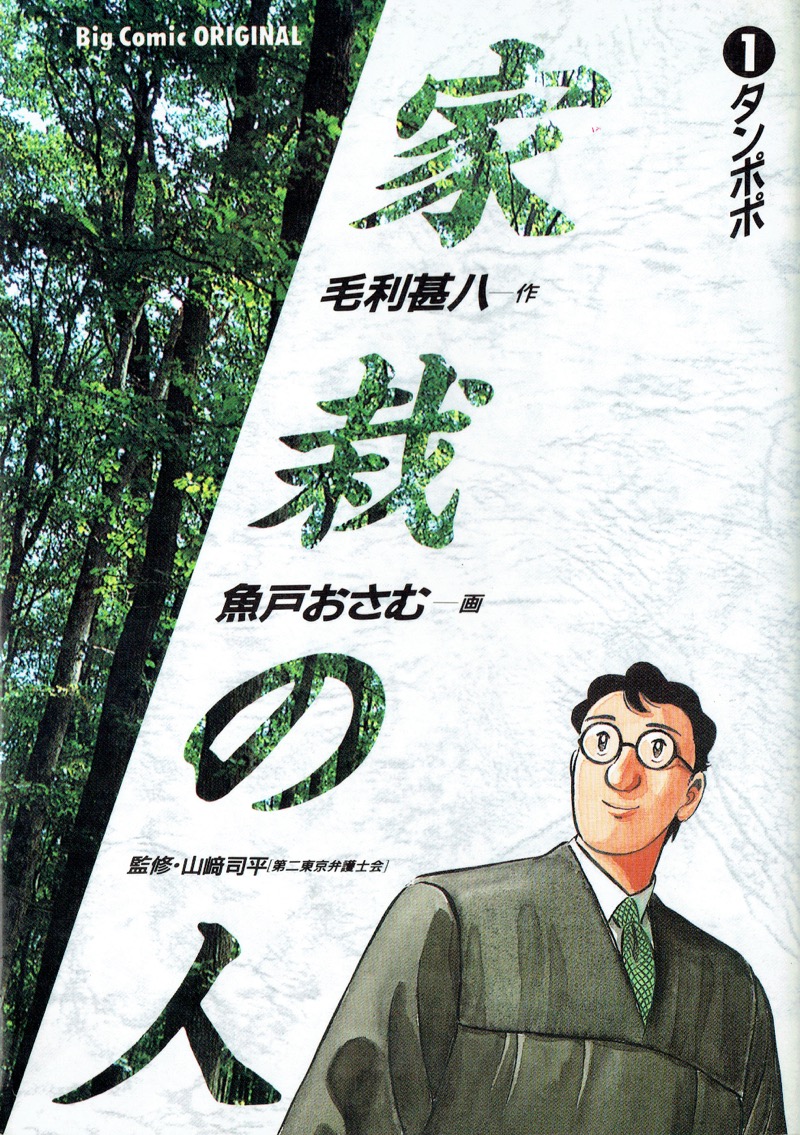
Iesai no Hito" is a humanistic youth manga about a court case written by Jinpachi Mohri and illustrated by Osamu Uodo and serialized in "Big Comic Original" from 1988 to 1996, as well as a TV drama based on this work. This humanistic manga describes the emotions of the people involved in the trial as the family court judge, Kuwata Yoshio, proceeds with the case. Through the trial, Kuwata helps people who come to the court with many worries and problems. Also fascinating are the unique court officials who are involved with Kuwata, who have various feelings for him.
Overview of "家栽 no Hito"
"家栽 no Hito" is a TV drama based on "Big Comic Original" serialized between 1988 and 1996. It is a ninjo-mono (human-interest story) comic for young people dealing with the trial of Jinpachi Mori's Osamu Uoto painting, which was serialized in "Big Comic Original". In addition to the 15 volumes of the book, the 10 volumes of the paperback edition are also on sale. It has also been made into a TV drama three times by Tokyo Broadcasting System and twice by TV Asahi. The title' 家栽' is for cultivation and is different from' Kasai,' an abbreviation for family court.
Family Court Judge Yoshio Kuwata A Yoshio, the son of the chief justice of the Tokyo High Court, is an excellent judge who continues to work at the Family Court. Although he seems to be always busy taking care of the court's flower bed and taking a walk around the town on holidays and lunch breaks, he solves various problems with his own insight and reasoning.
In addition to writing about family relationships and the rehabilitation of juvenile delinquents with a focus on psychological descriptions of people, plants always appear in the form related to stories, and the titles of each story are related to plants except for one. Most of the story is completed by one story, but the second half consists of several stories in one story, and the 13th to 15th volumes of the book are long volumes dealing with one case.
Outline and story of "家栽 no Hito"
Edited by Midoriyama Family Court
A single volume' Dandelion'
Yoshio KUWATA, a judge of the Midoriyama Family Court, is quite fond of plants. He takes care of potted plants and flower beds in the court, goes out for a walk during lunch break, and looks at the plants in town. He is a very talented judge, and he once declined to be a judge for the sake of his family. In the court where he works, there are many cases of divorce, mediation of inheritance, and trials of juveniles referred for delinquent acts every day. However, KUWATA carefully handles each case and finds a way for them to grow instead of just punishing them. There are many people who adore KUWATA, such as Hiroshi Yamamoto, a young assistant investigator, Risa ITO, a bright administrative official, and Shigezo SHINOHARA, a veteran secretary who can be said to be KuwatA's wife, and those who initially looked at KUWATA suspiciously as a strange person gradually become attracted by his personality.
In the juvenile's trial, the environment of the family in which they grew up is emphasized, and the problems of the family are clarified with the help of assistant investigator Yamamoto.
In one case, a 15-year-old girl brought to trial for did not appear to have had a problem when Yamamoto talked to her teachers and parents. However, Kuwata said, "I don't know until I look at the house," and when I went to the girl's house, I realized that it was a strangely clean house. On my way home again, I was told by the girl's younger brother that her mother had said, "My sister has become dirty, too, so I can't come back to this house." The next day, when I talked with Kuwata, who takes care of the trees, he heard that "fallen cherry blossom petals are nutrients for the trees, and there are also fallen and rotten petals, which is the beauty of the flowers." Yamamoto suspects that the mother's cleanliness was an indirect cause of the girl's delinquency. Later, at the court, Kuwata told her mother, "Can't you be a bigger mother so that this child can live while looking for herself?" and told her to decide for herself whether to go to various facilities or go home. Seeing her mother's upset appearance, the girl chose to go home.
Two volumes of the book,' Violet'
Kuwata's well-known Midoriyama Police Station detective, Ukon HOSOKAWA, was asked by his wife to divorce him, and he had to mediate between them. When they heard from both sides, the wife said she wouldn't say anything when her husband came home from work, and Ukon said she was angry with her for trivial things these days. The mediators thought the cause was his wife, but Kuwata concluded that the divorce was unavoidable and told Ukon that he didn't know what his marriage was like.
Her husband, Ukon, never complains at home, no matter how hard things are going on, and when he does, he drinks sake in silence, but he keeps his feelings hidden more than necessary, and he doesn't even realize that his wife hangs flowers at the front door every day to distract Ukon even a little. The reason he filed for divorce was that he couldn't keep his eyes on her. Ukon decided to accept the divorce, but Kuwata told him that his wife had offered him a' suspended sentence for divorce.' After that, the two of them live separately with their sentences suspended.
Hamaguchi is being transferred to the Midoriyama Family Court as its new president. Hamaguchi, who was transferred from the Tokyo High Court, wondered why Kuwata, the son of the chief justice of the High Court, had refused to be promoted to Tokyo, and asked Shinohara about Kuwata. When his predecessor, Kanematsu, asked Shinohara about the same thing, Kuwata said, "There are more than 50 kinds of violets, but recently we have finally found out the differences between several kinds. Boys are the same, and they meet hundreds of children a year, but each of them has a different problem. I want to think about those children."
Volume 3,' Yuri' (lily)
One day, Katoh, a legal apprentice, comes to Kuwata for training. Kuwata introduces the material of the juvenile injury case, which he is currently conducting, so that he can see the flow of the work. When asked about the treatment of the juvenile, Katoh insists that the juvenile should be sent back to the district court and punished in the same way as adults, on the grounds that he is 19 and a half years old. However, Kuwata sent the juvenile to a juvenile training school. If he was sent back to the district court, he might have been sentenced to a fine. Yamamoto said that Kuwata provided the juvenile with time to think before becoming an adult, and gave him a chance, not a punishment.
Hiromi KIRISHIMA, a new assistant judge, was troubled with the treatment of a boy who caused an accident with a stolen motorcycle. The boy's parents are divorced, and both of them have no financial problems, but they are busy with work and don't seem to be able to take time with the boy. There are also signs of mental sensitivity, and if he enters a juvenile training school, there is a possibility of mental damage. Kirishima, who had such anxiety, followed Kuwata, who was taking a walk. When I told Kuwata that I was always worried when deciding on the punishment of the boy, Kuwata said, "Aren't you just thinking about whether the punishment is strict or lenient?" "Why don't you forget that?" Kuwata said to Kirishima, who said it was difficult, "No matter how long the punishment is given, the boy will come back to society. He will live next to someone. At that time. isn't it a judge's job to look for the possibility that the boy is living with a smile?" Hearing this, Kirishima suggested to the boy's parents that one of them should eat together every day.
KUWATA was invited to become an investigator of the Supreme Court. The investigator of the Supreme Court was originally in the middle of the career path, and the transfer from a judge such as KUWATA, who had been transferred around a family court, was an exceptional personnel change. However, KUWATA counter-appointed the Harukawa branch of the Midoriyama District Family Court, which was smaller than the Iwasaki Court, and this was accepted and he was transferred.
Edited by Harukawa Branch, Iwasaki District Court
Volume 4: "Cosmos"
Naomasa SHIBUYA was a hot-blooded and hardworking investigator, but he was distrustful of judges such as Kazutomo Chokai, who was not enthusiastic about juvenile crimes. In such a situation, KUWATA came to the post and soon became in charge of the trial of the motorcycle theft boy whom KUWATA was in charge of. KUWATA had no expectations of KUWATA at all, but KUWATA immediately realized that the type of motorcycle that the boy liked was different from the type of motorcycle that had been stolen, and found out that the boy had been forced to commit the theft. Later, another boy whom KUWATA had been in charge of and whom KUWATA had decided not to punish, injured three people. This time, KUWATA is eager to rehabilitate the boy, but KUWATA pays attention to the only answer that says, "I like' rose balsam'" while he answers carelessly in the psychological test. After that, the investigation by KUWATA revealed that the reason why the man and his mother, who was supposed to be evaporated, left was his father's debt. In addition, the rose balsam in front of the boy's house was planted by the boy and his mother when he was three years old. The boy shed tears when he learned that his mother was coming to the court. In fact, KUWATA's mother was evaporated when he was young, and this trial triggered him to acknowledge KUWATA.
Volume 5,' Rape Flower'
Yoshinori Matsukaku is a bonsai master in Shunkawa City. His bonsai is so good that it costs 5 million yen. When Matsukaku finds out that Kuwata, who walks once a week, is a court official, he consults with Matsukaku about his grandson, who works only in bands and doesn't work. He asks Kuwata if he should find out his grandson's good points and give it to him. Later, Matsukaku scolds the grandson for not working, but the grandson destroys Matsukaku's precious bonsai. However, the father, who is still quiet, gets angry and slaps the grandson to pay for everything. The father, who was talking to Kuwata about the conflict between Matsukaku and his grandson just before the incident, is said to have told Kuwata that "the most important branch is broken." The father thought it was because he hesitated to speak to his grandfather.
Meguro Tomekichi was newly appointed as the head of the Shunkawa branch. On the first day of his move, Meguro came to the Shunkawa branch and met Kuwata, who had come to the branch on a holiday to plant a plum tree. Meguro misunderstood Kuwata as a gardener and talked with him. He evaluated Kuwata as a man who would be a waste to leave him as a gardener. However, he was surprised by Kuwata, who came to greet him as a judge the next day. Seeing him always looking after flowerbeds and potted plants, Meguro came to think that he was not working seriously. Furthermore, seeing Kuwata, who was supposed to be working at home, entering a bar, Meguro tried to rehabilitate him. In fact, Kuwata had come to investigate a store related to the case, but he did not expect it to be an investigation because a judge usually did not go that far.
Volume 6,' Sunflower'
Following Meguro Tomekichi, Kirishima Hiromi, who was working with Kuwata at the Midoriyama Family Court, was transferred to the Harukawa branch. She had once consulted with Kuwata about her anxiety, and she grew into a strong-willed woman, as she strongly protested against Kuwata's remark that "conditions are the same for men and women at the time of divorce."
One day, Kyoko IMANISHI, an investigator, picked up a notebook in which the chief of the Nishikyo branch had left information and evaluations of the staff. When she looked inside the notebook with Shibuya and Otaki, she found a lot of harsh evaluations of Kuwata, such as "He is weak and lacks dignity as a judge," and "Sometimes it takes a very long time to judge, and I am worried about his lack of determination." Shibuya gets angry, but Otaki says he doesn't understand the feelings of the chief of the Meguro branch. The boy he is looking at now is a complete conviction offender, and his father looks like a good father who is enthusiastic about education, but he doubts that Kuwata continued to judge by placing importance on listening to his father. However, Kuwata criticized the father who forced him to teach judo and continued to treat him harshly, and asked him, "Your child standing here now is the result of your education. How are you going to make up for this? Please tell me how to raise him from now on." Otaki knew the problems of this family from the father who didn't know what to do. Otaki, who had changed his evaluation of Kuwata, secretly left the notebook in the office of the chief of the branch.
Volume 7: "Sasanqua"
After being transferred to the Harukawa branch, assistant judge Kirishima came into conflict with conservative mediation committee member Kazuki KUBO. Since she was a young woman, she was often looked down on by those who went through mediation. Takasaki, the secretary, and Shibuya, the investigator, were worried and consulted with Kuwata, but Kuwata compared her to' oni-bue' (ogre bud), which is a bud of early blooming chrysanthemums, and told her to believe her. Kuwata, who had been associated with her for a long time, knew how tough and hardworking she was. After that, Kirishima continued mediation with his own stance without being discouraged, and he tried to reassure people who saw Kirishima with anxious eyes in mediation by telling them that he had already been involved in many mediation.
Volume 8' Momo' (peach)
A juvenile who committed and murder was sent to the Harukawa branch, and Kuwata was in charge of the case. The Imanishi investigator interviewed the juvenile, but the juvenile did not show any signs of remorse, and instead showed a provocative attitude such as grabbing Imanishi's breast. The case attracted public attention, and a weekly magazine interviewed Kuwata about the case, but Kuwata only answered, "We don't make a fuss about the different color of the flowers. We look at them every day." Imanishi told Kuwata that it was appropriate for him to be sent back to the district court to be tried by a criminal court, but Kuwata decided to be judged by the family court. Imanishi felt uneasy, but Shibuya investigator told him that it was the first time for him to see Kuwata seriously thinking about the flower bed, so he put his heart back into it. In fact, the boy and the victim had been dating from the beginning, and the crime was committed because he resented the fact that the victim had to get married, but the boy never talked about it. However, as the trial progressed, Imanishi began to realize that he was pushing himself too hard for the boy, whose provocative words and actions increased. Finally, Kuwata ordered the juvenile to be sent to a juvenile training school. Even if the juvenile was sent back to the district court for a criminal trial, there was a possibility that he would be released on parole in about three years, so he thought it would be better to send him to a juvenile training school.
Volume 9,' MISS HOKUSAI'
Kuwata goes out for a walk during lunch break again today. He asks Kuwata what the chief of the Meguro branch is looking at when he takes a walk, but Kuwata answers that it's all there and goes away. While taking a walk, Kuwata drops in at a private house and is told by a woman in the house that it has become dark since her husband moved here, but she just leaves. When she enters the "Haunted House Forest forest," she meets a man who is a scholar who is eagerly observing insects. They spend some time as they are, probably because they think they get along well. After that, they become friends. Kuwata drops in at the house again on the way home and points out to the woman that she knows the cause, and when she realizes that her husband still wanted to work in the place he moved to, the woman decides to apologize to her husband.
Volume 10,' Clarkia amoena' (Diary)

Tags
Contents
- Overview of "家栽 no Hito"
- Outline and story of "家栽 no Hito"
- Edited by Midoriyama Family Court
- A single volume' Dandelion'
- Two volumes of the book,' Violet'
- Volume 3,' Yuri' (lily)
- Edited by Harukawa Branch, Iwasaki District Court
- Volume 4: "Cosmos"
- Volume 5,' Rape Flower'
- Volume 6,' Sunflower'
- Volume 7: "Sasanqua"
- Volume 8' Momo' (peach)
- Volume 9,' MISS HOKUSAI'
- Volume 10,' Clarkia amoena' (Diary)
- Collection of 11 volumes,' Magnolia'
- Volume 12, "Casablanca"
- Kogen District Court
- Volume 13, "Deutzia crenata"
- Volume 14,' Gumi'
- Volume 15,' Nederlands Dianthus'
- TV drama "家栽 no Hito"
- Characters in "家栽 no Hito"
- Protagonist
- Yoshio Kuwata (played by Tsurutaro Kataoka, Saburo Tokito, and Eiichiro Funakoshi)
- Midoriyama Family Court Official
- Hiroshi Yamamoto
- Shigezo SHINOHARA
- Risa Ito
- Director Kanematsu
- Director Hamaguchi
- Hiromi Kirishima
- Midoriyama Police Station
- Ukon HOSOKAWA
- Employee of Harukawa Branch, Iwasaki District Court
- Kazutomo Chokai (played by Yosuke Saito)
- Kuramoto Akira
- Ryuzo TOI
- Mataji TAKASAKI (played by Hatsuo Yamaya)
- Naomasa Shibuya (played by Akira Emoto)
- OTAKI Makoto (Otaki Makoto, portrayed by Toru Kazama)
- Nishikyo IMANISHI (played by Nobuko Sendo)
- Maruya Maisamu
- Tomekichi MEGURO
- Kazuki KUBO
- Wataru ISHIMINE
- Iwasaki District Public Prosecutors Office, Chunhe Branch
- Higashiyama dried sweet potatoes Seishiro
- Tokugawa government
- Lawyer
- Saburo MITSUKOSHI
- Satoru Tanigawa
- Matsunosuke KIRA
- Hanabusa Kentaro
- Sakae Junior High School
- Terao Osushi
- Machida
- Akira Kawakami
- Atsushi Yokochi
- Teacher, Sakae Junior
- Ogata (Ogata)
- Adachi
- Tsurumaki
- Ryoji SEKI
- Officials of the Kogen District Court
- Shingo YAKUSHIJI
- Yusuke SAEKI
- Other people
- Yoshinori MATSUKADO
- A scholar who lives in a forest of ghost houses
- Ishimine Seira
- Mamoru KUWATA
- Sudo
- Terao no Haha
- Katsumata (Katsumata)
- The term "people of 家栽"
- Midoriyama Family Court
- Iwasaki District Court, Chunhe Branch
- Ghost House Forest
- Kogen District Court
- Kogen Municipal Sakae Junior High School
- Words, lines, scenes and scenes of "家栽 no Hito"
- Kuwata: "No matter how long the punishment is given, the boy will return to society. He will live next door to someone. When that happens. isn't it a judge's job to look for the possibility that the boy is living with a smile?"
- Kuwata: "If the town doesn't raise them, who will raise them?"
- Kuwata: "It is the result of your education that your child stands here now. How are you going to make up for this? Please tell me how you are going to raise him."
- Kuwata: "We are gathered here to raise that 10-year-old child. Even if he is 10 years old, doesn't he have his own world?"
- Kuwata: "What we can do with boys is small. But there are too many people who are ashamed of their small size and put them away."
- A scene where a Shibuya investigator carries his mother on his back to meet his son.
- A scene where a girl who was assaulted at work meets a wounded boy on her way home.
- Kuwata: "You just don't know. What kind of face people laugh with. when they get out of that terrible circle."
- Behind the Scenes, Trivia, Small Stories / Episodes and Anecdotes of "家栽 no Hito"
- The word' 家栽' on the manhole of the Fukuoka Family Court
- Two non-plant titles
- Unique color circle' Chinese lantern'
- Author Jinpachi Mori's posthumous work, "Will from' 家栽 no Hito' to Kimi, Sasebo Koichi Classmate Murder Case and Juvenile Law"
- Theme song and insert song of "家栽 no Hito"
- Tokyo Broadcasting System version drama theme song: Taeko Onuki "Haru no Tegami"