
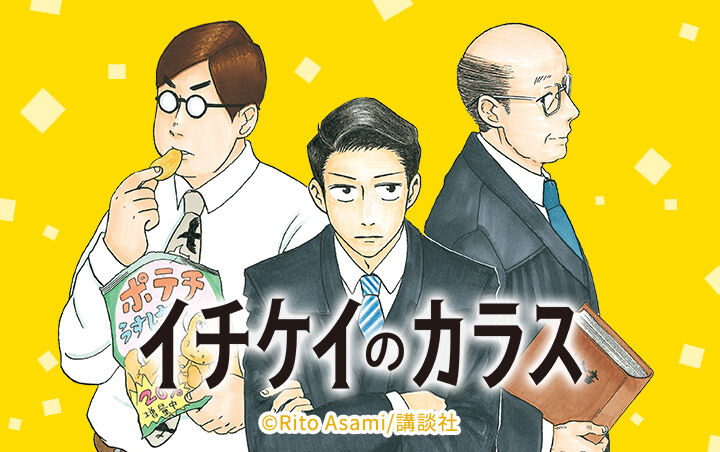
Ichikei no Karasu is a Japanese legal manga by Rito Asami featuring a judge. It was serialized in Morning from 2018. The main character, Sakama, is assigned to the First Criminal Division of the Musashino District Court, known as "Ichikei." There, he meets an unconventional judge, Michio Iruma. Unlike Sakama, who believes that judges are only supposed to issue rulings, Iruma is the type of judge who visits actual crime scenes and thoroughly examines anything that interests him. In this humanistic legal work, Sakama grows as a judge and as a person as he becomes involved with Iruma, who even considers the life of the defendant.
Bengoshi
A job of protecting basic human rights and fulfilling social justice within the provisions of the law at the request of the accused.
The work of lawyers varies widely, from acting as counsel in civil trials to acting as defense counsel for defendants in criminal trials, to receiving legal advice and meeting with clients. In the story, it refers to Iruma's former occupation, Tsutsumi and Warabi.
Defendant
First of all, a "suspect" is a person who is suspected of being involved in the crime. When the police investigate and suspect or arrest the person, he or she is called a suspect.
A person who is charged with a crime is called a defendant. If he or she is charged, he or she will go to trial, so he or she is called a defendant instead of a suspect.
Higaisha (victim)
It refers to those who were damaged or suffered from incidents, accidents, crimes or man-made disasters.
Suspension of execution of the sentence
A system of suspending the execution of a sentence for a convicted defendant. The reason for this system is that it does not deprive the defendant of the opportunity to return to society. It is reasonable to suspend the execution of a sentence for one to five years.
In some cases, a suspended sentence can be granted even if the defendant is found guilty on the grounds that he or she has sufficient remorse and room for rehabilitation, or on the conditions set by the Penal Code.
For example, if the defendant is found guilty and sentenced to two years in prison with a four year reprieve, the defendant does not immediately go to prison. This means that the defendant has four years to serve his sentence.
If a person is sentenced to two years in prison, he or she is immediately sent to prison.
And even with a suspended sentence or a prison sentence, there is no difference in the fact that a criminal record is obtained.
In addition, there are two types of suspended sentences: "Total suspended sentences" and "Partial suspended sentences."
For example, if a person does not commit a crime for four years, he or she is exempted from all two years of imprisonment.
A partial suspension of execution would be, for example, "two years in prison, with a three year reprieve for the execution of one year in prison, which is part of the sentence." In this case, the accused would spend one year in prison and return to society with the remaining one year of imprisonment suspended for three years. In many cases, partially suspended defendants are placed on probation after returning to society.
False accusation case
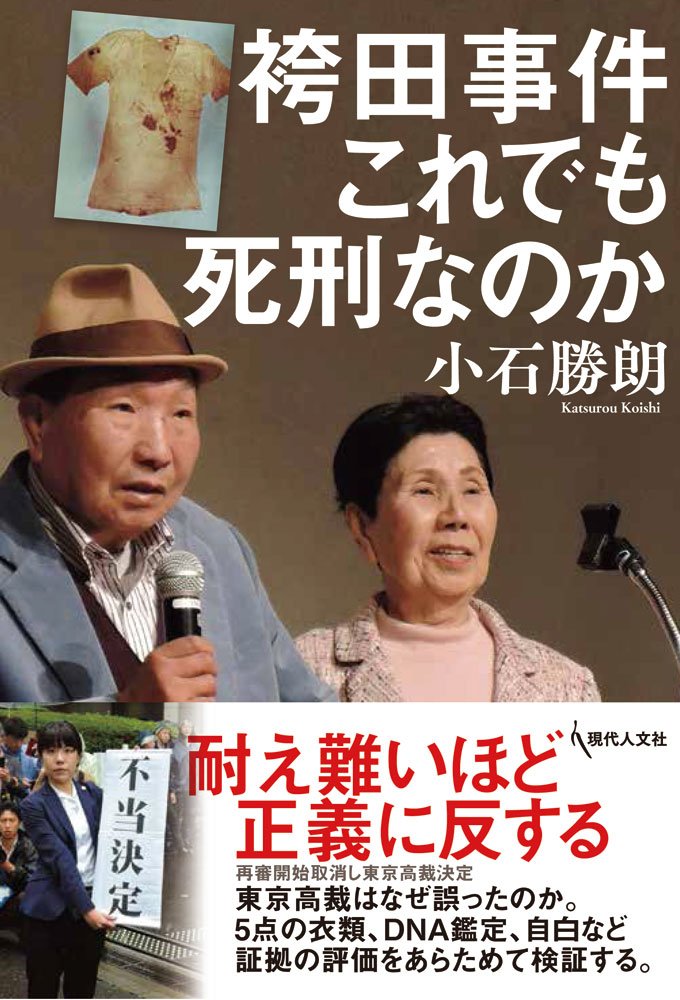
The Hakamada Incident is famous as a Japanese false accusation.
An innocent person is found guilty and punished for a crime he or she does not remember.
Innocent people don't do anything wrong, but they lose their family, their social trust, and their time in life if they go to prison. They also miss out on the real culprit, so people who do bad things are not properly judged.
Kokokuso
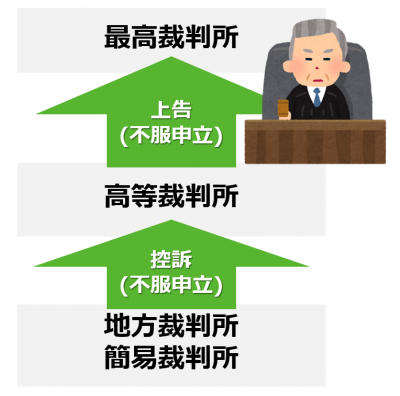
Flow of appeals and final appeal.
A procedure in which a person who is dissatisfied with a ruling issued by a district court or summary court, which is the primary court, seeks a different ruling again from a high court, which is a higher court than the primary court. If a person is dissatisfied with a ruling issued by a high court, the procedure in which the person seeks a different ruling again from the Supreme Court, which is the last resort, is called "jokoku appeal."
In this case, Sakama and his co-defendants are judges of the Musashino District Court, so if they are dissatisfied with the ruling issued by Sakama and his co-defendants, they will appeal the ruling and be tried again at the next high court.
The right to remain silent
One of the constitutional rights granted to suspects and defendants, as set forth in article 38, paragraph 1, of the Constitution and article 198, paragraph 2, and article 311, paragraph 1, of the Code of Criminal Procedure.
It means that you don't have to talk about what you don't want to talk about during a trial or an investigation.
Detention (koryu)
The arrest of a suspect or accused before trial by the police or in a detention facility.
After the suspect is arrested, the case is verified by the police and the prosecution. If the suspect is likely to escape or conceal evidence, the prosecution requests the judge to detain the suspect. If this is confirmed, the suspect is detained by the police or in a detention facility and cannot return to his or her home for a certain period.
On the other hand, there are cases where the detention is rejected if the suspect has reflected and there is no possibility of escape or concealment.
In this film, after Keiko committed shoplifting and was arrested, Tsutsumi, Keiko's attorney, came to Sakama to appeal to him to drop the detention, saying' Hotaru and Keiko will be separated.'
Sakama said, "There is a risk that Keiko will leave her fireflies with her sister and escape," adding that she will not be detained in light of the situation in which Keiko is reflecting.
By the way, there is also a term "detention" in the same reading, which means to detain the accused after the conviction has been determined.
Judgment document
It is read by a judge when he or she makes a ruling, and it describes the reason for the ruling and the process leading up to the ruling.
According to Iruma,' even if a person is found guilty, there is a difference in feelings between writing a judgment that the person is guilty without examining anything and writing a judgment that the person is guilty after thoroughly examining the evidence and testimony.' In addition, Komazawa instructed Sakama to write with all his heart, saying' that person will be seen in the judgment.'
Self-defense
As stipulated in Article 36, Paragraph 1 of the Penal Code, it is an unavoidable counterattack against an unlawful attack.
However, it is not self-defense to fight back when an unlawful attack is expected. For example, it is not self-defense to "return a blow because you were hit" in a situation where both parties know that they will fight, such as a duel.
In fact, it is difficult to draw a line between "self-defense" and "self-defense." For example, if the other party holds a grudge against you and you anticipate that "the other party may use violence against you," but you are still trying to resolve the situation through discussion, if the other party suddenly attacks you with a knife, the counterattack is considered self-defense.
In the story, he appeared in the criminal case of Ogi no shima and Tsudoi, and became the main point of contention.
The prosecution claimed,' I expected that Ogi island would be beaten by Tsunoi, and I intended to take advantage of the situation to hurt Tsunoi,' while the defense claimed,' Ogi island was trying to persuade Tsunoi through discussion, and did not intend to beat Tsunoi until he was attacked by Tsunoi, so it was self-defense.'
Kihimo-shitate (Petition for Challenge)
A person who is likely to cause a lack of impartiality in a trial may be removed from his / her duties.
In the live-action drama version, the prosecution and others who tried to cover up Iruma's attempt to reveal the truth often filed a motion to challenge him. In addition to judges, secretaries and others who were challenged would be removed from their duties.

Tags
Contents
- Outline of "Ichikei no Karasu"
- Outline and story of "Ichikei no Karasu"
- Sakama meets Michio Irima
- Sakama's Changing Feelings as a Judge
- Yanagida, a juror in the lay judge trial
- Iruma's Past and the Trial of Violent Teachers
- Characters in "Ichikei no Karasu"
- Key person
- Shinpei Sakama (Shimpei played by Haru Kuroki)
- Michio Iruma (played by Yutaka Takenouchi)
- Work-related
- Yoshio Komazawa (played by Fumiyo Kohinata)
- Bunta ISHIKURA (played by Mackenyu NITTA)
- Itoko ICHINOSE (played by Kaho Mizutani)
- Hamatani (played by Yuki Sakurai)
- Kawasono
- Yamanouchi
- Litigants
- Ide (played by Ikusaburo Yamazaki)
- Tsutsumi (bank)
- Warabi (bracken)
- Persons involved in the case
- Tabata no Norimichi
- Yoshiharu OKI
- Keiko 潮川 (played by Marin)
- 潮川 Hotaru (played by Aigetsu TERADA)
- Takuma 潮川 (played by Ryu Morioka)
- Takuma no Haha (played by Keiko Katsukura)
- Shuji OGISHIMA
- Kiyoshi Tsuui
- Kazuaki Kawashima Takuya
- Juries in lay judge trials
- Noriichi YANAGIDA
- Ochiai (Ochiai)
- Tatehara
- Saionji
- Konaka
- Omae
- Tsuna
- Niimura
- School-related
- Yuki Sudo
- Kohei SARASHINA
- Family
- Ishikura's grandmother
- Sakama 絵真
- Younger sister of Iruma
- Other
- Matsuda
- Amamiya
- Characters from the live-action drama "Ichikei no Karasu"
- Key person
- Chizuru Sakama (played by Haru Kuroki)
- Michio Iruma (played by Yutaka Takenouchi)
- Ichikei squad
- Yoshio Komazawa (played by Fumiyo Kohinata)
- Hiroshi Kawazoe (played by Nakamura Baijaku II)
- Bunta ISHIKURA (played by Mackenyu NITTA)
- Itoko ICHINOSE (played by Kaho Mizutani)
- Mio Hamatani (played by Yuki Sakurai)
- Supreme Court
- Aki Hidaka (played by Tamiyo Kusakari)
- Kenichiro KODA (played by Kenjiro Ishimaru)
- Tokyo District Public Prosecutor's Office
- Iori Ide (played by Ikusaburo Yamazaki)
- Reji JOJIMA (played by Takeshi Masu)
- Acquaintance of Iruma
- Koji Togashi (played by Tetsunori Akira)
- Mizuki Aoyama (played by Yuka Itaya)
- People involved in the case 12 years ago.
- Sosuke Nishina (played by Shunsuke Kubozuka)
- Yuki Nishina (played by Asami Usuda)
- FUSE Motoharu (played by Tsuyoshi Nakano)
- Soichiro SHIMA (played by Yuichi Haba)
- Episode 1: "Unconventional Judge vs. Stiff Elite Judge! The Birth of a Buddy"
- Kazuyoshi Jiang Bo (played by Masanobu Katsumura)
- Nagao Makoto (played by Riku Hagiwara)
- Nagao Yoichiro (played by Kazuyuki Matsuzawa)
- Mayumi SOMA (played by Wakana Matsumoto)
- Nana Soma (played by Rin Furukawa)
- Noboru ASAI (played by Tooru Namazu)
- Masuko (played by Yuya Takayama)
- Junior High School Students on a Court Tour (played by KITAHARA Toshiaki)
- Audience mania (Bocho mania / Performance: chocolate planet)
- Episode 2: "Child Abuse! child! A Judgment on a Popular Mother on SNS"
- Fukaze Yoko (Actor: Maeda Atsuko)
- KODA Takahisa (played by Toru Baba)
- Adachi Katsumi (played by Yuta Kanai)
- Shōko ONODA (played by 智順)
- Fukaze Keisuke (played by Kento Shibuya)
- Hiroko Fukaze (played by Yoneko Matsukane)
- Shiori Fukaze (played by Iroha YAMAUCHI)
- Satomi TSUCHIYA (Satomi Tsuchiya, played by Mari Nishio)
- Audience mania (played by Milk Boy)
- CHAPTER 3: "THE LEGENDARY JUDGE RUNS AWAY, THE LOVE OF A VIOLENT CRIMINAL"
- Shogo Fujishiro (played by Yoshinori Okada)
- Nao NOGAMI (played by Aimi Satsukawa)
- NOGAMI Midori (played by WATANABE Miyu)
- Tetsuji NOGAMI (played by Osamu Narimatsu)
- Keiichi Okazaki (played by Ron Mizuma)
- SAKOTA Atsushi (played by Hiroshi Okouchi)
- Yoshinori Horiguchi (played by Tomokazu Koshimura)
- 丈弘 TSUDA (played by Koichiro KANZAKI)
- Swindler (played by Terumi)
- Branch Manager (played by Toru Morinaga)
- Audience mania (played by Onigoe Tomahawk)
- Chapter 4: "17-Year-Old Boy Robs 50 million Yen"
- MOCHIZUKI Hiroto (played by Taketo Tanaka)
- Miki Yoshizawa
- Riku Takimoto (played by Kanata Hosoda)
- Tsukasa INAGAKI (played by Yasuyuki Maekawa)
- Monden Mitsuhiko (played by Tomonori Mizuno)
- TATSUMI Hiroyuki (played by Atom Shukugawa)
- Haruyo SANO (played by Moe Edamoto)
- Inono of fraud and extortion (played by Mei Nagano)
- Accused of violating the Firearms and Swords Control Law (played by Alice Hirose)
- Accused of larceny (played by Kenichi Endo)
- Audience mania (air stairs)
- CHAPTER 5: "THE FIRST LOVE BALLERINA IS THE SUSPECT."
- Kyoko BABA (played by Erika Ikuta)
- Kaede Makibara (played by Asuka Kurosawa)
- Masaya Yaguchi (played by 研也 MATSUKI)
- Jiro MOTOKI (played by Kenji Anan)
- Mami Enokida (played by Mayumi Myosei)
- TEZUKA Daisuke (played by FURUYA Yoshiya)
- Kaho (played by Kyoka Minakami)
- Other Witnesses (Played by Yoaoi YUKI, Rina Takeda, Anju Kurosu, and Satsuki 星乃)
- Sayuri (played by 3 o'clock heroine Yumecchi)
- Yoriko (played by the heroine at 3 o'clock)
- CHAPTER 6 "Reiwa'S GREAT THIEF APPEARS IN COURT!"
- Shigeru Kishida (played by Bakarhythm)
- Manabe Shin (played by SAKAGUCHI Kazuya)
- Tomoka Manabe (played by Kinuo Yamada)
- Nakamori Masakazu (Kamori played by Ken'ichi Yajima)
- Komiyama Akinori (played by Ryushin Tei)
- HATAKEYAMA (Hatake / played by Jo Hyuga)
- Keiji Toda (played by Genki Nakamura)
- Okuyama (played by Jun'ichi Nakano)
- Ryota SHIMOYAMA (played by Ryota NAGASHIMA)
- Administrative official in charge of the Komiyama public prosecutor (played by Reina Yoshida)
- Chapter 7: "When the Judiciary vs. the Unorthodox Judge Duel"
- Kanako Iida (played by Mayumi Oka)
- Ryoichi 友坂 (played by Yasushi Fuchikami)
- Audience mania (played by Dennis)
- CHAPTER 8: "THE SHOPLIFTER VS. THE SHOPLIFTER TRUTH?"
- Keiko 潮川 (played by Marin)
- Takuma 潮川 (played by Ryu Morioka)
- 潮川 Hotaru (played by Aigetsu TERADA)
- 史絵 YAMADERA (played by Mayumi Asaka)
- Shingo YAMADERA (played by Ryosuke Otani)
- Tsutsumi (played by Shohei Abe)
- Takuma no Imoto (Daughter of Takuma) (played by 朱梨 YAMASHITA)
- Takuma no Haha (played by Keiko Katsukura)
- Michihiko (played by Sou Takei)
- Yui Isozaki (played by Aimi Natsume)
- Yukinori Maebashi (played by Yutaro Watanabe)
- Spectator mania (sketch)
- CHAPTER 9: "WHAT'S GOING TO HAPPEN? A LAY JUDGE TRIAL"
- Azusa Takami (played by Misayo Haruki)
- Yuka KIRISHIMA (played by Saori YAGI)
- KIRISHIMA Nozomi (played by Risaki Matsukaze)
- Masakazu Omae (played by Ginnojo Yamazaki)
- Ochiai Kiyomi (played by Shoko Ikezu)
- TABE Kohei (played by Shigehiro Yamaguchi)
- Katsunori SAIONJI (played by Takato Nagata)
- Risako Tatehara (played by Junko OTA)
- Kokonagisa (played by Nagi Hasegawa)
- Sanae NIIMURA (played by Aika YUKIHIRA)
- Yabushita (played by Kazuki Horike)
- Audience mania (played by Oswald)
- CHAPTER 10: "THE STORY THAT FOLLOWS THE FINAL EPISODE: THE SAD TRUTH"
- Shinichi MITARAI (played by Itsuji Itao)
- Jun Asakura (played by Akira Onodera)
- Tae (played by Ginpuncho)
- Tsuyoshi SAKAGUCHI (played by Riku Ichikawa)
- Keishi Hashimoto (played by Shota Taniguchi)
- Riko MOGAMI (played by Miyu MATSUSHITA)
- Audience mania (played by Taro Yabe and Ken Koga of Karateka)
- The final episode: "The last trial of an unconventional judge? A mastermind who tries to reverse the truth. Sayonara, Michio Irima"
- Takaomi ANZAI (played by Kuranosuke Sasaki)
- Tanokami Kozo (played by Eisuke Sasai)
- Yasuo ANZAI
- Sasaoka Yosuke (portrayed by Ken Sugawara)
- Akira HONJO (played by Yusuke ONISHI)
- Yumiko HONJO (played by Yumiko Etsuyo Mitani)
- Ayumu HONJO (played by Sanetoshi Ariyama)
- Kensaku AOYAGI (played by Masaru Okada)
- Naomichi MATOBA (played by Yoshinobu Kanai)
- Hideo Haraguchi (played by Ryotaro Yonemura)
- Mei Haraguchi (played by Ai Sakurai)
- TODA Junji (played by Gakudai Yamazaki)
- Yutaka Soneyama (played by Makoto Matsumoto)
- EBARA Satoshi (also played by Satoshi Hashimoto)
- 美知恵 YANAGISAWA (played by Miwako Kakei)
- Tominaga (played by Kazuma Nozaki)
- Saki (also played by Hashizume Kei)
- Audience mania (Actor: Miki)
- Characters from the movie "Ichikei no Karasu"
- Eiji Ujo (played by Osamu Mukai)
- Shingo Tsukimoto (also known as Takumi Saitoh)
- Jun Doi (played by Tokio Emoto)
- Kimiko Akagi (played by Nanase Nishino)
- "Ichikei no Karasu" Differences and differences between manga and dramas
- Characters different from the original
- The live-action drama version is full of original stories.
- The term "Ichikei no Karasu"
- Court language
- Saibankan (judge)
- Criminal trial
- Saiban-in trials
- Shoki (secretary)
- Public Prosecutor
- Bengoshi
- Defendant
- Higaisha (victim)
- Suspension of execution of the sentence
- False accusation case
- Kokokuso
- The right to remain silent
- Detention (koryu)
- Judgment document
- Self-defense
- Kihimo-shitate (Petition for Challenge)
- Location
- Musashino District Court, First Criminal Division (Daiichi Kei-Jibu)
- Arashigaoka Station
- Taguchi General Hospital
- CorpMart
- Tsuki no Mori Ground
- Tokyo Metropolitan Samidare High School
- Other
- The party to watch over Michio IRUMA (Irumami-chio-o Mimamori-kai)
- "Saibankan no tameno soshoshiki nyumon"
- Kreptomania
- Shaken baby syndrome
- Words, lines, scenes and scenes of "Ichikei no Karasu"
- Michio Irima "We have to be crows."
- Michio Irima "Why don't you let your wife live a little longer inside you?"
- Keiko 潮川: "I will never let my daughter come to court again."
- Komazawa: "I think. the biggest tragedy is a false accusation."
- SODO Yuki: "Please. help Sensei and me."
- Shinpei Sakama "But. it's an interesting job for me."
- Behind the Scenes, Trivia, Small Stories / Episodes and Anecdotes of "Ichikei no Karasu" (The Crow of Ichikei
- Realistic stories based on actual incidents
- Komazawa's model is two judges.
- Wagakki Band sang the theme song for the live-action version.
- The theme song and inserted song of "Ichikei no Karasu"
- Theme song: WGB (Wagakki Band) "Starlight"