

We have compiled a collection of out-of-place artifacts, relics that were inconceivable with the technology of the time, so-called "oparts". Enjoy these interesting and mysterious urban legends that will make you lose sleep. Believe it or not, it's up to you.
In 1822, it was deciphered by Jean-François Champollion, which gave Rosetta Stone the key to understanding Egyptian hieroglyphs and the subsequent translation of other Egyptian texts.
The Rosetta Stone is on display at the British Museum.
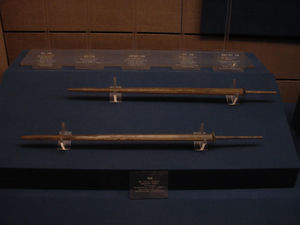
First Emperor's chrome-plated sword
Source: blogs.yahoo.co.jp
In 1974, a chrome-plated bronze long sword was discovered at the site of Army of terracota in the famous Qin Dynasty (3rd century BC, the first unified Chinese dynasty). Of the more than 8000 ceramic dolls of soldiers and horses displayed at the site of Army of terracota, the sword on the hip of the statue of a soldier is said to be so shiny and undegraded that it is hard to believe it was 2200 years old.
In fact, it seems that this sword still has enough cutting power to cut more than a dozen sheets of newspaper.
The sword is said to be a copper sword of 90 cm in length, and the surface of the sword is coated with chromium plating at a thickness of 10 to 15 microns, but chromium plating was invented in Germany in 1937, and there is no record that this technology existed during the period of the Qin Dynasty.
By the way, all the bronze swords made in the Han Dynasty 150 years later are so corroded that they do not retain their original form.
Therefore, this plating technology is considered to be a kind of lost technology that was lost without being inherited in the next Han Dynasty.
An ancient iron hammer
Source: www.maniado.jp
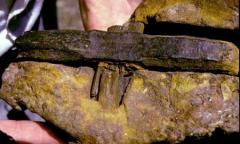
In 1934, a suspected man-made iron hammer was unearthed in Texas, the United States, from Ordovician strata with a fossilized handle.
The Ordovician period was more than 450 million years ago, when mammals and even dinosaurs had not yet been born and trilobites flourished.
In 1989, an analysis of the cast iron in the head of the hammer found that it contained 96.6% iron, 2.6% chlorine, 0.74% sulfur% sulfur, and 0.06% silicon. It is obvious that the purity of iron is very high, but it should be noted that it contains chlorine.
This proves that the hammer is a product of super-high technology.
Because, of course, at the time of its discovery, the creation of alloys containing chlorine was impossible even with modern science, so the hammer transcends current technology.
Palenqué Sarcophagus
Source: ameblo.jp
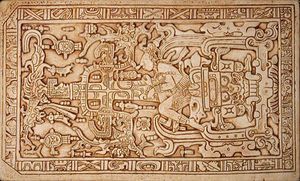
On June 15, 1952, archaeologist Albert Ruth Louis Riel discovered in the basement of the Temple of Inscriptions, an ancient Mayan site in Palenqué in the Mexican state of Chiabus, a stone coffin hollowed out from a piece of rock that measures 3m by 2.1m by 1.1m and weighs 5 tons. The surface of the coffin was carved with a side view of what appears to be an ancient astronaut piloting a rocket.
In the background is a cross of corn, called the Tree of Life, topped by the symbol of life, the sacred Mayan bird Quetzal Coeur.
Since humans first ventured into space in the mid-20th century, the sarcophagus on which the "ancient astronaut" was drawn is said to be a genuine o-part.
Steps of Saint Joseph
Source: takashi1016.com
Over five years from 1873, and at a cost of $ 30000, a beautiful Gothic cathedral, Loretto Chapel, was built in the town of Santa Fe. The chapel has a vaulted ceiling and a second floor box at the back for the choir.
However, there were no steps to climb the sashiki. In fact, because the chapel was small, there was no space to install the steps. Therefore, ladders were prepared to climb the choir seats, but the nuns were very afraid of using them. Then, they began a nine day prayer.
It is said that the prayer was offered to Saint Joseph, the husband of the Mary.
For Joseph was a carpenter by profession.
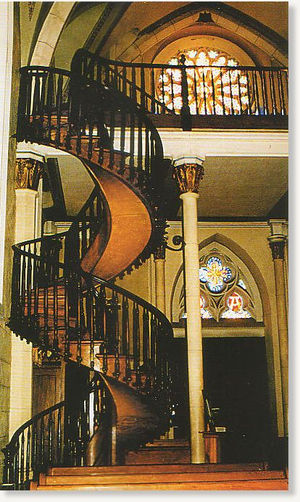
On the last day of the nine day prayer, a white-haired man with a donkey and a carpenter's toolbox came from nowhere. With only a few tools, such as a hammer, saw, and T-ruler, he built a space-saving "spiral staircase" in the spaceless chapel, so that he could safely go up and down the choir's balcony.
The staircase has 33 full 360-degree spirals. Wood nails are used, but none of the iron nails are used. And, surprisingly, there are no props to support the spiral staircase, as if it were floating in the air. The man who built the spiral staircase disappeared without receiving any wages.
The pillarless spiral staircase is said to be a miracle and an architectural engineering mystery even with modern science. The spiral staircase did not have a handrail, but because it swung up and down with each step, a handrail was later installed at the request of the nuns.

Contents
- Table of Contents
- Crystal skull
- Ashoka Pillar
- Damascus steel
- Voynich manuscript
- Map of Piri Reis
- Pleistocene springs
- Golden jet
- Golden bulldozer
- Ancient batteries of Baghdad
- Stone spheres of Costa Rica
- Boulders of Baalbeck
- Rosetta Stone
- First Emperor's chrome-plated sword
- An ancient iron hammer
- Palenqué Sarcophagus
- Steps of Saint Joseph
- Antikythera machines
- Nebula Disk
- Emerald Tablet
- Mickey Mouse Mural
- Dinosaur clay figure