
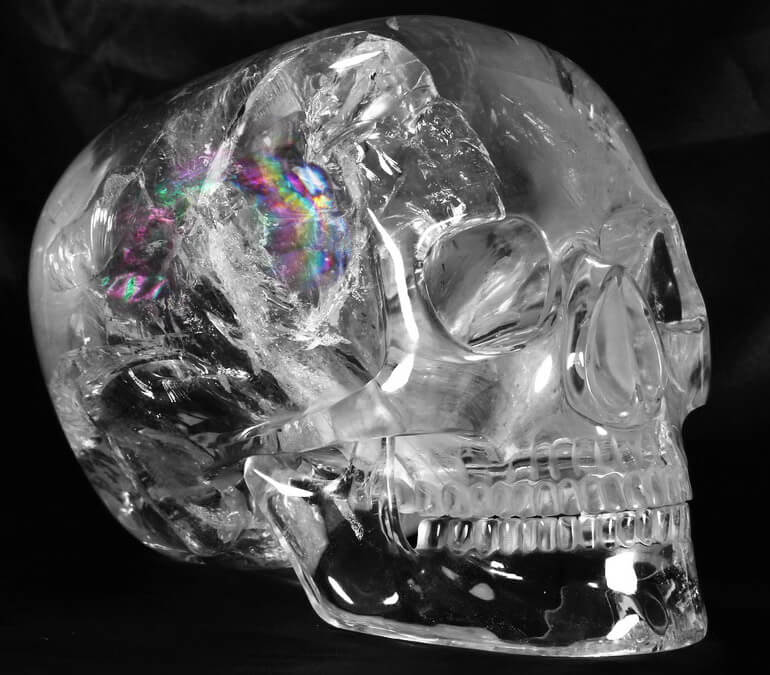
We have compiled a collection of out-of-place artifacts, relics that were inconceivable with the technology of the time, so-called "oparts". Enjoy these interesting and mysterious urban legends that will make you lose sleep. Believe it or not, it's up to you.
Ancient batteries of Baghdad
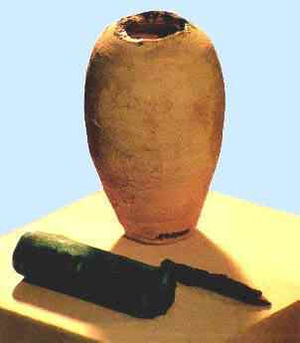
Source: blogs.yahoo.co.jp
In 1936, a strange pot was discovered at the ancient Parthian site, about 2000 years old, in クジュトラブア, on the southwestern outskirts of the Iraqi capital Baghdad, and was sent to the Institute of the Iraqi National Museum. The pot, about 15 cm high, contained a residue of asphalt (black fixed natural bituminous substance), a copper cylindrical object about 10 cm high and 2.6 cm in diameter firmly fixed to it, and an extremely corrosive iron bar inside.
German archaeologist Dr. Wilhelm König, who has studied similar jars found at other sites near Baghdad, has come to the surprising conclusion that they are ancient batteries.
After World War II, a replica of the "ancient battery" proved to produce 5 to 2 volts of electricity, confirming Koenig's reasoning.
Since the battery was invented in the late 18th century, did ancient Iraq already have the technology long before this?
Stone spheres of Costa Rica
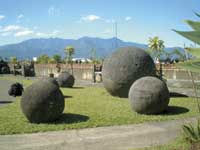
Source: blogs.yahoo.co.jp
In 1930, while logging in the jungles of the Dikiss region on the Pacific coast of Costa Rica, Central America, more than 200 spheres were discovered, ranging in size from only 2 cm in diameter to up to 2.6m in diameter and weighing as much as 25 tons.
The great thing about this 石球 is that everything is close to a perfect sphere, with a diameter error of only 0.2% at most, and a diameter of 2006.6 at the 1/100 level. Two spheres with no error have been discovered.
The material of these stone balls is mostly granite. Granite is so hard that it could not be worked so smoothly with simple tools. It is believed that the Dixitic peoples of the 4th to 9th centuries A.D. made the stone balls, but it is said that they knew no more than copper and jade tools.
If so, how was this 石球 built? What was it built for? There is a theory that it was modeled after a planet in the solar system, but it is not certain.
Boulders of Baalbeck
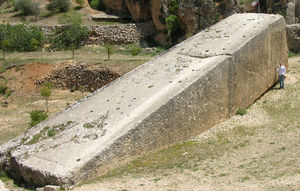
Source: kenshin2013.blog.fc2.com
The ruins of the religious city of Baalbec in Lebanon claim to contain some of the world's largest megaliths. First, there are three megaliths called Tori Riton (The Mitsuishi of Wonder) that are used as the foundation of the Temple of Jupiter, which is also the symbol of this site. The size of this Mitsuishi is 18 meters long, 4 meters high and wide, and weighs between 650 and 970 tons. If calculated by human power, it takes 15000 people, but it is said to be impossible in reality to put all that human power into a stone.
The "Stone of the South," which lies midway between the temple and the quarry, is located 1 km away from the temple. Although it is not used in buildings, it is said to be the world's largest quarry stone. It is estimated to be 4.3m long, 4.6m wide, 21.4m long and weighs more than 1200 tons.
According to the calculation, it is said that it can be moved with the power of 32000 people, but in reality, it is said that it is impossible to move due to the arrangement of towing tools and people. In addition, it is true that this huge stone was removed in some way as it was found after being cut out from the quarry.
Incidentally, even with the best heavy equipment NASA uses to move rockets, it is not possible to lift this huge rock because the maximum weight that can be lifted is 700 tons.
Rosetta Stone
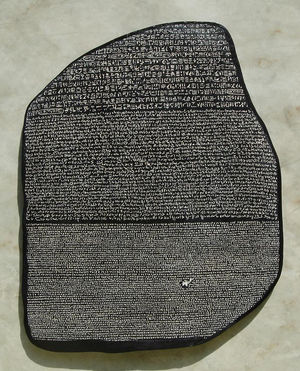
Rosetta Stone is said to have been discovered in the Egyptian port city of Rosetta on 15 July 1799 by French army captain Pierre-François Bouchard during Napoleon's Egyptian expedition.
It is said that the British army landed in Egypt in 1801 and forced the French army to surrender, and since then it has been in the hands of the British.
The Rosetta Stone, 114.4 cm long, 72.3 cm wide, 27.9 cm thick and weighing 760 kg, is part of a fragment of an ancient Egyptian dark granodiorite pillar inscribed with an imperial decree issued in Memphis in 196 BC for Ptolemy V Epiphanes. A later investigation in Rosetta has not found the rest of the pillar.
The inscription is written in three characters: the sacred alphabet of ancient Egyptian (hieroglyph), the popular alphabet (demotic) and the Greek alphabet.

Contents
- Table of Contents
- Crystal skull
- Ashoka Pillar
- Damascus steel
- Voynich manuscript
- Map of Piri Reis
- Pleistocene springs
- Golden jet
- Golden bulldozer
- Ancient batteries of Baghdad
- Stone spheres of Costa Rica
- Boulders of Baalbeck
- Rosetta Stone
- First Emperor's chrome-plated sword
- An ancient iron hammer
- Palenqué Sarcophagus
- Steps of Saint Joseph
- Antikythera machines
- Nebula Disk
- Emerald Tablet
- Mickey Mouse Mural
- Dinosaur clay figure