

We have compiled a collection of out-of-place artifacts, relics that were inconceivable with the technology of the time, so-called "oparts". Enjoy these interesting and mysterious urban legends that will make you lose sleep. Believe it or not, it's up to you.
The contents of this Voynich Manuscript book are said to be worth "a million dollars". If you are interested, why not give it a try?
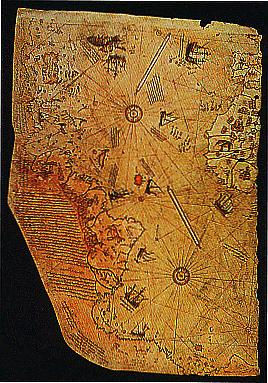
Map of Piri Reis
Source: japaneseclass.jp
Piri Reis's map is the 1513 version of two existing maps of the world created by Ottoman naval officer Piri Reis and was discovered in 1929 at the Topkapı Palace Museum in Istanbul.
The map is believed to have been created using the latest technology of the time, but surprisingly, the Antarctic continent, which was successfully mapped all over the land in 1920, has already been accurately drawn and is said to have been impossible under the circumstances of the time.
The map was made in 1513 and presented to Egyptian conqueror Selim I in 1517, and it is recorded that it was drawn with reference to 33 maps.
The distortion of the terrain is also accurately depicted, and the fact that it uses the' azimuthal equidistant projection' used today is also drawing attention.
But to draw so accurately, it's necessary to accurately measure longitudes and latitudes, a method that dates back to the 18th century, and Piri Reis's map represents an accuracy unimaginable with technology at the time.
Pleistocene springs
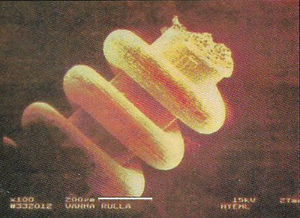
A Pleistocene spring was discovered in 1991 by gold miners in a river in the eastern Ural Mountains of Russia. It is said to be a perfectly shaped, mostly copper coil, screw, or spring-like shape.
The components were all extremely small, with the largest being about 3 cm and the smallest being about 3 microns (0.003 mm). Most were like copper coils or screws. Others were made of tungsten or molybdenum.
According to an analysis by the Russian Academy of Sciences, they were produced in the Pleistocene period, which is estimated to be 20000 to 300,000 years ago. The Pleistocene period refers to the time when the old Neanderthals walked on the earth. It is hard to believe that they formed materials such as tungsten, which does not melt without heat of several thousand degrees, in a size less than a millimeter.
The report by the Russian Academy of Sciences' Centre for Precious Metals and Geologic Exploration Sciences, which was responsible for the study, said it strongly indicated the existence of extraterrestrial life because it could not explain the existence of the amazing nano-technology except that it was concluded by an alien with an already advanced culture that it was a piece of metal left on Earth.
Golden jet
Source: umablog1.blog110.fc2.com
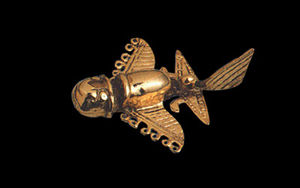
The Golden Jet, also known as the Golden Shuttle or Golden Jet, is a type of o-part that was excavated from an old site in Colombia and resembles an airplane or space plane.
The golden jet, discovered in 1929 at a Pre-Inca site in the Sinú region of Colombia, South America, is a goldwork that resembles a jet plane, measuring approximately 5 cm in diameter, and is on display at the Gold Museum attached to the National Bank of Bogotá, Colombia.
It is said to have been made between 500 and 800 A.D. (Sinoe Civilization) and the Bre-Inca Civilization (around the time of the Andes Civilization before the Inca Empire). This golden jet, which was made about 3000 years ago, is about 5-10 cm long and has many features of a modern airplane such as triangular wings, vertical tail wings and horizontal tail wings as if it had calculated aerodynamics. It has a groove that reminds you of the cockpit.
When it was first discovered, it was said to be in the shape of a bird, but Dr. アイブァン Sanders, an zoologist, claimed that it was in the shape of an airplane. In fact, experiments by airlines have confirmed that the golden jet can fly. Did Costa Rica have such advanced flight technology at the time?
It is also said that there might be some connection because the place of discovery is close to Colombia and Peru where Nazca Lines is located, and the golden jet and Nazca Lines were built in the same year, but it is not certain.
Golden bulldozer
Source: ww5.tiki.ne.jp
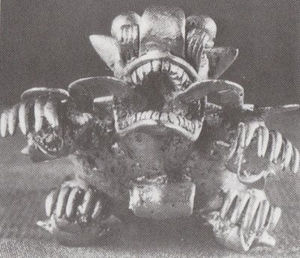
The Golden Bulldozer is a piece of gold work discovered in 1940 in an underground grave in the remains of the Kocre region in southern Panama.
It is said that while most of the other golden statues discovered were easy to understand because they were based on animal motifs, only this one could not be identified.
This statue, about 12 cm in length, which at first appeared to be a jaguar or alligator, was clearly different from the other statues only in that it had a toothed tail, something like a handle, a nearly flat back, and an emerald embedded in it.
The late American Ivan T. Sanderson, who was both an zoologist and a researcher of strange phenomena, said, "This is clearly modeled after a civil engineering machine, with the hands and feet representing power shovels and the eyes representing lights. It seems to have been a large machine like a bulldozer and crane.
In fact, it was not in the shape of an animal like this, but probably an ancient person who saw a construction machine for the first time at that time did not know that it was a machine and looked like an unknown animal. In the process of making the actual statue, the image was based on the image of an animal, but partly mixed with the elements of a machine as they were, so it was made into the image of an animal-like machine.' He announced that it was an ancient bulldozer and attracted attention.

Contents
- Table of Contents
- Crystal skull
- Ashoka Pillar
- Damascus steel
- Voynich manuscript
- Map of Piri Reis
- Pleistocene springs
- Golden jet
- Golden bulldozer
- Ancient batteries of Baghdad
- Stone spheres of Costa Rica
- Boulders of Baalbeck
- Rosetta Stone
- First Emperor's chrome-plated sword
- An ancient iron hammer
- Palenqué Sarcophagus
- Steps of Saint Joseph
- Antikythera machines
- Nebula Disk
- Emerald Tablet
- Mickey Mouse Mural
- Dinosaur clay figure