
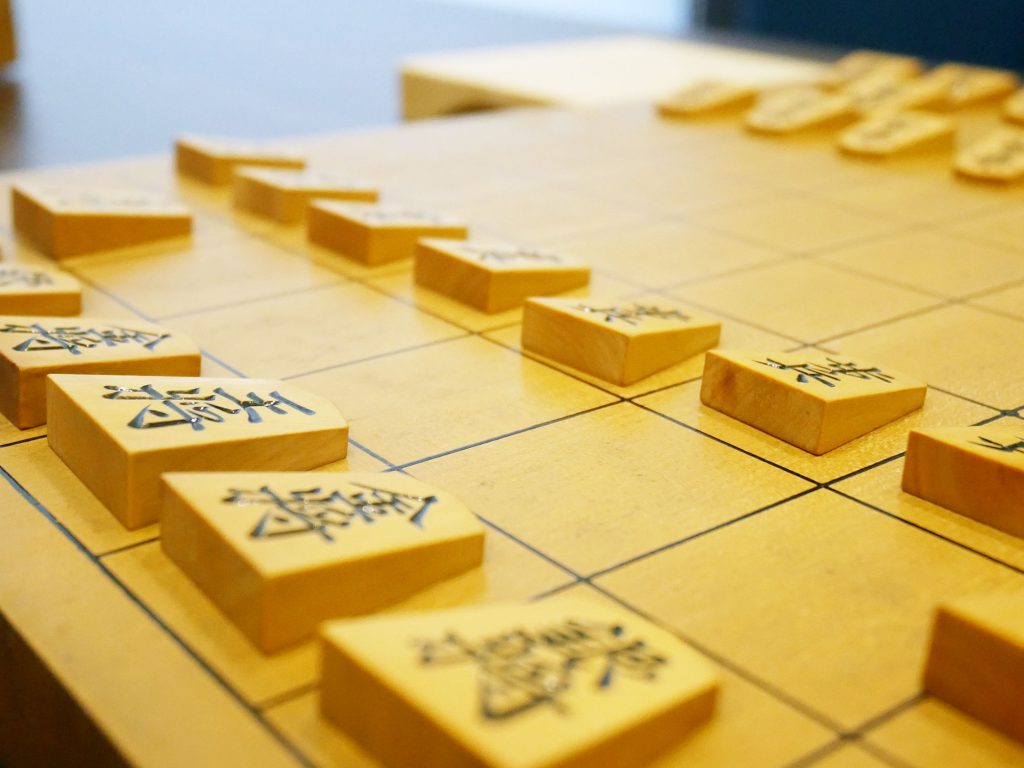
This article summarizes basic knowledge of Shogi, such as the roles of Shogi pieces, how they move, rules, and fouls. The explanation is concise enough for even beginners to remember, so please read this article if you are thinking of starting Shogi or if you have just started and still do not understand it well.
In this context, "go to a place where a piece cannot move" means moving a piece to a place other than where it should go (for example, moving an infantry diagonally).
When you move your Kakugyo, it's easy to make a mistake, so please be careful.
Unable to strike infantry from a handpiece into a line where infantry have already been deployed
Source: ja.wikipedia.org
This is a foul called two steps.
When striking foot soldiers from a hand-held piece (placing the hand-held piece is called striking), there should be no foot soldiers in the same vertical line (i.e., no more than one foot soldier per line).
However, if you have a foot soldier (= and gold) with a piece already in place, you can hit the foot soldier.
Two steps is a foul that even professionals sometimes do, so you should be careful when you hit an infantry from your own piece.
You can't hit a retained piece at a position where there is no place to go.
Source: ja.wikipedia.org
It is a foul to hit a piece (put a piece) where you can't move.
To be specific, it is not allowed to hit a Keima, a carriage, and foot soldiers on the 1st stage of the enemy line and a Keima on the 2nd stage of the enemy line.
If a ball is put on, you have to point to a hand to prevent the ball from being put on, such as running away.
Source: www.shogi.or.jp
Oate is to make a condition to be able to take Osho if you do nothing after the opponent.
Shogi is not a game to take a king, but a game to make a king's general unable to move, so if this king's hand is put on, it is necessary to prevent it without fail.
If you commit this foul, in the end, the king will be taken away and you will lose, so you don't have to think deeply at first.
ONCE YOU'VE LEARNED THIS FAR, LET'S POINT IT OUT!
Komao
www.geocities.jp
Noiframe. Pick your hand. Hirate. Two drops. Four drops. Six drops. Eight drops. Ten drops. Chuigaki ・ 10 maiochikaoryaku ・ counter ・ counter.
Pick out the 10 losses from this game and try to move the pieces anyway.
I think you can somehow understand the feeling of the game called Shogi.
If you can win at 10 Tsuma-ochi, let's move on to 8 Tsuma-ochi, 6 Tsuma-ochi, 4 Tsuma-ochi, 2 Tsuma-ochi, and Hirate.
※ When you go to the place where a piece becomes, the selection screen of whether it becomes or not appears on the left side, so please choose there.
Special Rules of Shogi
・ Sennichi te
In Shogi, a situation in which the arrangement of pieces and the number of moves are exactly the same appears several times in one game.
Source: ja.wikipedia.org
This is a special rule mainly for the case where both players keep pointing the same hand. In the case of Shogi, if the same phase appears 4 times, it will be a draw.
However, in the case of Sennichi Te where the Oute is held continuously, the Oute is regarded as a foul.
・ Jishogi
Jishogi is a special rule in which, when both balls enter the game and there is no chance that they will be stuck together, the pieces are counted as points to decide the winner.
Source: d.hatena.ne.jp
This rarely happens, so you don't need to remember it at this stage.
・ Uchiashibue
In Shogi (Japanese Chess), to attack the opponent's Tamasho (general) Tamasho in a deadlock.
Source: ja.wikipedia.org
This also rarely happens, so you don't need to memorize it at this stage, but keep it in the corner of your head.
▼ Related articles
Summary of how to learn and get stronger at Shogi on the Internet [No need for technical books! - RENOTE [RENOTE].
renote.net
Even if you have zero knowledge of Shogi, you can become somewhat proficient in the game by simply using the Internet without having to buy a Shogi book. Here we summarize how to do it. Computer Shogi is also introduced, so why don't you try the knowledge you learned there?
* This article was written on November 9, 2014.

Contents
- Children's Rule Setsumei is this way!
- Don't young people know the rules of shogi these days?
- The Basics of Shogi
- ◆ Basic rules of Shogi
- ◆ The movement of the piece
- ◆ Special Rules of Shogi (1) Narikoma
- ◆ Special Rules of Shogi (Japanese Chess) ② Hand Pieces
- ◆ Foul play in shogi
- ONCE YOU'VE LEARNED THIS FAR, LET'S POINT IT OUT!
- Special Rules of Shogi
- ・ Sennichi te
- ・ Jishogi
- ・ Uchiashibue
- ▼ Related articles