
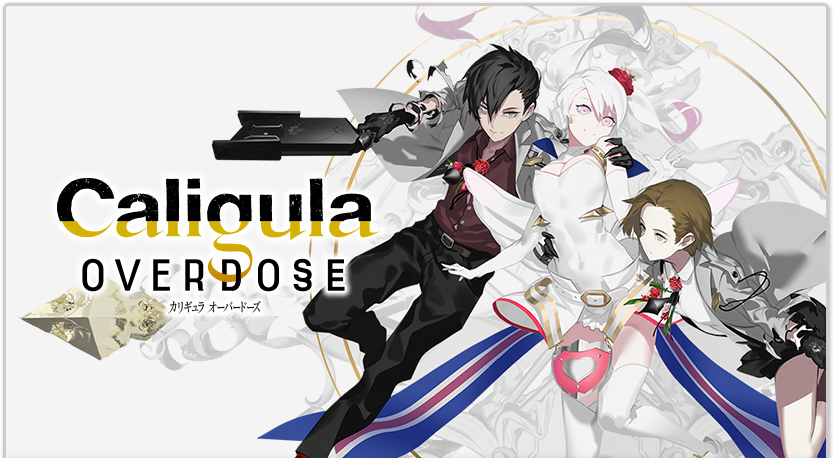
Caligula Overdose" is a PS4 title that is a remake of the PSvita RPG software "Caligula" released by Frew. The storyline is the same as the PSvita version, with the main character and his friends forming a "homecoming club" to return to reality and escape from the virtual world, but the main feature of this title is the addition of the storyline of the "Musicians of Ostinato," the nemesis of the homecoming club.
Suzuna Kagura: Lunchmate Syndrome
It is a communication-related psychosis proposed by psychiatrist Shizuo Machizawa, in which the patient feels a kind of fear of not having a lunchmate at school or at work. The name comes from the fact that one of Shizuo Machizawa's counseling patients described his dining partner as his "lunch mate.
This patient with psychosis mainly has a fear of eating alone and a fear that he or she is worthless as a human being who eats alone. Therefore, eating alone will be seen as unattractive and worthless by those around them," leading to a negative mindset.
They are extremely afraid of being rejected because it induces anxiety about their "worthlessness," and they are unable to invite anyone to dinner on their own, and moreover, they often hide in libraries or restrooms to avoid being seen eating alone. In worse cases, she becomes reluctant to take meals, does not last long at work or school, and may even abandon her job or higher education. Suzuna was afraid of being alone, eating alone, and being rejected by others as per this symptom, and often hid in the bathroom to eat in Mobius, let alone in reality.
Aya Amamoto voice: Heterophobia
It is a kind of psychosis that is generally seen in women, and is manifested as trauma to men by those who have had painful experiences involving men, such as being bullied by boys when they were children, being raped, or being abused by their fathers (or brothers). Since her adolescence, Ayako has often been molested and peeped at by Stork and Taiyo in real life, which has made her distrustful of men, but the attack on an underground idol by Tadokoro seven years ago triggered her full-blown heterophobia.
Eiji Biwasaka: Psychopath (psychopath)
It is a psychological term that refers to a type of antisocial personality and is used primarily in the fields of abnormal psychology and biological psychiatry. According to criminal psychologist Robert D. Hare and Oxford University psychology expert Kevin Dutton, a psychopath is defined as a person who fits the following characteristics
An abnormal lack of conscience and human emotion.
Extremely ruthless and often unsympathetic to others.
Lies chronically and with impunity
Egoism, putting their own interests and results first.
They are unable to take responsibility for their own actions.
They have no sense of guilt and are ruthless.
Excessive self-esteem and self-centeredness
They are glib and charming on the surface.
These are the main characteristics of a person who fits the description of a psychopath. Currently, however, only a checklist is used as a diagnostic criterion, so even if a person is medically considered to be a psychopath, he or she is not a psychopath unless he or she is so vicious and brutal that he or she can be seen as an antisocial person. On the other hand, people who meet the diagnostic criteria for antisociality often show behavioral abnormalities such as behavior problems from childhood, and Eiji also showed abnormalities such as abusing animals and assaulting and injuring his classmates from childhood.
Suite P: Transvestism (cross-dressing habit)
A type of psychopathology and preference in which people who are uncomfortable with the conventional dress code of society and want to be free without regard to gender, role, culture, etc., choose to dress themselves in the opposite sex's clothing. It is like cross-dressing or cross-dressing in general. Sweet P had developed a taste for girls from a young age in real life, and even though he understood that it was unacceptable for a man born male, he acted outwardly as a normal male while devoting himself to his hobbies and fantasies by creating music on the Internet by disguising his appearance and gender.
Stork: Stalking
It is a psychosis that derives sexual pleasure from peeping at nudity, etc. It is a strong sexual preference that is derived from the act of undressing or undressing an unwary stranger or from watching another human being perform a sexual act. In everyday language, it is called "peeping habit" or "bucktooth turtle.
In real life, Stork was influenced by his Christian mother's strict upbringing and was never exposed to, or even looked at, anything sexual until he was in high school. This led to a repressed sexuality, and he developed a habit of voyeurism, which was triggered by adult magazines and videos shown to him by his classmates, which led to a sexual outburst after he developed a plagiarism disorder.
Juvenile Doll: Avoidant Personality Disorder
A personality disorder characterized by a pattern of pervasive and persistent social inhibition, an apparent sense of self-deprecation and "I don't belong", sensitivity to negative evaluation by others, and avoidance of social interaction. It is commonly known as APD (Avoidant Personality Disorder).
The psychotic believes that he or she is socially inadequate, lacking in competence and attractiveness, and has an extreme fear of being laughed at, shamed, excluded, or disliked, and tends to avoid social interaction altogether. They also tend to report a sense of being alone and left out.
The boy Dole also lacks self-confidence in reality, and is extremely afraid of embarrassing himself in front of others and of being disliked by others, as indicated by this symptom. He hides his true feelings of wanting to have friends and to be accepted by others, and covers up his dissatisfaction and emptiness with the belief that he can live on his own.
Gardenia: aphonia (loss of voice)
A condition in which a person becomes unable to speak due to psychogenic causes such as stress or psychological trauma. At first glance, aphasia may appear to be a similar condition to aphasia, in that the patient has lost the ability to speak even though there is no problem with the vocal organs, but aphasia is an entirely different condition in that physical damage to the language area of the brain causes difficulty with vocabulary memory and understanding the meaning of language.
While on a school trip, Gardenia hears the news of a house fire and rushes home from her trip to see her parents and older sister, who have not returned home after the fire. The sudden death of her family left Gardenia deeply traumatized by despair, and she lost her voice again when she saw Eiji, the cause of the fire.
Mirei: narcissistic personality disorder
A personality disorder in which a person is unable to love and accept themselves as they are and believes that they must be "superior" or "wonderful and special and great". It is commonly known as Narcissistic Perosonality Disorder (NPD).
No effective treatment for this psychosis has been found, and treatment itself is considered difficult, since the patient is usually completely unaware that he or she has a problem.
Because of her pampered upbringing as the daughter of the Ichinose family, Mirei has suffered from this personality disorder ever since she can remember, and she feels that she must be the best in every environment and that everything must be her own way. He has changed jobs through his father's connections, but none of them lasted long because of his personality disorder. He has also repeatedly arranged marriages with upper-class people, including the sergeants of third-rate companies, but he is not satisfied with the fact that they are not first-class partners, and the people he has arranged marriages with have turned him down because they are not satisfied with his personality. However, he was turned down by the other people with whom he had arranged meetings because he was not convinced that they were not first-class partners and that he could not be a partner for them.
Shadow Knife: Chunibyo
It is one of the most popular and well-known forms of mental illness, and is Internet slang that makes fun of the narcissistic fantasies, behaviors, and preferences seen in adolescents around the second year of junior high school in the Japanese educational system. Incidentally, although it includes the word "disease," it has nothing to do with illness or mental illness in the medical sense that actually requires treatment.
In reality, Shadowknife was clearly traumatized by being bullied in junior high and high school for his love of anime, and he kept day and night fantasizing about becoming a hero and taking revenge on his bullies. This led him to develop a chunibi-phobia, and when he was first discovered by μ and accepted as a musician, his first wish for Mobius was to "become an anime character itself," the very realization of the fantasy he had been accumulating for years.
Thorn: Grief
The word translates as "deep sadness" or "grief," and refers to the physical and emotional changes that occur when a person mourns a loved one, such as a family member or loved one. Grief is not limited to bereavement, as in the case of Thorn, but can also be experienced in a variety of situations, such as when a relationship breaks up due to other reasons or triggers, such as divorce or separation, or when a cherished pet dies.
Grief is therefore a natural response to loss and can happen to anyone at some time.
The person becomes forgetful and frequently forgets things such as keys or words he or she was about to say.
Loneliness in the company of many people, including family and friends.
∙ Overwhelmed by feelings that seem to overflow
The person suddenly becomes depressed after a period of calmness.
The fact that a loved one has passed away is hard to believe, and the person begins to have illusions that he/she will return someday.
Sudden sadness when visiting familiar places or smelling the perfume worn by the deceased.
When I go to a nostalgic place or smell a perfume worn by the deceased, I suddenly feel sad.
When I listen to nostalgic songs, I feel sad.
These cases show that grief has different symptoms for each person. Some people cannot stop crying after the death of a loved one, such as a lover or family member, while others are in shock and do not feel sadness for a while. In Thorn's case, she could not believe that Ichirin had died, and she was immersed in the illusion that Ichirin was still alive and here, even if she had to abandon herself. This distorted illusion and her resentment toward Shogo caused Mobius, which was supposed to be an ideal world, to turn into a birdcage-like hell.
Wicked: sociopath (antisocial personality disorder)
It is a psychosis that manifests the same antisocial personality as psychopaths, but this one is considered to be an acquired psychosis, with the environment being the main trigger. The main factors that may contribute to psychosis are, for example, a poor family environment where she was born and raised, physical and mental abuse, and traumatic childhood experiences. In reality, Mariie Mizuguchi, a.k.a. Wicked, also suffered trauma in her childhood, as she was continuously abused by her parents and chastised by her grandfather.
When sociopaths commit crimes, they tend to do so unplanned and impulsively, without considering the risk to themselves or the consequences of their actions, and a slight lapse in judgment can lead to the exposure of their crimes and a high probability of being cornered or arrested. Furthermore, it has been confirmed that they tend to become agitated and emotional quickly, and often turn violent. Wicked is no exception to this violent behavior, becoming enraged when things don't go his way, and displaying his violent tendencies by attacking people he doesn't like as soon as he sees them.
New developments you can see if you are a female protagonist
The gender change of the main character, which was added for the first time in this work, changes the development of the scenario to some extent. This, along with the storyline of the musician's route, is a major element of interest in this work.

Related Articles

Spoiler commentary and discussion of Caligula -Caligula- (anime)
Caligula" is an anime adaptation of a juvenile RPG game released by Furyu. It depicts a group of people with a dark heart who try to escape from an idealized virtual world. The story is about the main character, Ritsu Shima, who is the official character of the game, and his attempt to return to reality from the virtual world created by μ. He confronts the musicians of Ostinato, who provide songs to μ and still cooperate with μ, and destroys the virtual world to return to reality.
Read Article
LITTLE NIGHTMARES spoiler commentary and discussion summary
LITTLE NIGHTMARES" is a suspense adventure game released by Namco Bandai Entertainment. It was developed by Tarsier Studios. The main character is Six, a young girl in a yellow raincoat who wakes up in the depths of the Mou, a huge ship called a stomach. The player controls Sixx and proceeds to escape the Mou while solving various tricks that exist in the Mou and sometimes escaping from the enemies that attack her.
Read Article
Tags
Contents
- Overview of "Caligula Overdose
- Synopsis and story of Caligula Overdose
- Return home route, top
- Prologue - Kagi P.
- Sweet P ed.
- Stork Edition
- Musicians' Route, Upper
- Yoshimai High School
- Return home route, middle
- Shonen Dole ed.
- Gardenia ed.
- Mirei, ed.
- Musicians' route, middle
- Miyahi Onsen Monogatari Edition
- City Libraries, ed.
- Return home route, bottom
- Ike P ed.
- Shadow Knife Edition
- Wicked Edition
- Musicians' route, bottom
- Theme Park Edition
- Aquarium Edition
- Landmark Tower Edition
- concluding volume (part) (e.g. of novel)
- Thorne, ed.
- A Reality Named Hope (µ version: Homecoming Route Ending)
- Beyond Betrayal (Aria version: Musicians' Route ending)
- Game System of "Caligula Overdose
- field
- Conversations with Students
- Encounter with Digihead (Lagarde)
- trauma quest
- WIRE
- stigma
- skill reel
- battle
- action option
- weapon system
- Two pistols (main character, Ike P.)
- Pistol (Shogo)
- Bow (Kotono, sweet P)
- Tekko (Koutarou)
- Great Sword (Keisuke)
- Hammer (Miho Mirei)
- Spear (Suzuna Thorn)
- Bit (Naruko)
- Nails (boy doll)
- One-handed sword (Weigen, Shadow Knife)
- Stun gun (colored voice, gardenia)
- Whip (Eiji Stork)
- Bomb (Wicked)
- DigiHead equipment
- Future Prediction (Imaginary Chain)
- overdose skill
- risk
- Characters in Caligula Overdose
- group of school pupils who are not members of any club
- protagonist
- aria
- Shogo Satake
- Izuru Minezawa
- Kotaro Tomoe
- Kensuke Hibiki / Kagi P
- Kotono Kashiwaba
- Naruko Morita
- Mifue Shinohara
- Suzuna Kagura
- Ayana Amamoto
- Eiji Biwasaka
- Ostinato Musicians
- Lucid
- μ
- Sweet P / Shizuka Nijoin
- Stork / Masahiro Sagan
- Shounen Doll / Akira Komori
- Gardenia (Gardenia jasminoide) / Yumino walnut
- Mirei Ichinose / Mirei Ichinose
- Ike P / Tomoya Koike
- Shadow Knife / Hiroki Yamada
- Thorn / Asuka Natsume
- Wicked / Marie Mizuguchi
- Other characters
- Koki Tadokoro
- Himari Minamide
- Flower Princess Rose / Lily / Iris
- Toshizo Natori
- Bifue's mother
- Worldview and terminology for Caligula Overdose
- Moebius
- Miyabishi
- landmark tower
- sea paraiso (Origanum vulgare)
- Miyabi Onsen Monogatari
- metavarces
- digital head
- The Department of Return Home (KITAKUBU)
- Ostinato (persistent repetition) musician
- cathartic effect
- astral syndrome
- Famous quotes, lines/scenes and scenes from "Caligula Overdose".
- Another perspective not seen back home.
- An unexpected encounter leads to a new beginning
- The First Battle of the Jet-Black Musicians
- The protagonist who became the true last boss.
- Theme song and insert song for "Caligula Overdose
- Theme song: Cradle
- featured songs
- Suicide Prototype
- Peter Pan syndrome
- Tokimeki☆Liberie
- Love Scope
- Originality Incident
- dilapidated
- Sadistic Queen
- Song of the Angels
- Sin
- Distorted†Happiness
- cosmo dancer
- Orbit
- Veritas
- Backstory, Trivia, and Small Stories/Episodes/Anecdotes from "Caligula Overdose".
- What is the Caligula effect?
- Mental illness suffered by the characters
- Shogo Satake: Adjustment disorder (てきおうしょうがい)
- Minezawa Weigen: Schizoid Personality Disorder
- Kotaro Tomoe: Messiah Complex
- Kikisuke Hibiki: Peter Pan Syndrome
- Kotono Kashiwaba: Cinderella Complex
- Naruko Morita: Internet addiction
- Mifue Shinohara, Ike P.: Body Dysmorphic Disorder (Body Dysmorphic Disorder)
- Suzuna Kagura: Lunchmate Syndrome
- Aya Amamoto voice: Heterophobia
- Eiji Biwasaka: Psychopath (psychopath)
- Suite P: Transvestism (cross-dressing habit)
- Stork: Stalking
- Juvenile Doll: Avoidant Personality Disorder
- Gardenia: aphonia (loss of voice)
- Mirei: narcissistic personality disorder
- Shadow Knife: Chunibyo
- Thorn: Grief
- Wicked: sociopath (antisocial personality disorder)
- New developments you can see if you are a female protagonist
- No. 1: Yuri couples go to a tea party
- No.2: Sneaking into the women's bath
- No.3: Ayako wakes up to the yuri
- Aria and Koutarou are dogs and monkeys in this film as well.
- No. 1: A grand quarrel from the very beginning of our meeting.
- No. 2: Aria, the "big head".
- No.3: A blowout at Suzuna's lunch box
- A beautiful flute that is about to awaken into the wild?
- Suzuna has a yandere attribute.
- Musicians being scratched by Naruko
- No. 1: A boy doll whose room is open to the public.
- No. 2: Mirei furious at the perverted commotion at the hot springs.
- No. 3: Ike P explodes at the disclosure of his appearance in real life.