
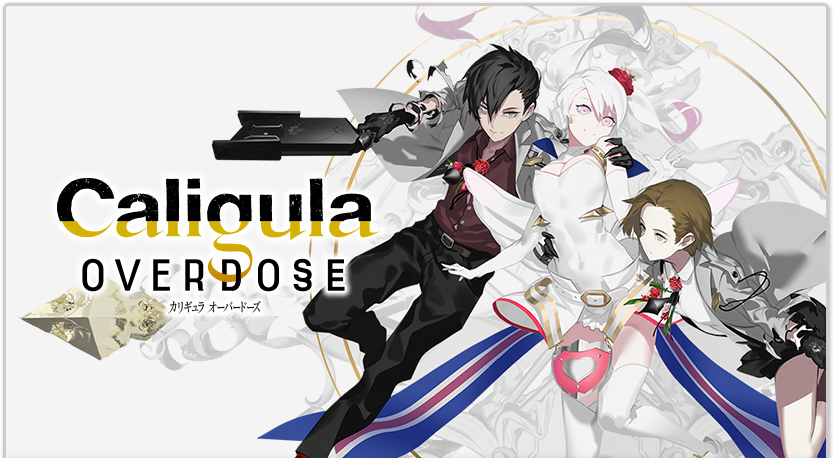
Caligula Overdose" is a PS4 title that is a remake of the PSvita RPG software "Caligula" released by Frew. The storyline is the same as the PSvita version, with the main character and his friends forming a "homecoming club" to return to reality and escape from the virtual world, but the main feature of this title is the addition of the storyline of the "Musicians of Ostinato," the nemesis of the homecoming club.
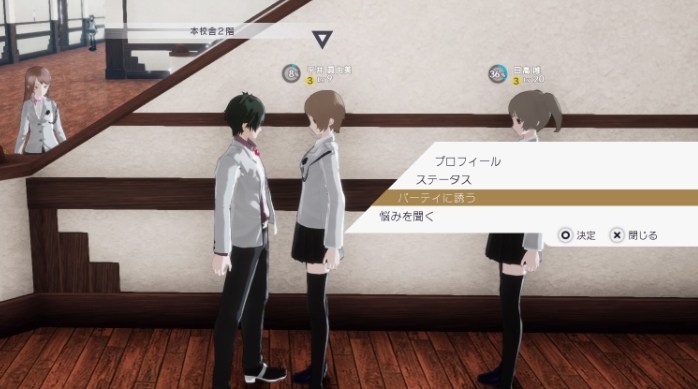
Trauma Quests are event quests that occur when the students' friendship level is increased, and the students are consulted about their trauma-based problems, and they are required to take on these event quests in order to solve their problems. The conditions and contents of the quests are mainly "to fight a certain number of battles with the students in your party," "to equip a specified stigma," and "to meet a specific person or thing you are looking for with the students in your party. The "passive effect" is a powerful item that can be obtained as a reward for clearing the course according to these conditions.
The students in the party and the musicians also have trauma quests, and their trauma quests can be unlocked by watching all the sub-events "character episodes. However, there are up to four or five "stage limits" for character episodes, and these limits can only be removed by progressing through the main storyline, and the character episodes cannot be advanced to the end without removing these stage limits.
If you make a wrong choice in a character episode, the relationship will be broken at that point and you will not be able to watch the rest of the episode.
WIRE

A messenger application where the homecoming club and Ostinato musicians, students who have reached at least two friendship ranks and an acquaintance or higher, are registered, allowing them to talk about appropriate topics and gain a trace amount of friendship. In addition, group messages of homecomers and musicians can be used to confirm the next course of action. In addition to sending messages, you can also check the profiles of the homecoming club, musicians, and other students, and call one student of your choice at the entrance.
When the messenger application is opened, the person selected by the cursor is the person whose profile was viewed immediately before. Also, from the profile screen displayed from the messenger application, you can go to the causal genealogy to check the relationships around you.
stigma
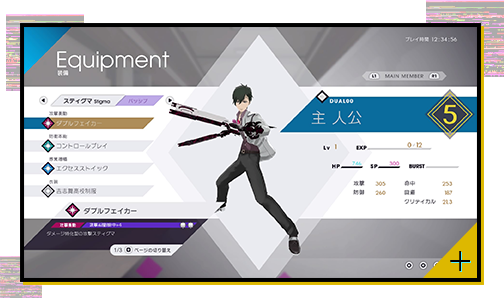
In the Vita version, you can equip up to two items, but in this version, you can only equip one.
The "theoretical armament," which reinforces the words you use against others, is a weapon, the "ideological foundation," which is necessary to maintain yourself, is a piece of armor, and the "psychological trauma," which forms your personality and holds you back, is an accessory.
There are two ways to obtain the "Soul Residue," which is a sphere on the field and corresponds to a treasure chest in general RPGs, or by defeating a Digihead or Lagarde and receiving a drop. The blue and yellow colored spheres can be obtained from the "Soul Residue," but the green and red colored spheres are locked and can only be unlocked by defeating the Digihead or Lagarde on the floor.
skill reel
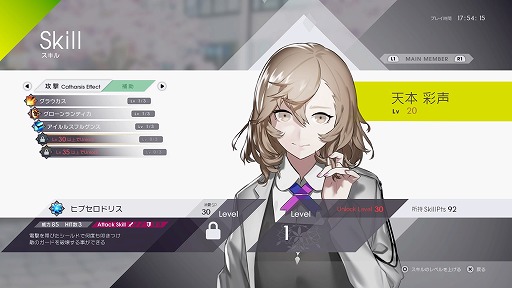
It is a growth system that consumes "skill points," special points obtained when a certain number of battles are cleared or party characters level up, which can be used to acquire offensive, auxiliary, and recovery skills.
The reels are divided into four columns according to trend: "Catharsis," "Battle," "Affection," and "Passive," and players can select the skill they wish to acquire from these four columns by going up, down, left, or right. You can also check the skills you have already acquired.
battle
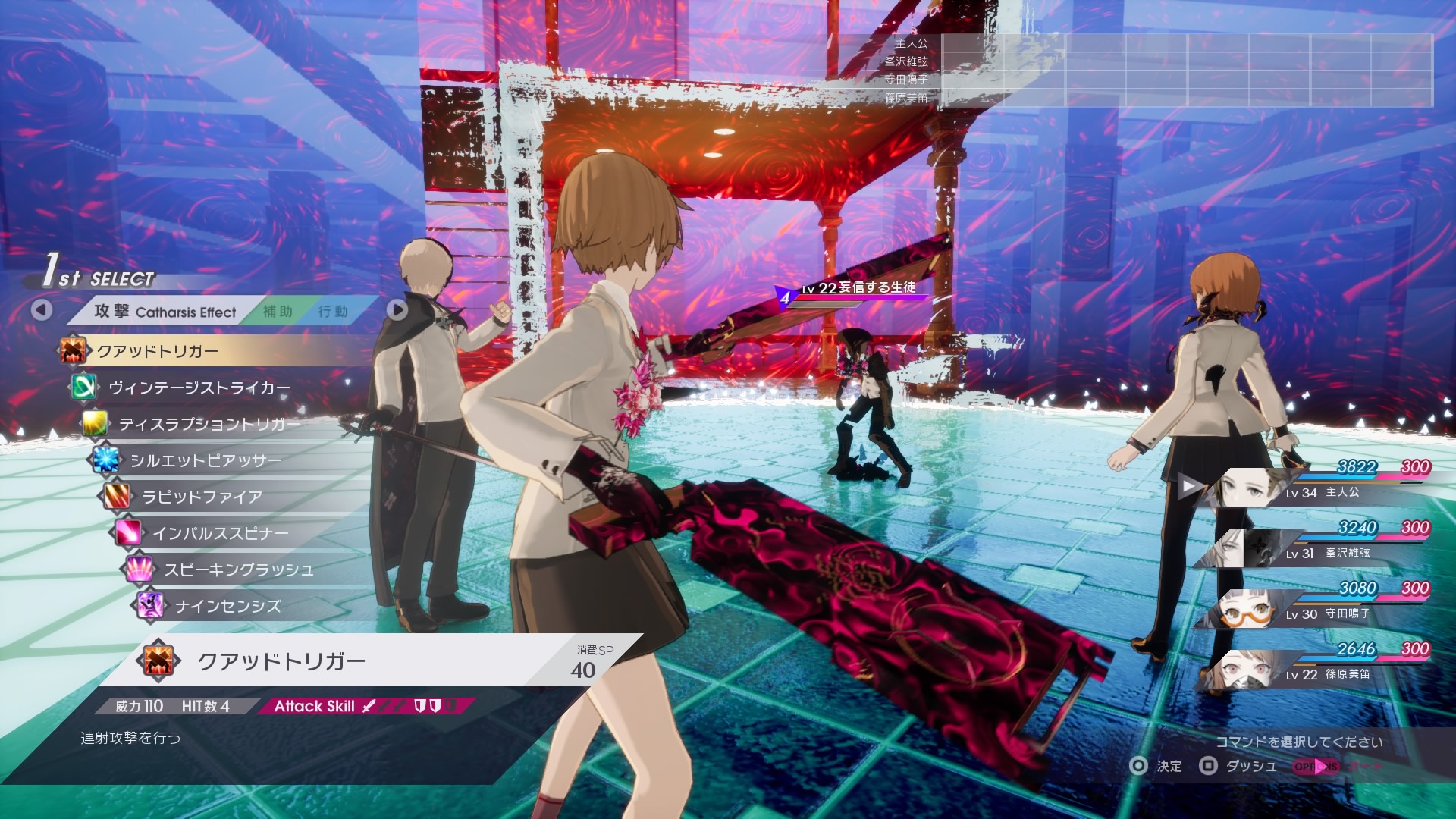
With the port to PS4, this title offers a realistic and impactful battle experience.
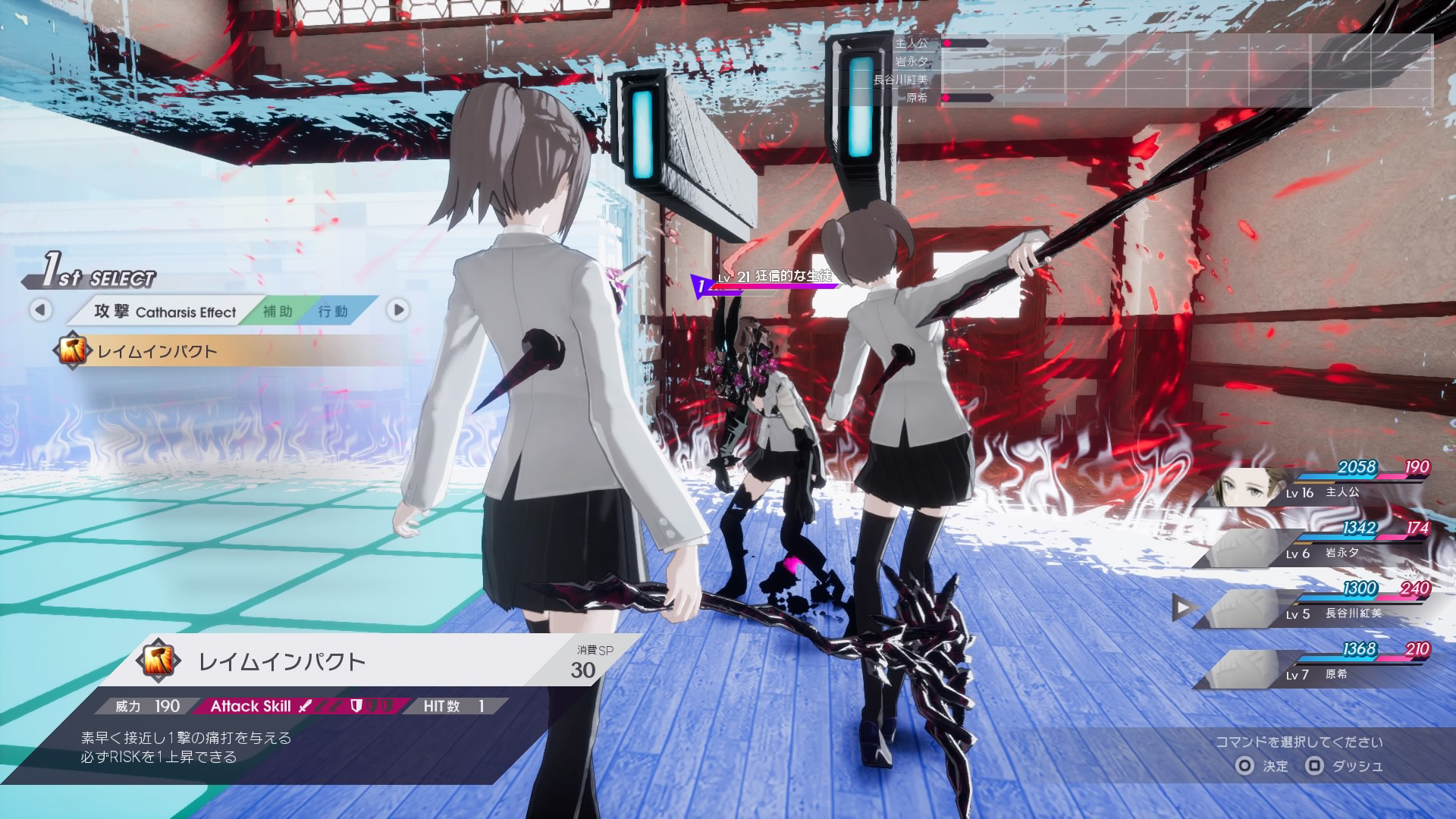
And in this work, too, students can form parties with other students with whom they have developed friendships to fight.
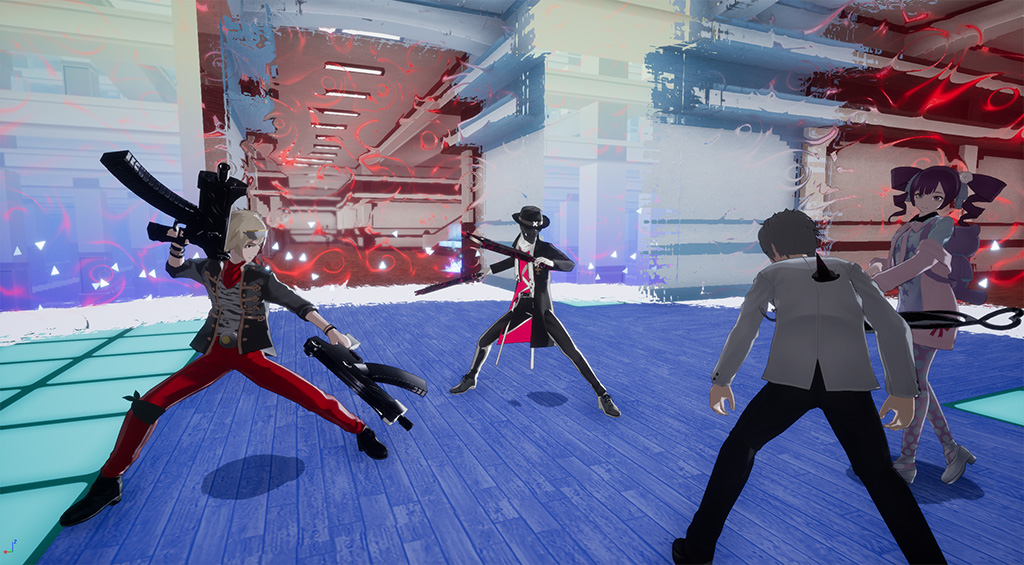
In addition, one of the most notable elements of this work is the ability to form a party of musicians to fight.
As in the Vita version, the main flow of combat is to battle and destroy the digi-heads (or laggards in the Musicians' Route) encountered by a party of up to four players, If there are other enemies nearby, they will also be targeted in the battle, and if another DigiHead or Lagarde enters the battle area during the battle, it will also join the battle as a reinforcement.
The key to the strategy is to confirm the results of the actions of other characters and enemies by using the "imaginary chain" described later in this section, and to select appropriate actions based on the results of the confirmation. Some digiheads and laguards with "NM" in their names are even more enhanced than others, and are involved in the progress of the story or seal the sphere of stigmas.
In addition, there is no set level of digiheads and laguards in the field, but be aware that occasionally there are individuals with overwhelmingly enhanced status, exceeding their level by 20 to 30 or more (often there is a Stigma sphere nearby as a basic landmark).
action option
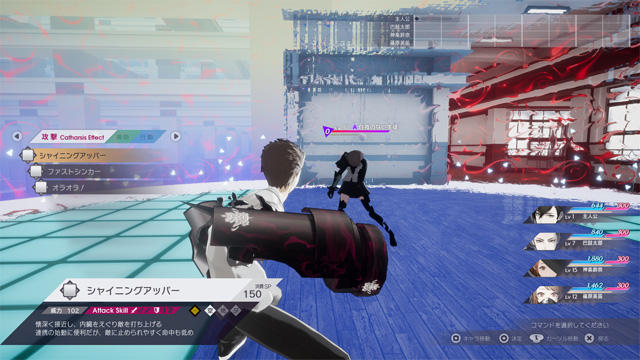
In combat, party characters can perform up to three actions at one time (including movement and waiting), and in some cases, choosing a series of attack-type actions can reduce the waiting time before starting and make it quicker. Incidentally, acting requires a gauge called "SP," and the consumed SP decreases if the character performs an action that consumes SP during the same turn. In other words, there is a risk that if you take many actions at one time, your SP will decrease by that amount and you will not be able to move as much as you would like, or you will show an opening to the enemy.
Attacks have parameters called "attack level" and "defense level," respectively, the former indicating how easy it is to "cancel" an enemy's action when an attack is given, and the latter indicating how hard it is to cancel from an enemy when attacked during an action. There are also special attacks called "derivation techniques," which are combo-based and wait until the enemy is floated or downed, and when those conditions are met, the attacker automatically follows up with a derivation technique. However, the drawback is that it cannot be launched at will, and there is a risk that it will be canceled if another action is performed during the generation timing of the derivation technique.
weapon system
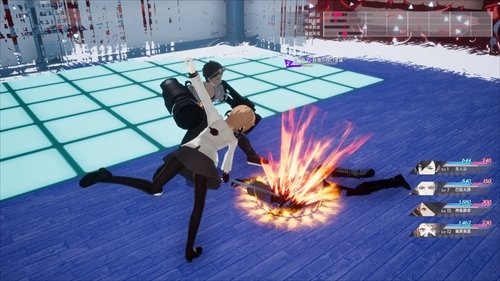
There are a total of 13 different types of weapons equipped by the musicians of the Homecoming Club and Ostinato, each with different characteristics.
Two pistols (main character, Ike P.)
It is an all-rounder type that has attacks for both long and short range, as well as counter attacks for hitting, shooting, and guarding, and has a high hit count. However, overall, it is neither good nor bad, and has no outstanding characteristics.

Related Articles

Spoiler commentary and discussion of Caligula -Caligula- (anime)
Caligula" is an anime adaptation of a juvenile RPG game released by Furyu. It depicts a group of people with a dark heart who try to escape from an idealized virtual world. The story is about the main character, Ritsu Shima, who is the official character of the game, and his attempt to return to reality from the virtual world created by μ. He confronts the musicians of Ostinato, who provide songs to μ and still cooperate with μ, and destroys the virtual world to return to reality.
Read Article
LITTLE NIGHTMARES spoiler commentary and discussion summary
LITTLE NIGHTMARES" is a suspense adventure game released by Namco Bandai Entertainment. It was developed by Tarsier Studios. The main character is Six, a young girl in a yellow raincoat who wakes up in the depths of the Mou, a huge ship called a stomach. The player controls Sixx and proceeds to escape the Mou while solving various tricks that exist in the Mou and sometimes escaping from the enemies that attack her.
Read Article
Tags
Contents
- Overview of "Caligula Overdose
- Synopsis and story of Caligula Overdose
- Return home route, top
- Prologue - Kagi P.
- Sweet P ed.
- Stork Edition
- Musicians' Route, Upper
- Yoshimai High School
- Return home route, middle
- Shonen Dole ed.
- Gardenia ed.
- Mirei, ed.
- Musicians' route, middle
- Miyahi Onsen Monogatari Edition
- City Libraries, ed.
- Return home route, bottom
- Ike P ed.
- Shadow Knife Edition
- Wicked Edition
- Musicians' route, bottom
- Theme Park Edition
- Aquarium Edition
- Landmark Tower Edition
- concluding volume (part) (e.g. of novel)
- Thorne, ed.
- A Reality Named Hope (µ version: Homecoming Route Ending)
- Beyond Betrayal (Aria version: Musicians' Route ending)
- Game System of "Caligula Overdose
- field
- Conversations with Students
- Encounter with Digihead (Lagarde)
- trauma quest
- WIRE
- stigma
- skill reel
- battle
- action option
- weapon system
- Two pistols (main character, Ike P.)
- Pistol (Shogo)
- Bow (Kotono, sweet P)
- Tekko (Koutarou)
- Great Sword (Keisuke)
- Hammer (Miho Mirei)
- Spear (Suzuna Thorn)
- Bit (Naruko)
- Nails (boy doll)
- One-handed sword (Weigen, Shadow Knife)
- Stun gun (colored voice, gardenia)
- Whip (Eiji Stork)
- Bomb (Wicked)
- DigiHead equipment
- Future Prediction (Imaginary Chain)
- overdose skill
- risk
- Characters in Caligula Overdose
- group of school pupils who are not members of any club
- protagonist
- aria
- Shogo Satake
- Izuru Minezawa
- Kotaro Tomoe
- Kensuke Hibiki / Kagi P
- Kotono Kashiwaba
- Naruko Morita
- Mifue Shinohara
- Suzuna Kagura
- Ayana Amamoto
- Eiji Biwasaka
- Ostinato Musicians
- Lucid
- μ
- Sweet P / Shizuka Nijoin
- Stork / Masahiro Sagan
- Shounen Doll / Akira Komori
- Gardenia (Gardenia jasminoide) / Yumino walnut
- Mirei Ichinose / Mirei Ichinose
- Ike P / Tomoya Koike
- Shadow Knife / Hiroki Yamada
- Thorn / Asuka Natsume
- Wicked / Marie Mizuguchi
- Other characters
- Koki Tadokoro
- Himari Minamide
- Flower Princess Rose / Lily / Iris
- Toshizo Natori
- Bifue's mother
- Worldview and terminology for Caligula Overdose
- Moebius
- Miyabishi
- landmark tower
- sea paraiso (Origanum vulgare)
- Miyabi Onsen Monogatari
- metavarces
- digital head
- The Department of Return Home (KITAKUBU)
- Ostinato (persistent repetition) musician
- cathartic effect
- astral syndrome
- Famous quotes, lines/scenes and scenes from "Caligula Overdose".
- Another perspective not seen back home.
- An unexpected encounter leads to a new beginning
- The First Battle of the Jet-Black Musicians
- The protagonist who became the true last boss.
- Theme song and insert song for "Caligula Overdose
- Theme song: Cradle
- featured songs
- Suicide Prototype
- Peter Pan syndrome
- Tokimeki☆Liberie
- Love Scope
- Originality Incident
- dilapidated
- Sadistic Queen
- Song of the Angels
- Sin
- Distorted†Happiness
- cosmo dancer
- Orbit
- Veritas
- Backstory, Trivia, and Small Stories/Episodes/Anecdotes from "Caligula Overdose".
- What is the Caligula effect?
- Mental illness suffered by the characters
- Shogo Satake: Adjustment disorder (てきおうしょうがい)
- Minezawa Weigen: Schizoid Personality Disorder
- Kotaro Tomoe: Messiah Complex
- Kikisuke Hibiki: Peter Pan Syndrome
- Kotono Kashiwaba: Cinderella Complex
- Naruko Morita: Internet addiction
- Mifue Shinohara, Ike P.: Body Dysmorphic Disorder (Body Dysmorphic Disorder)
- Suzuna Kagura: Lunchmate Syndrome
- Aya Amamoto voice: Heterophobia
- Eiji Biwasaka: Psychopath (psychopath)
- Suite P: Transvestism (cross-dressing habit)
- Stork: Stalking
- Juvenile Doll: Avoidant Personality Disorder
- Gardenia: aphonia (loss of voice)
- Mirei: narcissistic personality disorder
- Shadow Knife: Chunibyo
- Thorn: Grief
- Wicked: sociopath (antisocial personality disorder)
- New developments you can see if you are a female protagonist
- No. 1: Yuri couples go to a tea party
- No.2: Sneaking into the women's bath
- No.3: Ayako wakes up to the yuri
- Aria and Koutarou are dogs and monkeys in this film as well.
- No. 1: A grand quarrel from the very beginning of our meeting.
- No. 2: Aria, the "big head".
- No.3: A blowout at Suzuna's lunch box
- A beautiful flute that is about to awaken into the wild?
- Suzuna has a yandere attribute.
- Musicians being scratched by Naruko
- No. 1: A boy doll whose room is open to the public.
- No. 2: Mirei furious at the perverted commotion at the hot springs.
- No. 3: Ike P explodes at the disclosure of his appearance in real life.